
Ultrasonic Cleaning Transducer Acceptance: Before and After Tank Installation
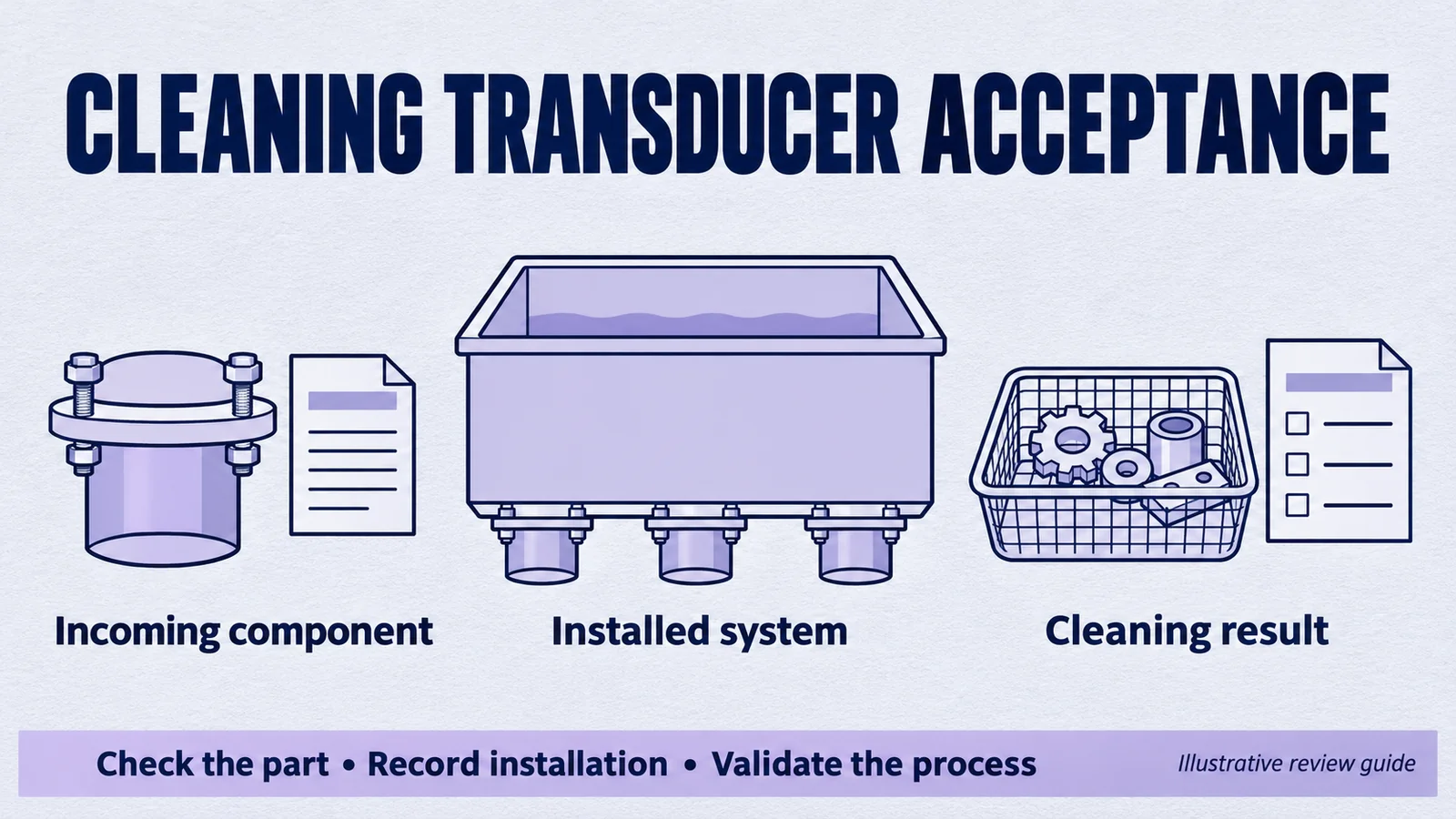
A cleaning transducer's incoming inspection and a cleaning machine's process validation answer different questions. One concerns the purchased component under specified test conditions. The other concerns the installed system working with a tank, generator, liquid and load.
Connecting those stages makes failures easier to investigate. It also helps a cleaning-equipment OEM agree what the component supplier must deliver and what the machine builder must verify.
The following acceptance structure is a proposed engineering record. Use the approved installation and test procedures for the particular transducer and equipment; it is not an instruction to operate an unloaded or dry tank.
Create the first record before installation
Keep the transducer model, lot or other agreed identifier with the incoming inspection result. Check the mechanical and electrical characteristics required by the order, using the defined fixture and measurement conditions.
In his webinar on transducer impedance analysis, Husain Shekhani includes cleaning-transducer measurements and discusses the effect of measurement support conditions. The practical implication for an acceptance record is to identify the setup alongside the result.
A supplier's measurement and an incoming measurement should be compared on a compatible basis. When fixture, support or excitation differs, record that difference before treating a numerical discrepancy as a defective part.
Identify the actual component
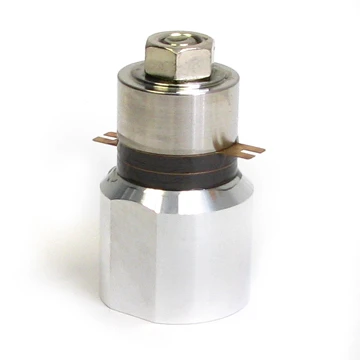
YJ's HJ-3528B page lists a resonance frequency of 28.0 ±0.5 kHz and static capacitance of 3000 pF. The HJ-3828 page lists 27.8 ±0.3 kHz and 4000 pF.
These are current catalog entries, not measurements of an installed tank. Retain the precise model and order specification in the build record. Do not use “approximately 28 kHz” as the only identifier for a component intended for repeat machine production.
The cleaning transducer range provides other starting points. Final selection requires the generator, installation and intended duty to be reviewed together.
Record the transition into the tank
Installation introduces a new configuration that needs its own identity. Associate each transducer position with the tank drawing and installation procedure. Record the applicable attachment details, process reference, wiring and inspection outcome.
Where adhesive is part of the approved design, follow its specified preparation, application and curing process. Where another mounting method is used, document that method. An unspecified instruction such as “tighten firmly” is not a repeatable production record.
Use staged acceptance rather than one final pass/fail
| Stage | Record to keep | What it establishes |
|---|---|---|
| Incoming component | Identity, visual/dimensional results and agreed electrical checks | Conformity with the component purchase specification |
| Completed installation | Tank revision, position map, attachment process and wiring checks | Conformity with the installation procedure |
| Installed electrical check | Approved low-signal setup, connections and measured response | An electrical baseline for the installed configuration |
| Authorized powered evaluation | Generator settings, liquid condition, load, duty and observations | Behavior under that defined operating condition |
| Cleaning-process validation | Actual part/soil requirement and agreed assessment method | Whether the cleaning process achieves its intended result |
Define the authorization and conditions for each stage. A low-signal electrical check must not be confused with permission to apply full operating power under the same loading condition.
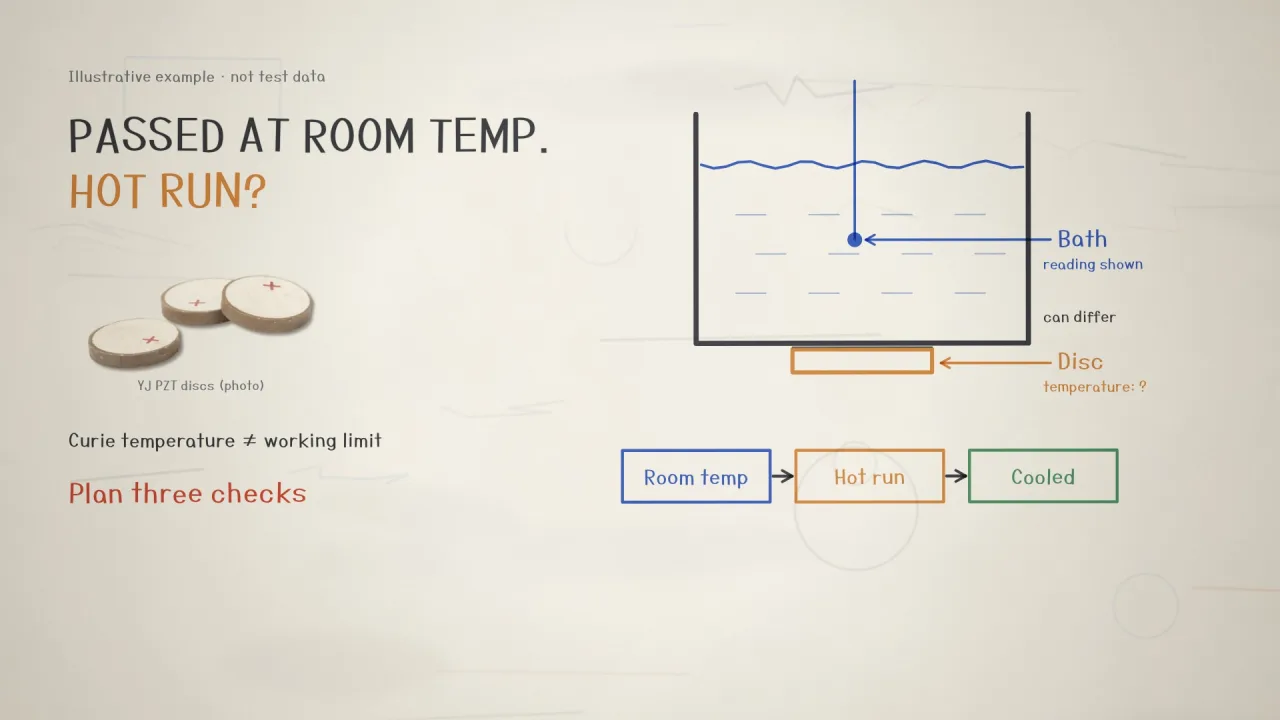
Video: Qualify the Installed PZT Disc at Operating Temperature
Using a bonded PZT disc in a cleaner as an example, define the temperature measurement point and compare the same installed output at baseline, during the hot run and after cooldown. Curie temperature is not an assembly acceptance limit; verify the conditions and limits for your actual disc or transducer design.
English video · Watch on YouTube
Review PZT disc requirements. Share the disc drawing, mounting, drive, temperature measurement point and planned operating conditions.
Preserve enough information to locate a failure
Consider a hypothetical machine that passes incoming component checks but produces unacceptable cleaning results after assembly. That finding does not isolate a cause. Review the installation map, process record, generator configuration and operating conditions before replacing transducers.
Compare the installed configuration with its own agreed baseline. If a component has to be removed or replaced, record its position and identity first. If the attachment process or generator settings change at the same time, identify those changes in the retest record.
Similarly, a change in electrical response does not quantify cleaning effectiveness by itself. The OEM must define the process outcome using a suitable assessment for the actual parts and contaminants. Do not substitute a component datasheet value for that requirement.
Turn the first machine into a controlled reference
After a configuration is approved, retain the tank drawing, component list, generator revision and installation/test procedures as one identifiable build. Record permitted alternatives and the conditions under which they require another evaluation.
This gives purchasing a useful basis for recurring orders: the transducer configuration used in the approved build, the required receiving checks and the expected batch quantities. It also gives service teams a clearer replacement reference.
Ask YJ to review the component requirement
Send your cleaning-transducer inquiry with the model or existing component drawing, tank material and dimensions, mounting layout, transducers per tank, generator information, liquid/load conditions and operating duty.
Include the inspection records you need, sample quantity, production order size and estimated annual equipment volume. YJ will review the requested supply and documentation scope for the project.
For the commercial purchasing fields, the existing bulk cleaning transducer RFQ guide provides a companion checklist. Keep that purchasing specification connected to the installation and process-validation records described here.
Related Products
Related Guides
Review Your Cleaning Transducer Requirement
Identify the component, tank installation, generator, acceptance plan and evaluation and production quantities.
Discuss Your Cleaning Equipment Project