
Matched PZT Ring Sets: From Individual Inspection to Stack Acceptance
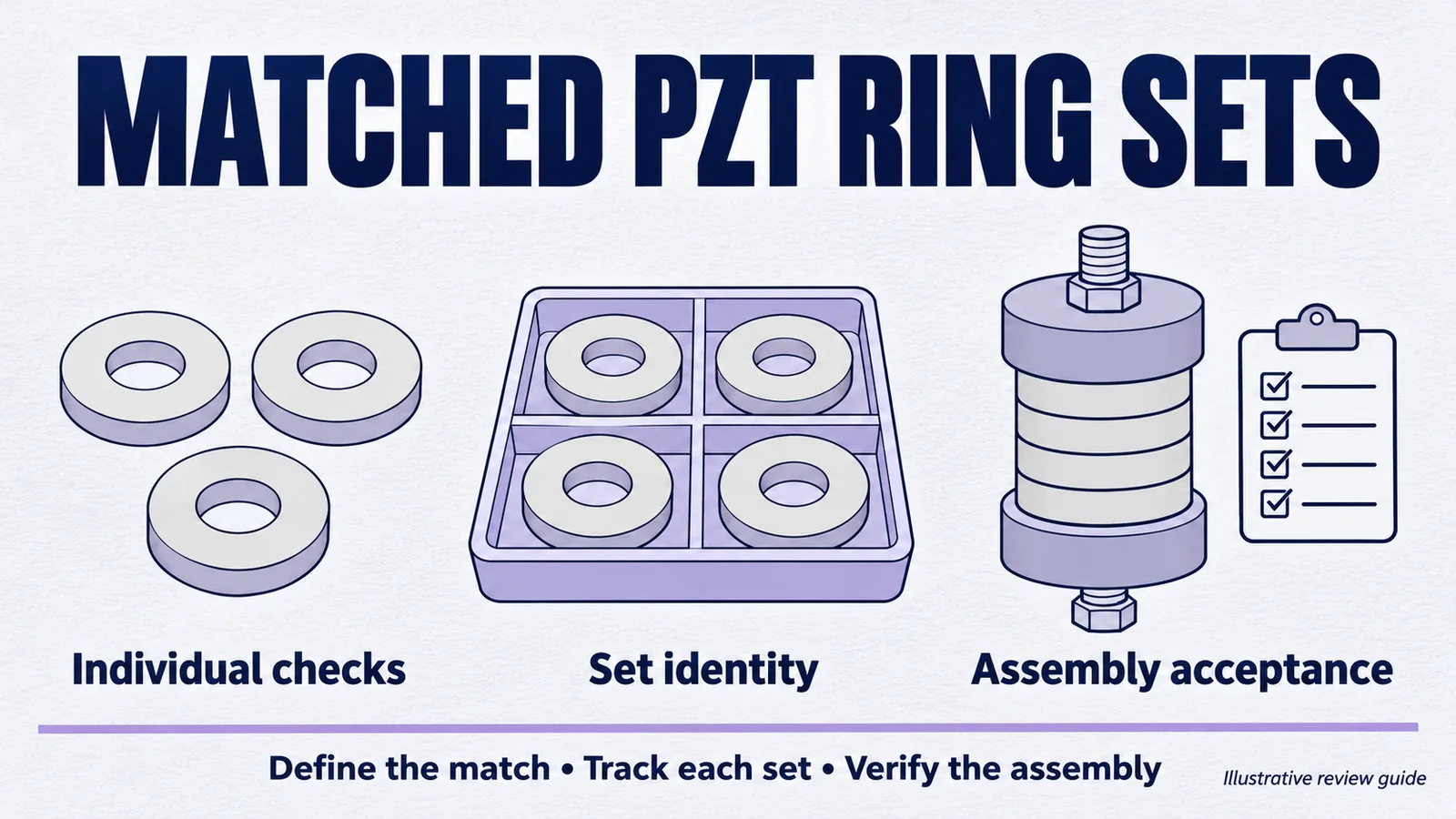
An ultrasonic stack can contain several ceramic rings that each satisfy a purchasing specification. That does not answer a second question: does the assembled stack meet the requirement of the machine in which it will operate?
For an OEM buying recurring quantities, “matched rings” should identify a measurable selection rule and an assembly evaluation. Without those definitions, the buyer and supplier may agree on the phrase while expecting different deliverables.
This guide proposes a way to connect individual inspection with a traceable set. The selection rules and acceptance limits must be agreed for the actual design.

Define the set before defining the match
Begin with the number of rings per assembly, the ring drawing, material, electrode arrangement and polarization identification. State whether you are buying individual ceramics, selected sets, or an assembled transducer. These scopes require different records.
YJ's piezo ceramic ring range is the starting point for standard and custom ring inquiries. The material table lists grades including P-43, P-44 and P-81. Grade selection still depends on the part and its operating conditions; a grade name does not establish a matching tolerance.
Decide which characteristics need a limit for each ring and which, if any, need an additional limit within a set. If your engineering team wants a within-set spread calculated, define the formula, units, measurement conditions and treatment of borderline results.
For example, requesting “capacitance matching” without specifying whether the limit applies to each part, the difference within a group or both leaves the acceptance rule incomplete. This is an illustration of specification ambiguity, not a recommended selection criterion for every stack.
Keep individual measurements and assembly results separate
Record the test arrangement alongside each result. Husain Shekhani's impedance-analysis webinar outline highlights the importance of measurement conditions, including how supporting a transducer can affect a measurement.
A component measurement and a stack measurement describe different configurations. Define the required result for each stage before using either to accept a set.
| Record | Individual ring | Identified set | Assembled stack |
|---|---|---|---|
| Identity | Part and lot reference | Member list and set reference | Assembly serial or batch reference |
| Drawing | Ring revision | Required configuration and count | Stack revision and assembly process |
| Electrical checks | Agreed values and conditions | Agreed selection calculation, if applicable | Agreed assembly response under specified conditions |
| Orientation | Defined polarity marking | Orientation instructions | Verification against the assembly drawing |
| Decision | Accept or reject the part | Accept or reject the proposed grouping | Accept or reject the assembled configuration |
This record prevents a supplier's component result from being compared directly with a customer's assembled-stack result as if both measurements described the same object.
Video: Verify a Minimum d33 Before Accepting PZT
A lot average can meet the target even when a sampled piece falls below the agreed minimum. Agree the measurement method, part limit, and lot acceptance rule before checking incoming PZT.

English video · Watch on YouTube
Discuss your PZT requirements. Share the drawing, d33 limit, test method, and sample quantity you have.
Use a controlled assembly comparison
For an initial evaluation, ask the engineering team to document the assembly procedure, mechanical interfaces, electrical connections and measurement fixture. Preload must follow the validated design procedure; a generic bolt torque is not an adequate substitute.
If one set behaves differently, preserve its membership and assembly record before replacing parts. Change one identified factor at a time where the test design permits. Otherwise, swapping a ceramic, altering the clamp condition and retuning the driver together makes the result hard to interpret.
Keep the raw measurement associated with the assembly identity. Record the relevant operating load and thermal condition for any powered evaluation. A low-signal component check and a loaded operating test serve different purposes.
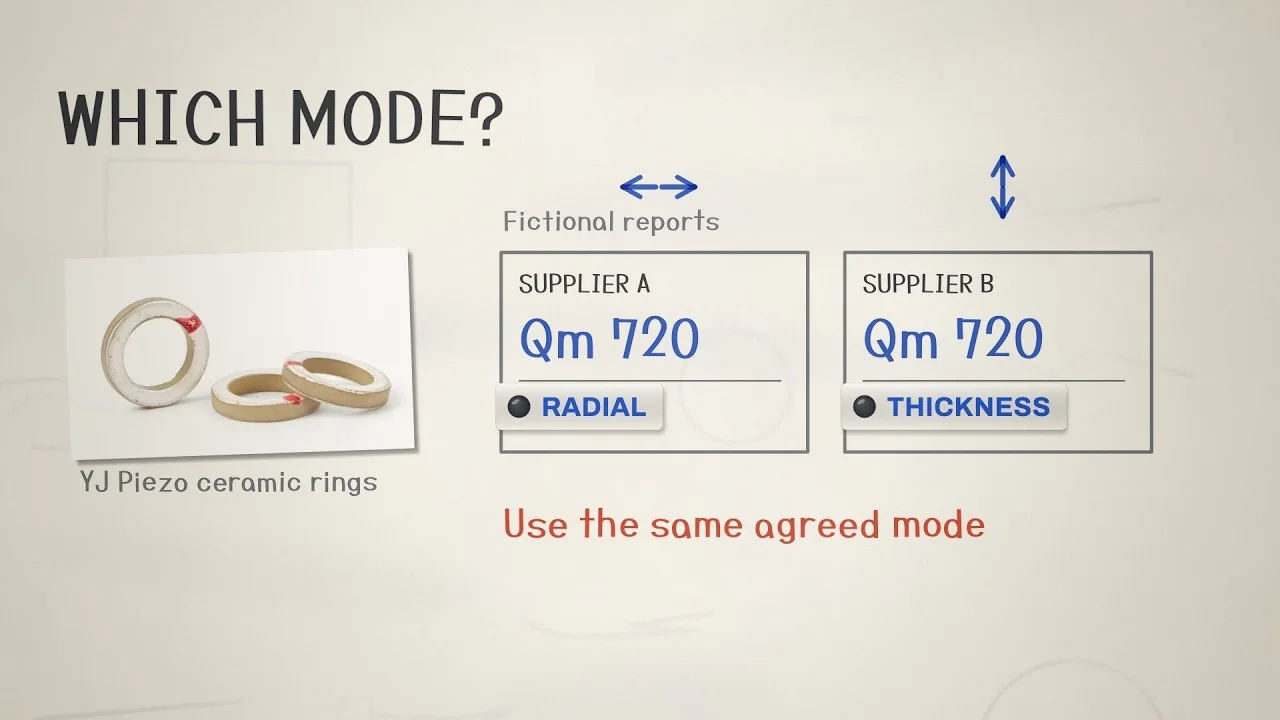
Comparing Qm reports for PZT rings
Compare the vibration mode, fixture and measurement conditions before using Qm values to accept a lot of rings.
Make “replace one ring” a defined production decision
Consider an illustrative production line that receives selected sets in trays. One ceramic is damaged during handling. Replacing it with an individually acceptable ring may satisfy the single-part specification, but the original set-selection calculation may no longer apply.
Decide in advance whether replacement requires reselection, recalculation or an assembly retest. Mark the revised membership rather than retaining the original set record unchanged. The appropriate action depends on the agreed matching rule.
The same discipline helps with returns: an identified set and a documented assembly condition are more useful than a box of loose rings described as “the ones that did not work.”
Request the inspection scope you need
YJ can review the ceramic drawing and requested inspection scope. Set selection, individual serialization and delivery of detailed records should be requested explicitly and confirmed in the quotation. They are not implied by ordering a ring model.
If your project needs a complete assembly, review the ultrasonic welding transducer range or cleaning transducer range and state the required supply boundary.
Send YJ your ring-set requirement, including:
- Ring drawing and material requirement.
- Rings per set, electrode pattern and polarity identification.
- Individual limits and any proposed within-set limits.
- Measurement methods and assembly conditions.
- Required records and packaging arrangement.
- Evaluation sets, production sets per order and expected annual demand.
Is a matched set automatically a validated transducer? No. The defined selection has to be connected to the intended assembly and operating evaluation.
Can YJ propose a matching rule? Include the assembly problem and available data in the inquiry. The feasible scope and acceptance method need engineering review before they become an order commitment.
Related Products
Related Guides
Define Your PZT Ring Set Requirement
Share the ring drawing, rings per set, requested selection rules, evaluation quantity and planned production volume.
Request a Ring Set Review