
Clear Object Detection: Why Ultrasonic Beats Optical in Packaging
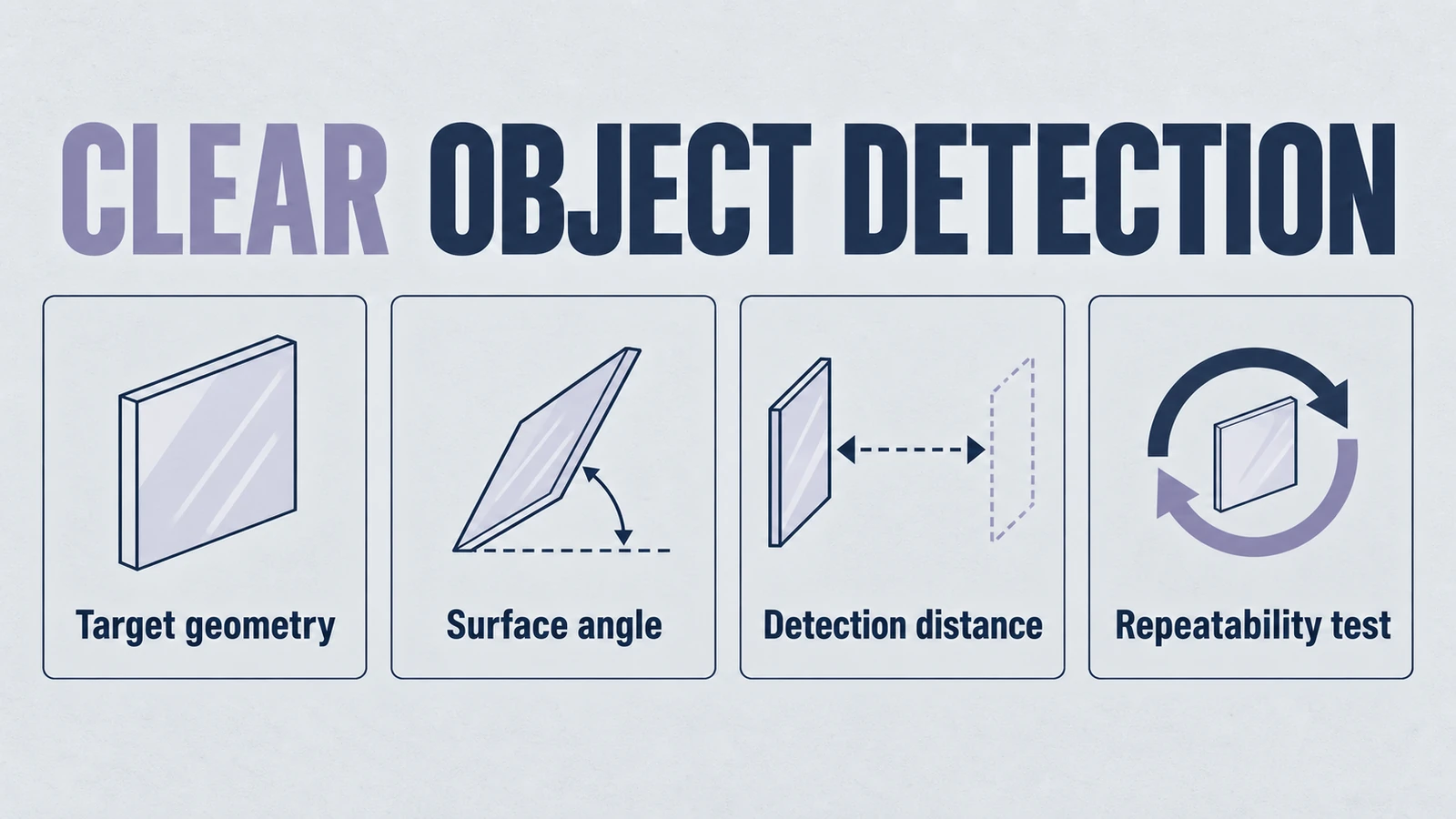
1. The Transparency Paradox in Modern Manufacturing
The modern packaging industry is currently navigating a significant aesthetic and material shift. Consumer preference has moved decisively toward transparency. In the beverage sector, clear Polyethylene Terephthalate (PET) bottles have become the standard for water, soft drinks, and juices, valued for their lightweight nature, recyclability, and ability to showcase the purity of the product inside. Similarly, in the pharmaceutical industry, clear glass vials and ampoules remain the gold standard for parenteral drugs, allowing medical practitioners to visually inspect contents for particulate matter before administration.
However, this transition to transparent media has introduced a critical vulnerability in the automation architecture of filling and packaging lines: the "invisibility" of the product to standard sensors. For decades, the industry relied on photoelectric sensors—devices fundamentally designed to detect the interruption or reflection of light—to manage line flow, count units, and trigger downstream processes like labeling and capping. When the target object is designed specifically to transmit light (transparency) or scatter it unpredictably (refraction), these legacy optical sensors face a physical paradox. They are tasked with detecting the presence of an object that is optically engineered to be absent.
The consequences of this "transparency paradox" are not merely theoretical; they manifest as tangible operational losses. A single missed bottle on a high-speed line running at 60,000 units per hour can cause a jam in the erratic flow of a packer, leading to minutes of downtime that equate to thousands of dollars in lost throughput. Furthermore, miscounts in regulated industries like pharmaceuticals can trigger disastrous quality assurance deviations, requiring manual reconciliation of batches and potential regulatory fines.
Product path for this search intent
Match the article topic to the right YJ Piezo product page
Use this article when sensor performance depends on target distance, beam angle, housing material, liquid behavior, or false echo control. For "Clear Object Detection: Why Ultrasonic Beats Optical in Packaging", the practical value is in turning the topic into a measurable selection or sourcing decision.
- Ultrasonic Sensors
Distance, level, and detection sensor portfolio
- Flow Measurement Transducers
Bubble and flow-related ultrasonic sensing paths
- Air Acoustic Transducers
Air-coupled transducers for range and presence detection
Clear-object detection can use specialized optical or ultrasonic architectures; compare the exact configurations under actual container, line-speed, contamination and cleaning conditions. Ultrasonic sensors, specifically the Yujie MU18 and MU30 series, utilize high-frequency sound waves to detect objects. Because sound interacts with the density and acoustic impedance of a material rather than its optical clarity, ultrasonic technology bypasses the limitations of light entirely. By analyzing the failure modes of optical systems and the robust physics of piezoelectric sensing, this report provides a comprehensive argument for the adoption of ultrasonic technology in the detection of clear PET bottles and glass vials.
2. The Physics of Failure: Why Optical Sensors Struggle with Clear Media
To appreciate the suitability of particular ultrasonic solutions alongside specialized clear-object optical sensors, it is essential to first deconstruct the failure mechanisms of photoelectric sensors. Optical sensors typically operate on contrast—the difference in light intensity received when an object is present versus when it is absent. Transparent objects minimize this contrast to near-zero levels, leading to several distinct failure modes.
2.1 The "Burn-Through" Phenomenon
The most prevalent failure mode in standard photoelectric detection is known as "burn-through." In a through-beam configuration, a transmitter sends a beam of light to a receiver. The system registers a count when an opaque object blocks the beam. However, when a clear PET bottle passes through the beam, it does not block the light; it transmits it.
High-quality clear plastic and glass can transmit over 90% of visible light. To the receiver, the slight attenuation caused by the bottle is often indistinguishable from the normal fluctuations of the light source or ambient dust. Consequently, the sensor logic determines that the beam is unbroken, and the bottle passes undetected. This leads to under-counting errors, where the programmable logic controller (PLC) believes the line is empty when it is actually full, potentially causing collisions at the infeed of the next machine.
2.2 The Lens Effect and Refraction
Compounding the issue of transparency is the geometry of the target. Bottles and vials are rarely flat; they are cylindrical, often with complex ribbing, tapers, or hourglass shapes for ergonomic gripping. These curvatures turn the container into a lens.
When a light beam strikes the curved surface of a liquid-filled PET bottle, the bottle acts as a cylindrical lens, refracting the light. Instead of scattering the beam (which might trigger a "break" in detection), the bottle may actually focus the beam more intensely onto the receiver, or deflect it onto a reflective surface that bounces it back to the sensor. This unpredictable light path means that detection becomes dependent on the precise angle of incidence and the refractive index of the liquid inside. A sensor might reliably detect a full bottle of water but fail to detect a full bottle of clear soda, or fail completely when the bottle is empty.
2.3 Challenges with Retro-Reflective Systems
Retro-reflective sensors, which house the emitter and receiver in the same unit and bounce light off a specialized reflector, are a common stopgap in packaging. However, clear objects present a "mirroring" risk. The smooth, shiny surface of a glass vial or a pristine PET bottle can act as a mirror.
When the sensor emits its light pulse, a significant portion may reflect off the surface of the bottle directly back to the receiver. The sensor is unable to distinguish between the light returned from the reflector (indicating "no object") and the light returned from the bottle surface (indicating "object present"). While manufacturers attempt to mitigate this with polarizing filters—which rely on the reflector to rotate the polarization of the light 90 degrees—this solution is imperfect. PET production involves stretching the plastic, which induces birefringence (stress polarization). This can rotate the polarization of the light passing through it, potentially re-aligning it with the receiver's filter and tricking the sensor into seeing the reflector "through" the bottle.
2.4 Environmental Degradation: The Washdown Factor
Beyond the physics of light, the physical environment of a packaging line is hostile to optical components. Food and beverage lines require frequent sanitation using high-pressure hot water and caustic chemicals (washdown).
- Lens Fogging: The temperature differential between hot washdown water and the cooler sensor housing can cause condensation on the optical lens. A fogged lens scatters light, leading to false triggers (detecting an object when none is present) or blinded sensors.
- Reflector Damage: The reflectors required for retro-reflective systems are prone to degradation. Over time, exposure to chemicals and physical abrasion from cleaning scrubs dulls the reflector, reducing the signal margin. A dull reflector might fail to return enough light to the sensor even when the path is clear, causing the system to lock up.
- Particulate Interference: In dusty environments, such as those packing dry powders or tablets, dust accumulation on the lens attenuates the signal. Optical sensors require a "hair-trigger" sensitivity to detect clear objects, which lowers their tolerance for lens contamination. A small amount of dust can cause the sensor to malfunction, necessitating frequent maintenance stops for cleaning.
3. The Ultrasonic Advantage: Acoustics over Optics
Ultrasonic technology bypasses the optical spectrum entirely, relying instead on the propagation of mechanical waves (sound) through air. This fundamental shift in physics provides inherent immunity to the challenges of transparency, color, and ambient lighting.
3.1 The Principle of Acoustic Impedance
Ultrasonic sensors, such as the Yujie MU series, operate by emitting a burst of high-frequency sound (typically 200 kHz to 400 kHz) and listening for the echo returning from the target. The strength of this reflection is governed by the difference in acoustic impedance between the air and the target material.
Acoustic impedance (Z) is the product of density (ρ) and the speed of sound (c) in a material: Z = ρ × c. The impedance mismatch between air and a solid object like a PET bottle or glass vial is enormous.
- Air: Extremely low impedance.
- Glass/Plastic: High impedance.
When the sound wave traveling through air hits the hard surface of a bottle, the vast majority of the energy is reflected back. It does not matter if the bottle is transparent, opaque, black, or mirrored; the acoustic boundary is solid. This means that "burn-through" is physically impossible with ultrasonic sensors in this application. The sound wave cannot pass through the solid wall of the bottle without significant reflection.
3.2 Material Independence
Because the detection is based on the physical presence of a density change, ultrasonic sensors are "colorblind." A packaging line can switch from running clear 500ml water bottles to opaque blue energy drink bottles subject to the actual bottle geometry, target spacing, threshold and validated recipe; optical color independence alone does not guarantee no adjustment. This is a massive operational advantage for contract packers who run multiple SKUs (Stock Keeping Units) per shift. Optical sensors would typically require sensitivity recalibration or even replacement when switching from dark to clear targets, consuming valuable changeover time.
3.3 Immunity to Ambient Conditions
Ultrasonic sensors are unaffected by the visual environment.
- Lighting: Changes in factory lighting, shadows cast by moving machinery, or strobing safety lights have zero effect on acoustic waves.
- EMI/RFI: While all electronic sensors must be shielded, the fundamental sensing element (the piezoelectric crystal) is less susceptible to optical noise.
- Dust and Moisture: The active face of an ultrasonic transducer vibrates at high frequency. This vibration creates a self-cleaning effect, atomizing water droplets and shaking off dry dust particles that would otherwise obscure an optical lens. This characteristic significantly extends the maintenance intervals in dirty or washdown environments.
3.4 Precision through Time-of-Flight
The Yujie MU sensors utilize the Time-of-Flight (ToF) principle to determine not just the presence of an object, but its exact distance.
Distance = (Speed of Sound × Time) / 2
This allows for "background suppression." The sensor can be taught to recognize the conveyor rail as the background (e.g., at 500mm). Any object that returns an echo sooner (e.g., at 400mm) is counted as a target. This digital gating is far more reliable than the analog intensity thresholding used by optical sensors, which drifts with temperature and dirt accumulation.
4. Product Spotlight: Yujie MU18 and MU30 Series
To capitalize on the theoretical advantages of ultrasonic sensing, Yujie Piezo Technology offers the MU18 and MU30 series sensors. These devices are engineered specifically to bridge the gap between laboratory-grade precision and industrial durability.
4.1 MU18 Series: The Compact Solution for Tight Spaces
The MU18 series is designed with an M18 threaded cylindrical housing, a standard form factor in industrial automation. This allows it to physically replace existing photoelectric sensors without requiring new mounting brackets.
Key Technical Specifications:
- Sensing Range: 100 mm to 1000 mm.
- Housing Material: Nickel-Plated Brass or Plastic options.
- Output Types: PNP, Analog (Voltage/Current), RS232/485.
- Protection Rating: IP67.
- Blind Zone: ~100 mm.
- Feature: Teach-in button for rapid setup.
Operational Context: The 100mm to 1000mm range of the MU18 is ideal for side-mounting on conveyor belts. The sensor can be positioned 150mm back from the line (safely out of the way of potential jams) while maintaining a strong signal lock on the passing bottles. The "Teach-in" feature is critical for rapid deployment; operators simply place a bottle in front of the sensor and press the button to set the switching point, eliminating the trial-and-error potentiometer adjustments common with optical sensors.
4.2 MU30 Series: High Power and Long Range
The MU30 series utilizes a larger M30 housing, which accommodates a larger diameter piezoelectric ceramic element. This larger transducer generates a more powerful acoustic pulse, translating to longer range and better penetration through environmental obscurants.
Key Technical Specifications:
- Sensing Range: 200 mm to 6000 mm.
- Housing Material: Nickel-Plated Brass, Plastic, or Stainless Steel.
- Output Types: PNP, Analog, RS232/485.
- Protection Rating: IP67 (Standard) / IP68 (UltraNova variants).
- Blind Zone: ~200 mm.
Operational Context: Select the exact MU30 configuration against its controlled range, housing, response and environmental documentation. Do not treat separate stainless/UltraNova families as documented MU30 variants or infer guaranteed echoes through foam, steam or cleaning chemicals.
4.3 Technical Comparison Matrix
The following table contrasts the key attributes of the two series to aid in selection.
| Feature | MU18 Series | MU30 Series |
|---|---|---|
| Housing Diameter | 18mm | 30mm |
| Max Sensing Range | 1000 mm | 6000 mm |
| Blind Zone (Dead Band) | ~100 mm | ~200 mm |
| Acoustic Power | Standard | High |
| Primary Application | Bottle counting, web tension, near-field detection | Tank level, washdown areas, far-field detection |
| Chemical Resistance | Good (Nickel-Brass/Plastic) | Excellent (Stainless/PVDF options) |
4.4 Advanced Features: Analog Output
Both series offer Analog (V/I) output options. This is a game-changer for quality control. Instead of a simple On/Off signal, the sensor sends a voltage proportional to the distance.
- Cap Detection: If an MU18 is mounted above the line looking down at the bottle caps, the analog signal can differentiate between a "capped" bottle (e.g., height = 200mm) and an "uncapped" bottle (height = 195mm). A simple logic comparator in the PLC can then trigger a reject arm for the uncapped bottle, combining counting and quality inspection in a single sensor.
5. Application Scenarios: Solving the "Invisible" Problem
The deployment of Yujie ultrasonic sensors addresses specific pain points in the packaging of beverages and pharmaceuticals.
5.1 Reliable Counting of PET Bottles
In high-speed beverage lines, PET bottles often travel on air conveyors, supported by the neck ring. They can swing, jitter, and touch each other (back-to-back pressure).
The Challenge:
- Transparency: Optical sensors burn through the clear plastic.
- Contact: Bottles touching each other eliminate the light gap needed for through-beam sensors.
- Static: PET generates significant static electricity, attracting dust to optical lenses.
The Ultrasonic Solution: An MU18 sensor mounted perpendicular to the bottle neck is the optimal solution.
- Neck Detection: The neck of the bottle is a distinct, hard target that is separated from the adjacent bottles even when the bodies are touching. The narrow beam of the MU18 reliably detects the neck, providing an accurate count even in back-pressure accumulation zones.
- Gap Logic: Even if the bottles are touching, the curvature of the bottle creates a "valley" between them. The ultrasonic wave reflects differently from this valley compared to the peak of the bottle surface. Advanced users can utilize the analog output to visualize this waveform and set precise switching thresholds to count "humps" rather than just gaps.
- Response Time: The linked MU30 public catalogue states approximately 195 ms response and switching at no more than 4 Hz for that configuration, which does not substantiate 500–800 bottles/min (8.33–13.33 objects/s). Validate target/gap dwell, total response and counting rate; any fast variant needs its own controlled specification.
5.2 Glass Vials in Pharmaceutical Packaging
Pharma lines handle small glass vials containing vaccines or injectables. These lines run in cleanroom environments (ISO 5/7) but are subject to rigorous sterilization using Vaporized Hydrogen Peroxide (VHP) or steam.
The Challenge:
- Reflectivity: The glass is highly polished, causing specular reflections that fool optical sensors.
- Size: Vials are small (2ml - 10ml), requiring a tight detection spot.
- Sterility: Sensors must withstand aggressive chemical fogging without degrading.
Selection: Confirm the actual product family and documented housing/seal/chemical compatibility. A catalogue family name or stainless enclosure does not establish suitability for every chemical environment.
- Hard Target: Glass is an acoustically "hard" target. The echo from a glass vial is crisp and strong, minimizing jitter in the detection signal.
- Tray Counting: When vials are loaded into trays for lyophilization (freeze-drying), an array of ultrasonic sensors can scan the tray. Because the sound beam expands in a cone, it can cover a wider area than a laser point, ensuring that vials slightly out of position are still counted. This volumetric detection is superior to the "pinpoint" detection of lasers which might miss a vial sitting 2mm off-center.
5.3 Clear-on-Clear Labeling
Applying a clear plastic label to a clear plastic bottle is the ultimate optical nightmare. Capacitive sensors are often used here but are notoriously difficult to set up and stable only over short ranges (<20mm).
- Web Tension: The MU18 can be used to monitor the diameter of the label roll (web tension control). As the roll of clear labels unwinds, the ultrasonic sensor measures the shrinking radius. It sees the roll as a solid mass, unaffected by the transparency of the label layers. This allows the machine to adjust tension dynamically, preventing web breaks.
6. Implementation Best Practices
To achieve the "install and forget" reliability that ultrasonic technology promises, engineers must adhere to specific installation guidelines that respect the physics of sound.
6.1 Managing the Blind Zone
Every ultrasonic sensor has a "blind zone" (dead band) immediately in front of the transducer face. This is caused by the mechanical ringing of the piezoelectric ceramic after it transmits the pulse; it cannot receive an echo until it stops vibrating.
- MU18 Blind Zone: Approx 100 mm.
- MU30 Blind Zone: Approx 200 mm.
Best Practice: Sensors must be recessed. Do not mount the MU18 flush with the conveyor rail. Mount it at least 100mm back. If space is constrained, use a 45-degree smooth metal deflector plate to fold the sound path. The sound travels from the sensor (mounted parallel to the conveyor) to the mirror, turns 90 degrees, hits the bottle, and returns. This adds the necessary flight distance to clear the blind zone while keeping the sensor footprint compact.
6.2 Angular Alignment
Sound waves reflect efficiently when they hit a surface at 90 degrees. However, for round bottles, a perpendicular mount can sometimes cause "double echoes" from the background.
Best Practice: A slight angle (10-15 degrees) relative to the bottle travel can help. This ensures that the primary echo comes from the leading edge of the bottle. Furthermore, tilting the sensor slightly downward can help ignore objects in the background (like a passing operator) by directing missed pulses into the floor.
6.3 Electrical Noise and Cabling
Piezoelectric sensors generate low-voltage signals internally that are amplified. While Yujie sensors have built-in shielding, the industrial environment is noisy (VFDs, motors).
Best Practice: Use shielded cabling for all sensor runs. Ensure the "Short-Circuit Guardian" and "Polarity Shield" features are active by correctly wiring the sensor protection circuits. The MU series includes these protections, but proper grounding of the shield wire at the panel end is critical to prevent ground loops.
6.4 Synchronization
When multiple sensors are used in close proximity (e.g., on a multi-lane conveyor), "crosstalk" can occur. Sensor A might receive the echo from Sensor B's pulse, registering a ghost object.
Best Practice: Connect the synchronization wires (if available on the specific model) or stagger the sensors physically. Alternatively, use the PLC to multiplex the power, turning on Sensor A, taking a reading, then turning on Sensor B.
7. Comparative Analysis: The ROI of Ultrasonics
While the initial unit cost of an ultrasonic sensor (e.g., MU18) may be higher than a basic photoelectric switch, the Total Cost of Ownership (TCO) can favor ultrasonic technology for clear object applications when optical false trips, cleaning time, and downtime are included.
7.1 Cost of Downtime vs. Hardware Cost
A basic optical sensor may cost less than an ultrasonic sensor. However, if the optical sensor causes repeated stops due to "burn-through" or lens cleaning requirements, the process cost can exceed the hardware price difference:
- Lost Production: 5 minutes x 500 bottles/min = 2,500 bottles.
- Revenue Loss: Lost production value depends on the product price, line speed, and recovery time.
- Payback: Payback should be calculated from the site's actual downtime and maintenance data.
7.2 Maintenance Savings
Optical sensors in washdown environments may require frequent cleaning. The vibrating face of an ultrasonic sensor can reduce buildup in some applications, but inspection frequency should be set by the plant's actual contamination and maintenance data.
7.3 Technology Comparison Table
| Feature | Standard Photoelectric | Laser | Capacitive | Yujie Ultrasonic (MU Series) |
|---|---|---|---|---|
| Detection of Clear PET | Unreliable (Burn-through) | Moderate (Needs specialized mode) | Good | Excellent (Native capability) |
| Washdown Durability | Poor (Lens fogging) | Poor | Moderate | High (Sealed face, no optics) |
| Sensing Range | Long (10m+) | Long (10m+) | Short (<50mm) | Medium (0.1m - 6m) |
| Setup Complexity | Medium (Reflector alignment) | High (Precision alignment) | High (Potentiometer tuning) | Low (Teach-in button) |
8. Electrical Robustness in Industrial Grids
The reliability of a sensor is not just about its sensing element; it is about its survival in the electrical ecosystem of a factory. Industrial power grids are plagued by voltage spikes, surges from starting motors, and wiring errors during hasty repairs.
High-quality sensors like the Yujie MU series include critical protection features:
- Short-Circuit Guardian: If a technician accidentally shorts the output wire to ground, the sensor automatically cuts the circuit to prevent the internal transistor from frying.
- Polarity Shield: Built-in polarity protection ensures the sensor simply doesn't power up if 24V+ and 0V- are swapped, rather than failing severely.
- Overvoltage Protection: Internal suppression protects the sensor electronics from transients caused by large inductive loads.
These "invisible" features are what differentiate a sensor that lasts 10 years from one that fails in 10 days.
9. Future Trends: Smart Sensors and IIoT
The MU series is not just a passive switch; with options for RS232/485 communication, it is an active node in the Industrial Internet of Things (IIoT).
- Predictive Maintenance: By monitoring the strength of the echo signal over time, the control system can detect if the sensor face is obstructing before failure occurs.
- Recipe Management: When line changeovers occur, the PLC can download new parameters directly to the sensor over the digital bus, eliminating manual adjustment.
10. Conclusion: The Clear Choice
The era of struggling with clear object detection is over. Specialized optics and ultrasonic sensing can both detect transparent objects. Optical clarity is not the acoustic variable, but target angle, size, shape, spacing and environmental conditions still govern ultrasonic echo detection.
For packaging engineers dealing with PET bottles and glass vials, the Yujie MU18 and MU30 series are candidates to evaluate alongside specialized optics using actual target and process tests.
- The MU18 fits the tight spaces of conveyor counting, solving the "burn-through" and "neck-to-neck" counting problems with ease.
- The MU30 brings heavy-duty acoustic power to washdown zones and tank level applications, subject to configuration-specific echo, sealing, temperature and chemical qualification.
By adopting ultrasonic technology, manufacturers are not just upgrading a sensor; they are upgrading their operational reliability. They are removing the variable of "visibility" from their process control, ensuring that every bottle is counted, every vial is filled, and every label is applied, regardless of how transparent the future of packaging becomes.
The shift is clear: When the target is transparent, the solution is ultrasonic.
Related Technical Resources
Use these internal references to compare geometry, material selection, reliability testing, and sourcing decisions.
Engineering decision notes
Ultrasonic sensing and detection
Use this article when sensor performance depends on target distance, beam angle, housing material, liquid behavior, or false echo control. For "Clear Object Detection: Why Ultrasonic Beats Optical in Packaging", the practical value is in turning the topic into a measurable selection or sourcing decision.
YJ Piezo treats ultrasonic sensing as an acoustic interface problem: transducer frequency, beam shape, housing, drive electronics, and target environment are reviewed together.
Selection checks
- Define target range, dead zone, beam angle, and mounting geometry before choosing the sensor family.
- Check the medium, target surface, temperature swing, foam, vapor, and side-wall risk.
- Separate detection repeatability from ideal lab accuracy when the sensor will operate in a tank, tube, or moving line.
Failure risks
- A sensor can pass bench distance tests and still fail in tanks with foam, agitation, vapor, or narrow geometry.
- Changing only frequency without reviewing beam angle and mounting can increase false echoes.
- Ignoring housing material or sealing requirements can shorten lifetime in washdown or chemical environments.
RFQ details
- What is the minimum and maximum detection distance?
- Is the target liquid, solid, sheet material, air flow, or a moving object?
- What temperature, humidity, IP rating, and output signal does the system require?
Relevant YJ Piezo pages
- Ultrasonic Sensors
Distance, level, and detection sensor portfolio
- Flow Measurement Transducers
Bubble and flow-related ultrasonic sensing paths
- Air Acoustic Transducers
Air-coupled transducers for range and presence detection
Application FAQ
- What makes an ultrasonic sensor page useful for procurement?
- It should connect range, beam angle, output signal, housing, mounting, and environmental limits to a concrete use case. A model name alone is not enough for reliable supplier comparison.
- Which information speeds up an ultrasonic sensor RFQ?
- Send the target material, distance range, installation geometry, output interface, temperature range, IP rating, and whether the application involves foam, vapor, liquid, or moving objects.