
Comparison of Different Ultrasonic Transducers: Technology, Performance, and Applications
Ultrasonic transducers are the heart of ultrasonic systems, responsible for converting electrical energy into high-frequency mechanical vibrations and vice versa. Choosing the right type of ultrasonic transducer is critical to achieving optimal performance in your application—whether it is in industrial non-destructive testing, medical imaging, distance measurement, or cleaning systems.
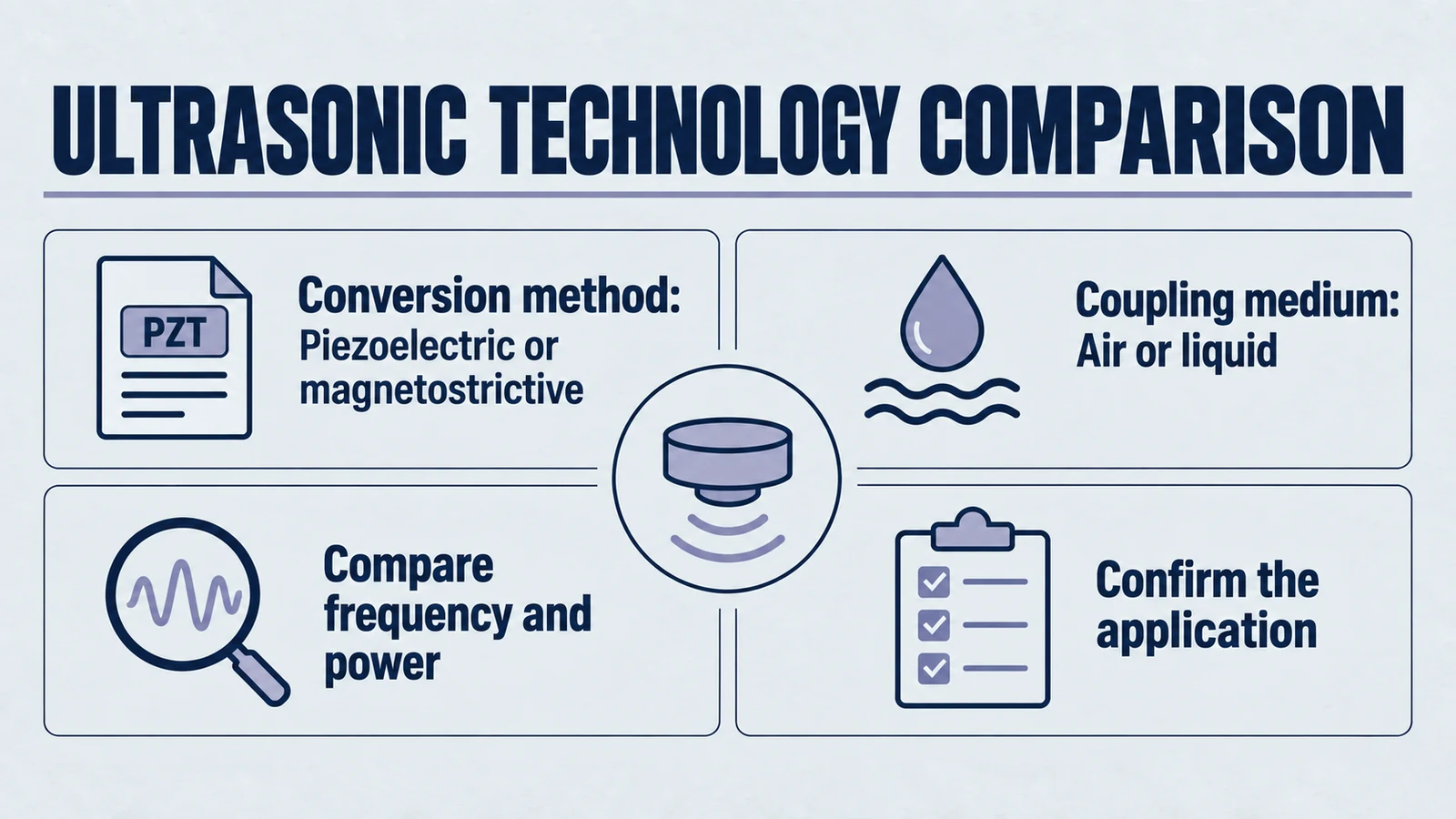
Compare two different classification axes: piezoelectric and magnetostrictive describe conversion mechanisms, while air-coupled and immersion describe coupling arrangements. An air-coupled or immersion transducer can itself be piezoelectric. Evaluate the combined architecture against the medium and measurement requirements.
1. Piezoelectric Ultrasonic Transducers
Technology
Product path for this search intent
Match the article topic to the right YJ Piezo product page
Use this article as an application note that connects piezoelectric material behavior, transducer design, and OEM sourcing decisions. For "Comparison of Different Ultrasonic Transducers: Technology, Performance, and Applications", the practical value is in turning the topic into a measurable selection or sourcing decision.
- Piezoelectric Ceramics
PZT shapes, materials, and custom manufacturing
- PZT Material Hub
Material property tradeoffs and grade selection
- Ultrasonic Transducer Supplier Hub
OEM transducer development and sourcing
Piezoelectric ultrasonic transducers rely on the piezoelectric effect, where certain ceramic or crystal materials (such as PZT – lead zirconate titanate) deform when subjected to an electric field, generating mechanical vibrations at ultrasonic frequencies.
Performance Characteristics
- Frequency Range: 20 kHz to several MHz
- Sensitivity: High
- Resolution: Excellent
- Power Output: Medium to high (depending on design)
- Durability: Moderate; sensitive to high temperatures and mechanical shocks
Advantages
- High efficiency in converting electrical to mechanical energy
- Broad frequency options for various applications
- Compact size and ease of integration into devices
Limitations
- Performance drops at high temperatures
- May require impedance matching for optimal efficiency
Applications
- Medical Imaging (e.g., ultrasound scanners)
- Industrial Non-Destructive Testing (NDT)
- Ultrasonic Cleaning - see our HJ-3528B and HJ-3828
- Precision Distance Measurement
2. Magnetostrictive Ultrasonic Transducers
Technology
Magnetostrictive transducers use materials like Terfenol-D that change shape when exposed to a magnetic field. The mechanical vibrations generated are transferred to the working medium (solid, liquid, or gas).
Performance Characteristics
- Frequency Range: Typically 20–40 kHz
- Power Output: High
- Durability: Excellent, robust under harsh conditions
- Efficiency: Slightly lower than piezoelectric for high frequencies
Advantages
- High power handling capability
- Long operational life, even in extreme environments
- Ideal for large-scale industrial applications
Limitations
- Limited high-frequency operation
- Larger size compared to piezoelectric designs
Applications
- Heavy-Duty Ultrasonic Cleaning
- Metal Welding - for high-power applications, consider our HJ-6015
- High-Power Sonochemistry
- Marine Sonar Systems
3. Air-Coupled Ultrasonic Transducers
Technology
Air-coupled transducers are designed to send and receive ultrasonic waves through air as the propagation/coupling medium, without liquid couplant or direct contact. They often use special piezoelectric materials or composite membranes that can efficiently transmit sound in low-density mediums.
Performance Characteristics
- Frequency Range: 40 kHz to several hundred kHz
- Sensitivity: Lower than liquid-coupled systems
- Durability: Good for non-contact applications
Advantages
- Non-contact operation (no need for water, gel, or direct contact)
- Ideal for delicate or moving targets
- Can be used for inline inspection without stopping production
Limitations
- Lower transmission efficiency in air compared to liquids or solids
- Sensitive to environmental conditions (temperature, humidity)
Applications
- Material Thickness Measurement
- Packaging Inspection
- Food Industry Quality Control
- Non-Contact Distance Measurement
4. Immersion Ultrasonic Transducers
Technology
Immersion transducers operate in a water tank or other liquid medium, using water as a coupling medium to transmit ultrasonic waves into the test object. This eliminates the need for direct contact.
Performance Characteristics
- Frequency Range: 1 MHz to 10 MHz or more
- Resolution: Very high
- Signal Quality: Excellent due to reduced signal loss in water
Advantages
- Uniform coupling and signal transmission
- Ideal for complex shapes and automated scanning
- Superior image resolution for flaw detection
Limitations
- Requires a water tank or immersion setup
- Not suitable for portable field use
Applications
- Advanced Non-Destructive Testing
- Automated Scanning in Manufacturing
- High-Resolution Flaw Detection
Comparison Table
| Feature | Piezoelectric | Magnetostrictive | Air-Coupled | Immersion |
|---|---|---|---|---|
| Frequency Range | 20 kHz - MHz | 20 - 40 kHz | 40 kHz - 500 kHz | 1 - 10+ MHz |
| Power Output | Medium to High | High | Low to Medium | Medium |
| Durability | Moderate | Excellent | Good | High |
| Coupling Medium | Gas/Liquid/Solid | Solid/Liquid | Air | Liquid |
| Ideal Application | Medical, NDT, Cleaning | Welding, Heavy Duty | Packaging, Non-contact | High-res NDT |
How to Choose the Right Ultrasonic Transducer
When selecting an ultrasonic transducer, consider the following factors:
- Medium – Is the sound traveling through air, liquid, or solid?
- Frequency – Higher frequencies offer better resolution but less penetration.
- Power Requirements – Industrial cleaning or welding demands higher power.
- Environmental Conditions – Harsh conditions may favor magnetostrictive technology.
- Application Goals – Precision imaging vs. heavy-duty power delivery.
Final Thoughts
Each ultrasonic transducer technology has its strengths and trade-offs. Piezoelectric transducers dominate in precision and versatility, magnetostrictive types excel in heavy-duty industrial uses, air-coupled transducers are perfect for non-contact inspection, and immersion transducers provide strong resolution in controlled environments.
By aligning your choice with your operational needs, you can maximize performance, efficiency, and long-term reliability. For specialized applications, explore our range of precision cleaning transducers like the HJ-3825 and high-power welding solutions such as the HJ-5020B.
Engineering decision notes
Piezoelectric application engineering
Use this article as an application note that connects piezoelectric material behavior, transducer design, and OEM sourcing decisions. For "Comparison of Different Ultrasonic Transducers: Technology, Performance, and Applications", the practical value is in turning the topic into a measurable selection or sourcing decision.
YJ Piezo reviews piezoelectric projects from material, geometry, electrode, assembly, and outgoing inspection together so the final part fits the real operating condition.
Selection checks
- Clarify whether the design is primarily sensing, actuation, power ultrasonics, atomization, or acoustic measurement.
- Connect the article topic to geometry, material grade, tolerance, operating field, and validation method.
- Define which measurements matter before comparing suppliers: resonance, impedance, capacitance, d33, Qm, or acoustic output.
Failure risks
- A component can meet a simple datasheet value and still fail after bonding, clamping, heat, or acoustic loading.
- Generic material selection can create drift, heating, weak output, or unstable resonance.
- Insufficient RFQ detail forces suppliers to quote assumptions instead of the real engineering requirement.
RFQ details
- What is the operating mode and target application?
- Which electrical, mechanical, and environmental limits must be controlled?
- What sample evidence or outgoing reports are needed before production approval?
Relevant YJ Piezo pages
- Piezoelectric Ceramics
PZT shapes, materials, and custom manufacturing
- PZT Material Hub
Material property tradeoffs and grade selection
- Ultrasonic Transducer Supplier Hub
OEM transducer development and sourcing
Application FAQ
- What extra detail makes a piezoelectric article more useful for engineers?
- Useful detail connects the topic to material choice, geometry, operating load, measurable acceptance criteria, and supplier evidence. That helps readers move from background knowledge to a sourcing or design decision.
- What information should I send YJ Piezo for application guidance?
- Send the application, target dimensions, frequency or sensitivity target, operating medium, duty cycle, temperature range, expected quantity, and any current test data or failure symptoms.