
The Critical Role of Double Sheet Detection in EV Battery Manufacturing: A Comprehensive Guide to Preventing Fires and Machine Damage
Executive Summary
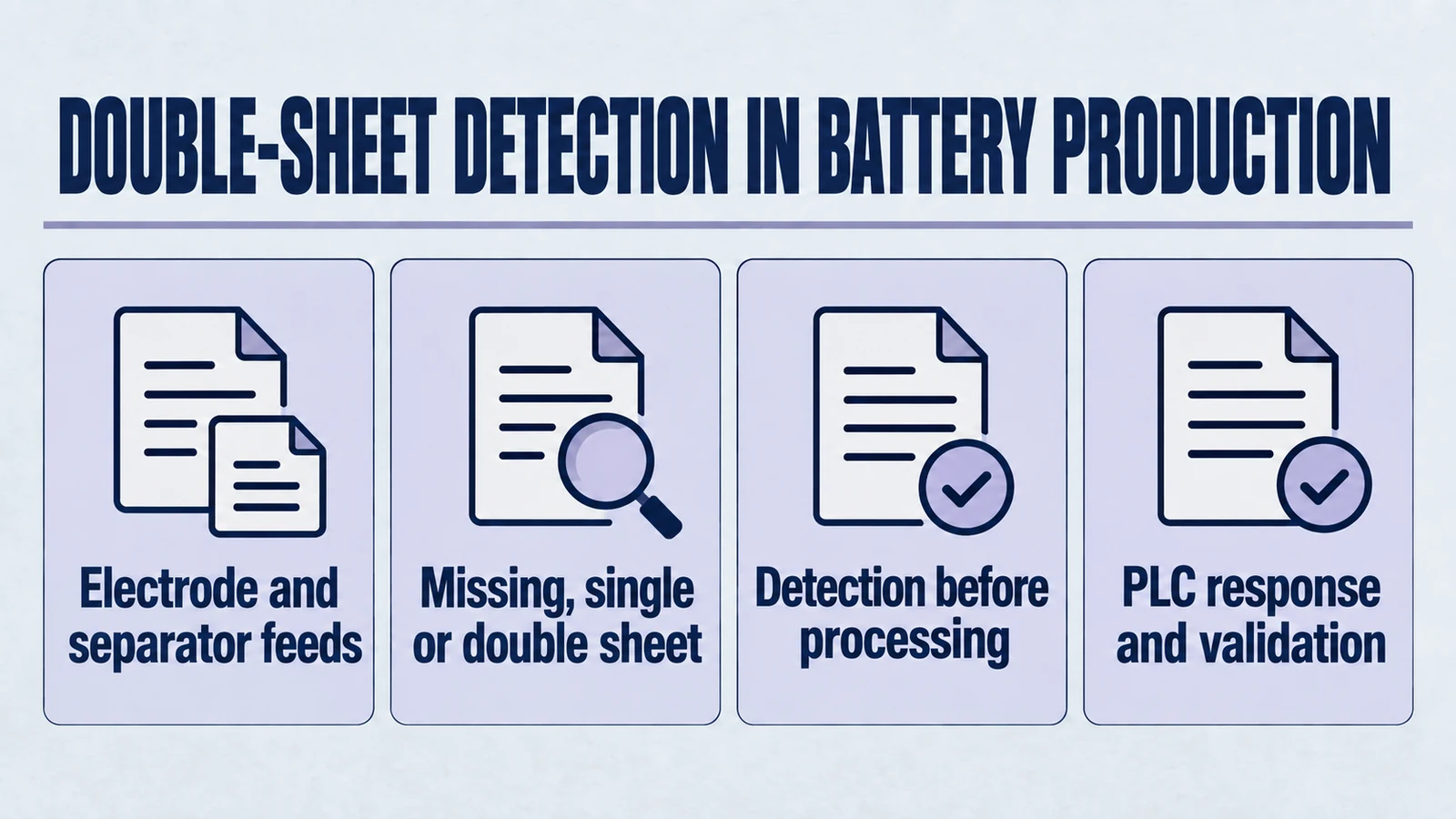
The global transition toward electrification has reshaped battery manufacturing. As electric-vehicle production scales, battery cell lines process thin electrode materials at high speed, and the tolerance for defects becomes tighter. In electrode manufacturing, one important anomaly is the inadvertent feeding of double electrode foils, which can create equipment risk, scrap, and downstream cell-quality concerns if it is not detected and controlled.
This guide explains the role played by Double Sheet Detection systems in the electrode manufacturing process. It examines mechanical and electrochemical risks associated with double feeds, the vulnerabilities of calendering and cell assembly equipment, and the importance of sensor technologies. Central to this discussion is ultrasonic sensing technology, specifically the MDC Double Sheet Detection Sensor provided by Yujie Piezo Technology, which helps distinguish between single, double, and spliced layers of micrometer-thin anode and cathode foils. By integrating these sensors, manufacturers can add a documented control point for equipment protection and electrode handling.
The analysis examines ultrasonic attenuation, separator mechanics, and the triboelectric behavior of electrode foils. It also explains why non-contact double-sheet detection can be a practical control point as the industry pushes toward higher energy densities and thinner current collectors. The MDC sensor is one option for teams that need documented detection behavior before calendering, stacking, or other sensitive process steps.
Product path for this search intent
Match the article topic to the right YJ Piezo product page
Use this article when sensor performance depends on target distance, beam angle, housing material, liquid behavior, or false echo control. For "The Critical Role of Double Sheet Detection in EV Battery Manufacturing: A Comprehensiv...", the practical value is in turning the topic into a measurable selection or sourcing decision.
- Ultrasonic Sensors
Distance, level, and detection sensor portfolio
- Flow Measurement Transducers
Bubble and flow-related ultrasonic sensing paths
- Air Acoustic Transducers
Air-coupled transducers for range and presence detection
1. The Gigafactory Paradigm: Scale, Speed, and the Zero-Defect Imperative
1.1 The Evolution of Battery Manufacturing
To understand the criticality of double sheet detection, one must first appreciate the operational complexity of the modern Gigafactory. The production of a lithium-ion cell is not merely an assembly task; it is a chemical engineering feat performed at mechanical speeds. A typical electrode manufacturing line operates on a roll-to-roll (R2R) basis, processing metal foils at speeds often exceeding 50 to 100 meters per minute. These lines run continuously, 24 hours a day, to meet the insatiable demand of the EV market.
In the early days of battery production, lower speeds allowed for manual inspection or simpler optical checks. However, the modern requirement for cost parity with fossil fuels has driven manufacturers to maximize throughput. This has led to wider webs, faster rollers, and significantly thinner materials. The current collectors—copper for the anode and aluminum for the cathode—have seen their thickness reduced from 20 micrometers (µm) down to 6µm or even 4.5µm in advanced applications.
This reduction in material thickness is a double-edged sword. While it increases the volumetric energy density of the battery by reducing "dead weight," it makes the handling of these foils exponentially more difficult. Thinner foils are more prone to wrinkling, tearing, and, critically, sticking together. The phenomenon of "double sheeting"—where two layers of foil adhere to one another and are processed as one—has become a primary failure mode in high-speed lines.
1.2 The Economic Equation of Yield and Process Risk
In a Gigafactory, yield is king. A reduction in yield of even a fraction of a percentage point can translate to millions of dollars in lost revenue annually. However, the cost of a "double sheet" event goes beyond simple scrap rates. It introduces two distinct categories of risk:
- Immediate Equipment Damage: This occurs when a double thickness of material enters a precision gap machine, such as a calender or a slitter. The resulting damage can require repair, recalibration, and production downtime.
- Latent Cell-Quality Risk: This occurs when a double sheet passes through manufacturing undetected and ends up inside a finished cell. This defect can create a localized stress point that must be considered in the cell manufacturer's risk controls.
The industry's response has been to implement "quality gates" at multiple stages of the process. The double sheet detector is one of these gates, helping verify whether electrode material entering a sensitive process is single layer, double layer, or a splice condition.
2. Anatomy of the Electrode: Materials, Mechanics, and Vulnerabilities
2.1 The Composition of the Electrode
The fundamental building block of the lithium-ion battery is the electrode. It consists of a metal foil current collector coated with active materials.
- The Cathode: Typically uses an Aluminum foil substrate. The active material is a paste of lithium metal oxides (like NMC, LFP, or LCO), conductive carbon, and a binder (like PVDF). The total thickness of a coated cathode might range from 100µm to 200µm, but the foil edges—often the site of double sheet detection—remain bare metal. Understanding piezoelectric materials is essential for designing effective detection sensors.
- The Anode: Uses a Copper foil substrate coated with graphite or silicon-graphite mixtures. Copper is denser and more conductive than aluminum, presenting different challenges for inspection systems.
The manufacturing process involves coating this slurry onto the foil, drying it in long ovens to remove solvents (NMP or water), and then compressing it. Throughout this process, the foil is unwound, rewound, slit, and stacked multiple times. Each handling step introduces the risk of static adhesion or mechanical interlocking.
2.2 The Role of the Separator
Sandwiched between the anode and cathode is the **separator**, a porous membrane made of polyethylene (PE) or polypropylene (PP). This membrane separates the electrodes while permitting ionic transport; cell construction determines the other insulating and protective features. It is electrically insulating but permeable to lithium ions.
The separator is a thin and important barrier in the cell structure, typically around 12µm to 25µm. It is designed to withstand uniform pressure, but localized point loading can become a concern. If a manufacturing defect, such as a double layer of electrode foil, creates a hard lump or a step-change in thickness within the cell stack, the separator may experience localized stress that the cell manufacturer must evaluate.
2.3 Why Double Sheets Occur
Understanding the "why" is crucial because double sheets are a known process risk in high-speed material handling.
- Triboelectric Charging (Static): The unwinding of polymer-coated films and dry separator materials can generate static charge. In dry battery-production environments, static electricity may not dissipate easily, which can cause adjacent layers of foil to cling together and mimic a single solid sheet.
- Vacuum Suction Errors: In the "Pick and Place" operations used for stacking pouch cells, robots use vacuum cups to lift individual electrode sheets. If the foils are slightly porous or if the vacuum is too strong, the suction can bleed through the top sheet and lift the second sheet underneath it.
- Slitting Burrs: When the wide master roll of electrode is slit into narrower strips (daughter rolls), the cutting blades can leave microscopic burrs on the metal edge. These burrs can act like Velcro, mechanically hooking the layers together. When the daughter roll is unwound, the burrs pull the underlying layer up along with the active layer.
- Splicing: To run continuously, the end of one roll is taped to the beginning of the next. This "splice" is an intentional double sheet event that must be detected and managed.
3. Machine-Damage Risk in the Calendering Process
One of the most immediate and financially painful consequences of a double sheet event is damage to the **calendering** machine. This section details the mechanics of this failure mode and the economic necessity of protection.
3.1 The Calendering Process
Calendering is the process of compacting the dried electrode coating to increase its energy density. The coated foil is passed between two massive, counter-rotating steel rollers. These rollers exert enormous hydraulic pressure—often ranging from 1,000 to 3,000 Newtons per millimeter of line contact—to crush the porous electrode structure to a precise target thickness.
The goal is to reduce the porosity of the coating (typically from ~50% down to ~30%) to ensure good electrical contact between particles and to fit more active material into the limited volume of the battery can. The gap between the rollers is fixed and controlled with sub-micron precision.
3.2 The Physics of Roller Deformation
The calender rollers are precision-engineered components, often made of hardened tool steel or chilled cast iron, with a surface finish polished to a mirror shine. Despite their hardness, they are designed to operate within a specific elastic deformation range.
When a **double sheet** enters the calender nip, the thickness of the material entering the gap effectively doubles instantly.
- Scenario: A single cathode sheet might be 150µm thick. A double sheet is 300µm thick.
- Reaction: The hydraulic system that maintains the roller gap cannot react instantaneously to relieve the pressure. Consequently, the stress at the point of contact spikes exponentially.
- Result: The stress exceeds the yield strength of the roller surface or the electrode material. This results in Brinelling—permanent indentation of the roller surface.
Once a calender roller is dented, it becomes unusable. The dent will imprint a corresponding defect onto every subsequent meter of electrode foil that passes through the machine. This "periodic defect" creates high spots on the electrode which are prime locations for lithium plating and dendrite growth.
3.3 The Economic Impact of Roller Failure
The cost of a double sheet event in the calendering stage can include several categories:
- Replacement Cost: Precision calender rolls can be expensive and may have long replacement lead times.
- Downtime: Changing the rolls is a heavy mechanical operation that requires stopping the line, cooling down heating systems, swapping the rolls, and recalibrating parallelism and gap accuracy.
- Material Scrap: Any electrode processed by the damaged roller before the line is stopped must be scrapped.
Given these costs, placing a Yujie MDC Double Sheet Sensor before the calender inlet can provide an additional process-control checkpoint. By detecting a double sheet before it enters the nip, the system can support machine-protection logic defined by the line integrator. The sensor relies on precision piezoelectric ceramic components including piezo discs for detection.
4. Separator Failure and Thermal Risk Mechanisms
While machine damage is expensive, downstream cell-quality risk is also important. Double-sheet detection can support the manufacturer's broader controls for reducing process-related contributors to internal short-circuit risk.
4.1 The Mechanism of Internal Short Circuits
As established in Section 2.2, the separator is the critical safety barrier. If a double sheet of electrode foil is incorporated into a cell—whether a cylindrical jelly roll or a prismatic stack—it creates a geometric anomaly.
- Local Compression: The double thickness creates a region of localized high compression within the cell case.
- Separator Stress: This compression squeezes the separator. Over time, thermal expansion and contraction during charging cycles (batteries "breathe" as ions move in and out of the anode) cause the separator to rub against this hard spot.
- Puncture: Eventually, the separator may thin out or be punctured by the rough surface of the electrode or a metal burr associated with the double sheet.
Once the separator is breached, the anode (negative) and cathode (positive) come into direct electrical contact. Electrons rush through this short circuit, bypassing the external load. This rapid discharge generates intense Joule heating ($I^2R$).
4.2 Thermal Runaway and HF Gas Release
If the heat generation exceeds the rate at which the cell can dissipate it, the temperature rises uncontrollably.
- Separator thermal response: Distinguish shutdown, shrinkage and loss of mechanical integrity. PE and PP have different thermal transitions; use the separator construction and cell-specific thermal data rather than assigning both a universal 130–150°C melting threshold.
- Cathode Decomposition: Cathode reactions and possible oxygen release depend on chemistry, construction, state of charge and thermal history; use cell-specific evidence rather than a universal onset temperature.
- Combustion Risk: Released oxygen can react with organic electrolyte, contributing to fire risk under severe abuse or failure conditions.
Electrolyte decomposition can also release hazardous gases, including hydrogen fluoride (HF) depending on chemistry and conditions. This is one reason battery manufacturers treat internal short-circuit prevention as a system-level safety and quality topic rather than a single-sensor claim.
4.3 Lithium Plating and Dendrites
Double sheets also disrupt the electrochemical balance of the cell. The "hard spot" created by the double thickness alters the local current density. In areas of high compression, the flow of lithium ions into the graphite anode can be impeded. Instead of inserting themselves into the graphite structure (intercalation), the lithium ions pile up on the surface, forming metallic lithium plating. Over subsequent cycles, this metallic lithium grows into needle-like structures called **dendrites**. These dendrites can puncture the separator from the inside out, causing a short circuit long after the battery has left the factory.
By detecting and rejecting double sheets, manufacturers can reduce one process-related risk path associated with separator stress and downstream cell-quality concerns.
5. The Science of Sensing: Why Conventional Sensors Fail
Given the stakes, reliable detection is important. However, the specific material properties of battery electrodes make many common industrial sensors difficult to apply.
5.1 Optical Configuration and Surface Effects
Optical sensors (photoelectric eyes) are the workhorses of general automation. They typically work by detecting the interruption or reflection of a light beam.
- Specular Reflection: Battery foils (Copper and Aluminum) are shiny metals. They act like mirrors. If an optical sensor directs a beam at the foil, the light may be reflected away from the receiver entirely (giving a false "no object" signal) or reflected too strongly, blinding the sensor.
- Contrast Issues: The active coating is typically jet black (carbon/graphite), while the edges are shiny metal. Optical sensors struggle to handle this extreme contrast range within the same web.
- Dust Sensitivity: The slitting and calendering processes generate significant dust. Optical lenses are easily obscured by this particulate matter, requiring frequent cleaning and prone to false trips.
5.2 The Limitations of Capacitive Sensors
Capacitive sensing can measure conductive metal foils in an appropriate configuration. Compare a specified thickness or double-sheet system with the required material, grounding, geometry and defect; limitations of a simple presence switch do not establish incapability of all capacitive architectures.
- Conductivity: Conductivity changes the applicable measurement architecture; purpose-designed capacitive systems can measure metal foil. Confirm suitability for the specific layer-count or thickness task.
- Grounding: The signal can be heavily influenced by how well the foil is grounded to the machine, leading to inconsistent results as the contact resistance of the rollers changes.
5.3 The Ultrasonic Advantage
Ultrasonic technology has emerged as the industry standard for this application because it relies on sound, not light or electromagnetism.
- Transmission Physics: Ultrasonic sensors work by sending a high-frequency sound wave through the material.
- Single Sheet: The sound wave hits the sheet, induces a vibration in the material, travels through it, and re-radiates from the other side to the receiver. A specific, calibrated amount of energy is received.
- Double Sheet: When two sheets are present, there is inevitably a microscopic layer of air trapped between them (even if they appear stuck). This creates a **Solid-Air-Solid** interface.
- Impedance Mismatch: Sound travels poorly from solid to air and back to solid. The acoustic impedance mismatch is enormous. This interface acts as a sound barrier, drastically attenuating the signal. The receiver sees a massive drop in signal amplitude compared to the single sheet.
- Material Independence: Ultrasound penetrates black carbon, shiny copper, and matte aluminum with equal efficacy. It is unaffected by the color, transparency, or ambient lighting conditions.
6. Yujie Piezo Technology: The MDC Double Sheet Detection Sensor
To address these specific challenges, Yujie Piezo Technology has developed the MDC Double Sheet Detection Sensor, a solution purpose-built for high-reliability detection in harsh industrial environments.
6.1 Product Overview and Specifications
The MDC sensor is a through-beam ultrasonic system designed to detect single, double, and missing sheets. Based on the manufacturer's data, the system is engineered with parameters specifically optimized for the battery industry.
6.1.1 Frequency Optimization: The 400 kHz Advantage
One of the most critical specifications of the MDC series is its operating frequency. Yujie offers the system in two primary frequency bands, with **400 kHz** being the premier choice for electrode manufacturing.
- Carrier frequency and thin foil: At 343 m/s, 400 kHz has a wavelength of about 0.858 mm. Through-transmission detection may distinguish much thinner layers from their received-amplitude signatures; it does not spatially resolve foil thickness from wavelength alone. Validate gauge, layer count, spacing, tension and incidence for the actual detector.
- High Resolution: The 400 kHz signal is capable of detecting double layers in extremely thin materials, such as the 6µm copper foils used in advanced anodes.
- Narrow Beam: Higher frequencies generate a narrower, more focused sound beam. This allows the sensor to be mounted closer to the web edges or in tight spaces without interference from machine frames or rollers.
- 255 kHz Option: Yujie also offers a 255 kHz version. This lower frequency provides higher energy penetration, which is useful for thicker laminates, cardboard, or multi-layer pouch cell packaging materials where the total stack thickness is greater.
6.1.2 Housing and Integration
The MDC sensors are available in robust industrial housings to fit various machine geometries:
- M18 Cylindrical: A compact form factor ideal for tight spaces, such as inside a Z-fold stacking machine or immediately prior to a slitter blade.
- M30 Cylindrical: A larger housing that supports a larger transducer face, providing a wider detection area and easier alignment for webs that may have significant "flutter" or vertical movement.
- Connection: The sensors feature standard M12 connectors and offer PNP/NPN switching outputs, allowing for plug-and-play integration with any standard PLC (Siemens, Allen-Bradley, Mitsubishi, etc.).
6.1.3 Material Versatility
The MDC series is explicitly rated for the detection of Paper, Metal, and Labels. This tri-modal capability is vital.
- Metal: Optimized for the high acoustic impedance of Copper and Aluminum.
- Paper/Labels: Useful for detecting the masking tapes used at splices or the paper interleaves sometimes used to protect foils during transport.
- Labels/Splices: The sensor can distinguish the localized thickness increase of a splice tape, acting as a splice detector (see Section 10).
6.2 The Core Technology: Advanced Piezoelectric Ceramics
The performance of any ultrasonic sensor is dictated by the quality of its transducer—the component that converts electrical energy into sound. Yujie Technology is a primary manufacturer of Piezo Ceramic Elements, giving them a vertical integration advantage.
The MDC sensor utilizes high-performance PZT (Lead Zirconate Titanate) ceramics with specific characteristics:
- Coupling: Specify the relevant mode and controlled grade data. Planar kp is not assembled conversion efficiency and does not establish cool, stable 24/7 operation; qualify electrical/acoustic output, losses and temperature for the actual MDC configuration.
- Response: Terminal impedance alone does not establish detection latency. Measure burst/settling, acquisition, filtering, decision and output timing for the exact configuration and include downstream control delays.
- Thermal stability: Low-loss material can reduce a heat contribution but does not eliminate ambient-temperature drift or false detections. The internal grade and complete-device compensation/performance require controlled model evidence and testing.
6.3 Signal Evaluation Logic
The MDC sensor contains an integrated microprocessor that evaluates the amplitude of the received signal.
- Teach-In: The user places a single sheet in the gap and presses a "Teach" button (or triggers it remotely). The sensor records the signal strength for "1 layer."
- Operation:
- Signal > Teach Value (approx): Single Sheet (Pass).
- Signal << Teach Value: Double Sheet (Fail/Stop). The air gap causes massive attenuation.
- Signal >> Teach Value (Max): No Sheet (Air). Indicates a web break or end of roll.
A de-energize-to-trip signal convention alone does not establish coverage of every sensor, cable or controller fault. Treat the detector as a process-quality input unless the complete safety function and its diagnostic coverage, fault response and stopping performance have been validated.
7. Implementation Strategy: Critical Control Points in the Electrode Line
To effectively protect the manufacturing process, the MDC Double Sheet Sensor must be deployed strategically. It is not a "one size fits all" solution; its placement dictates its function.
7.1 Control Point 1: Unwinding and Splicing (The Input Gate)
At the very beginning of the line, raw coils of copper and aluminum are unwound.
- The Risk: As the roll unwinds, the "tackiness" of the foil or edge burrs can cause layers to stick. Additionally, splices (where two rolls are joined) enter here.
- MDC Application: The sensor monitors the unwinding web.
- Objective:
- Detect Double Feeds: Stop the line immediately if the unwinder pulls up two layers, preventing them from entering the coating machine (where they would mess up the slot-die head).
- Detect Splices: Signal the coater to "skip" coating over the splice tape. Coating over tape creates a messy, unstable patch that will contaminate the electrolyte later.
7.2 Control Point 2: Pre-Calendering (The Asset Protector)
This is the most financially critical location, as detailed in Section 3.
- Placement: Set the position from the worst-case detection/filter, controller and actuator delays, deceleration, material motion and margin. At 100 m/min, 100–300 mm gives only 60–180 ms of travel; it is not a generally validated protective placement.
- MDC Application: Continuous high-speed monitoring.
- Objective: Identify selected feed anomalies for process control. Design and validate any stop or roller-opening function for the actual machine rather than assuming a detector output guarantees protection.
- Requirement: Obtain the controlled variant’s detection and fault-response timing. Carrier frequency alone does not establish the total detection-to-stop delay or ability to overcome mechanical inertia.
7.3 Control Point 3: Die Cutting and Stacking (The Safety Gate)
In pouch cell manufacturing, the continuous roll is cut into discrete sheets (e.g., A4 size) and stacked: Anode-Separator-Cathode-Separator.
- The Risk: The vacuum grippers used to move these sheets are prone to picking up two sheets at once ("double pick").
- MDC Application: The sensor is often mounted on the robot arm or at a fixed verification station that the sheet passes through.
- Objective: Fire Prevention. This is the last line of defense. If a double sheet passes here, it goes into the cell. The MDC sensor ensures that every single layer placed into the stack is verified as a singleton.
- Integration: The M18 housing is ideal here due to the crowded nature of the stacking cell.
8. Advanced Applications: Splice Detection and Traceability
While the term "Double Sheet Detection" implies error prevention, the technology is equally vital for process control in the form of **Splice Detection**.
8.1 The Splice Challenge
In continuous manufacturing, stopping to change a roll is inefficient. Manufacturers use "Flying Splicers" to tape the end of the old roll to the start of the new one. This splice consists of: Foil A + Tape + Foil B (overlap) + Tape. It is a multi-layer stack. This splice **must not** end up in a finished battery. It is electrically insulating (due to the tape) and mechanically thick.
8.2 MDC as a Splice Detector
The Yujie MDC sensor acts as a splice detector by identifying the sudden change in signal amplitude caused by the splice tape and overlap.
- Traceability: When the MDC detects a splice, it sends a signal to the MES (Manufacturing Execution System). The system records the exact position (meter count) of the splice.
- Rejection: The system virtually "tags" this section of the web. Downstream, at the cutting or slitting station, the machine automatically rejects the few meters of electrode containing the splice based on this tag.
- Efficiency: This automated detection eliminates the need for operators to manually watch for splices or for the line to be stopped to cut them out, significantly boosting OEE (Overall Equipment Effectiveness).
9. Integration Best Practices: Overcoming Environmental Challenges
Deploying ultrasonic sensors in a battery plant requires attention to environmental details.
9.1 Web Flutter and Stabilization
Foil webs moving at high speed often vibrate or "flutter" vertically. This can change the distance between the foil and the sensor heads, potentially affecting the signal.
- Solution: Mount the MDC sensor close to a guide roller where the web is most stable.
- Yujie Design: The 400 kHz beam is relatively focused, but users should ensure the pass-line is centered. The M30 housing with its larger face can be more forgiving of slight flutter than the M18.
9.2 The Dry Room Environment
Battery assembly takes place in dry rooms with dew points below -40°C.
- Acoustics: The speed of sound and the attenuation of sound in air are dependent on humidity.
- Yujie Design: The MDC sensors are equipped with temperature compensation to handle the thermal fluctuations of the plant, but the inherent stability of the Yujie piezo elements ensures reliable operation even in these bone-dry atmospheres.
9.3 Electromagnetic Interference (EMI)
Battery plants are filled with high-power servo motors, welding equipment, and corona treaters, all of which generate electrical noise.
- Solution: Use shielded cables for the sensor connections.
- Yujie Design: The MDC sensor electronics are housed in industrial-grade metal (nickel-plated brass) or shielded plastic housings to reject EMI, ensuring that the switch signal is clean and reliable.
10. The Economic Justification: ROI Analysis
The installation of double sheet protection is easier to justify when the site compares sensor cost with the cost of scrap, machine repair, restart time, and validation risk.
| Cost Category | Description | How to Estimate |
|---|---|---|
| Prevention Cost | Yujie MDC Sensor | Supplier quotation and integration cost |
| Direct Failure Cost | Calender Roller Replacement | Roll replacement, service, and calibration records |
| Indirect Failure Cost | Production Downtime (24-48 hrs) | Line value, restart time, scrap, and labor records |
| Liability Cost | Battery Fire / Recall | Finished-cell quality and recall-risk analysis |
The Asymmetry of Risk: The cost of the sensor is negligible—often less than the cost of a few minutes of production time. In contrast, a single failure event can destroy the profitability of a line for a month (machine damage) or destroy the brand's reputation forever (fire safety). Therefore, the Yujie MDC sensor is not just a component; it is an insurance policy with a near-infinite payout ratio.
11. Future Outlook: The Next Generation of Battery Manufacturing
As the EV industry moves toward **Battery 4.0**, the role of sensors will evolve.
11.1 Thinner Foils and Solid State
The trend is toward even thinner foils (4µm) and new materials like Lithium Metal anodes for Solid State Batteries.
- Impact: Thinner foils are harder to detect. This will drive the adoption of even higher frequency ultrasonics. Yujie's mastery of piezo-ceramics positions them well to develop 500kHz+ sensors for these next-gen applications.
- Solid State: Even in solid-state batteries, the layering process remains. The need to prevent double layers of solid electrolyte or lithium metal will remain a critical safety check.
11.2 Data-Driven Quality
The future is not just "Stop/Go" switching. It is Data.
- Smart Sensors: Future iterations of double sheet sensors will likely output analog data or IO-Link information, providing real-time feedback on the *quality* of the bond or the *density* of the coating, not just the presence of a double sheet. This data will feed into AI-driven process control models to optimize the entire line.
12. Conclusion
In the grand machinery of the electric revolution, the Yujie MDC Double Sheet Detection Sensor plays a role that is physically small but operationally colossal. It stands as the guardian of the Gigafactory, protecting the intricate machinery that powers our future and, more importantly, the lives of the people who build and drive electric vehicles.
By leveraging the precise physics of ultrasonic attenuation and the material excellence of high-performance piezoelectric ceramics, the MDC sensor provides the a documented method to detect double electrode foils. It is one candidate for selected feed anomalies. Compare the actual ultrasonic, optical or capacitive system against foil gauge, layer separation, mounting, process timing and fault response; no single sensor guarantees all defects are detected.
For the process engineer, the plant manager, and the safety officer, the message is clear: Zero Defects is not a slogan; it is a survival requirement. And in the world of electrode manufacturing, Zero Defects starts with ensuring that One Sheet—and only One Sheet—enters the machine at a time. The Yujie MDC series delivers that assurance, layer after layer, roll after roll, securing the foundation of the electric age.
Technical Note: For detailed product specifications, wiring diagrams, and integration guides for the MDC Double Sheet Detection Sensor, please refer to the official Yujie Piezo Technology product page. Need even more detail? See our deep dive definitive guide to MDC double sheet detection.
Engineering decision notes
Ultrasonic sensing and detection
Use this article when sensor performance depends on target distance, beam angle, housing material, liquid behavior, or false echo control. For "The Critical Role of Double Sheet Detection in EV Battery Manufacturing: A Comprehensiv...", the practical value is in turning the topic into a measurable selection or sourcing decision.
YJ Piezo treats ultrasonic sensing as an acoustic interface problem: transducer frequency, beam shape, housing, drive electronics, and target environment are reviewed together.
Selection checks
- Define target range, dead zone, beam angle, and mounting geometry before choosing the sensor family.
- Check the medium, target surface, temperature swing, foam, vapor, and side-wall risk.
- Separate detection repeatability from ideal lab accuracy when the sensor will operate in a tank, tube, or moving line.
Failure risks
- A sensor can pass bench distance tests and still fail in tanks with foam, agitation, vapor, or narrow geometry.
- Changing only frequency without reviewing beam angle and mounting can increase false echoes.
- Ignoring housing material or sealing requirements can shorten lifetime in washdown or chemical environments.
RFQ details
- What is the minimum and maximum detection distance?
- Is the target liquid, solid, sheet material, air flow, or a moving object?
- What temperature, humidity, IP rating, and output signal does the system require?
Relevant YJ Piezo pages
- Ultrasonic Sensors
Distance, level, and detection sensor portfolio
- Flow Measurement Transducers
Bubble and flow-related ultrasonic sensing paths
- Air Acoustic Transducers
Air-coupled transducers for range and presence detection
Application FAQ
- What makes an ultrasonic sensor page useful for procurement?
- It should connect range, beam angle, output signal, housing, mounting, and environmental limits to a concrete use case. A model name alone is not enough for reliable supplier comparison.
- Which information speeds up an ultrasonic sensor RFQ?
- Send the target material, distance range, installation geometry, output interface, temperature range, IP rating, and whether the application involves foam, vapor, liquid, or moving objects.