
Advancements and Prospects of Piezoelectric Ceramics in Industrial Applications
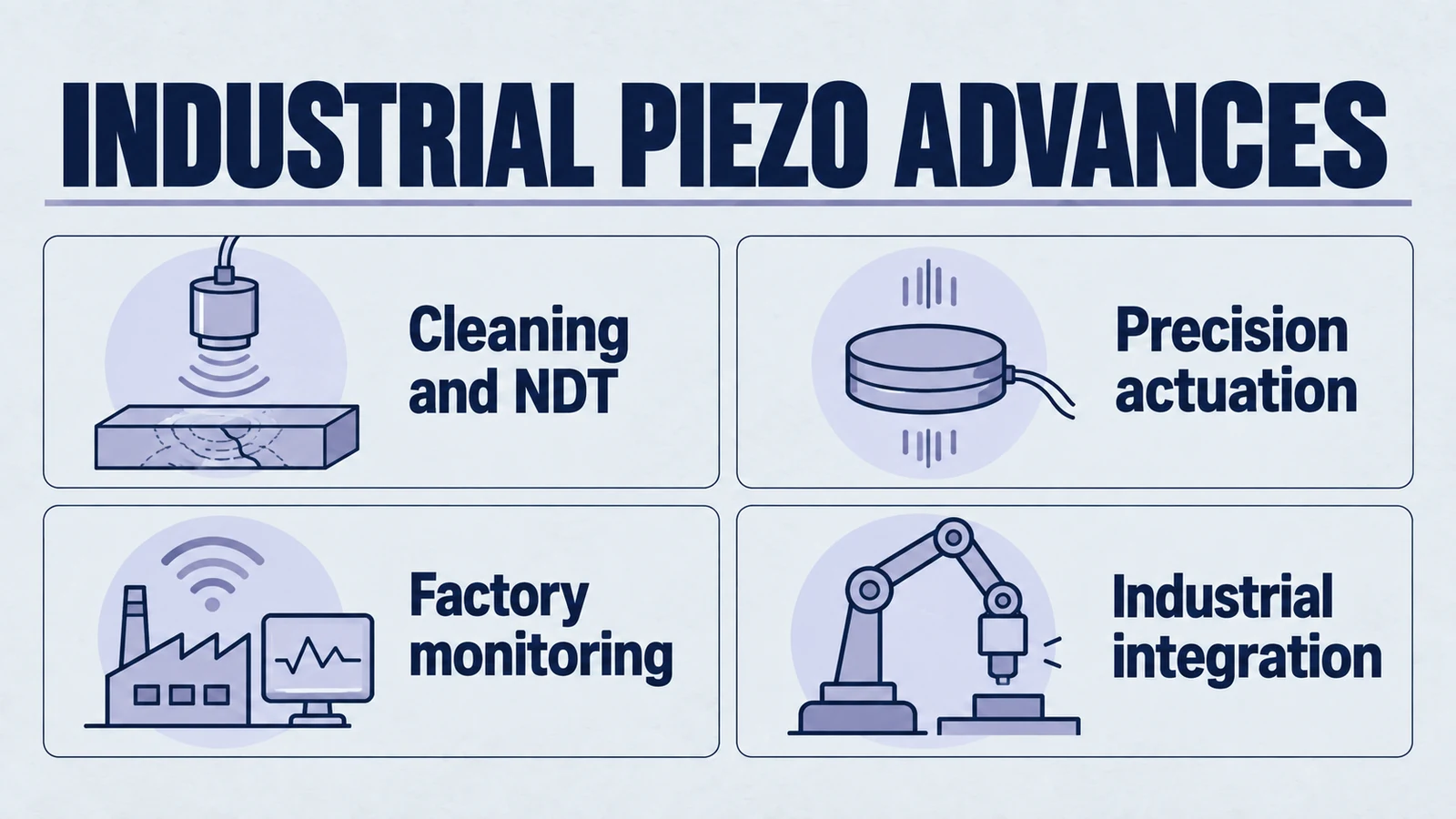
Piezoelectric ceramics have emerged as critical components within contemporary industrial technologies, underpinning significant advancements in automation, precise measurement, and sustainable energy applications. These advanced materials, characterized by their unique capacity to convert mechanical energy into electrical signals—and vice versa—are witnessing rapid development driven by heightened industry demand and technological innovation. The growing emphasis on enhanced accuracy, operational efficiency, and environmental sustainability underscores the increasing industrial reliance on piezoelectric ceramics.
Fundamental Principles of Piezoelectric Ceramics
Piezoelectric ceramics function on the principle of piezoelectricity, wherein the application of mechanical stress generates electrical charges, and conversely, applied electric fields induce mechanical deformation. Such ceramics exhibit superior sensitivity, rapid response times, and notable mechanical and electrical stability, positioning them ideally for rigorous industrial environments.
Prominent piezoelectric ceramics include:
Product path for this search intent
Match the article topic to the right YJ Piezo product page
Use this article when the risk is supplier selection, engineering support, validation evidence, integration reliability, and whether the manufacturer can scale from sample to production. For "Advancements and Prospects of Piezoelectric Ceramics in Industrial Applications", the practical value is in turning the topic into a measurable selection or sourcing decision.
- Ultrasonic Transducer Supplier Hub
OEM sourcing and engineering collaboration
- PZT Material Supplier Hub
Material control and grade selection
- Piezoelectric Ceramics
Ceramic manufacturing and custom shapes
- Lead Zirconate Titanate (PZT): Renowned for exceptional electromechanical coupling and sensitivity, extensively employed across various industrial applications.
- Barium Titanate (BaTiO3): Characterized by robust dielectric properties, applicable primarily within sensor technologies and capacitors.
- Lead-Free Ceramics (e.g., Potassium Sodium Niobate - KNN): Increasingly adopted in response to stringent environmental legislation and sustainability goals.
Our materials research focuses on advancing both traditional and environmentally-friendly piezoelectric ceramics for diverse industrial applications.
Current Industrial Applications and Implementations
Piezoelectric ceramics currently play a pivotal role across multiple industrial sectors:
Ultrasonic Cleaning Technologies
Widely employed within electronics and precision manufacturing industries, ultrasonic transducers based on piezoelectric ceramics facilitate effective contaminant removal through high-frequency vibrational cleaning. Industries such as semiconductor manufacturing extensively rely on these methods to ensure contamination-free surfaces, thereby improving yield and device reliability.
Non-destructive Testing (NDT)
Critical within aerospace, automotive, and infrastructure sectors, piezoelectric sensors enable accurate detection of internal structural defects without material compromise, significantly enhancing reliability and safety standards. Applications include detecting fatigue cracks in aircraft wings and assessing integrity in bridges and infrastructure.
Precision Actuation
Piezoelectric actuators, essential within micro-positioning and precision movement applications, underpin critical operations in semiconductor manufacturing, optics, and precision engineering fields. Their capability for nanometer-scale resolution makes them important for applications like optical alignment and semiconductor lithography.
Robotics and Industrial Automation
Integrated piezoelectric sensors and actuators provide essential capabilities for real-time feedback and precise motion control, vital to advanced robotic systems and automated manufacturing platforms. Our Rectangular Series components are specifically designed for integration into sophisticated automation systems.
Vibration Monitoring
Employing piezoelectric vibration sensors, predictive maintenance strategies in manufacturing, energy, and transportation sectors have significantly improved machinery diagnostics and preventive maintenance efficiency. Continuous monitoring of machinery health allows early detection of wear, preventing unexpected downtime and costly repairs.
Emerging Trends and Technological Innovations
Recent innovations shaping the future landscape of piezoelectric ceramics include:
Development of Lead-Free and Sustainable Materials
Stringent environmental regulations catalyze the advancement of high-performance lead-free piezoelectric ceramics, achieving ecological compliance without sacrificing performance. Research efforts focus on enhancing the electromechanical properties of materials like KNN, enabling their widespread adoption in various high-performance applications.
Nanostructured Piezoelectric Ceramics
Nanostructuring can support miniaturized architectures, but sensitivity and response depend on composition, density, domains, interfaces and complete-device design. Smaller grains do not inherently improve every electromechanical property. The development of nanocomposite piezoelectric ceramics opens new avenues for highly responsive sensor technologies and advanced functional devices like our Disc Series.
Integration within IoT and Smart Manufacturing
Piezoelectric ceramics increasingly function as critical components in powering smart sensors, actuators, and autonomous energy-harvesting devices, facilitating comprehensive data acquisition, analysis, and predictive maintenance within interconnected industrial ecosystems. Such integration enhances operational intelligence, promoting efficiency and resource optimization.
Multifunctional Composite Materials
Advancements in multifunctional piezoelectric composites enable simultaneous performance of sensing, actuation, and structural roles, markedly enhancing component integration, functionality, and industrial performance. Our innovative Hollow Sphere Series exemplifies this multifunctionality, particularly valuable in aerospace and automotive industries where component weight reduction and enhanced functionality are critical.
Market Dynamics and Future Industrial Outlook
Demand for piezoelectric ceramics is supported by industrial automation, healthcare equipment development, and automotive applications. The Asia-Pacific region, notably China and Japan, remains important because of its manufacturing base, automation investment, and established supply chain for advanced ceramic components.
Nonetheless, the sector faces notable challenges, including sustainability concerns, scalable manufacturing processes, and maintaining competitive cost structures, each providing opportunities for further research and industrial innovation. Additionally, increasing regulatory pressures toward sustainable manufacturing underscore the importance of lead-free and eco-friendly piezoelectric materials.
Strategic Recommendations for Engineers and Procurement Specialists
Key considerations for effectively integrating piezoelectric ceramics into industrial designs include:
- Future-Oriented Design Practices: Selection of advanced, environmentally compliant ceramics to align with future regulatory frameworks.
- Customized Piezoelectric Solutions: Collaborating closely with suppliers offering tailored, application-specific materials and components, thereby enhancing competitive advantage and operational efficiency.
- Supplier Selection Criteria: Emphasizing suppliers with demonstrable excellence in quality assurance, consistent delivery performance, and extensive technical support. Additionally, prioritizing suppliers engaged in ongoing research and development ensures access to cutting-edge technologies.
Conclusion: Piezoelectric Ceramics as Catalysts for Industrial Transformation
The strategic integration of piezoelectric ceramics is poised to substantially influence the future landscape of industrial technology, offering unprecedented levels of precision, efficiency, and sustainability. Industry leaders and engineering professionals leveraging these advanced materials will significantly contribute to shaping innovative industrial practices and technologies. As research progresses and new applications continue to emerge, piezoelectric ceramics will undoubtedly remain central to industrial innovation, influencing a broad spectrum of future technological advancements.
Interested in leveraging advanced piezoelectric ceramics for your industrial applications? Contact us today to discuss tailored solutions designed to meet your specific requirements and gain insights into upcoming technological advancements in the field.
Engineering decision notes
OEM integration and supplier qualification
Use this article when the risk is supplier selection, engineering support, validation evidence, integration reliability, and whether the manufacturer can scale from sample to production. For "Advancements and Prospects of Piezoelectric Ceramics in Industrial Applications", the practical value is in turning the topic into a measurable selection or sourcing decision.
YJ Piezo combines direct project coordination with ceramic manufacturing support, so procurement and engineering teams can evaluate material control, application review, sample validation, and production consistency together.
Selection checks
- Ask whether the supplier controls ceramic manufacturing or only assembles purchased elements.
- Review sample policy, inspection records, engineering response quality, and production lead-time stability.
- Compare suppliers and integration paths by validation evidence, not only by unit price and datasheet similarity.
Failure risks
- A low-price sample can pass early tests but fail when batch variation, thermal load, or assembly stress appears.
- A supplier without material control may not explain why impedance, capacitance, or resonance drift occurs.
- Weak RFQ information leads to quotes that are fast but not technically comparable.
RFQ details
- What application, operating environment, and failure cost should the supplier design around?
- Which sample tests and outgoing records are required before pilot production?
- What customization, MOQ, tooling, and delivery constraints must be known before quotation?
Relevant YJ Piezo pages
- Ultrasonic Transducer Supplier Hub
OEM sourcing and engineering collaboration
- PZT Material Supplier Hub
Material control and grade selection
- Piezoelectric Ceramics
Ceramic manufacturing and custom shapes
Application FAQ
- How should an OEM compare piezoelectric suppliers?
- Compare material control, engineering support, test evidence, customization ability, sample policy, and batch consistency. Unit price matters, but only after the technical risk is understood.
- What makes an RFQ technically useful?
- A useful RFQ includes application, dimensions, target frequency, electrical limits, duty cycle, operating medium, environment, expected quantity, required reports, and current failure or replacement context.