
How Piezoelectric Ceramics Enhance the Efficiency of Ultrasonic Cleaners
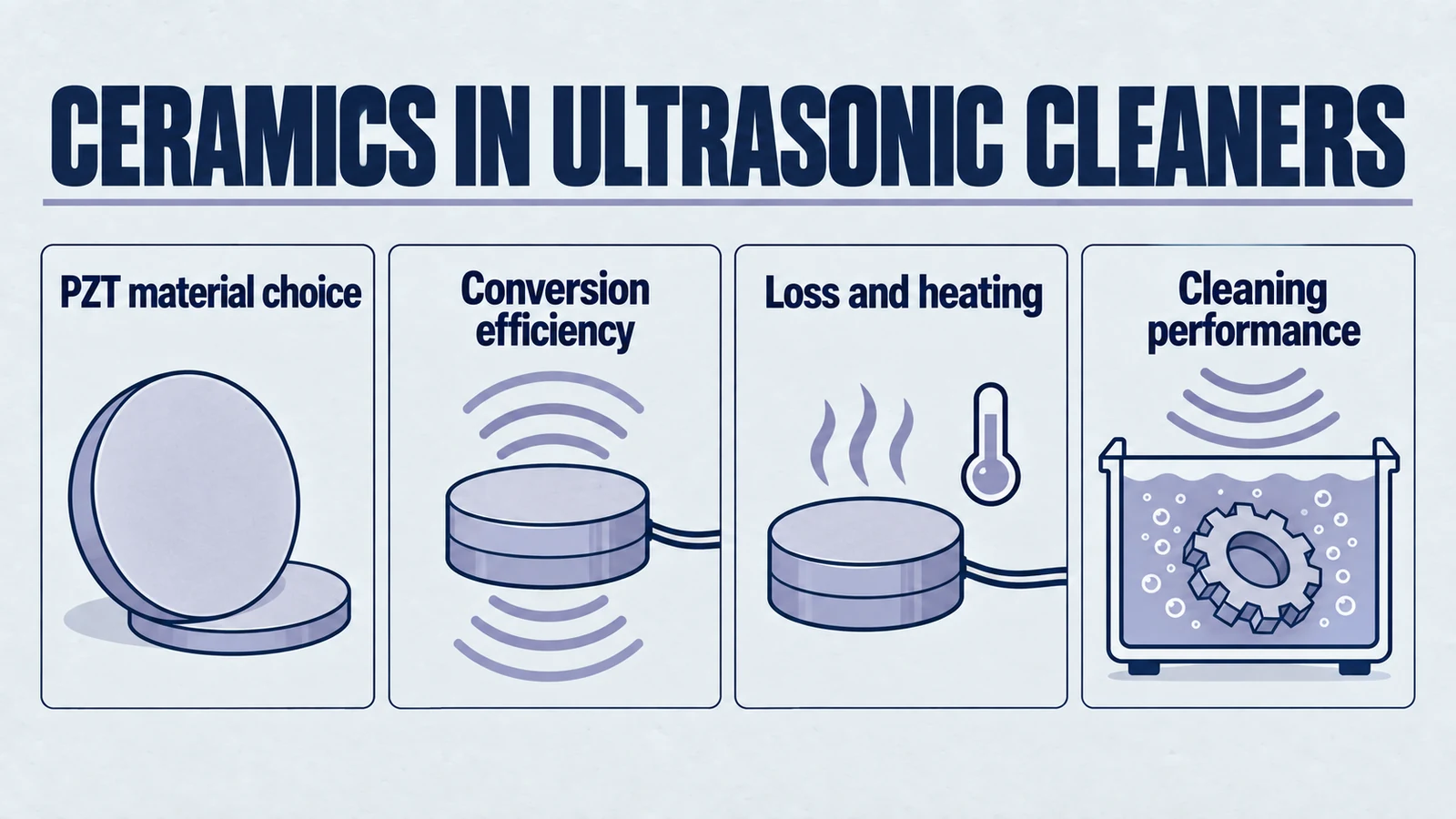
In the realm of industrial and medical cleaning, ultrasonic cleaners have become important tools due to their ability to remove contaminants from intricate and delicate surfaces. At the heart of this technology lies a critical component: piezoelectric ceramics. These materials are responsible for converting electrical signals into the ultrasonic vibrations necessary for precision cleaning. Understanding how piezoelectric ceramics function and why they are vital to ultrasonic transducers is essential for improving cleaning efficiency and device reliability.
The Role of Ultrasonic Transducers
Ultrasonic cleaners operate by using high-frequency sound waves—typically ranging from 20 kHz to several hundred kHz—to agitate a liquid cleaning solution. This agitation creates microscopic cavitation bubbles that implode with immense energy, dislodging dirt, grease, and other contaminants from surfaces. The component that generates these ultrasonic waves is the ultrasonic transducer.
Ultrasonic transducers typically consist of a piezoelectric ceramic element bonded to a metal backing and connected to an electrical signal generator. When an alternating current is applied to the piezoelectric element, it vibrates at ultrasonic frequencies, transmitting these vibrations into the cleaning fluid. Our HJ-3528B cleaner transducers demonstrate this principle in action.
Product path for this search intent
Match the article topic to the right YJ Piezo product page
Use this article when the choice is not just a shape, but a material tradeoff between sensitivity, loss, coupling, stability, and operating field. For "How Piezoelectric Ceramics Enhance the Efficiency of Ultrasonic Cleaners", the practical value is in turning the topic into a measurable selection or sourcing decision.
- PZT Material Hub
Material grades and application tradeoffs
- Piezoelectric Ceramics
Shapes and ceramic manufacturing options
- PZT Material Supplier Hub
Material control, grade selection, and sourcing support
Why Piezoelectric Ceramics Are Crucial
Piezoelectric ceramics, such as lead zirconate titanate (PZT), possess the unique ability to convert electrical energy into mechanical vibrations—and vice versa. This property, known as the piezoelectric effect, is what enables the generation of ultrasonic waves in a controlled and efficient manner.
The key reasons piezoelectric ceramics are essential in ultrasonic transducers include:
- High Electromechanical Coupling Efficiency: Piezoelectric ceramics can convert a high proportion of electrical energy into mechanical motion, minimizing energy loss. Learn more about factors affecting efficiency.
- Frequency Precision: These ceramics can be manufactured to resonate at specific frequencies, allowing for tailored cleaning processes suited to different applications. Our acoustic transducer series showcases precision frequency control.
- Durability and Stability: PZT-based ceramics are known for their stability over time and resistance to mechanical and thermal stress, ensuring consistent performance.
- Compact Design Potential: The high energy density of piezoelectric ceramics allows for miniaturized transducers, enabling compact cleaner designs without compromising performance.
Enhancing Cleaning Efficiency Through Material Optimization
The choice of piezoelectric ceramic material directly influences the performance of the ultrasonic cleaner. Factors such as the electromechanical coupling coefficient (k), dielectric constant, and mechanical Q-factor must be optimized to match the intended application.
For instance:
- High-k materials are ideal for applications requiring high sensitivity and strong vibration.
- Materials with high mechanical Q are suitable for narrow-band, high-frequency operations where consistent output is crucial.
Tailoring the ceramic properties allows manufacturers to fine-tune ultrasonic transducers for specific tasks—be it cleaning jewelry, surgical tools, semiconductor components, or automotive parts. Understanding how to choose the right piezoelectric ceramic is crucial for optimal performance.
Application Versatility Enabled by Piezoelectric Ceramics
The adaptability of piezoelectric ceramics has expanded the application scope of ultrasonic cleaners:
- Medical and dental fields: Soil/residue removal before the required validated disinfection or sterilization process; ultrasonic cleaning alone does not establish sterility. Explore our medical device applications.
- Electronics manufacturing: Removing flux and particulates from delicate circuitry.
- Automotive and aerospace: Cleaning complex parts with cavities and surface irregularities.
- Laboratory and scientific research: Preparing glassware and instruments free from micro-contamination.
Our comprehensive range includes specialized transducers like the HJ-3825, HJ-3828, and HJ-4528 for various cleaning applications.
The Future: Smarter, More Efficient Systems
As demand grows for energy-efficient and application-specific ultrasonic cleaners, piezoelectric ceramics continue to evolve. Innovations in lead-free piezo materials, multi-layer ceramic structures, and composite transducer designs are driving cleaner systems toward:
- Lower power consumption
- More precise control over cavitation intensity
- Wider frequency adaptability
- Integration with IoT and smart monitoring systems
These developments position piezoelectric ceramics not just as components, but as enablers of next-generation ultrasonic cleaning technologies. Learn about the future of piezoelectric ceramics in industrial applications.
Advanced Cleaning Solutions
Our specialized cleaning transducers demonstrate the power of optimized piezoelectric ceramics:
- High-frequency applications: HJ-5025 and HJ-5028 for precision cleaning
- Heavy-duty cleaning: HJ-4520 for industrial applications
- Specialized formats: HJ-300ML for unique configurations
Each solution is backed by advanced manufacturing techniques and rigorous quality control.
Conclusion
Piezoelectric ceramics are the technological cornerstone of ultrasonic cleaners, converting electrical energy into finely tuned mechanical vibrations. Their efficiency, precision, and reliability make them important in transducer design and performance. As new materials and configurations emerge, piezoelectric ceramics will play an increasingly important role in pushing the boundaries of ultrasonic cleaning—making it faster, safer, and more effective across industries.
Understanding the science behind ultrasonic transducers and working with experienced manufacturers like Yujie ensures optimal cleaning performance for your specific applications.
For expert guidance on selecting the ideal piezoelectric ceramics for your ultrasonic cleaning applications, contact us at business@szyujie.com or visit yujiepiezo.com.
Explore our complete range of ultrasonic cleaning transducers, acoustic solutions, and piezoelectric ceramic materials to discover how piezoelectric ceramics can enhance your cleaning efficiency.
Engineering decision notes
PZT material and ceramic selection
Use this article when the choice is not just a shape, but a material tradeoff between sensitivity, loss, coupling, stability, and operating field. For "How Piezoelectric Ceramics Enhance the Efficiency of Ultrasonic Cleaners", the practical value is in turning the topic into a measurable selection or sourcing decision.
YJ Piezo coordinates PZT ceramic projects with manufacturing support, so material formulation, sintering, polarization, electrode process, and outgoing inspection can be reviewed against the final application.
Selection checks
- Separate sensing needs from high-power actuation needs before comparing d33 or coupling values.
- Check dielectric loss, Qm, Curie temperature, aging behavior, and operating field against the real duty cycle.
- Confirm whether the application needs standard PZT grades or a custom formulation and geometry.
Failure risks
- Choosing only the highest d33 can create heat, drift, or depolarization risk in power ultrasonics.
- A ceramic that performs well in free measurement can fail once bonded, clamped, or loaded.
- Material substitutions without batch testing can change capacitance, resonance, and system tuning.
RFQ details
- Is the part used for sensing, actuation, atomization, cleaning, welding, or measurement?
- What field strength, temperature, duty cycle, and mechanical load will the ceramic see?
- Which values must be controlled: d33, capacitance, resonance, impedance, Qm, or dimensional tolerance?
Relevant YJ Piezo pages
- PZT Material Hub
Material grades and application tradeoffs
- Piezoelectric Ceramics
Shapes and ceramic manufacturing options
- PZT Material Supplier Hub
Material control, grade selection, and sourcing support
Application FAQ
- Is the highest d33 always the best PZT choice?
- No. High d33 can be useful for sensitivity, but high-power ultrasonic systems often need lower loss, higher Qm, better thermal stability, and safer operation under field and stress.
- What makes PZT material selection different from catalog buying?
- The right PZT choice depends on geometry, load, drive field, duty cycle, temperature, and inspection targets. A catalog value is only useful when it is tied to the final assembly conditions.