
The 'In-Spec' Failure: Why Your Piezoelectric Ultrasonic Transducer Needs More Than a Datasheet
How Yujie's Material-First Manufacturing De-Risks Your High-Stakes Application
The Procurement Paradox: When Datasheets Create Risk
In the development of any advanced system, from medical imaging devices to high-power industrial welders, sourcing a piezoelectric ultrasonic transducer is a high-reliability decision. The performance, reliability, and reputation of your entire product are inextricably linked to this core component. This transducer is the engine, responsible for the precise conversion of electrical energy into mechanical vibration.
This high-stakes quest leads engineers and procurement managers to a central, frustrating challenge: the procurement paradox. You meticulously gather technical datasheets from multiple suppliers for a component, such as a PZT-4 or PZT-8 transducer. On paper, these documents appear nearly identical, listing comparable piezoelectric coefficients, coupling factors, and dielectric constants.
This is the paradox: the very document intended to mitigate risk often conceals it. These identical numbers fail to answer the most critical questions:
- What is the real-world performance under sustained operational stress?
- What is the long-term reliability and projected lifespan?
- Most importantly, what is the crucial batch-to-batch consistency?
This "discrepancy between the specification sheet and operational reality represents a substantial and often hidden source of project risk".
The Business Cost of "Good Enough"
This hidden risk is not merely a technical annoyance; it has severe and cascading business consequences. A transducer that performs "to spec" in a validation lab but fails in the field creates a domino effect. This "risk" is the true cost of sourcing a component based on a datasheet alone. It manifests as:
- Derailing Timelines: A component that fails validation trials forces entire projects back to the design phase, delaying market entry.
- Inflating Costs: The expense of rework, warranty claims, recalls, and complete redesigns far outweighs any initial savings on component-level procurement.
- Compromising Reputation: In high-reliability fields like medical diagnostics or industrial NDT, component failure is not an option. A false negative in a sensor or a failure in a medical device can have serious results, permanently damaging your end-product's reputation.
This market-level disconnect is unsustainable. The industry is trending toward extreme specialization, with demands for miniaturization and complex IoT integration. Treating the core component as a "black box" commodity is a strategy that is likely to fail. The anxiety this creates for engineers—this unquantifiable risk—is not solved by a better datasheet. It is solved by a better partner.
The Anatomy of Failure: What Datasheets Don't Predict
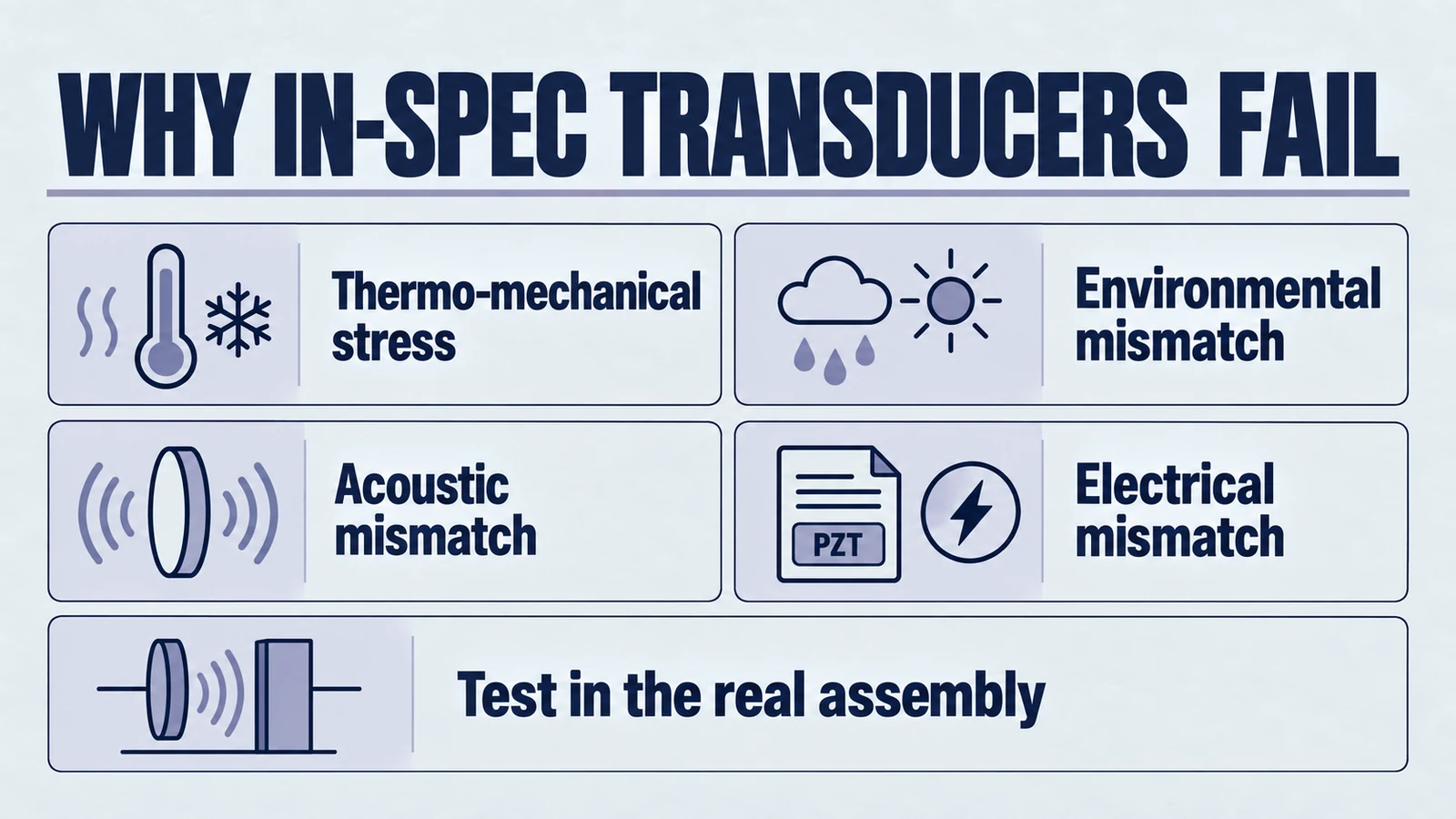
A piezoelectric ultrasonic transducer can be 100% "in-spec" on a datasheet and still fail seriousally within your system. This is because failure is almost never a simple component-level issue; it is a system-level problem. The datasheet cannot predict the complex interplay of electrical, mechanical, and thermal forces in your specific application.
Understanding the anatomy of these failures demonstrates why a system-level engineering partner is essential.
Failure Mode 1: Thermo-Mechanical Breakdown
In high-power industrial applications, the most common failures are physical and thermal. A datasheet for a PZT-8 disc will not tell you how it will behave under your specific thermo-mechanical load.
- Piezoceramic Overheating and Cracking: When a transducer overheats, it is often due to high dielectric loss in the PZT material—a property that can vary significantly batch-to-batch, even if the primary coefficients match the spec sheet.
- Stack Bolt Failure: Many industrial transducers are bolt-clamped Langevin-type (BLTs). A "cracked piezoceramic" is often a symptom of a deeper, systemic design flaw. It indicates a critical mismatch between the ceramic's material properties, the mechanical clamping stress of the stack bolt, and the thermal load generated by the high-power drive.
Failure Mode 2: Environmental and Material Mismatch
A transducer is an assembly, and its failure is often environmental. The datasheet for the piezoelectric element itself says nothing about how the final assembly will survive your application.
- Matching and Backing Layers: A piezoelectric ultrasonic transducer is more than its ceramic core. The properties of the backing and matching layers can change considerably with environmental exposure, with common materials being unsuitable for harsh environments.
- Harsh Environments: The industry faces unsolved challenges, such as developing transducers that can survive long-term exposure to temperatures above 500°C without complex, failure-prone cooling systems. Assess the exact temperature, duration, cycles, environment, coupling and available prototype/component evidence; high-temperature research does not establish a timeless universal impossibility or that one supplier solves it.
Failure Mode 3: Acoustic and Electrical Mismatches
Even if a transducer doesn't physically break, it can fail functionally by not performing its intended job.
- Inefficient Cavitation: In ultrasonic cleaning, the core mechanism is "acoustic cavitation". A transducer that is poorly matched to the tank, the drive signal, or the liquid will be acoustically inefficient. It will heat the water but fail to generate the powerful cavitation bubbles required to clean the parts.
- Signal Noise and Artifacts: In medical applications, precision is everything. A bulky, off-the-shelf probe can restrict motion or introduce artifacts, rendering a diagnostic image useless. In industrial sensing, ambient noise or interference can cause false positives or false negatives—a critical failure that a generic, unshielded sensor is not designed to filter.
Failure can involve material, process, assembly, electronics, handling, environment and integration. Joint engineering/procurement review can reduce selected risks but does not establish one universal root cause. The reliable way to break this cycle of risk is to fuse them, engaging a single partner who understands both.
The Yujie Solution: A Partnership Built on Three Pillars
At Yujie Technology, our entire business model is designed to solve the datasheet paradox and de-risk your product's lifecycle. We are a leading global piezoelectric manufacturer built upon three foundational pillars that provide the transparency, control, and collaboration that "datasheet-only" suppliers cannot.
As we state in our mission, "our clients are not merely purchasing a ceramic component; they are investing in quantifiable performance, assured reliability, and a strategic partnership designed to de-risk their entire product development lifecycle".
Pillar 1: Deep Material Science Expertise (We Are a PZT Supplier First)
This is our core differentiator. Yujie is not just an assembler of transducers; we are a "PZT Material Supplier". We control the single most critical, high-risk variable in the entire supply chain: the ceramic itself.
We manufacture our own high-performance piezoelectric ceramics, giving us complete control over the powder formulation, sintering process, and final material properties. This vertical integration is your first line of defense against risk.
- Material for the Mission: Separate diagnostic/receiving duties from therapeutic or power ultrasound regardless of industry. Candidate hard/soft grades must be selected by mode, sensitivity, stress, drive, loss and thermal requirements; medical tools can also require hard high-power ceramics.
- Beyond the Standard: For challenges that have no off-the-shelf answer, we offer "custom formulations". We can engineer the material's properties to match your application's unique environmental or performance demands.
Pillar 2: Rigorous and Transparent Process Control (Manufacturing at Scale)
This pillar directly addresses the "batch-to-batch consistency" problem. Because we are also a "Piezoelectric Component Supplier", we manage the entire manufacturing chain with rigorous quality control.
- From Component to Assembly: We control the process from bulk ceramics to the precision machining of discs, rings, plates, and custom shapes. This capability flows directly into our final "Ultrasonic Transducer Supplier" division, ensuring that the properties we engineered in the lab are the properties you receive in every single unit.
- Quality at Scale: Prototype results must be translated into an agreed production process, inspection plan, and realistic quantity schedule. Capacity is reviewed against the selected design and forecast.
Pillar 3: Collaborative, Partnership-Based Engineering (The 5-Step OEM Process)
This pillar is the active mechanism that solves the system-level failures from Section 2. We don't just sell components; our "comprehensive OEM services" are built on a formal, collaborative process. This 5-step process is not a "sales process"; it is a technology-transfer framework that fuses your application expertise with our material-science expertise.
- Customer Request: We begin by understanding your exact requirements.
- Design: Our experienced team analyzes your entire system—the clamping stress, the drive signal, the thermal environment—and designs a tailored piezoelectric ultrasonic transducer solution.
- Prototyping: We create functional prototypes for validation in your system.
- Manufacturing: We leverage our PZT-first manufacturing (Pillar 1) and process control (Pillar 2) to produce your custom component at scale.
- Support: We deliver high-quality custom components and provide ongoing partnership to ensure your success.
Application in Focus: Why a "One-Size-Fits-All" Transducer Fails
The myth of a "general purpose" piezoelectric ultrasonic transducer is just that—a myth. The engineering requirements for high-power industrial applications and high-precision medical devices are diametrically opposed. A component that is "good" for everything is "optimal" for nothing.
Yujie's product portfolio is not a catalog; it is a portfolio of evidence demonstrating our mastery across the entire engineering spectrum.
Case 1: Industrial High-Power (Cleaning, Welding, NDT)
- The Challenge: Extreme electrical and mechanical stress, high-power drive, and the need for powerful, efficient acoustic cavitation or the mechanical force for welding.
- The Yujie Solution:
- Material: Our robust "hard" PZT-4 and PZT-8 ceramics, designed for these high-reliability applications.
- Products: We have a proven line of industrial transducers, such as our industrial cleaning transducers optimized for powerful cavitation, and the HJ-6015 Heavy-Duty Welding transducer, designed to withstand the unique thermo-mechanical loads of ultrasonic welding.
Case 2: Medical and Precision (Imaging, Atomization, Aesthetics)
- The Challenge: The opposite of industrial. Not high power, but high precision. This demands high sensitivity, low signal noise, extreme miniaturization, and contact-path validation, output control, and risk documentation.
- The Yujie Solution:
- Material: Our high-sensitivity "soft" PZT-5A and PZT-5H formulations.
- Products: We demonstrate mastery of high-frequency applications (1.0MHz to 3.5MHz). This includes atomizer transducers which generate the "fine mist" required for medical nebulizers, and beauty device transducers which deliver optimized, precise ultrasound energy for skincare applications.
Case 3: Custom OEM and Sensing (Flow, Level Detection)
- The Challenge: Bespoke requirements, unique form factors, or specific frequency needs for applications like flow measurement or bubble detection.
- The Yujie Solution: This is where our OEM process and "Custom Modification" capabilities are the primary product. Our flow measurement transducers and custom bubble detection sensors are examples of solutions born from collaborative engineering.
| Application Sector | Core Requirement | Yujie's Engineering & Material Focus |
|---|---|---|
| Industrial Ultrasonics (e.g., Cleaning, Welding) | High Power, Durability, High Duty Cycle, Reliability | Vertically integrated PZT-4 & PZT-8 "hard" ceramics; robust mechanical design to prevent overheating and cracking. |
| Medical Ultrasonics (e.g., Imaging, Atomizers) | High Precision, High Sensitivity, Stability, Miniaturization, Material-contact validation | PZT-5A & PZT-5H "soft" formulations; expertise in high-frequency (1.0MHz - 3.5MHz) transducers for precision imaging and nebulizers. |
| Custom OEM / Sensing (e.g., Flow, NDT) | Bespoke Performance, Unique Form Factors, Environmental Resistance | Collaborative 5-step OEM/ODM process; custom PZT formulations and component assemblies to meet exact client specifications. |
The "Custom" Difference: From Form Factor to Foundational Science
Many suppliers offer "custom" solutions. However, it is critical to understand the two different definitions of "custom" in our industry, as they lead to vastly different outcomes.
Level 1: "Custom-Assembly" (The Competitor Model)
This is the most common form of "customization." An assembler will offer to change a wire length, a connector, or a housing. This superficial modification does nothing to solve the core risks identified in Section 2. It does not address material inconsistency, prevent thermo-mechanical failure, or improve acoustic matching.
Level 2: "Custom-Engineering" (The Yujie Model)
This is Yujie's approach. For us, "custom" means starting at the beginning—at the level of foundational science. We ask:
- Do you need a "custom formulation" of the PZT material itself to survive a high-temperature environment?
- Do you need a "custom shape" for the ceramic element to fit a miniaturized medical device?
- Do you need a fully custom assembly designed to operate in an environment with high "ultrasonic noise"?
This foundational customization is non-negotiable for true innovation. A smart wheelchair, for example, needs "custom ultrasonic" sensors to "see things that a typical ultrasonic sensor can't". A simple "custom-assembly" sensor would be useless. Likewise, an R&D project for "next-generation composite manufacturing" that uses a network of 57 custom ultrasonic sensors demands a partner who can co-develop novel technology, not a vendor who just supplies a standard part.
This is the difference between buying a component and partnering on an R&D program. Yujie is built for the latter.
Conclusion: Don't Buy a Datasheet. Secure Your Supply Chain.
We return to the central problem. The performance, reliability, and long-term success of your product are too critical to be left to a generic datasheet.
A "datasheet-only" procurement strategy is not a "cost-saving" move; it is a "risk-introduction" move. The true cost of a "cheap" component is project failure, redesign delays, and a compromised reputation. The choice of a piezoelectric ultrasonic transducer supplier is not a procurement decision; it is a strategic partnership decision.
The Yujie Pledge: Your Partner for Performance and Reliability
When you partner with Yujie, you are not just buying a component. You are investing in:
- Quantifiable Performance: Built on our vertically integrated PZT material science.
- Assured Reliability: Built on our rigorous, transparent process control.
- A Strategic Partnership: Built on our collaborative 5-step OEM process, "designed to de-risk your entire product development lifecycle".
Your application is not generic. Your components shouldn't be either.
Partner with a supplier that builds your piezoelectric ultrasonic transducer from the material up. Stop buying datasheets and start designing solutions.
Contact the Yujie engineering team today to discuss your needs.
Or, if you have specifications ready, request a custom solution.
Product path for this search intent
Match the article topic to the right YJ Piezo product page
Use this article when the risk is supplier selection, engineering support, validation evidence, integration reliability, and whether the manufacturer can scale from sample to production. For "The 'In-Spec' Failure: Why Your Piezoelectric Ultrasonic Transducer Needs More Than a D...", the practical value is in turning the topic into a measurable selection or sourcing decision.
- Ultrasonic Transducer Supplier Hub
OEM sourcing and engineering collaboration
- PZT Material Supplier Hub
Material control and grade selection
- Piezoelectric Ceramics
Ceramic manufacturing and custom shapes
Engineering decision notes
OEM integration and supplier qualification
Use this article when the risk is supplier selection, engineering support, validation evidence, integration reliability, and whether the manufacturer can scale from sample to production. For "The 'In-Spec' Failure: Why Your Piezoelectric Ultrasonic Transducer Needs More Than a D...", the practical value is in turning the topic into a measurable selection or sourcing decision.
YJ Piezo combines direct project coordination with ceramic manufacturing support, so procurement and engineering teams can evaluate material control, application review, sample validation, and production consistency together.
Selection checks
- Ask whether the supplier controls ceramic manufacturing or only assembles purchased elements.
- Review sample policy, inspection records, engineering response quality, and production lead-time stability.
- Compare suppliers and integration paths by validation evidence, not only by unit price and datasheet similarity.
Failure risks
- A low-price sample can pass early tests but fail when batch variation, thermal load, or assembly stress appears.
- A supplier without material control may not explain why impedance, capacitance, or resonance drift occurs.
- Weak RFQ information leads to quotes that are fast but not technically comparable.
RFQ details
- What application, operating environment, and failure cost should the supplier design around?
- Which sample tests and outgoing records are required before pilot production?
- What customization, MOQ, tooling, and delivery constraints must be known before quotation?
Relevant YJ Piezo pages
- Ultrasonic Transducer Supplier Hub
OEM sourcing and engineering collaboration
- PZT Material Supplier Hub
Material control and grade selection
- Piezoelectric Ceramics
Ceramic manufacturing and custom shapes
Application FAQ
- How should an OEM compare piezoelectric suppliers?
- Compare material control, engineering support, test evidence, customization ability, sample policy, and batch consistency. Unit price matters, but only after the technical risk is understood.
- What makes an RFQ technically useful?
- A useful RFQ includes application, dimensions, target frequency, electrical limits, duty cycle, operating medium, environment, expected quantity, required reports, and current failure or replacement context.