
IP67 vs IP68 vs PVDF vs Stainless Steel: Procurement Matrix for Harsh Environments
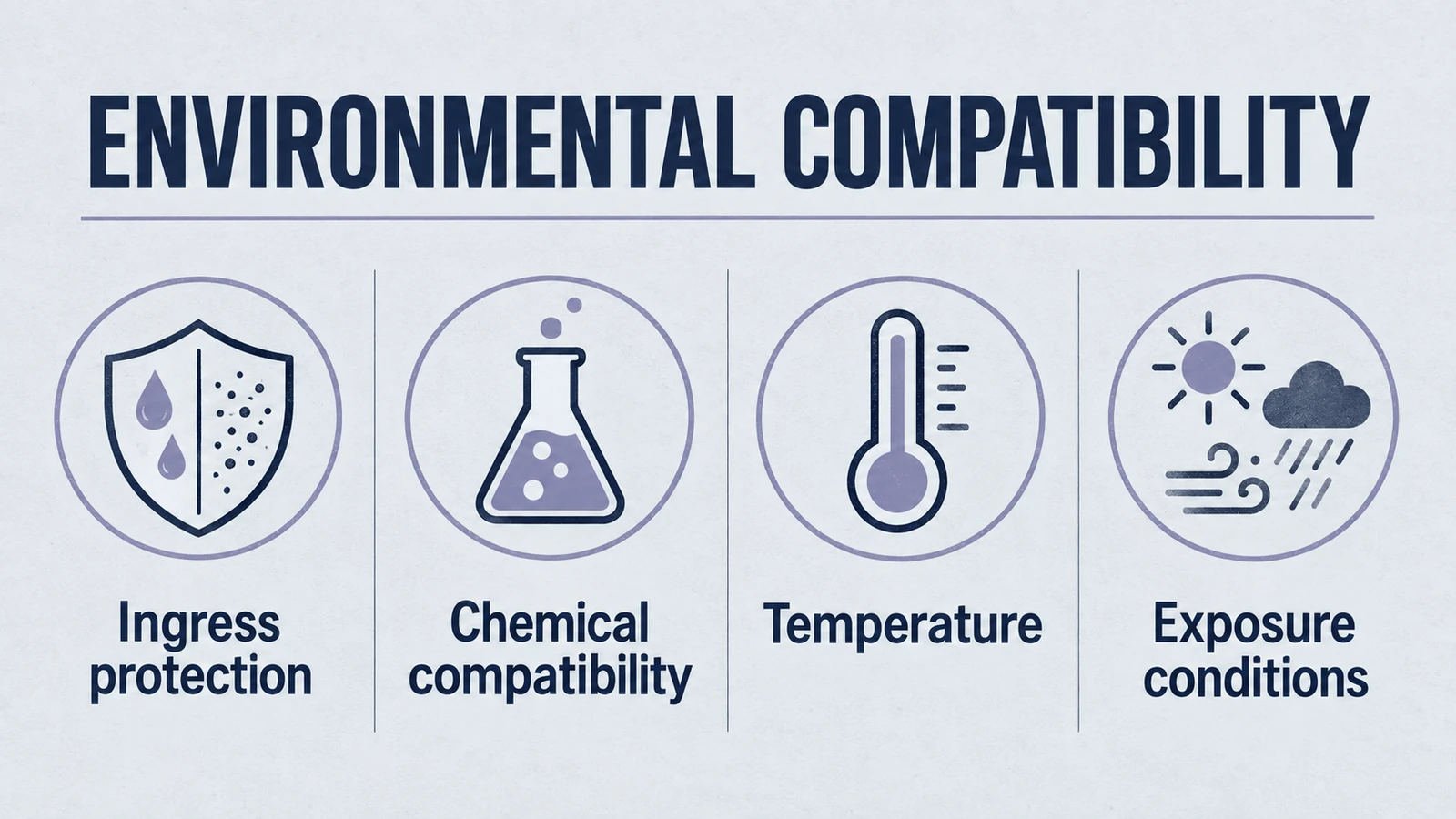
In harsh-environment procurement, many teams still compress the entire decision into one line item: "Need an IP68 ultrasonic sensor." That shortcut feels efficient because ingress protection is visible, comparable, and easy to place into a sourcing table. The problem is that IP rating alone does not describe whether the housing survives caustic washdown, whether acid vapor attacks connectors, or whether the selected material remains stable after repeated thermal cycling.
This is where procurement projects quietly fail. One supplier quotes an IP68 plastic sensor intended for outdoor rain exposure. Another quotes a stainless steel housing intended for hygienic washdown. A third recommends PVDF because the liquid media is corrosive. On paper all three look defensible. In the field they solve different risk profiles, which means price comparison without environment mapping is not a real comparison.
This article is written as a buyer-side decision guide for chemical and washdown environments. Its purpose is not to repeat generic material science. Its purpose is to show how procurement teams should compare sensor product families, separate ingress rating from chemical compatibility, and route RFQs toward the right commercial page such as the stainless steel housing sensor or the broader ultrasonic transducer supplier capability page.
Problem Context
Product path for this search intent
Match the article topic to the right YJ Piezo product page
Use this article when the risk is supplier selection, engineering support, validation evidence, integration reliability, and whether the manufacturer can scale from sample to production. For "IP67 vs IP68 vs PVDF vs Stainless Steel: Procurement Matrix for Harsh Environments", the practical value is in turning the topic into a measurable selection or sourcing decision.
- Ultrasonic Transducer Supplier Hub
OEM sourcing and engineering collaboration
- PZT Material Supplier Hub
Material control and grade selection
- Piezoelectric Ceramics
Ceramic manufacturing and custom shapes
Procurement confusion around harsh environments usually starts with a category error: buyers treat IP67 or IP68 as if it also certifies chemical resistance, washdown survivability, and lifecycle reliability. It does not. IP rating tells you how the enclosure resists solid ingress and water exposure under defined conditions. It does not tell you whether sodium hydroxide, oxidizing cleaners, acid mist, H2S, or UV aging will degrade the housing, seals, or cable interface over time.
That misunderstanding creates three recurring failure patterns. First, an IP68 sensor is selected for a corrosive tank because it sounds "more rugged," but the housing polymer is not the right match for the vapor chemistry. Second, stainless steel is specified because it looks safer for washdown, but the process media or cleaning chemistry favors PVDF for long-term chemical stability. Third, the housing material is chosen correctly, yet the connector, gasket, or cable entry remains the actual weak point and field failures still occur.
Why Buyers Keep Overusing the IP Shortcut
The IP shortcut survives because it simplifies supplier comparison. A spreadsheet can easily sort IP67 versus IP68. It cannot easily score vapor composition, cleaning chemistry concentration, dwell time, or gasket compatibility. Procurement teams under schedule pressure therefore use the field they can compare quickly rather than the data they actually need for deployment quality.
The commercial cost appears later. Samples arrive with the wrong material logic. Engineering asks for requalification. Acceptance tests are rewritten after installation. Unit price stops mattering because launch timing and maintenance risk now dominate. If the application is above chemical tanks or sanitary process vessels, the hidden cost can include shutdown windows, replacement labor, and safety exposure.
Typical Harsh-Environment Misreads
- IP is treated as chemistry approval: The quote says IP68, so buyers assume strong acids, alkalis, and oxidants are already covered.
- Stainless steel is treated as universally superior: The metal housing feels like the premium option even when PVDF is the safer choice for certain corrosive media and vapor loads.
- PVDF is treated as a full hygienic answer: PVDF can be excellent for corrosion resistance, but hygienic washdown, mechanical abuse, and cleanability requirements may still favor stainless architecture.
- Outdoor waterproofing is mixed with washdown duty: Rain resistance and permanent wet service are not the same thing as repeated caustic cleaning.
If you need engineering detail on stainless design constraints, use the existing stainless steel technical guide. If your primary question is corrosion-resistant plastic housing, use the UltraNova1 product guide. This article does something different: it decides how buyers should compare those choices before RFQ.
Engineering Constraints
Procurement does not need to become a materials laboratory, but it does need a disciplined way to collect the right environment facts. For harsh environments, the quote is only as good as the boundary conditions sent to the supplier.
1) Ingress Protection Is Not Chemical Compatibility
IP67 and IP68 answer a limited question: how the enclosure performs against dust and water ingress under specified test conditions. They do not describe whether the housing resists oxidants, acid vapor, alkaline detergents, or hydrocarbon contamination. A waterproof sensor can still be chemically wrong. A chemically resistant housing can still fail if sealing points are weak.
This distinction is the first screen in supplier comparison. Buyers should treat IP as one required dimension, not the final proxy for harsh-environment suitability.
2) Temporary Immersion and Continuous Wet Service Are Different Risks
Many buyers read IP68 as "appropriate forever in any wet environment." That is too broad. Wet outdoor service, sewage humidity, spray exposure, and chemical washdown create different reliability mechanisms. Temporary immersion testing does not fully represent long-term condensation, thermal cycling, or repeated cleaning chemistry attacking the same interfaces over months.
For wastewater or outdoor utility deployments, compare IP level together with housing durability and long-term moisture management. For a related stability issue, review temperature compensation and drift behavior in field conditions.
3) Housing Material Is Only One Part of the Envelope
Procurement teams often collect only the main housing material, for example PVDF or stainless steel. That is not enough. The actual survivability chain includes the transducer face, connector body, cable sheath, seal material, potting compound, and cable gland. In harsh environments, failure often starts at the interface between these parts rather than the main enclosure body.
This is why good supplier responses should explain the whole sealing architecture, not just the headline material. If the quote mentions stainless housing but says nothing about connector compatibility or cable resistance to cleaning fluids, the risk picture is incomplete.
4) Washdown and CIP Are Not the Same as Outdoor Weatherproofing
Outdoor weatherproofing focuses on rain, splash, dust, UV, and broad temperature variation. Washdown focuses on repeated direct exposure to chemicals, pressure, thermal shock, and residue removal. A sensor that performs well above an outdoor sump may not be the right sensor for alkaline or acidic washdown lines. That gap is especially important in chemical and cleaning processes where exposure is frequent and predictable rather than occasional.
If your process includes open cleaning cycles or residue risk, it is worth pairing this article with open versus closed sensor architecture in CIP environments.
5) Chemical Family Matters More Than Generic "Corrosive" Labels
Do not send suppliers an RFQ that simply says "corrosive environment." That description is too vague to support a decision-grade quote. Buyers should state whether the environment includes acids, alkalis, oxidants, solvents, H2S, salt spray, or mixed washdown cycles. They should also state concentration, temperature, exposure frequency, and whether the threat is liquid splash, vapor, or permanent headspace exposure.
A stainless steel housing may be the right answer for repeated washdown, hygienic lines, and mechanical robustness. A PVDF ultrasonic sensor option may be better when chemical compatibility with aggressive media or vapor load is the governing variable. The right decision is therefore chemistry-specific, not prestige-specific.
6) Temperature Cycling, UV, and Mounting Geometry Still Belong in Procurement
Harsh environment RFQs should also include UV exposure, storage temperature, operating temperature cycling, and mounting constraints such as nozzle size, stand-off, and proximity to splash or spray sources. Materials age differently under sunlight and thermal movement. Seals fail faster when cable orientation traps water. Installation geometry can either reduce or amplify those risks.
This is one reason why procurement should provide application context, not just a model number. A correct quote describes where the sensor lives, not only what the sensor is called.
7) Lifecycle Evidence Must Be Requested Before Sample Approval
A harsh-environment quote should include more than a datasheet. Buyers should ask what evidence supports the recommendation: ingress protection claim, material statement, compatibility assumption, recommended cleaning boundary, and acceptance method. If the supplier cannot explain why a model was selected for your specific chemistry and washdown pattern, then the proposal is still at catalog level rather than application level.
Selection Matrix
Use the matrix below before comparing prices. It converts environment type into the correct procurement questions and prevents IP rating from carrying the full decision by itself.
| Environment Profile | Main Risk | IP Requirement | Material Preference | Procurement Note |
|---|---|---|---|---|
| Chemical tank with acid or oxidant vapor above liquid surface | Long-term chemical attack on housing and sealing interfaces | IP67 or IP68 only after chemistry is defined | PVDF-first comparison, then validate sealing architecture | Ask supplier to separate splash exposure from vapor exposure and state compatibility assumptions explicitly |
| Frequent alkaline or acidic washdown in process area | Chemical cleaning plus thermal shock and mechanical spray impact | Specify the actual jet/immersion exposure and tested rating; immersion alone does not establish washdown protection | Stainless steel for washdown robustness, confirm cleaner compatibility | Request cleaning chemistry, temperature, pressure, and cycle frequency in the RFQ |
| Humid wastewater pit or outdoor utility monitoring | Permanent moisture, condensation, H2S, weather exposure | Select ingress tests for actual exposure; humidity alone does not establish an immersion requirement | IP68 waterproof platform with proven outdoor sealing | Check long-term wet service evidence, not only bench waterproof claim |
| Food or pharma washdown as secondary benchmark | Cleanability, material exposure, hygienic robustness | Specify dust, water-jet/immersion, temperature and chemical requirements separately | Stainless steel often preferred, but verify full hygienic architecture | Do not use this benchmark to override chemical compatibility needs in non-hygienic plants |
| Dusty industrial area with splash but low chemical exposure | Ingress and general durability, limited chemistry risk | IP67 may be sufficient | Material choice can follow installation and cost logic | Avoid overbuying chemistry-resistant materials when environment does not justify them |
The practical conclusion is simple. IP68 is not a substitute for chemical compatibility. Stainless steel is not automatically superior to PVDF in every corrosive environment. The real procurement decision is always a combined judgment about IP level, housing material, cleaning chemistry, mounting, and lifecycle evidence.
Supplier Review Workflow (Step-by-Step)
Use this sequence to keep supplier comparison evidence-based rather than marketing-led.
- Define the environment in procurement language: chemistry, washdown, humidity, vapor, UV, temperature cycling, and installation orientation.
- Split ingress from material questions: ask for IP rating and material recommendation as separate response lines.
- Request a primary model and a backup model: one quote line is not enough for harsh environments.
- Ask what assumptions drive the recommendation: especially vapor composition, cleaning cycle, and exposure frequency.
- Require interface details: connector, cable, seal, and power/output assumptions should be visible before sample stage.
- Define sample acceptance method before shipment: decide which conditions must be reproduced during validation.
- Compare lifecycle risk, not just unit price: include replacement cost, commissioning delay, and maintenance burden in the commercial review.
Procurement teams that follow this sequence usually discover that the most expensive option on paper is not always the highest-cost option in lifecycle terms, and the lowest-priced option is often the one carrying the most hidden qualification risk.
Model Mapping
For harsh environments, ask suppliers to map the environment to a model pair, not a single SKU. This keeps comparison disciplined when the governing risk changes from chemistry to washdown, or from outdoor waterproofing to compact installation.
| Procurement Scenario | Primary Model | Backup Model | Why This Mapping Works |
|---|---|---|---|
| Chemical process area with frequent washdown and strong mechanical cleaning exposure | Stainless Steel Housing | SR55 | Prioritizes washdown robustness and process-area durability while keeping an IP68 waterproof alternative in reserve |
| Corrosive tank or vapor-rich chemical application where media compatibility dominates | UltraNova1 | Stainless Steel Housing | Keeps PVDF-led chemical resistance in the first position while preserving a metal-housing comparison for cleaning-heavy zones |
| Outdoor wastewater, utility, or permanently wet environment needing waterproof reliability | SR55 | UltraNova2 | Centers the decision on IP68 waterproof service and outdoor reliability rather than chemistry-first housing selection |
| Compact installation with IP68 demand but constrained mounting geometry | UltraNova2 | SR55 | Addresses installation constraints without turning the article into a long-range level selection discussion |
This is also why the article does not center on SR80. Long-range tank architecture is a different procurement problem from harsh-environment material and ingress comparison. Here, the decision logic belongs around stainless steel housing, the PVDF ultrasonic sensor option, and an IP68 waterproof sensor for wet service.
If procurement wants upstream supplier context before quote comparison, pair this mapping with the supplier capability overview and the relevant product pages instead of relying on generic catalog copy.
RFQ Checklist
A harsh-environment RFQ should force engineering and procurement to describe the environment the sensor must survive, not just the distance it must measure. Use the following checklist before requesting commercial quotes.
- Range: minimum, normal, and maximum operating distance including installation stand-off.
- Environment: chemistry type, washdown pattern, humidity, vapor composition, UV, and temperature cycle.
- Output interface: switching, analog, or digital communication expectations.
- Power: supply range, cable policy, connector preference, and grounding limitations.
- Quantity and lead-time: sample, pilot, annual demand, and required delivery date.
- Cleaning chemistry: acid, alkali, oxidant, solvent, or mixed cycle with temperature and concentration notes.
- Exposure frequency: continuous vapor, daily washdown, intermittent splash, or outdoor weather only.
- Mounting constraints: nozzle size, bracket style, cable direction, and any trapped-moisture risk.
- Preferred housing material: stainless, PVDF, or supplier recommendation with explanation.
- Validation method: what sample test, acceptance report, or evidence package is required before approval.
Mandatory five fields for fast RFQ routing: range + environment + output interface + power + quantity + lead-time. If these are missing, the quote will almost certainly drift into assumptions rather than application fit.
Copy-Paste RFQ Starter
Application: [tank / process line / utility monitoring]
Range: [min / normal / max]
Environment: [chemical family, washdown, vapor, humidity, UV, temperature cycle]
Output + Power: [interface], [supply range]
Exposure Pattern: [continuous vapor / daily washdown / splash / outdoor wet service]
Preferred Housing: [stainless / PVDF / supplier recommendation]
Quantity + Lead Time: [sample / pilot / annual], [required date]
Validation Method: [site test / sample approval / report requirement]
Minimum Acceptance Package Before Sample Approval
Before a sample is accepted, buyers should ask for four decision items: the recommended model and backup model, the material logic behind the recommendation, the environmental assumptions used by the supplier, and the exact pass/fail method for onsite validation. Without these four items, sample approval is vulnerable to interpretation drift.
If you are ready to route the project into quotation, use the request engineering quote page after aligning the requirement package with the sensor product hub.
FAQ
Is IP68 always better than IP67 for procurement?
Not by itself. IP68 may be the right requirement for long-term wet service, but it does not replace material compatibility review. If the chemistry is wrong, a higher IP line item can still be the wrong purchase.
When is PVDF better than stainless steel?
When chemical compatibility with aggressive media or vapor is the governing risk. PVDF should be evaluated first when the main threat is corrosion from the process environment rather than hygienic washdown or mechanical cleaning impact.
Does stainless steel document chemical resistance?
No. Stainless steel is strong for many washdown and hygienic environments, but procurement should still check the exact chemistry, temperature, and exposure pattern. "Stainless" is not a universal chemical approval.
Can IP68 sensors survive caustic washdown?
Sometimes, but only when the housing and sealing system are designed for that duty. IP68 proves water ingress performance, not automatic resistance to caustic cleaners or repeated thermal shock during washdown cycles.
How should buyers compare supplier claims on harsh environments?
Ask each supplier to state environment assumptions, material logic, connector and seal architecture, and the acceptance method used to validate the recommendation. Claims without assumptions are not comparable.
What must be validated before sample approval?
Validate the selected model, the backup model, the defined environment profile, the mounting conditions, and the sample acceptance procedure. Sample approval should not happen on price and datasheet alone.
When should procurement move from generic sensor sourcing to application-specific quoting?
As soon as the environment includes meaningful chemistry, repeated washdown, permanent humidity, vapor exposure, or lifecycle risk. At that point, generic catalog selection is no longer a appropriate decision method.
For buyers who want deeper background before RFQ, the most relevant internal reading set is the stainless steel housing analysis, the UltraNova1 PVDF overview, and the field drift and compensation guide. Those pages explain the engineering detail. This page remains the procurement matrix for choosing between them.
Engineering decision notes
OEM integration and supplier qualification
Use this article when the risk is supplier selection, engineering support, validation evidence, integration reliability, and whether the manufacturer can scale from sample to production. For "IP67 vs IP68 vs PVDF vs Stainless Steel: Procurement Matrix for Harsh Environments", the practical value is in turning the topic into a measurable selection or sourcing decision.
YJ Piezo combines direct project coordination with ceramic manufacturing support, so procurement and engineering teams can evaluate material control, application review, sample validation, and production consistency together.
Selection checks
- Ask whether the supplier controls ceramic manufacturing or only assembles purchased elements.
- Review sample policy, inspection records, engineering response quality, and production lead-time stability.
- Compare suppliers and integration paths by validation evidence, not only by unit price and datasheet similarity.
Failure risks
- A low-price sample can pass early tests but fail when batch variation, thermal load, or assembly stress appears.
- A supplier without material control may not explain why impedance, capacitance, or resonance drift occurs.
- Weak RFQ information leads to quotes that are fast but not technically comparable.
RFQ details
- What application, operating environment, and failure cost should the supplier design around?
- Which sample tests and outgoing records are required before pilot production?
- What customization, MOQ, tooling, and delivery constraints must be known before quotation?
Relevant YJ Piezo pages
- Ultrasonic Transducer Supplier Hub
OEM sourcing and engineering collaboration
- PZT Material Supplier Hub
Material control and grade selection
- Piezoelectric Ceramics
Ceramic manufacturing and custom shapes
Application FAQ
- How should an OEM compare piezoelectric suppliers?
- Compare material control, engineering support, test evidence, customization ability, sample policy, and batch consistency. Unit price matters, but only after the technical risk is understood.
- What makes an RFQ technically useful?
- A useful RFQ includes application, dimensions, target frequency, electrical limits, duty cycle, operating medium, environment, expected quantity, required reports, and current failure or replacement context.