
Medical Ultrasonic Transducers for Imaging: How to Choose the Right One
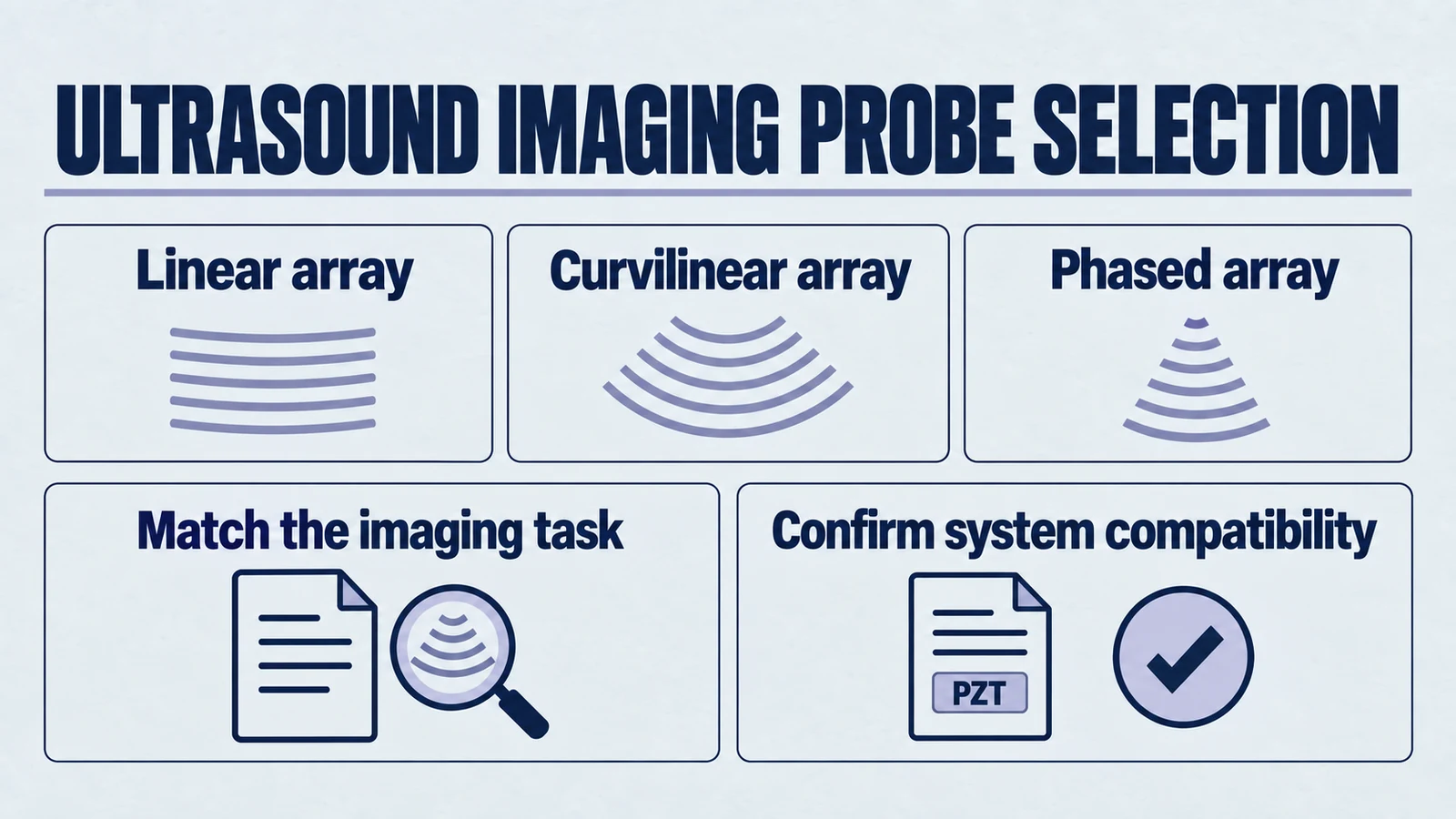
Medical ultrasonic transducers are the core components in diagnostic ultrasound imaging systems, converting electrical energy into high-frequency sound waves and receiving the echoes reflected from tissues to create images. Choosing the right medical ultrasonic transducer is critical for imaging clarity, diagnostic accuracy, and workflow efficiency in finished-device settings.
Understanding Medical Ultrasonic Transducers
A medical ultrasonic transducer typically consists of piezoelectric elements, matching layers, backing material, and housing. When driven by an electrical signal, the piezoelectric element vibrates, producing ultrasonic waves that penetrate the body. The reflected waves are captured by the same or another transducer, converting them back into electrical signals for image processing.
Different imaging applications require different transducer characteristics:
Product path for this search intent
Match the article topic to the right YJ Piezo product page
Use this article as an application note that connects piezoelectric material behavior, transducer design, and OEM sourcing decisions. For "Medical Ultrasonic Transducers for Imaging: How to Choose the Right One", the practical value is in turning the topic into a measurable selection or sourcing decision.
- Piezoelectric Ceramics
PZT shapes, materials, and custom manufacturing
- PZT Material Hub
Material property tradeoffs and grade selection
- Ultrasonic Transducer Supplier Hub
OEM transducer development and sourcing
- Frequency Range: Higher frequencies (7-15 MHz) provide better resolution but lower penetration, ideal for superficial structures such as thyroid or musculoskeletal imaging. Lower frequencies (2-5 MHz) offer deeper penetration for abdominal or cardiac imaging.
- Footprint: The size and shape of the transducer affect the field of view and accessibility to specific anatomical regions. Linear probes are suited for vascular and musculoskeletal imaging, while curvilinear and phased array probes are used for abdominal and cardiac imaging, respectively.
Types of Ultrasound Imaging Transducers
1. Linear Array Transducers
- Frequency: 5-15 MHz
- Applications: Vascular, small parts, musculoskeletal, and superficial imaging.
- Advantages: High resolution with a wide near-field view.
2. Curvilinear Array Transducers
- Frequency: 2-7 MHz
- Applications: Abdominal, obstetric, and gynecological imaging.
- Advantages: Wider field of view for deeper structures.
3. Phased Array Transducers
- Frequency: 1.5-5 MHz
- Applications: Cardiac and transcranial imaging.
- Advantages: Small footprint for imaging between ribs with high frame rates.
4. Endocavitary Transducers
- Frequency: 5-9 MHz
- Applications: Transvaginal and transrectal imaging.
- Advantages: Close proximity to target structures for high-resolution imaging.
Key Factors to Consider When Choosing a Medical Ultrasonic Transducer
1. Imaging Application Requirements
Identify your device use cases to determine the frequency and type of probe needed for optimal resolution and penetration depth. Consider our range of high-frequency transducers for superficial imaging applications.
2. Transducer Compatibility
Ensure the ultrasound imaging transducer is compatible with your ultrasound system, including connector type, software support, and image processing capabilities.
3. Ergonomics and Weight
Lightweight and ergonomic designs reduce sonographer fatigue during extended procedures. Our piezoelectric ring elements contribute to compact transducer designs.
4. Durability and Waterproofing
Use contact- and application-specific manufacturer-approved cleaning, disinfection or sterilization methods and cycle limits. Not every probe tolerates sterilization; an IP rating does not establish chemical or reprocessing compatibility.
5. Cost and Maintenance
High-frequency probes are typically more expensive. Consider the total cost of ownership, including maintenance, cable replacement, and warranty support.
Emerging Trends in Medical Ultrasonic Transducers
- Single-Crystal Technology: Improves bandwidth and sensitivity for clearer images.
- Matrix Array Transducers: Provide 3D and 4D imaging capabilities for advanced diagnostic applications.
- Wireless Transducers: Enable point-of-care imaging with greater flexibility.
- Elastography-Capable Probes: Facilitate tissue stiffness measurement for oncology and liver diagnostics.
Why Choosing the Right Transducer Matters
Selecting the appropriate medical ultrasonic transducer directly impacts diagnostic confidence and diagnostic workflow quality. Using the wrong transducer may lead to suboptimal imaging, missed diagnoses, and increased procedure times.
At Yujie, we specialize in high-performance piezoelectric elements and transducers that support OEM customization for ultrasound imaging transducers, ensuring the right balance between resolution, penetration, and system compatibility for your imaging needs. Our piezoelectric tubes and disc elements are commonly used in medical transducer applications.
Ready to Find the Right Medical Ultrasonic Transducer for Your System?
Contact us today to discuss your ultrasound imaging transducer requirements, or explore our range of piezoelectric ceramics and transducer components that help you achieve clear, reliable imaging for every finished-device application.
Engineering decision notes
Piezoelectric application engineering
Use this article as an application note that connects piezoelectric material behavior, transducer design, and OEM sourcing decisions. For "Medical Ultrasonic Transducers for Imaging: How to Choose the Right One", the practical value is in turning the topic into a measurable selection or sourcing decision.
YJ Piezo reviews piezoelectric projects from material, geometry, electrode, assembly, and outgoing inspection together so the final part fits the real operating condition.
Selection checks
- Clarify whether the design is primarily sensing, actuation, power ultrasonics, atomization, or acoustic measurement.
- Connect the article topic to geometry, material grade, tolerance, operating field, and validation method.
- Define which measurements matter before comparing suppliers: resonance, impedance, capacitance, d33, Qm, or acoustic output.
Failure risks
- A component can meet a simple datasheet value and still fail after bonding, clamping, heat, or acoustic loading.
- Generic material selection can create drift, heating, weak output, or unstable resonance.
- Insufficient RFQ detail forces suppliers to quote assumptions instead of the real engineering requirement.
RFQ details
- What is the operating mode and target application?
- Which electrical, mechanical, and environmental limits must be controlled?
- What sample evidence or outgoing reports are needed before production approval?
Relevant YJ Piezo pages
- Piezoelectric Ceramics
PZT shapes, materials, and custom manufacturing
- PZT Material Hub
Material property tradeoffs and grade selection
- Ultrasonic Transducer Supplier Hub
OEM transducer development and sourcing
Application FAQ
- What extra detail makes a piezoelectric article more useful for engineers?
- Useful detail connects the topic to material choice, geometry, operating load, measurable acceptance criteria, and supplier evidence. That helps readers move from background knowledge to a sourcing or design decision.
- What information should I send YJ Piezo for application guidance?
- Send the application, target dimensions, frequency or sensitivity target, operating medium, duty cycle, temperature range, expected quantity, and any current test data or failure symptoms.