
Technical Guide to Industrial Precision: The Yujie Piezo MU30 Ultrasonic Distance Sensor
Chapter 1: The Strategic Imperative of Non-Contact Sensing in Industry 4.0
In the modern industrial landscape, the convergence of physical manufacturing and digital intelligence—often termed Industry 4.0—has fundamentally altered the requirements for sensor technology. No longer are sensors merely passive devices that trigger simple relays; they are the sensory organs of the autonomous factory, providing the critical data streams that drive predictive maintenance, process optimization, and logistical efficiency. Among the myriad sensing modalities available to the automation engineer, ultrasonic technology has emerged as a cornerstone solution, offering a unique balance of versatility, robustness, and cost-effectiveness. Specifically, the M30 cylindrical form factor, represented by the Yujie Piezo MU30 Ultrasonic Distance Sensor, has become the industry workhorse for reliable non-contact measurement.
The shift toward non-contact sensing is not merely a trend but a strategic necessity. Traditional contact-based methods—such as float switches in tanks or mechanical limit switches on conveyors—are inherently prone to wear, mechanical fatigue, and contamination. In contrast, ultrasonic sensors utilize sound waves to interrogate the environment, eliminating physical contact with the target medium. This capability is paramount when dealing with corrosive chemicals, viscous fluids, or hygienic food products where contamination is a critical risk.
Yujie Piezo Technology, established in 1996, supports industrial acoustic sensing through vertical integration. Unlike many sensor suppliers who function primarily as assemblers of third-party components, Yujie controls key parts of the manufacturing value chain—from the formulation of the piezoelectric ceramic powder to the calibration of sensor modules. The MU30 sensor reflects this material and process experience, designed to meet demanding industrial applications while providing the customized flexibility that modern integrators require.
Product path for this search intent
Match the article topic to the right YJ Piezo product page
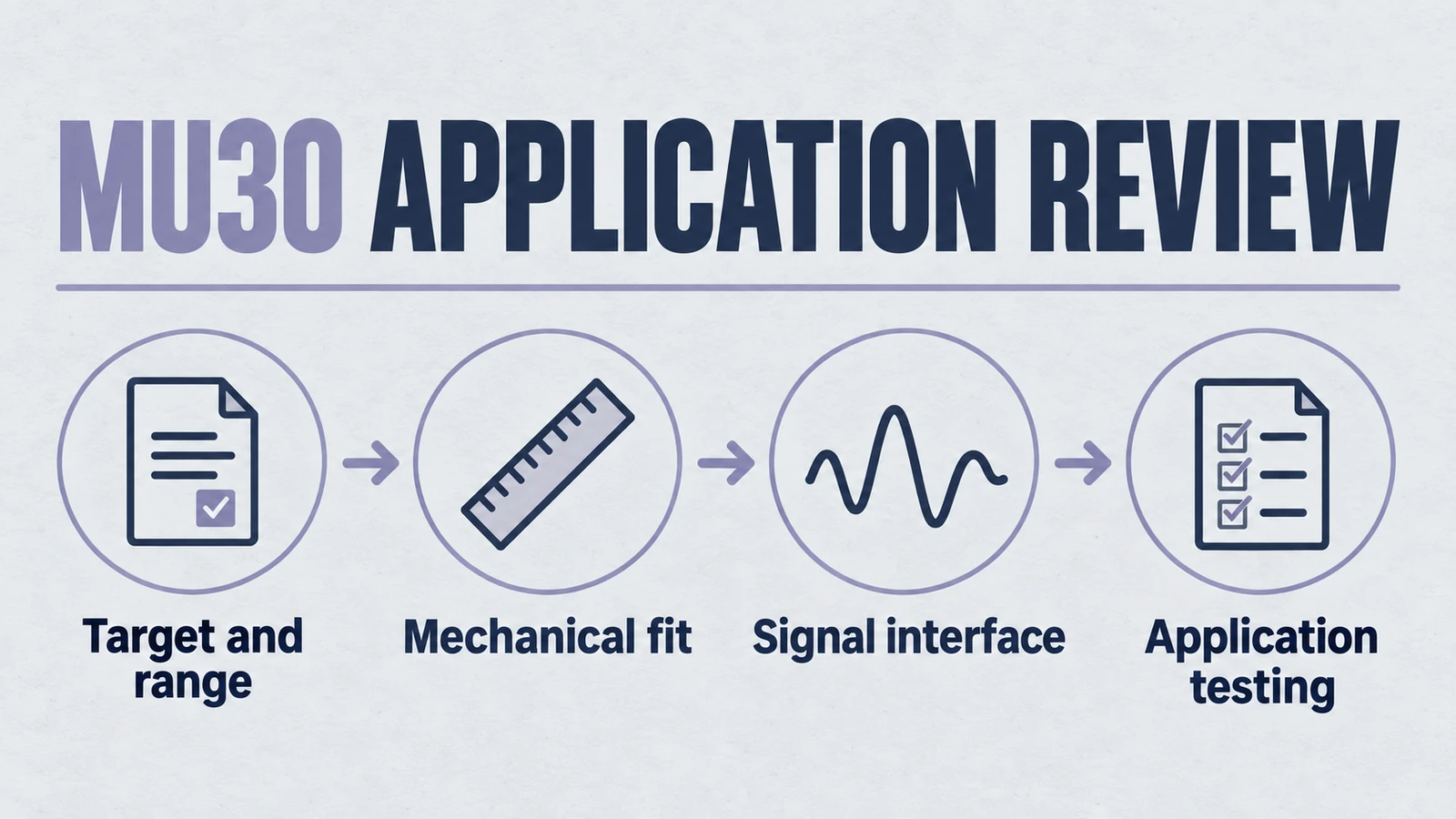
Use this article when sensor performance depends on target distance, beam angle, housing material, liquid behavior, or false echo control. For "Technical Guide to Industrial Precision: The Yujie Piezo MU30 Ultrasonic Distance Sensor", the practical value is in turning the topic into a measurable selection or sourcing decision.
- Ultrasonic Sensors
Distance, level, and detection sensor portfolio
- Flow Measurement Transducers
Bubble and flow-related ultrasonic sensing paths
- Air Acoustic Transducers
Air-coupled transducers for range and presence detection
This guide serves as both a technical manual and a strategic reference for engineers, procurement officers, and system integrators. It explores the physics behind the MU30, compares it with optical and radar technologies, and details applications across sectors ranging from wastewater treatment to factory automation.
Chapter 2: Yujie Piezo Technology – A Legacy of Acoustic Excellence
To understand the MU30 sensor, it helps to start from the engineering experience behind it. YUJIE TECHNOLOGY supports product development through its Shenzhen office and manufacturing operations in Wuxi, with experience in piezoelectric ceramics dating to the mid-1990s.
2.1 The Value of Vertical Integration
In the sensor industry, the quality of the transducer—the component that actually generates and receives sound—is the single most critical determinant of performance. Many "manufacturers" in the automation space are actually integrators; they purchase standard piezoelectric discs from external vendors and house them in plastic shells. This approach often leads to "batch variance," where slight differences in the ceramic formulation from the vendor cause inconsistencies in sensor range, sensitivity, and temperature stability.
Yujie Piezo operates differently. The company possesses an in-house capability to manufacture piezoelectric ceramic components, including the specialized PZT (Lead Zirconate Titanate) materials used in the MU30. This vertical integration provides several strategic advantages:
- Material Optimization: Yujie's material scientists can tailor the grain size, porosity, and chemical composition of the ceramic to maximize specific electromechanical coupling coefficients. For the MU30, this means the ceramic can be engineered specifically for high-power transmission (to punch through dust) or high-sensitivity reception (to detect soft targets like foam).
- Acoustic Impedance Matching: The interface between the hard ceramic and the soft air is a critical choke point for sound energy. Yujie engineers design custom matching layers that bridge this impedance gap perfectly for their specific ceramic formulations. This proprietary matching technology minimizes signal loss and extends the effective range of the sensor beyond what generic components can achieve.
- Rapid Prototyping and Customization: Because Yujie controls the core technology, they can offer ODM (Original Design Manufacturer) and OEM services that go beyond cosmetic changes. If a client needs a sensor with a non-standard frequency to avoid interference with a specific machine, Yujie can alter the piezo ceramic geometry guide to resonate at that exact frequency—a feat impossible for assemblers.
2.2 Global Manufacturing Standards
Yujie's manufacturing operations in Wuxi support ultrasonic sensor production, with process controls and inspection plans reviewed for the product and project. Environmental or durability testing such as thermal cycling, humidity exposure, or vibration can be discussed when required, while available capacity is confirmed against the selected design and forecast.
Chapter 3: The Physics of Precision – How the MU30 Works
The MU30 Ultrasonic Distance Sensor operates on principles of acoustics that, while grounded in basic physics, require sophisticated engineering to implement effectively in industrial settings.
3.1 The Piezoelectric Effect
At the heart of the MU30 is a piezoelectric transducer. The term "piezo" is derived from the Greek word for "press." In these materials, mechanical pressure generates an electrical charge (the direct piezoelectric effect), and conversely, an applied electrical voltage causes mechanical deformation (the converse piezoelectric effect).
When the MU30 initiates a measurement, the internal microcontroller sends a burst of high-frequency electrical pulses (typically centered around 40kHz to 200kHz, depending on the range model) to the PZT ceramic disc. The ceramic expands and contracts at this frequency, acting like a piston to compress and rarefy the air molecules in front of it. This generates a longitudinal sound wave that propagates outward in a conical beam pattern.
3.2 Time-of-Flight (ToF) Measurement
The core sensing logic of the MU30 is the Time-of-Flight (ToF) calculation. Once the pulse is emitted, the sensor switches to "listen" mode. The sound wave travels through the air, hits the target object (liquid surface, box, machine part), and reflects back as an echo. When the echo strikes the transducer face, it vibrates the ceramic, generating a small voltage spike.
The distance D is calculated using the formula:
Where:
- Δt is the time elapsed between transmission and reception.
- c is the speed of sound in the medium (air).
- The division by 2 accounts for the round-trip travel of the pulse.
3.3 The Crucial Role of Temperature Compensation
The speed of sound in air is not a constant; it is heavily dependent on temperature. At 0°C, sound travels at approximately 331.3 m/s. At 40°C, it speeds up to 354.7 m/s. Without compensation, a temperature shift of just 10°C would introduce a measurement error of nearly 2%, which is unacceptable for precision tank gauging.
The Yujie MU30 integrates a high-precision thermistor (temperature sensor) embedded within the sensor housing near the transducer face. This sensor continuously monitors the ambient air temperature and feeds this data to the microprocessor. The sensor's firmware dynamically adjusts the value of c in the ToF equation, ensuring that the distance reading remains accurate even as the day heats up or the facility cools down at night. This feature, known as Automatic Temperature Compensation (ATC), is a defining characteristic of industrial-grade sensors compared to hobbyist modules.
3.4 Beam Patterns and the Physics of Detection
Unlike a laser, which emits a collimated point of light, an ultrasonic sensor emits a sound cone. The MU30 typically features a beam angle of approximately 8° to 12°.
- The Advantage of the Cone: This spreading beam allows the MU30 to detect objects that are not perfectly aligned with the sensor. It can detect the surface of a liquid that is rippling, or a wire mesh that has gaps. It effectively integrates the reflection over a small area, providing a stable reading where a laser might pass through a gap or be deflected by a facet.
- The Blind Zone: Every piezoelectric sensor has a minimum sensing distance, known as the "dead band" or "blind zone" (e.g., 200mm for the MU30). This is a physical limitation caused by the "ringing" of the ceramic. After the transmit pulse is cut off, the ceramic continues to vibrate for a few milliseconds due to its inertia. During this time, it cannot detect an incoming echo. Yujie engineers use advanced damping backing materials to absorb this excess energy quickly, reducing the blind zone to the absolute minimum physics will allow, thereby enabling the sensor to be mounted closer to the application.
Chapter 4: Architecture of the MU30 – Built for the Industrial Environment
The "M30" designation refers to the sensor's housing standard—a threaded cylinder with a 30mm diameter. This standardization is crucial for ensuring the MU30 can be easily retrofitted into existing mounting brackets across global facilities. However, the internal architecture reveals the specific quality of the Yujie design.
4.1 Housing Materials and Durability
The MU30 is available in robust housing materials designed to withstand physical impact and environmental corrosion.
- Nickel-Plated Brass: The standard housing for general automation. It offers excellent mechanical strength and resistance to oxidation.
- Stainless Steel (AISI 316L): For food and beverage or pharmaceutical applications, Yujie offers stainless steel housings that resist caustic washdowns and meet hygiene standards.
- PVDF/PTFE Face: For applications involving corrosive chemicals (like sulfuric acid fumes), the transducer face—the part exposed to the process—can be protected with a layer of PVDF (Kynar) or PTFE (Teflon). This prevents the chemical vapors from embrittling the matching layer or corroding the ceramic, significantly extending the lifespan of the sensor in harsh chemical environments.
4.2 Ingress Protection (IP) Ratings
Industrial facilities are rarely clean and dry. They are often dusty, humid, or subject to high-pressure cleaning. The MU30 is engineered to meet IP67 standards.
- IP6x (Dust Tight): The first digit 6 addresses dust ingress under the specified enclosure test. It does not establish vacuum-tight or hermetic sealing, or chemical suitability for a particular service.
- IPx7 (Water Immersion): The "7" indicates that the sensor can be submerged in water up to 1 meter deep for 30 minutes without failure. While the MU30 is designed to measure distance through air, this rating ensures it survives accidental flooding of a sump, heavy rain in outdoor tank farms, or direct jet spray during equipment cleaning cycles.
4.3 Output Logic and Connectivity
To integrate seamlessly with the diverse ecosystem of PLCs (Programmable Logic Controllers) and DCS (Distributed Control Systems), the MU30 offers a versatile array of output options.
- Analog Current Loop (4–20 mA): The process signal is analog. Use the documented output wiring, mapping, supply and load limits; regulation holds only within the circuit’s compliance/headroom. In a multi-wire device, signal current need not equal total sensor supply current. Noise tolerance depends on installation.
- Analog Voltage (0-10V): Often used in HVAC systems and simpler automation controllers.
- Discrete Switching (PNP/NPN): The sensor acts as a limit switch. The user "teaches" the sensor a specific distance (e.g., "trigger when water hits 90%"). When the level is reached, the output switches state. This is commonly used for pump control (auto-fill/auto-drain logic) and alarm systems.
- Digital Communication (RS485 / Modbus / IO-Link): Recognizing the trend toward Industry 4.0, advanced versions of the MU30 support digital protocols. This allows the sensor to report not just the distance, but also diagnostic data such as signal strength, internal temperature, and error codes. This data is invaluable for predictive maintenance, allowing operators to clean a dirty sensor face before the measurement fails completely.
Chapter 5: Strategic Comparison – MU30 vs. Competing Technologies
In the sensor selection process, engineers often weigh ultrasonics against other non-contact technologies like optical (laser/IR) and radar. While each has its place, the MU30 offers a distinct set of advantages that make it the optimal choice for a wide "sweet spot" of applications.
5.1 MU30 Ultrasonic vs. Optical (Laser) Sensors
Optical sensors rely on the reflection of light. While they are extremely fast and have a focused beam, they suffer from critical limitations that the MU30 overcomes.
- Color and Reflectivity Independence: Optical sensors struggle with black surfaces (which absorb light) or highly polished, tilted surfaces (which reflect light away like a mirror). The MU30 uses sound, which reflects effectively off almost any hard or liquid surface, regardless of color, texture, or transparency. This makes the MU30 the only choice for detecting clear glass bottles, clear plastic film, or dark black rubber tires.
- Environmental Robustness: In dusty environments (flour mills, woodworking), light beams are scattered by airborne particles, causing false readings. Ultrasonic waves, having a much longer wavelength, can diffract around small dust particles and penetrate the cloud to detect the target. Furthermore, the vibration of the piezoelectric face creates a self-cleaning action that sheds dust accumulation.
5.2 MU30 Ultrasonic vs. Radar (Microwave)
Radar sensors are often marketed as the high-end alternative to ultrasonics. They use electromagnetic waves and are immune to temperature gradients and vapors. However, they come with significant trade-offs.
- Cost-Effectiveness: A high-quality radar sensor can cost 3 to 5 times as much as an M30 ultrasonic sensor. For the vast majority of water, wastewater, and non-volatile chemical applications, the MU30 provides identical performance reliability at a fraction of the cost. This allows for broader instrumentation of a facility within a fixed budget.
- Dead Band and Near-Field Performance: Radar sensors often have larger "dead bands" close to the antenna and can struggle with very short-range measurements (e.g., small dosing tanks). The MU30 is often superior for ranges under 2 meters, providing high resolution in compact spaces.
- Installation Simplicity: Radar often requires complex configuration to filter out tank echoes and manage dielectric constants. The MU30 operates on a simple time-of-flight principle that is intuitive for technicians to install and calibrate without specialized training.
5.3 MU30 Ultrasonic vs. Capacitive and Float Sensors
Non-Contact Advantage: Capacitive sensors and float switches require physical contact with the medium. This exposes them to chemical attack, coating/buildup (e.g., glue or grease sticking to the float), and mechanical jamming. The MU30 sits safely above the liquid, immune to the corrosiveness or stickiness of the product below. This "install and forget" reliability significantly lowers the Total Cost of Ownership (TCO).
Table 5.1: Technology Comparison Matrix
| Feature | Yujie MU30 Ultrasonic | Optical (Laser/IR) | Radar (Guided Wave) | Mechanical Float |
|---|---|---|---|---|
| Detection Principle | Sound Waves (Acoustic) | Light Waves (Optical) | Microwaves (EM) | Physical Buoyancy |
| Non-Contact | Yes | Yes | No (Guided) / Yes (Free) | No |
| Cost | Low / Medium | Medium / High | High | Low |
| Dust/Dirt Immunity | High (Self-cleaning) | Low (Lens fouling) | High | N/A |
| Clear Object Detection | Excellent | Poor (Transparent) | Fair (Low Dielectric) | Excellent |
| Color Independence | Yes | No | Yes | Yes |
| Chemical Resistance | High (PVDF options) | Low (Lens materials) | High | Variable |
| Applications | Liquids, Solids, Clear Film | Positioning, Robotics | Large Silos, Vacuum | Simple Tanks |
Chapter 6: Deep Dive Applications – Where the MU30 Thrives
The versatility of the MU30 allows it to serve as a critical component in diverse industries. By understanding specific use cases, we can better appreciate the sensor's value proposition.
6.1 Water and Wastewater Treatment
The water industry is the largest consumer of ultrasonic sensors.
- Lift Stations and Sumps: Municipal sewage is collected in lift stations where it is pumped to treatment plants. These pits are humid, corrosive, and prone to grease buildup. The MU30 is ideal here because it mounts above the water, avoiding the "ragging" (clogging with debris) that plagues float switches. The IP67 rating protects it from the methane and humidity.
- Open Channel Flow: By measuring the height of water in a weir or flume, the MU30 can be used to calculate flow rate. Its high resolution (1mm) ensures accurate billing and process control for effluent discharge.
- Chemical Dosing: Treatment plants use chemicals like ferric chloride or sodium hypochlorite. These are stored in small day tanks. The MU30, often paired with a chemically resistant face, monitors these levels to ensure continuous supply for the treatment process.
6.2 Chemical Processing and Storage
Managing inventory in chemical plants requires safety and compatibility.
- Corrosive Liquids: For acids, caustics, and solvents, contact sensors fail quickly. The MU30 provides a appropriate distance measurement. For fuming acids that might absorb sound (like high-concentration sulfuric acid), Yujie can advise on specific frequency models or mounting adapters (like stilling wells) that isolate the vapor, maintaining measurement integrity.
- IBC Tote Monitoring: Intermediate Bulk Containers (totes) are moved around plants. The MU30's compact size allows it to be mounted on tote caps for mobile inventory tracking, often connected via wireless IoT nodes.
6.3 Factory Automation and Manufacturing
Beyond liquids, the MU30 is an essential "eye" for machines.
- Roll Diameter Control (Tensioning): In industries like paper, plastic film, and textiles, materials are wound onto rolls. To maintain constant tension, the motor speed must change as the roll diameter shrinks. The MU30 continuously measures the radius of the roll. Because it uses sound, it works perfectly on clear plastic shrink wrap, which optical sensors cannot see, and black rubber, which absorbs laser light.
- Hopper Level (Injection Molding): Plastic pellets are fed into injection molding machines from small hoppers. If the hopper runs dry, the machine stops. An MU30 mounted in the lid alerts operators to refill the pellets. The sensor's ability to punch through the dust generated by the pellets makes it superior to photo-eyes.
- Box Sorting and Palletizing: Logistics centers use the MU30 to measure the height of boxes on a conveyor to sort them or to control the stacking height of robotic palletizers. The sensor's wide beam can detect a box even if it is slightly skewed on the belt.
6.4 Agricultural Technology (AgTech)
- Grain and Feed Silos: Farmers use the MU30 to monitor feed levels in poultry and swine houses. Automating this process ensures animals are always fed and reduces the labor of manually climbing silos. The acoustic vibration helps keep the sensor face clean of feed dust.
- Spray Booms: On crop sprayers, MU30 sensors point downwards to measure the distance to the crop canopy. This allows the boom to automatically adjust its height, maintaining optimal spray coverage while preventing the boom from hitting the ground on uneven terrain.
Chapter 7: Installation, Calibration, and Troubleshooting Guide
A successful sensor deployment depends as much on installation as on the hardware itself. This guide ensures users get the most out of their MU30.
7.1 Mounting Best Practices
- Perpendicular Alignment: The sensor must be mounted at a 90° angle to the target surface. If angled, the echo will bounce away, resulting in signal loss.
- Clearance: The sound beam spreads. Ensure there are no obstructions (ladders, agitators, pumps) within the beam cone. For an 8° beam, an idealized 8° full-angle cone has a radius of about 7 cm and a diameter of about 14 cm at 1 m. Actual detection boundaries depend on target and threshold; use measured curves.
- Stilling Wells: In turbulent liquids or tanks with heavy foam, install the sensor in a vented PVC pipe (stilling well). This creates a calm surface for the sensor to read and blocks out foam and sludge.
7.2 Wiring and Electrical Noise
- Shielded Cables: Always use shielded twisted-pair cables for the 4-20mA signal, especially in plants with Variable Frequency Drives (VFDs) which generate heavy electrical noise. Ground the shield at the panel side only.
- Power Supply: Ensure a clean 12-24V DC power supply. Unstable voltage can cause measurement drift.
7.3 Managing Environmental Factors
- Sun Shields: If mounted outdoors, use a sun shield. Direct sunlight heating the sensor housing can cause the internal temperature sensor to read higher than the actual air temperature, throwing off the compensation logic.
- Condensation: Mount the sensor slightly recessed or use a face heater option if available to prevent water droplets from forming on the transducer face, which can block the acoustic signal.
7.4 Troubleshooting Common Issues
- Symptom: Reading stuck at maximum.
- Cause: No echo received.
- Fix: Check alignment. Is the liquid level too low? Is there heavy foam absorbing the sound?
- Symptom: Reading stuck at minimum.
- Cause: Obstruction in the blind zone or sensor face is dirty.
- Fix: Clean the face. Ensure the sensor is mounted high enough (using a nozzle) so the liquid never enters the blind zone.
- Symptom: Fluctuating output.
- Cause: Turbulence or electrical noise.
- Fix: Increase the "damping" or "averaging" filter in the sensor settings. Check cable shielding.
Chapter 8: Future Trends – The Smart Sensor Revolution
The MU30 is evolving. As Industry 4.0 matures, Yujie is leading the integration of "smart" features into the ultrasonic platform.
- IO-Link Integration: This protocol allows the sensor to communicate bi-directionally. It can tell the controller, "My signal is getting weak, I might be dirty," enabling predictive maintenance. It also allows for remote parameterization, so engineers can change range settings without climbing a tank.
- Wireless IIoT: Combining the low-power consumption of Yujie's piezo elements with LoRaWAN or NB-IoT radios allows for battery-powered remote monitoring of distant assets, such as river levels or agricultural reservoirs, sending data directly to the cloud.
Conclusion
The Yujie Piezo MU30 Ultrasonic Distance Sensor represents the synthesis of deep material science and practical industrial engineering. It is not merely a component; it is a solution to the fundamental challenge of perception in the automated world. By offering a non-contact, robust, and cost-effective means of measuring the physical environment, the MU30 empowers industries to operate more efficiently, safely, and intelligently.
For the automation engineer, it provides reliability where optical sensors fail. For the procurement manager, Yujie's factory-direct model offers a competitive commercial edge. And for the plant manager, it offers peace of mind. As we move further into the era of automation, Yujie Piezo stands ready to provide the acoustic foundation upon which the factories of the future are built.
Ready to integrate precision sensing into your application?
Contact Our Engineering Team →
Related Resources
Engineering decision notes
Ultrasonic sensing and detection
Use this article when sensor performance depends on target distance, beam angle, housing material, liquid behavior, or false echo control. For "Technical Guide to Industrial Precision: The Yujie Piezo MU30 Ultrasonic Distance Sensor", the practical value is in turning the topic into a measurable selection or sourcing decision.
YJ Piezo treats ultrasonic sensing as an acoustic interface problem: transducer frequency, beam shape, housing, drive electronics, and target environment are reviewed together.
Selection checks
- Define target range, dead zone, beam angle, and mounting geometry before choosing the sensor family.
- Check the medium, target surface, temperature swing, foam, vapor, and side-wall risk.
- Separate detection repeatability from ideal lab accuracy when the sensor will operate in a tank, tube, or moving line.
Failure risks
- A sensor can pass bench distance tests and still fail in tanks with foam, agitation, vapor, or narrow geometry.
- Changing only frequency without reviewing beam angle and mounting can increase false echoes.
- Ignoring housing material or sealing requirements can shorten lifetime in washdown or chemical environments.
RFQ details
- What is the minimum and maximum detection distance?
- Is the target liquid, solid, sheet material, air flow, or a moving object?
- What temperature, humidity, IP rating, and output signal does the system require?
Relevant YJ Piezo pages
- Ultrasonic Sensors
Distance, level, and detection sensor portfolio
- Flow Measurement Transducers
Bubble and flow-related ultrasonic sensing paths
- Air Acoustic Transducers
Air-coupled transducers for range and presence detection
Application FAQ
- What makes an ultrasonic sensor page useful for procurement?
- It should connect range, beam angle, output signal, housing, mounting, and environmental limits to a concrete use case. A model name alone is not enough for reliable supplier comparison.
- Which information speeds up an ultrasonic sensor RFQ?
- Send the target material, distance range, installation geometry, output interface, temperature range, IP rating, and whether the application involves foam, vapor, liquid, or moving objects.