
Open vs Closed Ultrasonic Sensors in CIP Environments
1. What CIP Really Does to an Ultrasonic Sensor
Clean-in-place (CIP) is not “just hot water.” In most plants it is a repeating sequence of thermal shocks, chemical exposure, pressure transients, and high-shear flow. The sensor is not merely splashed. It is repeatedly subjected to:
- Alkaline and acidic chemistries (often alternating). These attack polymers, adhesives, and marginal seals.
- Elevated temperatures. Heat accelerates diffusion through seals and speeds hydrolysis in susceptible materials.
- Pressure cycling and water hammer. Short spikes exploit micro-leaks and fatigue thin windows.
- Aerosol and impingement washdown. Impact jets test gaskets, face seals, and cable glands.
- Foam and entrained air. These change acoustic loading and can collapse signal-to-noise during parts of the cycle.
If you want a sensor architecture that survives, you need to think like a failure analyst. CIP is a reliability test that runs every day.
Product path for this search intent
Match the article topic to the right YJ Piezo product page
Use this article when the risk is supplier selection, engineering support, validation evidence, integration reliability, and whether the manufacturer can scale from sample to production. For "Open vs Closed Ultrasonic Sensors in CIP Environments", the practical value is in turning the topic into a measurable selection or sourcing decision.
- Ultrasonic Transducer Supplier Hub
OEM sourcing and engineering collaboration
- PZT Material Supplier Hub
Material control and grade selection
- Piezoelectric Ceramics
Ceramic manufacturing and custom shapes
1.1 Why “works in production” can still fail in CIP
Many ultrasonic sensors perform well during steady-state production and then fail during cleaning. That is not a contradiction. Cleaning introduces conditions that are rarely present during production.
- Chemistry reversals. Alkaline removes organics. Acid removes scale. Alternation is effective for hygiene and brutal on marginal materials.
- Thermal cycling. Warm-up, hot hold, cool-down. Repeated differential expansion opens pathways along interfaces.
- Mechanical shear. Jets and turbulent return flow apply intermittent forces to faces and seals.
A practical implication. You should evaluate a sensor by how its measurement behaves across the entire CIP sequence. Not by its best-case signal when clean.
2. Two Architectures. Two Very Different Risk Profiles
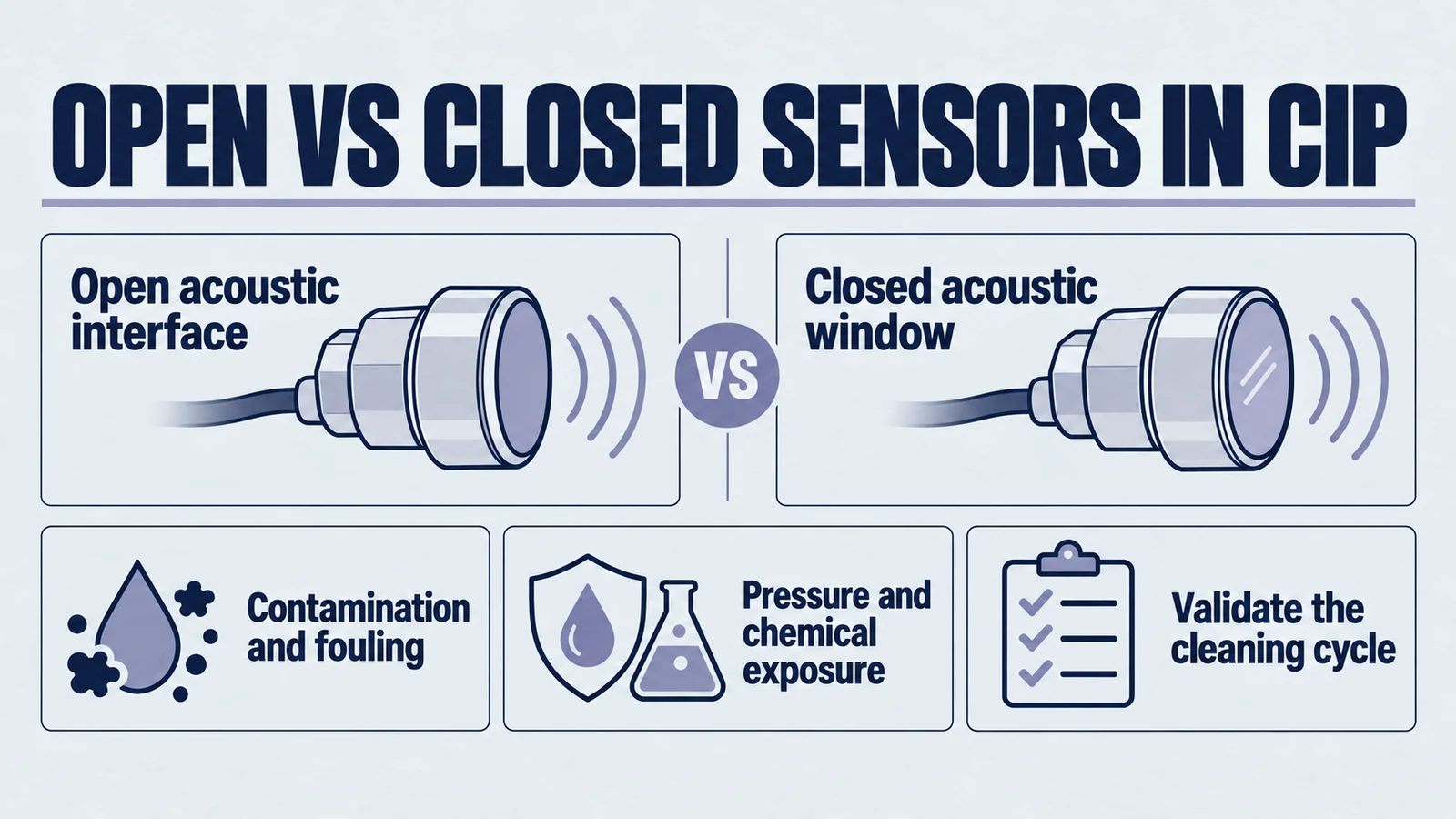
In CIP environments, “open” and “closed” ultrasonic sensors are not simply packaging variants. They are different failure philosophies.
Open-type (exposed acoustic interface)
The transducer or its acoustic interface is exposed to the process environment. This is common in distance or level sensing where you want direct acoustic coupling into air, foam, vapor, or liquid headspace.
Strength: Minimal acoustic layers. Often strong signal when clean.
Weakness: The acoustic path is vulnerable to contamination and chemistry. Small surface changes become measurement changes.
Closed-type (sealed behind an acoustic window)
The transducer stack is isolated from the process by a sealed acoustic window. This may be a thin metal diaphragm, a polymer window, a bonded composite, or a stainless face with an internal couplant.
Strength: The piezo stack and wiring can be protected. Hygienic geometry is easier to control.
Weakness: The window becomes the “single point of truth.” If the window fouls, chemically roughens, delaminates, or micro-cracks, you lose performance or you get water ingress.
A practical way to frame it.
- Open-type failures tend to be “front-end acoustic losses.”
- Closed-type failures tend to be “seal integrity and window physics.”
2.1 Hygienic compliance is geometry plus interfaces
In hygienic plants, the key question is not “open or closed.” It is “does the installed assembly eliminate trap points.” A sensor can be closed and still be non-hygienic if it creates a micro-gap, step change, or un-drainable pocket.
3. Acoustic Window Contamination. The Problem You Cannot Calibrate Away
3.1 Open-type contamination. What builds up and why it matters
In food and beverage plants, contamination is not a rare event. It is the default.
Common deposits include:
- Protein films (dairy, brewing). Tenacious layers that survive partial wash.
- Sugars and syrups. Hygroscopic residues that re-wet and re-dry.
- Fatty or oily films. Reduce wetting uniformity and trap particulates.
- Mineral scale. Hard deposits that resist short CIP cycles.
- Biofilm initiation layers. Early-stage films that change surface energy before they become visible.
An ultrasonic sensor relies on predictable boundary conditions at its face. When you add an uncontrolled layer, you introduce:
- Extra attenuation. Especially if the layer is lossy, porous, or bubbly.
- Phase distortion. A thin film can behave like an impedance transformer.
- Scattering. Roughness or bubbles trapped in residue break coherence.
The key point. A few tens of microns of residue can matter because ultrasonic wavelengths in many industrial sensor bands are on the order of millimeters to sub-millimeters. When the boundary condition shifts, the transducer “sees” a different load. That changes its effective , its ring-down duration, and its time-pickoff stability.
3.2 Closed-type window contamination. When “sealed” still fouls
A closed face is not immune. It just moves the battleground to the window.
- If the window is hydrophilic under CIP, it may hold a continuous film. That can be good for repeatability or bad due to extra damping.
- If it is hydrophobic, it may break into droplets. Droplets create scattering and unstable echoes.
- If product dries on the window between cycles, you get a repeating pattern. Good signal immediately after CIP. Degraded signal during production. Partial recovery after the next wash.
What engineers often underestimate. Closed sensors can have a more repeatable failure progression. A window gradually fouls or chemically roughens, and you see a steady drift in SNR and timing stability across weeks.
3.3 Condensation and flash cooling. A hidden “third contaminant”
In many plants, cold rinse follows hot caustic. That creates condensation on faces that are now cooler than the surrounding vapor. Condensation is not just water. It is a changing, uneven acoustic layer that comes and goes with airflow and temperature.
If your measurement becomes noisy only in the minutes after a phase change, suspect condensation dynamics before suspect electronics.
4. Pressure and Chemical Exposure. The Real Enemies are Interfaces
4.1 Open-type chemical risks
When the acoustic face is exposed, you are betting that:
- The front layer material is chemically compatible.
- Any potting or adhesive at the perimeter will not degrade.
- The wiring entry will remain sealed under thermal cycling.
- The surface finish will remain stable and not chalk or craze.
Failure typically begins at interfaces. Think: front coatings, bond lines, gaskets, and cable exits.
Common open-type CIP failure mechanisms include:
- Hydrolysis of susceptible polymers leading to softening and swelling.
- Chemical attack on adhesives causing edge lift or micro-gaps.
- Crevice formation at the face perimeter. Crevices become residue traps and corrosion initiators.
- Stress cracking from combined heat and chemistry in certain plastics and coatings.
4.2 Closed-type pressure and seal risks
Closed sensors accept a different bargain. The process can push hard on the window.
- If the window is a thin diaphragm, it flexes under pressure. Flexing can change acoustic behavior and fatigue the bond line.
- If the window is bonded, bond-line integrity becomes critical. Temperature swings create differential expansion. Over time, that can produce micro-delamination.
- Water hammer and fast valve closures can create short spikes. Those spikes are great at turning a “barely acceptable” seal into an ingress path.
A blunt rule. If you cannot confidently describe how the window is sealed and what the bond line is made of, assume it will fail eventually.
4.3 Material compatibility is not a checkbox
A sensor can be rated for “washdown” and still fail in your CIP recipe. Alkaline concentration, temperature, and dwell time interact. Acids can be oxidizing or non-oxidizing. Even water quality matters.
A pragmatic approach is to request and document.
- The wetted face material (for example 316L stainless, PEEK, PTFE, ceramics).
- The seal materials (for example EPDM, FKM, silicone, PTFE encapsulated elastomers).
- Any adhesive, couplant, or potting in the product zone.
If you cannot get that information, you are not selecting a sensor. You are accepting a future maintenance surprise.
5. Signal Degradation During Cleaning Cycles. How It Shows Up in Data
CIP cycles create a special kind of measurement problem. The sensor must survive the chemistry and also avoid creating control noise.
5.1 Open-type during CIP
Typical patterns:
- Sudden SNR drop at the start of alkaline wash. Often driven by wetting changes, foam, and aerosol.
- Unstable time-of-flight while jets impinge or turbulence increases.
- Apparent distance jumps when droplets form on the face.
- Short-term false echoes when bubbles or spray create transient reflectors.
Many engineers respond by filtering. Filtering helps, but it can also hide an early failure trend. If you filter away variance, you may miss the slow degradation that predicts failure.
5.2 Closed-type during CIP
Typical patterns:
- More stable output during spray if the face stays continuously wetted.
- A repeatable offset during hot phase due to temperature-driven speed-of-sound changes in the near-field gas or liquid film.
- Gradual loss of amplitude over many cycles if the window roughens or the bond line begins to delaminate.
- Ring-down lengthening as the effective load changes. This can reduce near-field resolution.
The important comparison. Open-type often has high variance during the cycle. Closed-type often has lower variance but more systematic drift over lifetime.
5.3 Temperature effects. Drift you should expect, and drift you should not
Even in ideal conditions, ultrasound depends on the speed of sound. In gases and liquids, speed of sound changes with temperature. Your sensor may compensate. Your installation may not.
A simple engineering reminder. If your measurement drift is tightly correlated to temperature and repeats every CIP, it may be physics. If the drift grows over weeks, it is more likely degradation.
6. Failure Patterns Observed in Real Plants. What Usually Breaks First
Below are failure patterns that show up repeatedly in CIP-heavy sites. They are not hypothetical “lab failures.” They are the boring, expensive failures that maintenance teams recognize.
6.1 Open-type. Common plant failures
- Front-face film that never fully cleans
The sensor works after CIP for a while, then progressively degrades in production. Operators start ignoring it. - Edge lift and crevice fouling
A perimeter gap forms. Residue accumulates. Cleaning jets cannot remove it. Signal quality becomes cycle-dependent. - Cable entry ingress
Not dramatic at first. You see intermittent behavior after washdowns. Eventually it becomes permanent failure. - Chemical whitening or surface roughening
Even without leakage, the acoustic interface becomes lossy. SNR slowly collapses. - Intermittent failures tied to phase changes
Works fine in production. Fails only during hot rinse or the first minutes after cold rinse. Condensation and thermal shock are usual suspects.
6.2 Closed-type. Common plant failures
- Window bond-line delamination
Starts as subtle amplitude reduction and longer ring-down. Then the sensor becomes temperature sensitive. Eventually it fails or becomes untrustworthy. - Micro-cracks in thin diaphragms
Often driven by pressure spikes and repeated flexing. Micro-cracks can propagate, then ingress follows. - Seal creep under thermal cycling
Gaskets and elastomers relax over time. After enough cycles, sealing force falls below what is needed. - Window surface chemistry change
The face becomes more prone to droplet formation or retains product film. Measurements become less repeatable even though the internal transducer remains healthy. - Internal condensation in imperfectly sealed assemblies
Even small ingress can produce intermittent behavior long before severe failure. The symptom is often “works after drying.”
If you take nothing else from this section. Closed-type failures are often structural. Open-type failures are often surface and interface. Both can be managed, but the mitigation strategies differ.
7. Hygienic Design Constraints. What Matters More Than Sensitivity
In hygienic plants, the sensor is part of the cleaning system. It must not create a cleaning blind spot.
Key hygienic constraints that influence architecture choice:
- Crevice-free front face. Any step, seam, undercut, or exposed bond line becomes a residue trap.
- Drainability. A face that holds droplets creates both measurement issues and hygiene risk.
- Material traceability and compatibility. Stainless grades, polymers, and adhesives must tolerate your exact CIP chemistry.
- Surface finish stability. Roughness increases biofilm attachment. A face that roughens over time is a slow-motion hygienic failure.
- Installation geometry. A perfect sensor can become non-hygienic if installed with a clamp, adapter, or gasket that creates a pocket.
This is where closed-type often wins on paper. You can design a clean stainless face, polish it, and remove features.
But it is not automatic. If the window is bonded and the bond line is exposed as a micro-gap, you have created a crevice. Hygienic design is about geometry and interfaces, not about whether something is “sealed” in a brochure.
7.1 Washdown ratings do not equal hygienic suitability
High-pressure washdown ratings can be relevant, but they do not by themselves confirm cleanability. Hygienic design requires that the surface is cleanable and drainable, and that interfaces do not trap soil.
8. Choosing Between Open and Closed. A Practical Engineering Comparison
8.1 When open-type tends to be the pragmatic choice
Choose open-type when:
- You need maximum acoustic coupling and minimal window effects.
- Your product environment is relatively dry, low-fouling, or you can support frequent full cleaning.
- You can physically protect the face from direct high-pressure jets without violating hygiene rules.
- You can tolerate more measurement variance during CIP and handle it in the control logic.
What you must demand:
- A front interface that is chemically compatible with your worst-case CIP recipe.
- A design that avoids perimeter crevices and exposed bond lines.
- A proven cable entry seal and gland design that survives thermal cycling.
- A face finish that remains stable after repeated chemical exposure.
8.2 When closed-type tends to be the safer architecture
Choose closed-type when:
- The process is consistently wet, sticky, or high-fouling.
- You need a truly hygienic, crevice-free stainless face.
- You can accept some window-related acoustic tradeoffs.
- The plant has aggressive washdown and you want to isolate the piezo stack from direct exposure.
What you must demand:
- Clear documentation of window material, thickness concept, and sealing approach.
- Evidence that pressure spikes and thermal cycling were considered.
- A design that keeps bond lines out of the product zone or seals them hygienically.
- A window design that is mechanically robust against repeated flexing and jet impact.
8.3 A realistic decision rule. Choose your dominant risk
If your dominant risk is fouling variability and cycle-to-cycle instability, closed-type often gives you a more controlled boundary condition.
If your dominant risk is window fatigue, delamination, or unknown sealing chemistry, an open-type architecture with a robust exposed interface may be easier to maintain and diagnose.
9. How to Validate in Your Plant. Tests That Actually Predict Survival
A lab bench test at room temperature is not a CIP qualification.
9.1 Validation steps that map to real failure modes
- Run the real CIP recipe (chemistry, temperature, dwell time) on a pilot loop if possible. Do not substitute “hot water plus detergent.”
- Monitor SNR and timing stability per phase. Record behavior at the start and end of each CIP segment.
- Trend over many cycles. Dozens is a start. Hundreds is better if you want to see delamination or seal creep.
- Inspect the face under magnification. Look for roughening, crazing, micro-cracks, edge lift, and seal extrusion.
- Check ingress indicators. Weight change, insulation resistance, intermittent behavior after washdown, or corrosion at cable entry.
- Introduce pressure transients if your plant has water hammer risk. If you cannot, assume you have it.
A practical mindset. You are not proving it works on Day 1. You are estimating the slope of degradation over time.
9.2 A symptom-to-cause table for troubleshooting
| Observed symptom during CIP or washdown | Most likely mechanism | What to check next |
|---|---|---|
| SNR collapses only during spray, then recovers | Droplets, foam, aerosol scattering | Face wetting pattern. Orientation. Shielding. Control logic during CIP |
| Repeatable offset in hot phase every cycle | Temperature physics near the face | Temperature compensation settings. Local vapor conditions. Mounting heat sink behavior |
| Slowly decreasing amplitude over weeks | Window roughening or delamination. Surface degradation | Face inspection. Ring-down trend. Compare to new unit. Look for bond-line changes |
| Intermittent failures after washdown | Early ingress or condensation inside housing | Insulation resistance. Cable gland integrity. Housing venting. Dry-out correlation |
| Measurement becomes more “noisy” after weeks but no obvious leakage | Surface chemistry change. Increased droplet formation | Surface energy changes. Cleaning efficacy. Face finish stability |
9.3 Qualification is also about installation
A sensor can pass all material checks and still fail because of installation details.
- Tri-clamp adapters and reducers can create pockets.
- Over-torqued gaskets can extrude and create crevices.
- A face mounted slightly off-angle can hold droplets and amplify scattering.
Validate the installed assembly, not just the sensor.
10. Bottom Line. Pick Your Failure Mode Intentionally
Open-type and closed-type ultrasonic sensors can both be engineered for CIP environments. The mistake is choosing based on an abstract “IP rating” or the word “hygienic” in a datasheet.
- Open-type is often limited by surface contamination, wetting variability, and exposed interface degradation.
- Closed-type is often limited by window physics, bond-line fatigue, seal creep, and pressure-driven damage.
In hygienic plants, reliability is not a single number. It is the outcome of how the architecture behaves under repeated cleaning cycles. If you choose an architecture, choose it knowing what will fail first, how you will detect it, and how you will replace or maintain it before it becomes a silent source of bad data.
A practical closing test. If you cannot write down the top three likely failure mechanisms for the architecture you chose, you have not completed selection. You have outsourced it to chance.
About the Author: Yujie Piezo Engineering Team focuses on piezoelectric ceramics and transducer elements used in sensing and ultrasonic actuation. This article is written as a failure-oriented engineering reference for hygienic automation teams working in CIP and washdown environments.
Engineering decision notes
OEM integration and supplier qualification
Use this article when the risk is supplier selection, engineering support, validation evidence, integration reliability, and whether the manufacturer can scale from sample to production. For "Open vs Closed Ultrasonic Sensors in CIP Environments", the practical value is in turning the topic into a measurable selection or sourcing decision.
YJ Piezo combines direct project coordination with ceramic manufacturing support, so procurement and engineering teams can evaluate material control, application review, sample validation, and production consistency together.
Selection checks
- Ask whether the supplier controls ceramic manufacturing or only assembles purchased elements.
- Review sample policy, inspection records, engineering response quality, and production lead-time stability.
- Compare suppliers and integration paths by validation evidence, not only by unit price and datasheet similarity.
Failure risks
- A low-price sample can pass early tests but fail when batch variation, thermal load, or assembly stress appears.
- A supplier without material control may not explain why impedance, capacitance, or resonance drift occurs.
- Weak RFQ information leads to quotes that are fast but not technically comparable.
RFQ details
- What application, operating environment, and failure cost should the supplier design around?
- Which sample tests and outgoing records are required before pilot production?
- What customization, MOQ, tooling, and delivery constraints must be known before quotation?
Relevant YJ Piezo pages
- Ultrasonic Transducer Supplier Hub
OEM sourcing and engineering collaboration
- PZT Material Supplier Hub
Material control and grade selection
- Piezoelectric Ceramics
Ceramic manufacturing and custom shapes
Application FAQ
- How should an OEM compare piezoelectric suppliers?
- Compare material control, engineering support, test evidence, customization ability, sample policy, and batch consistency. Unit price matters, but only after the technical risk is understood.
- What makes an RFQ technically useful?
- A useful RFQ includes application, dimensions, target frequency, electrical limits, duty cycle, operating medium, environment, expected quantity, required reports, and current failure or replacement context.