
Piezo vs. Magnetic Ultrasonic Transducers: Comparing Technologies
Quick answer: Piezoelectric ultrasonic transducers are usually smaller, faster, more efficient, and easier to tune across a wide frequency range. Magnetostrictive transducers can be rugged in heavy industrial environments, but they are larger and typically less efficient at higher frequencies.
Use piezoelectric vs ultrasonic transducers for terminology, and PZT ultrasonic transducer selection for material choices.
Ultrasonic transducers are fundamental components in modern sensing and actuation systems, enabling accurate control, measurement, and communication across a wide range of industries. From industrial automation and robotic control to medical imaging, ultrasonic cleaning, and fluid flow monitoring, their roles are diverse and high-reliability. Among the various types available, two dominant technologies have emerged: piezoelectric and magnetostrictive ultrasonic transducers. Each has unique operating principles, strengths, and ideal use cases. In this blog, we'll dive deep into the science behind these technologies, compare their performance characteristics, and explain why piezoelectric transducers often offer a superior solution in many engineering applications.
Understanding the Technologies
What Is a Piezoelectric Ultrasonic Transducer?
Product path for this search intent
Match the article topic to the right YJ Piezo product page
Use this article when the choice is not just a shape, but a material tradeoff between sensitivity, loss, coupling, stability, and operating field. For "Piezo vs. Magnetic Ultrasonic Transducers: Comparing Technologies", the practical value is in turning the topic into a measurable selection or sourcing decision.
- PZT Material Hub
Material grades and application tradeoffs
- Piezoelectric Ceramics
Shapes and ceramic manufacturing options
- PZT Material Supplier Hub
Material control, grade selection, and sourcing support
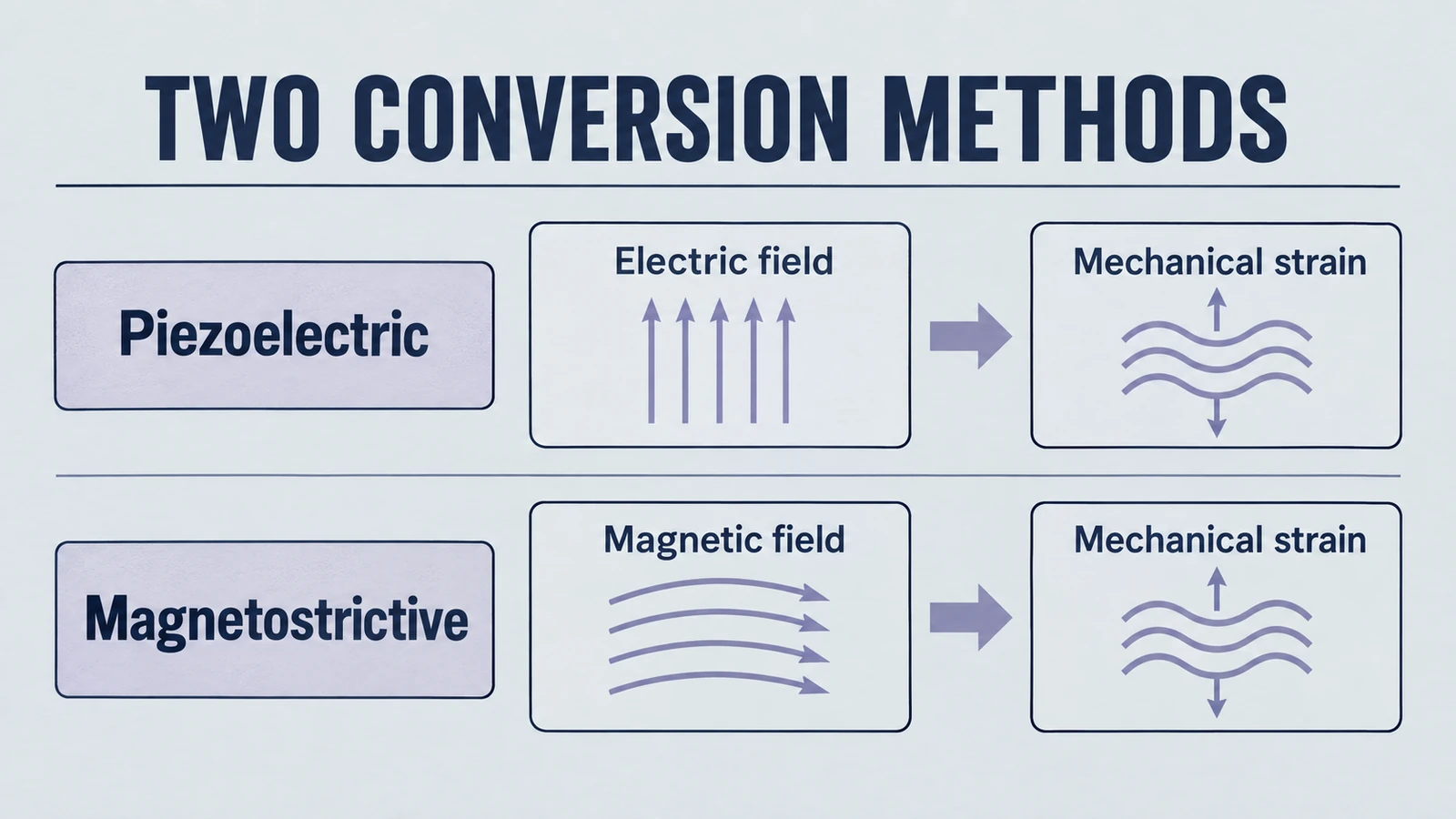
Piezoelectric ultrasonic transducers operate based on the piezoelectric effect—a physical phenomenon where specific materials generate an electrical charge in response to mechanical stress, and conversely, undergo mechanical deformation when exposed to an electric field. These materials, typically ceramics like PZT (lead zirconate titanate), can serve as both transmitters and receivers of ultrasonic waves. This bidirectional conversion is highly efficient and exceptionally responsive, making piezo transducers ideal for applications demanding rapid signal response, high precision, and wide frequency adaptability.
Piezoelectric materials can be manufactured in various shapes and thicknesses, allowing designers to tailor performance characteristics like resonant frequency, displacement amplitude, and directional sensitivity. These advantages have led to their widespread adoption in medical ultrasound devices, automotive sensors, air bubble detectors, flow meters, and more.
What Is a Magnetostrictive Ultrasonic Transducer?
Magnetostrictive transducers, by contrast, rely on the magnetostrictive effect. In this process, materials such as nickel, iron-based alloys, or advanced rare-earth metals like Terfenol-D change shape under the influence of a magnetic field. When an alternating magnetic field is applied, the core material expands and contracts at ultrasonic frequencies, generating mechanical vibrations that propagate as sound waves. These transducers typically include a coil (to create the magnetic field), a magnetostrictive core, and a coupling medium.
Although magnetostrictive devices are robust and capable of high-power output, the conversion process introduces mechanical and magnetic inertia, often resulting in slower response times, lower frequency capabilities, and reduced energy efficiency compared to their piezoelectric counterparts.
Piezo vs Magnetostrictive: Key Differences at a Glance
| Feature | Piezoelectric Transducer | Magnetostrictive Transducer |
|---|---|---|
| Operating Principle | Piezoelectric effect (electric-mechanical) | Magnetostrictive effect (magnetic-mechanical) |
| Material | PZT ceramics or crystals | Nickel, Terfenol-D, or other alloys |
| Frequency Range | Wide (kHz to tens of MHz) | Limited (typically <100 kHz) |
| Response Time | Extremely fast | Moderate to slow |
| Energy Efficiency | High | Moderate to low |
| Size & Form Factor | Compact, customizable | Larger, bulkier due to coils and core material |
| Temperature Stability | Good (customizable via material selection) | Excellent for extreme environments |
| Manufacturing Cost | Lower at volume | Higher due to complexity and material cost |
| Applications | Imaging, diagnostics, sensors, atomizers | Industrial cleaning, welding, sonar systems |
Why Piezoelectric Transducers Often Outperform
Despite the specific strengths of magnetostrictive transducers, piezoelectric ultrasonic transducers are preferred in the majority of sensing and actuation scenarios. Let's break down why:
1. Broader Frequency Response
Piezoelectric transducers are capable of operating from a few kilohertz to several megahertz. This wide frequency range supports both high-resolution imaging (as seen in medical ultrasonography) and fine-grained detection, making them invaluable in advanced diagnostic and control systems.
2. Superior Form Factor and Miniaturization
The inherent structure of piezoelectric ceramics allows them to be manufactured in ultra-thin, compact designs—ideal for modern embedded systems, handheld medical probes, miniaturized fluid control modules, and smart factory sensors.
3. Energy Savings and Performance Stability
With minimal energy lost during conversion, piezoelectric systems excel in energy-limited environments such as wireless devices, battery-powered instruments, and portable detectors. This efficiency leads to less heat generation, greater stability, and prolonged component lifespan.
4. Material Tunability and Engineering Control
Piezo materials can be precisely doped to meet application-specific requirements, such as high Qm for power handling, or high d33 for maximum sensitivity. Engineers have immense flexibility to tailor properties like dielectric constant, mechanical compliance, and resonant frequency.
5. Mature Supply Chain and Economical Production
The global market for piezoelectric ceramics is well-established, enabling economies of scale that drive down costs. This is especially important in mass-produced systems like automotive sensors, consumer electronics, and wearable medical devices.
6. Clean Signal Profiles for Measurement Accuracy
Piezoelectric transducers produce sharper waveforms with reduced harmonic distortion. In NDT (non-destructive testing) and precision metrology, this clarity translates into better signal-to-noise ratios and more reliable defect detection.
When to Consider Magnetostrictive Solutions
Though piezoelectric transducers dominate in performance metrics, there are cases where magnetostrictive technology shines. These include:
- Extreme Environmental Conditions: Magnetostrictive cores can tolerate higher mechanical shock, broader temperature swings, and corrosive chemicals.
- Heavy-Duty Industrial Use: Their rugged construction suits ultrasonic welding, cavitation cleaning systems, or applications demanding sustained power output.
- Specific Sonar and Naval Systems: Due to their magnetic properties, they are used in select underwater and sonar systems where signal reflection through dense media is critical.
Still, these are niche use cases compared to the broad adaptability and versatility of piezoelectric designs.
Final Verdict: Piezo Leads the Way in Modern Ultrasonics
If you're weighing piezo vs. magnetostrictive ultrasonic transducers, consider your priorities:
- Do you need high-frequency precision? → Choose piezo.
- Do you require compact integration? → Choose piezo.
- Are you optimizing for cost and efficiency? → Choose piezo.
Only in very rugged or specialized environments where bulk mechanical robustness is paramount would magnetostrictive transducers be a better fit.
For the vast majority of applications—especially those in medical devices, smart sensors, energy-efficient systems, and next-generation automation—piezoelectric ultrasonic transducers deliver strong performance, cost benefits, and design flexibility.
Ready to Explore Piezoelectric Solutions?
Yujie specializes in high-quality piezoelectric transducers, ceramic elements, and customized sensing modules for industrial, medical, and consumer electronics. With field experience built since 1996, we offer tailored guidance, rapid prototyping, and bulk production support.
📩 Contact us today to start your next project: business@szyujie.com
Let's build precise, reliable, and innovative ultrasonic systems—together.
Engineering decision notes
PZT material and ceramic selection
Use this article when the choice is not just a shape, but a material tradeoff between sensitivity, loss, coupling, stability, and operating field. For "Piezo vs. Magnetic Ultrasonic Transducers: Comparing Technologies", the practical value is in turning the topic into a measurable selection or sourcing decision.
YJ Piezo coordinates PZT ceramic projects with manufacturing support, so material formulation, sintering, polarization, electrode process, and outgoing inspection can be reviewed against the final application.
Selection checks
- Separate sensing needs from high-power actuation needs before comparing d33 or coupling values.
- Check dielectric loss, Qm, Curie temperature, aging behavior, and operating field against the real duty cycle.
- Confirm whether the application needs standard PZT grades or a custom formulation and geometry.
Failure risks
- Choosing only the highest d33 can create heat, drift, or depolarization risk in power ultrasonics.
- A ceramic that performs well in free measurement can fail once bonded, clamped, or loaded.
- Material substitutions without batch testing can change capacitance, resonance, and system tuning.
RFQ details
- Is the part used for sensing, actuation, atomization, cleaning, welding, or measurement?
- What field strength, temperature, duty cycle, and mechanical load will the ceramic see?
- Which values must be controlled: d33, capacitance, resonance, impedance, Qm, or dimensional tolerance?
Relevant YJ Piezo pages
- PZT Material Hub
Material grades and application tradeoffs
- Piezoelectric Ceramics
Shapes and ceramic manufacturing options
- PZT Material Supplier Hub
Material control, grade selection, and sourcing support
Application FAQ
- Is the highest d33 always the best PZT choice?
- No. High d33 can be useful for sensitivity, but high-power ultrasonic systems often need lower loss, higher Qm, better thermal stability, and safer operation under field and stress.
- What makes PZT material selection different from catalog buying?
- The right PZT choice depends on geometry, load, drive field, duty cycle, temperature, and inspection targets. A catalog value is only useful when it is tied to the final assembly conditions.