
PZT Material Selection for Ultrasonic Transducers: PZT-4 vs PZT-8 vs Soft Grades
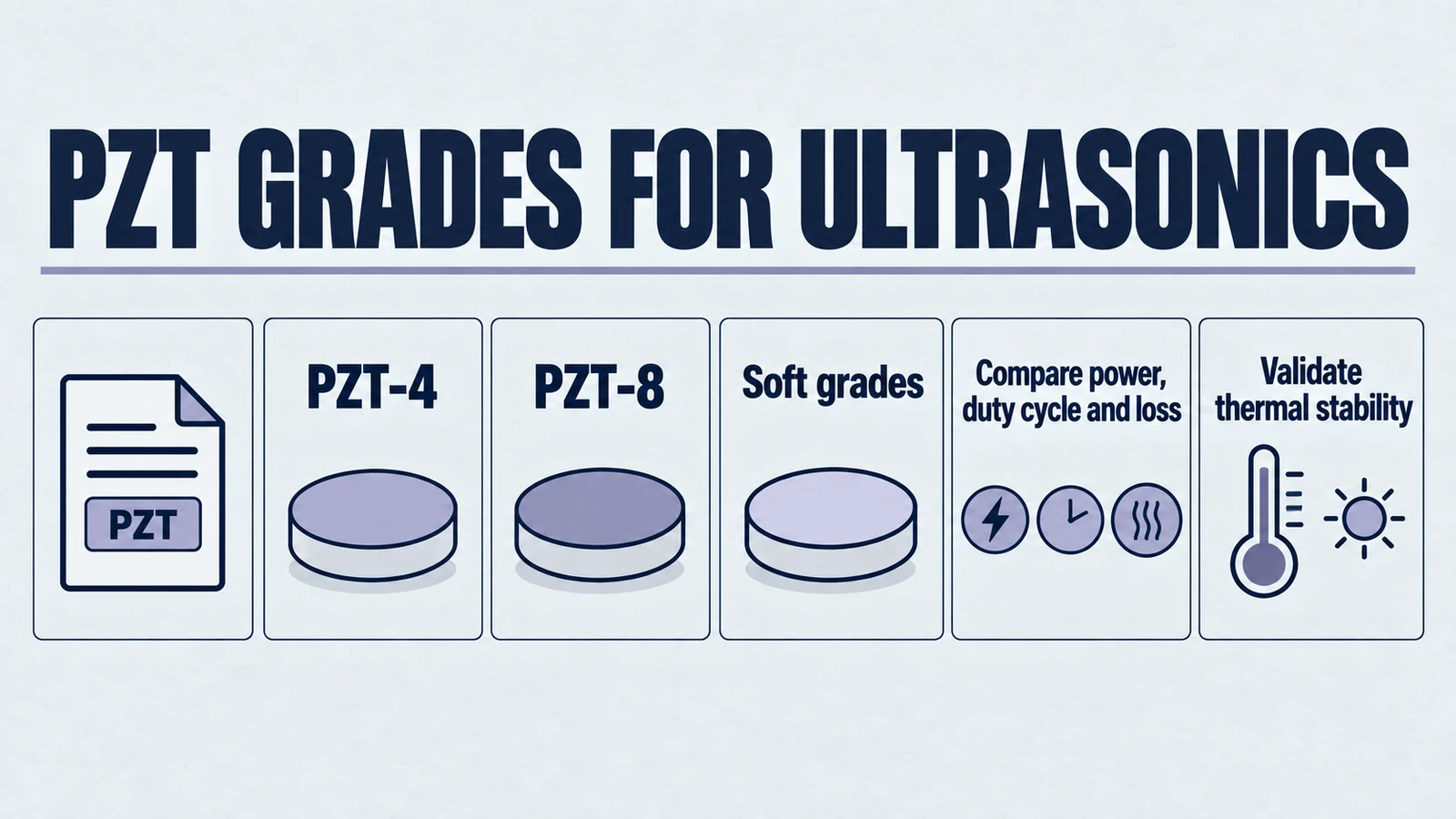
Quick answer: A PZT ultrasonic transducer uses lead zirconate titanate ceramic to convert electrical drive into ultrasonic vibration, usually above 20 kHz. PZT-8 is favored for high-power continuous duty, PZT-4 for balanced transmit/receive work, and soft PZT grades for higher sensitivity in receiving or low-power actuation.
Confirm the material choice against PZT fundamentals, soft vs hard PZT behavior, and d33, k, and Qm values.
PZT ultrasonic transducers are essential components in modern ultrasonic systems used for cleaning, medical imaging, and industrial sensing. Understanding their working principles and key applications helps engineers and procurement professionals make informed decisions when selecting or customizing these components for specific projects.
Engineering decision focus: Define frequency band, medium, and power target first, then map to transducer geometry and PZT grade.
Material Decision Context for PZT Transducers
Product path for this search intent
Match the article topic to the right YJ Piezo product page
Use this article when the choice is not just a shape, but a material tradeoff between sensitivity, loss, coupling, stability, and operating field. For "PZT Material Selection for Ultrasonic Transducers: PZT-4 vs PZT-8 vs Soft Grades", the practical value is in turning the topic into a measurable selection or sourcing decision.
- PZT Material Hub
Material grades and application tradeoffs
- Piezoelectric Ceramics
Shapes and ceramic manufacturing options
- PZT Material Supplier Hub
Material control, grade selection, and sourcing support
A PZT ultrasonic transducer is a type of piezoelectric ultrasonic transducer that uses lead zirconate titanate (PZT) ceramics to convert electrical energy into high-frequency mechanical vibrations (ultrasound) and vice versa. PZT materials are popular due to their high piezoelectric coefficients, mechanical strength, and ease of shaping into discs, rings, tubes, and custom geometries.
Working Principles of PZT Ultrasonic Transducers
Piezoelectric Effect
The core mechanism of a PZT ultrasonic transducer is the piezoelectric effect, where the application of an electric field across the PZT material causes it to deform mechanically. Conversely, when mechanical stress is applied, the material generates an electric charge.
Resonance and Frequency
PZT ultrasonic transducers are designed to operate at specific resonance frequencies (typically 20 kHz – several MHz), allowing efficient conversion between electrical and mechanical energy with minimal losses. Engineers select resonance frequency based on the intended application, balancing penetration depth and resolution.
Structure and Assembly
A typical PZT ultrasonic transducer consists of:
- PZT ceramic element: Responsible for the conversion between electrical and mechanical energy.
- Electrodes: To apply the electrical signal.
- Backing and matching layers: To enhance bandwidth, sensitivity, and energy transmission.
- Housing: Providing protection and mechanical stability.
Advanced designs may include multiple PZT elements stacked or arranged in arrays for focused or phased-array applications, especially in medical imaging and advanced industrial sensing.
Key Applications of PZT Ultrasonic Transducers
1. Ultrasonic Cleaning
PZT ultrasonic transducers are widely used in ultrasonic cleaning baths for precision cleaning of industrial parts, jewelry, medical instruments, and electronic components. The transducer generates high-frequency vibrations, producing cavitation bubbles in the liquid that remove contaminants effectively. Popular models include the HJ-3828 industrial cleaner transducer and HJ-3840 high-power cleaner transducer.
2. Medical Imaging (Ultrasound)
Medical ultrasound probes use PZT ultrasonic transducers to emit and receive high-frequency sound waves, creating images of internal organs and tissues. The high piezoelectric efficiency and stability of PZT materials contribute to high-resolution, reliable imaging. Our facial ultrasonic transducers are also used in medical aesthetics applications.
3. Non-Destructive Testing (NDT)
Industries use piezoelectric ultrasonic transducers for flaw detection and thickness measurement of materials without damaging them. PZT transducers can detect cracks, voids, and inclusions in metals, composites, and welds with high precision. High-frequency models like our KQ-230KH high-frequency transducer are ideal for detailed inspections.
4. Flow Measurement
Ultrasonic flow meters utilize PZT ultrasonic transducers to measure liquid or gas flow in pipes by tracking the time-of-flight or Doppler shift of ultrasonic signals, providing non-invasive and accurate flow monitoring. Our HJ-2112-1M flowmeter transducer and HJ-2825-1M liquid flow transducer are specifically designed for this application.
5. Ultrasonic Atomization
In humidifiers and atomizers, PZT ultrasonic transducers break water or liquid into fine mist using high-frequency vibrations, supporting applications in medical inhalers, consumer humidifiers, and essential oil diffusers. Our HJ-4036-1M beauty device transducer is commonly used in such applications.
Factors to Consider When Selecting PZT Ultrasonic Transducers
When selecting or customizing a PZT ultrasonic transducer for your application, consider:
- Resonance frequency: Determines the operational frequency and effectiveness in specific media.
- Impedance matching: Affects power transfer and efficiency.
- Power handling: Especially critical in cleaning and atomization.
- Size and geometry: Must fit within system design constraints.
- Operating environment: Including temperature, pressure, and exposure to chemicals.
Why Choose High-Quality PZT Ultrasonic Transducers?
Choosing a reliable piezoelectric ultrasonic transducer supplier ensures:
- Consistent performance and longevity
- High energy conversion efficiency
- Minimal signal distortion
- Lower failure rates in industrial and medical systems
At Yujie, we manufacture PZT ultrasonic transducers with precise control over material composition, geometry, and polarization to meet diverse application needs, including custom and OEM requirements.
Conclusion
PZT ultrasonic transducers play a crucial role across cleaning, medical, industrial, and consumer applications by leveraging the piezoelectric effect for precise, efficient ultrasonic energy generation and sensing. Understanding their working principles and application scope enables engineers and procurement teams to make data-driven decisions in system design and supplier selection.
If you are looking for high-quality PZT ultrasonic transducers tailored to your project, contact Yujie today to discuss your requirements and receive a technical consultation with our engineers.
Related Engineering Reading
- PZT-8 properties for high-power operation
- Piezoelectric vs ultrasonic transducer differences
- Ultrasonic product categories overview
- Contact engineering for RFQ
Material and Project Notes
For long-life programs, teams usually need to connect the transducer principles here to material choice, model screening, and RFQ details.
Application-to-Model Mapping
- Continuous-duty industrial sensing: SR80 series
- Compact short-range automation: MU18 series
- Chemical and sanitary environments: stainless-steel housing series
RFQ Checklist
- Target range and acceptable blind-zone limit.
- Environment details: dust, foam, vapor, washdown, or chemicals.
- Output interface: PNP/NPN, relay, analog, or RS485 requirements.
- Power and duty profile for continuous or intermittent operation.
- Annual quantity, sample timing, and delivery expectations.
Start model screening at the ultrasonic sensor hub, review supplier capabilities on PZT material supplier page, and send your requirements through engineering RFQ contact.
Engineering decision notes
PZT material and ceramic selection
Use this article when the choice is not just a shape, but a material tradeoff between sensitivity, loss, coupling, stability, and operating field. For "PZT Material Selection for Ultrasonic Transducers: PZT-4 vs PZT-8 vs Soft Grades", the practical value is in turning the topic into a measurable selection or sourcing decision.
YJ Piezo coordinates PZT ceramic projects with manufacturing support, so material formulation, sintering, polarization, electrode process, and outgoing inspection can be reviewed against the final application.
Selection checks
- Separate sensing needs from high-power actuation needs before comparing d33 or coupling values.
- Check dielectric loss, Qm, Curie temperature, aging behavior, and operating field against the real duty cycle.
- Confirm whether the application needs standard PZT grades or a custom formulation and geometry.
Failure risks
- Choosing only the highest d33 can create heat, drift, or depolarization risk in power ultrasonics.
- A ceramic that performs well in free measurement can fail once bonded, clamped, or loaded.
- Material substitutions without batch testing can change capacitance, resonance, and system tuning.
RFQ details
- Is the part used for sensing, actuation, atomization, cleaning, welding, or measurement?
- What field strength, temperature, duty cycle, and mechanical load will the ceramic see?
- Which values must be controlled: d33, capacitance, resonance, impedance, Qm, or dimensional tolerance?
Relevant YJ Piezo pages
- PZT Material Hub
Material grades and application tradeoffs
- Piezoelectric Ceramics
Shapes and ceramic manufacturing options
- PZT Material Supplier Hub
Material control, grade selection, and sourcing support
Application FAQ
- Is the highest d33 always the best PZT choice?
- No. High d33 can be useful for sensitivity, but high-power ultrasonic systems often need lower loss, higher Qm, better thermal stability, and safer operation under field and stress.
- What makes PZT material selection different from catalog buying?
- The right PZT choice depends on geometry, load, drive field, duty cycle, temperature, and inspection targets. A catalog value is only useful when it is tied to the final assembly conditions.