
Piezoelectric Sensors in Automotive: From Engine Monitoring to EV Battery Safety
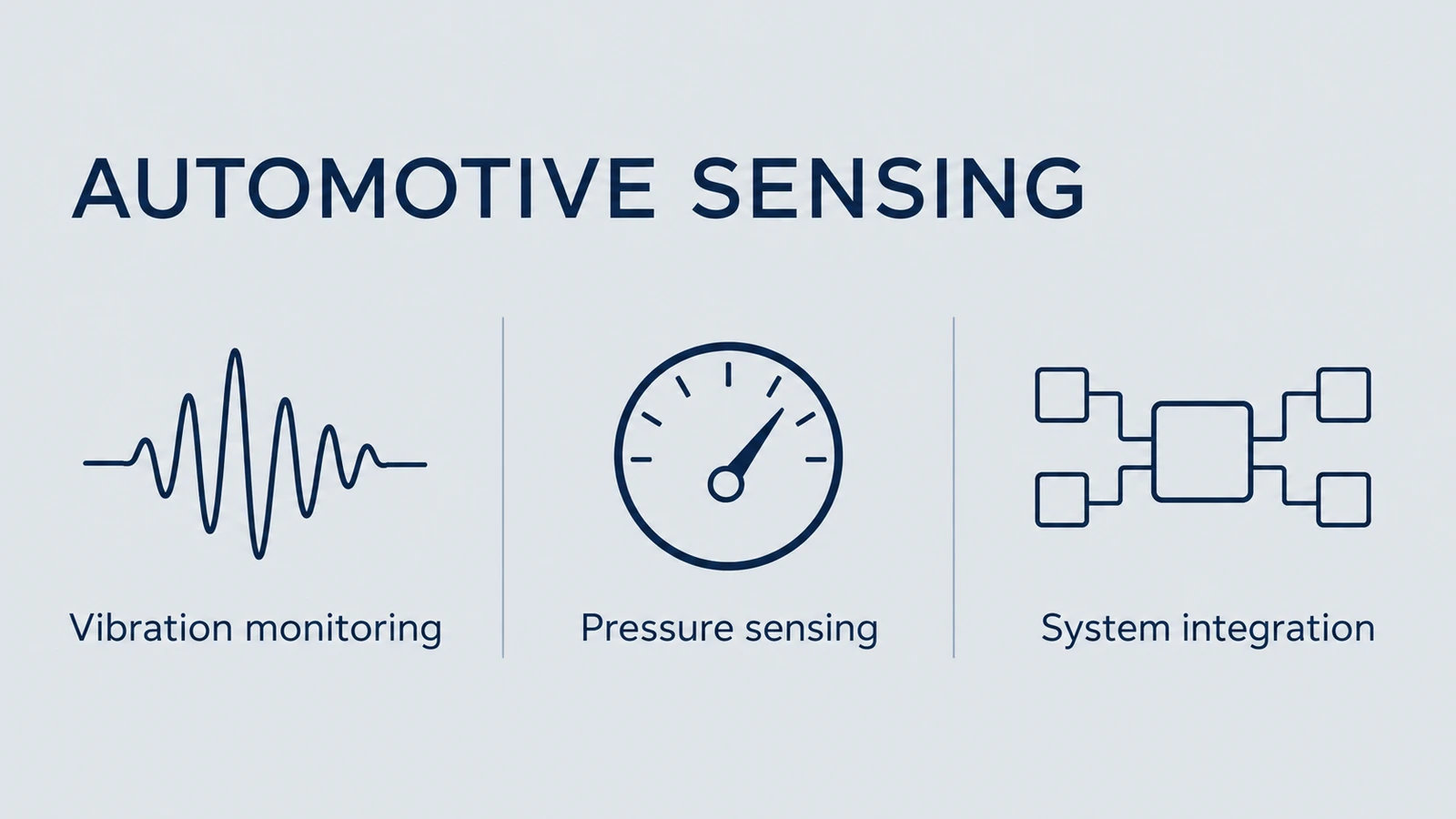
In the rapidly evolving automotive industry, sensors play a pivotal role in enhancing vehicle performance, safety, and efficiency. Among these, piezoelectric sensor automotive applications and automotive ultrasonic sensor technologies have emerged as crucial components, driving innovations from traditional engine monitoring to advanced EV battery management systems.
Understanding Piezoelectric Sensors in Automotive Applications
Piezoelectric sensors generate an electric charge when subjected to mechanical stress or vibrations. This unique property makes them exceptionally suitable for automotive applications where precise, real-time monitoring is critical.
Key Benefits of Piezoelectric Sensors:
Product path for this search intent
Match the article topic to the right YJ Piezo product page
Use this article when sensor performance depends on target distance, beam angle, housing material, liquid behavior, or false echo control. For "Piezoelectric Sensors in Automotive: From Engine Monitoring to EV Battery Safety", the practical value is in turning the topic into a measurable selection or sourcing decision.
- Ultrasonic Sensors
Distance, level, and detection sensor portfolio
- Flow Measurement Transducers
Bubble and flow-related ultrasonic sensing paths
- Air Acoustic Transducers
Air-coupled transducers for range and presence detection
- High sensitivity and accuracy: Detect subtle vibrations and pressures instantly.
- Fast response times: Offer immediate feedback to control systems.
- Durability: Operate reliably under extreme environmental conditions such as high temperatures and pressures.
- Maintenance-free operation: Provide stable, long-term performance without frequent calibration.
Applications of Piezoelectric Sensors in Automotive Industry
1. Engine Performance Monitoring
Piezoelectric sensor automotive applications are integral for monitoring engine combustion processes. They measure dynamic pressures inside engine cylinders, providing critical data on combustion efficiency, knocking, and overall engine health. By detecting subtle variations in cylinder pressure, they help optimize fuel efficiency, reduce emissions, and enhance engine longevity. For high-precision acoustic monitoring applications, our high-frequency transducer delivers exceptional performance in demanding automotive environments.
2. Tire Pressure Monitoring Systems (TPMS)
Conventional TPMS pressure measurement commonly uses capacitive or piezoresistive MEMS. Piezoelectric tire strain sensing or energy harvesting is a different function; identify the specific implementation before describing its pressure sensor as piezoelectric.
3. Automotive Ultrasonic Sensors for Parking Assistance
Automotive ultrasonic sensor technologies, utilizing piezoelectric elements to emit and receive ultrasonic waves, measure distances to nearby objects with high precision. They are widely used in parking assistance systems, blind-spot detection, and automated driving features to improve driver safety and convenience. For specialized bubble detection in automotive fluid systems, our ultrasonic bubble detection sensor provides reliable monitoring capabilities.
4. Crash Detection and Safety Systems
Crash and airbag systems use application-specific accelerometers and validated decision/control architectures; capacitive MEMS are one established implementation. Do not infer piezoelectric sensing or guaranteed deployment performance from a sensor’s ability to detect force or acceleration.
Piezoelectric Sensors in Electric Vehicles (EVs): Ensuring Battery Safety
With the rise of electric vehicles, the application of piezoelectric sensor automotive technologies has expanded significantly, particularly in EV battery management.
EV Battery Safety Monitoring
Piezoelectric sensors monitor battery pack health by detecting abnormal vibrations or thermal runaway conditions, an essential safety measure for preventing battery failures. Early detection of these anomalies ensures prompt intervention, protecting both the vehicle and its occupants from potential hazards.
Structural Health Monitoring of Battery Packs
Continuous monitoring of mechanical stress and vibration in battery packs by piezoelectric sensors aids in identifying structural integrity issues early on. This proactive approach reduces maintenance costs and extends the lifespan of expensive battery systems.
Flow Monitoring in Automotive Systems
Modern vehicles require precise fluid flow monitoring for optimal performance. Our ultrasonic flowmeter transducer provides accurate measurement for liquid flow applications, while the gas flow transducer offers reliable monitoring for exhaust gas recirculation and other gas flow systems. For liquid coolant systems, the liquid flow transducer ensures optimal thermal management in both traditional and electric vehicles.
Specialized Automotive Applications
Beyond traditional applications, automotive ultrasonic sensor technologies are expanding into specialized areas. For underwater applications such as amphibious vehicles or marine automotive systems, our submersible transducer provides reliable performance in challenging aquatic environments. For deep-water automotive testing and research applications, the deep-water transducer offers exceptional durability and precision.
Integrating Piezoelectric and Automotive Ultrasonic Sensors: Future Outlook
As vehicles continue to evolve towards greater automation and electrification, the integration of piezoelectric sensor automotive and automotive ultrasonic sensor technologies is set to grow exponentially. Advancements in sensor technology, including higher sensitivity and miniaturization, promise even greater functionality and new applications, from advanced driver-assistance systems (ADAS) to comprehensive vehicle health monitoring systems.
Conclusion
Piezoelectric sensors and automotive ultrasonic sensor technologies represent important tools in today's automotive industry, significantly enhancing vehicle performance, safety, and efficiency. As the automotive landscape moves towards advanced electrification and autonomy, these sensors will continue to drive innovation, making our journeys safer and more reliable than ever.
By harnessing the power of piezoelectric technology, automotive engineers and manufacturers are paving the way for smarter, safer, and more sustainable mobility solutions. Whether it's engine monitoring, battery safety, or advanced driver assistance, these sensors are at the forefront of automotive innovation.
Engineering decision notes
Ultrasonic sensing and detection
Use this article when sensor performance depends on target distance, beam angle, housing material, liquid behavior, or false echo control. For "Piezoelectric Sensors in Automotive: From Engine Monitoring to EV Battery Safety", the practical value is in turning the topic into a measurable selection or sourcing decision.
YJ Piezo treats ultrasonic sensing as an acoustic interface problem: transducer frequency, beam shape, housing, drive electronics, and target environment are reviewed together.
Selection checks
- Define target range, dead zone, beam angle, and mounting geometry before choosing the sensor family.
- Check the medium, target surface, temperature swing, foam, vapor, and side-wall risk.
- Separate detection repeatability from ideal lab accuracy when the sensor will operate in a tank, tube, or moving line.
Failure risks
- A sensor can pass bench distance tests and still fail in tanks with foam, agitation, vapor, or narrow geometry.
- Changing only frequency without reviewing beam angle and mounting can increase false echoes.
- Ignoring housing material or sealing requirements can shorten lifetime in washdown or chemical environments.
RFQ details
- What is the minimum and maximum detection distance?
- Is the target liquid, solid, sheet material, air flow, or a moving object?
- What temperature, humidity, IP rating, and output signal does the system require?
Relevant YJ Piezo pages
- Ultrasonic Sensors
Distance, level, and detection sensor portfolio
- Flow Measurement Transducers
Bubble and flow-related ultrasonic sensing paths
- Air Acoustic Transducers
Air-coupled transducers for range and presence detection
Application FAQ
- What makes an ultrasonic sensor page useful for procurement?
- It should connect range, beam angle, output signal, housing, mounting, and environmental limits to a concrete use case. A model name alone is not enough for reliable supplier comparison.
- Which information speeds up an ultrasonic sensor RFQ?
- Send the target material, distance range, installation geometry, output interface, temperature range, IP rating, and whether the application involves foam, vapor, liquid, or moving objects.