
PZT-4 vs PZT-5A for Ultrasonic Transducer Design: Transmit Power vs Receive Sensitivity
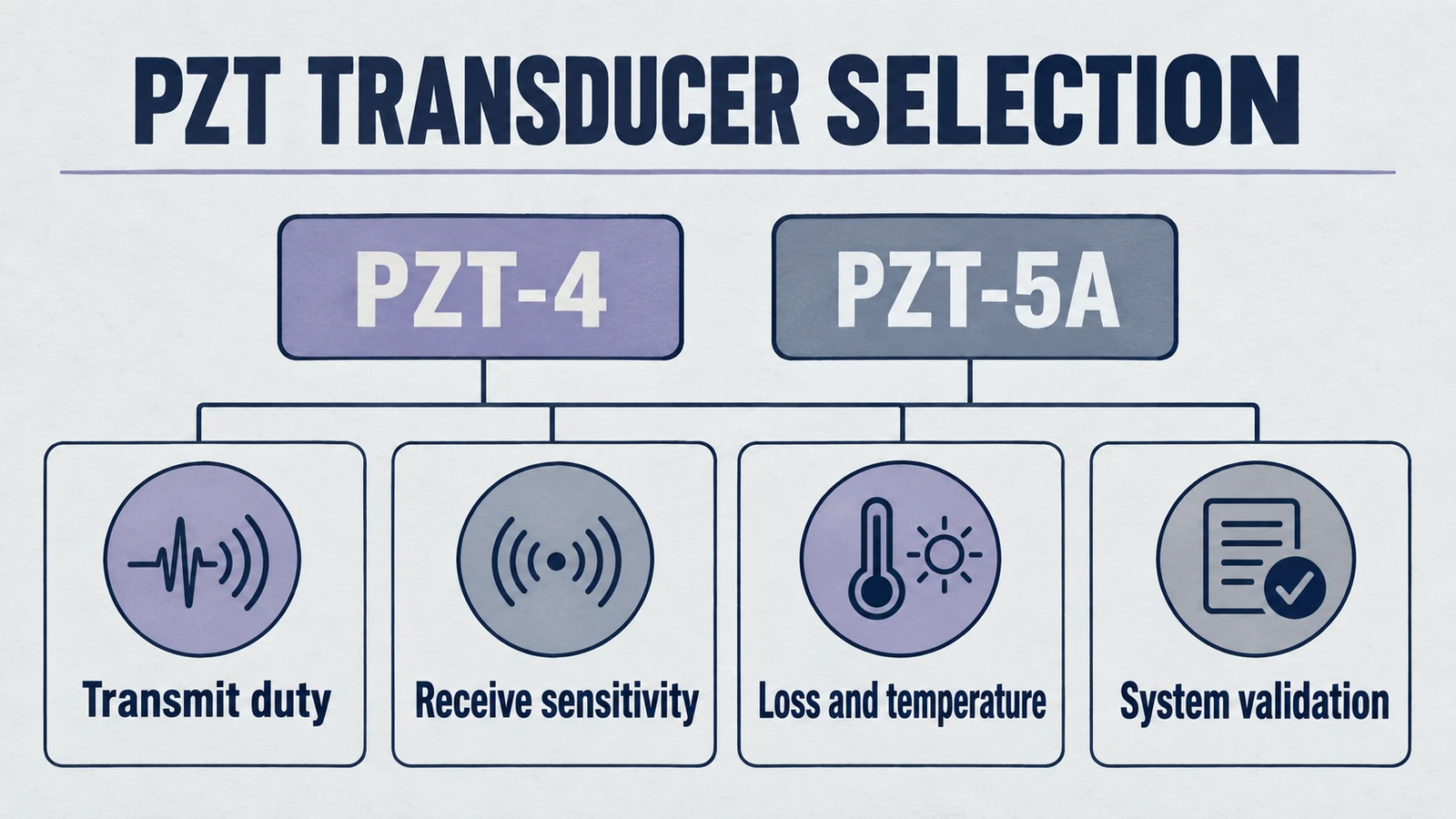
The most common material-selection mistake in ultrasonic design is not choosing the wrong ceramic family. It is choosing the ceramic for the wrong reason. Teams often overweight because it is easy to read, easy to compare, and easy to turn into a spreadsheet ranking. But a bolt-clamped Langevin stack, a pulse-echo NDT probe, a medical imaging element, and a hydrophone do not care about the same failure modes. One architecture is punished by heat and detuning. Another is punished by narrow bandwidth and long ring-down. A third is punished by poor receive sensitivity. The wrong material is usually selected because the team optimizes for free response instead of system-level loss, bandwidth, and duty cycle.
That is the real reason the PZT-4 versus PZT-5A decision matters. It is not a generic hard-versus-soft comparison. It is an architecture-selection decision. If the stack must deliver meaningful acoustic power under repeated or sustained drive, lower internal loss and better resonant stability usually matter more than a higher free coefficient. If the element is built to receive weak echoes, resolve short pulses, or support broader bandwidth, the softer material response becomes much more valuable. The design question is therefore not “which ceramic is better?” but “which ceramic fails more gracefully in the actual operating role?”
Broad classification of soft and hard grades is already covered in the broad soft-vs-hard overview. This article picks up one level deeper and treats the narrower architecture decision between PZT-4 and PZT-5A inside ultrasonic transducers. Supporting references for material constants and grade families are the d33, k, and Qm reference, the general PZT material reference, the PZT-4 sourcing note, the PZT-5 material consistency article, and the ceramic component catalog.
Problem Context
Product path for this search intent
Match the article topic to the right YJ Piezo product page
Use this article when the choice is not just a shape, but a material tradeoff between sensitivity, loss, coupling, stability, and operating field. For "PZT-4 vs PZT-5A for Ultrasonic Transducer Design: Transmit Power vs Receive Sensitivity", the practical value is in turning the topic into a measurable selection or sourcing decision.
- PZT Material Hub
Material grades and application tradeoffs
- Piezoelectric Ceramics
Shapes and ceramic manufacturing options
- PZT Material Supplier Hub
Material control, grade selection, and sourcing support
A design team usually arrives at the wrong shortlist when it treats piezo material selection as a one-number optimization problem. That is especially common in early quoting or early prototyping, when everyone wants a quick answer and the architecture is still underdefined. The engineer sees that PZT-5A often offers a stronger electromechanical response at low drive and assumes it will improve any ultrasonic transducer. Or the engineer sees that PZT-4 is known for higher power handling and assumes it must be the safer choice in any serious design. Both shortcuts fail for the same reason: they collapse system behavior into a single property.
Consider four common structures. A bolt-clamped Langevin stack is judged by power handling, resonant cleanliness, preload stability, and thermal drift under repeated excitation. A pulse-echo NDT probe is judged by pulse length, receive sensitivity, and echo resolution. A medical imaging element is judged by broad bandwidth, damping behavior, and array integration. A hydrophone is judged by weak-signal sensitivity, noise floor, and stability under small-signal receive conditions. These are not variations of the same job. They are different jobs with different failure penalties.
That difference shows up fast in testing. A softer ceramic may look attractive on the first bench sweep because it responds easily, but under transmit duty it can accumulate loss, heat, and detuning. A harder ceramic may look robust in a power stack but underperform in a receive-heavy pulse-echo design because the bandwidth is too narrow and the ring-down too long. In other words, the real choice is not “PZT-4 or PZT-5A?” in the abstract. The real choice is whether the transducer is fundamentally being designed to push sound or to resolve sound.
Why Alone Misleads
The temptation to rank by is understandable. It suggests stronger strain response under electric field and looks like an easy shortcut to performance. But it hides the parameters that dominate once the ceramic is mounted, preloaded, backed, matched, cabled, and driven near resonance. In ultrasonic transducers, the more decisive parameters are usually mechanical quality factor, dielectric loss, bandwidth, ring-down, thermal rise, and how the element interacts with the rest of the stack.
That is why architecture must come first. If the architecture is transmit-dominant, the material must remain stable under field stress and repeated energy storage. If the architecture is receive-dominant, the material must support bandwidth and pulse resolution without excessive ringing. Once that distinction is made, PZT-4 and PZT-5A stop looking like adjacent catalog grades and start looking like different answers to different system constraints.
Engineering Constraints
1) Defect Chemistry and Domain-Wall Mobility Define the Soft-Hard Split
At the material level, the hard-versus-soft distinction comes from how easily ferroelectric domains can move when the ceramic sees electric field and mechanical stress. In simplified form, the electromechanical response can be written through the constitutive relations below.
Practical interpretation: strain is not produced by electric field alone. It is jointly shaped by elastic compliance, applied stress, and piezoelectric coupling. That is why a ceramic cannot be judged in isolation from the stack stress state.
Practical interpretation: electric displacement depends on both mechanical loading and dielectric behavior. A material that looks attractive in open-circuit response can still be the wrong choice once electrical loading, backing, and real drive conditions enter the system.
PZT-4 behaves as a harder ceramic because defect chemistry restrains domain-wall motion more strongly. PZT-5A behaves as a softer ceramic because the domain structure is easier to move. In engineering terms, PZT-5A tends to offer a more compliant response and better receive-side sensitivity, while PZT-4 tends to waste less energy when repeatedly driven near resonance. That is the root of the transmit-versus-receive split.
2) , Ring-Down, and Bandwidth Change the Design Window
Once an element is mounted in a real transducer, bandwidth and ringing start to matter as much as raw amplitude. For an isolated, lightly damped linear resonance with a defined measured response, a practical narrow-band estimate uses the loaded assembly quality factor:
Practical interpretation: higher loaded Q means a sharper resonance and narrower half-power bandwidth for that mode. Loaded Q includes radiation, backing, matching, electrical, and structural losses and is not generally equal to the ceramic catalog Qm. That is useful in transmit architectures that want efficient resonant energy storage, but it is usually less helpful in receive architectures that need broader response.
Practical interpretation: the broader the required bandwidth , the less attractive a very high-Q material becomes. That is one of the clearest reasons PZT-5A fits pulse-echo, imaging, and sensing roles better than PZT-4.
Practical interpretation: Here τ is the 1/e amplitude-envelope decay time, using loaded Q for the assembled transducer. It grows with that quality factor; pulse-echo performance must be assessed with the actual backing, matching, loading, and receive electronics.
3) Dielectric Loss and Thermal Feedback Loops Decide Transmit Duty
Transmit-dominant ultrasonic designs are often limited by heat before they are limited by nominal coefficient values. For sinusoidal drive, with ω = 2πf and RMS voltage across the relevant capacitance, a small-signal dielectric-loss estimate shows why. Use capacitance and loss tangent applicable to the operating conditions:
Practical interpretation: loss power rises with frequency, capacitance, RMS voltage, and dielectric loss tangent. A material that looks lively at bench level can become unstable when the same architecture is pushed to higher duty cycle or higher field.
Practical interpretation: this is a lumped steady-state approximation using average total dissipated power and the applicable thermal resistance. It does not predict transient local hot spots. A softer ceramic with higher loss can drive a closed loop of heating, detuning, and more loss. That loop is exactly why PZT-5A can fail in transmit-heavy roles that initially seemed acceptable.
This is where PZT-4 usually earns its place. In medium-power resonant transmit systems, lower loss and better tolerance for repeated excitation make it a safer baseline than PZT-5A. The issue is not that PZT-5A cannot transmit. It can. The issue is that the architecture may ask it to transmit in a regime where heat and detuning become dominant design risks.
4) Receive Architectures Care About Damping and Pulse Resolution More Than Raw Drive Margin
Pulse-echo systems reverse the priority order. A receive-oriented NDT probe or medical imaging element is judged by how cleanly the emitted pulse stops and how faithfully the reflected event is resolved. Broad-band performance often matters more than peak resonant efficiency. In that environment, the softer response of PZT-5A becomes a strength, not a weakness.
That is why receive architectures often favor lower-Q, more compliant ceramic behavior. They are not trying to hold a single sharp resonance as efficiently as possible. They are trying to recover information across a broader frequency window with acceptable ring-down. PZT-4 is therefore not “bad” for imaging or NDT because it is low sensitivity. It is often the wrong fit because its transmit-style strengths are not the dominant success criteria.
5) Transducer Architecture Changes the Material Decision More Than Catalog Grade Names Do
A pre-stressed Langevin stack, a bonded disc transmitter, a backed probe element, and a hydrophone all place different mechanical and electrical demands on the ceramic. In a pre-stressed Langevin architecture, preload, resonant cleanliness, and energy throughput matter enormously. PZT-4 is usually much more comfortable in that environment than PZT-5A because it tolerates repeated drive and sharper resonance better. That is the same design logic that points engineers toward the power-ultrasonic welding class when the application begins to resemble high-duty industrial transmit hardware.
In contrast, array probes and pulse-echo sensing elements are designed around backing, matching layers, receive sensitivity, and bandwidth shaping. There the ceramic must cooperate with damping strategy instead of fighting it. PZT-5A therefore appears more naturally in imaging, NDT, and weak-signal sensing roles. The same ceramic family that looks too lossy in a transmit stack can be exactly right in a damped receive structure.
6) Miniaturization, Capacitance, and Front-End Loading Favor Softer Receive Materials
As ultrasonic elements shrink, the interface to the electronics becomes more punishing. Small receive structures suffer quickly if capacitance collapses, cable loading becomes significant, or the front-end cannot recover weak echoes. That is one reason PZT-5A remains attractive in miniaturized array and sensing architectures. Its softer behavior and higher receive usefulness fit the electrical realities of small-signal capture better than a harder power-oriented ceramic.
This is particularly relevant in medical imaging and compact NDT designs, where the element does not live as a free ceramic. It lives inside a tightly constrained electrical and acoustic system. Material selection must therefore account for the full receive chain, not just the ceramic data sheet.
7) Temperature Stability, Depoling Margin, and Aging Still Need to Be Closed in the Final Stack
Neither PZT-4 nor PZT-5A should be approved based on initial room-temperature measurements alone. The final stack must still be checked for thermal drift, field margin, long-term stability, and repeatability across samples. A mixed transmit/receive sonar projector, for example, may still lean toward PZT-4, but only if the duty pattern and thermal path support it. A receive array may lean toward PZT-5A, but only if the bandwidth target and loading conditions are still met after integration.
The practical point is simple. Final material confirmation belongs in a design review tied to duty cycle, drive voltage, backing, matching, geometry, and thermal behavior. It does not belong in an abstract ranking of catalog properties.
Selection Matrix
The first useful shortlist decision is not “which catalog grade is stronger?” It is “which architecture is being built?” The matrix below is intended as that first architecture screen.
| Design Objective | Main Failure Risk | Prefer PZT-4 or PZT-5A | Why | Engineering Note |
|---|---|---|---|---|
| Medium-power resonant transmitter | Thermal rise, detuning, and unstable amplitude under repeated drive | PZT-4 | Lower loss and higher transmit-duty tolerance make it safer in resonant power delivery | Best used when the stack is driven for acoustic output rather than broad receive bandwidth |
| Pulse-echo NDT probe | Long ring-down and poor echo separation | PZT-5A | Broader response and more natural receive behavior help short-pulse resolution | Check backing and matching design before treating the material decision as closed |
| Medical imaging array element | Insufficient bandwidth and poor receive fidelity | PZT-5A | Softer behavior supports broad-band pulse-echo work and receive sensitivity | Miniaturization and capacitance loading make the electrical interface part of the material decision |
| Mixed transmit/receive sonar projector | Receive benefit is outweighed by transmit heating and instability | Usually PZT-4 | The system still leans toward source level and drive stability more than receive bandwidth | If transmit duty rises further, re-open the shortlist and benchmark against PZT-8 |
| Passive acoustic sensing structure or hydrophone | Weak-signal output and poor receive sensitivity | PZT-5A | Receive-dominant architecture benefits more from sensitivity and usable bandwidth than from power robustness | This is the clearest case where transmit-oriented assumptions become misleading |
| Thermally constrained compact transmitter | Hot-spot formation in a poorly cooled package | Usually PZT-4 | Lower loss gives more thermal margin when package cooling is limited | Do not separate material choice from the actual housing thermal path |
When the Comparison Stops Being PZT-4 vs PZT-5A
One more boundary needs to be stated clearly. PZT-4 and PZT-5A do not cover every power-ultrasonic decision. Once field stress, duty cycle, and thermal loading move far enough upward, the real comparison shifts toward a harder high-power class rather than staying inside the PZT-4 versus PZT-5A frame.
| Duty Pattern or Architecture | Why the Comparison Changes | Escalate to PZT-8? | Engineering Note |
|---|---|---|---|
| Heavy continuous-wave or very high-voltage power ultrasonics | Loss control and thermal margin dominate more strongly than receive-side sensitivity | Yes, usually | This is the regime where the shortlist should resemble high-power industrial transmit systems more than mixed-duty ultrasonic elements |
| Bolt-clamped Langevin stack with long on-time | Preload stability and self-heating begin to dominate the design margin | Often | PZT-4 may remain valid for medium duty, but do not assume it is the last step in the power direction |
| Broad-band receive probe or damped pulse-echo array | Bandwidth and receive sensitivity, not extreme power handling, remain the main constraints | No | Stay in the PZT-5A-style receive-oriented decision space unless testing points somewhere else |
Application Mapping
Sonar Transmit/Receive
Mixed sonar-style systems often look balanced on paper but still lean transmit-dominant in practice. Source level, resonant stability, and survivable drive stress usually weigh more heavily than purely receive-side sensitivity. That is why PZT-4 is often the better baseline for projector-style sonar architectures, especially where the system sits closer to the underwater transmit class than to a passive sensing element. The usual failure of the wrong choice is that PZT-5A initially measures well, then warms, detunes, and loses repeatability under realistic transmit duty.
NDT Pulse-Echo
NDT probes usually reward pulse cleanliness more than brute-force resonant efficiency. PZT-5A is often the stronger baseline because the dominant constraint is short-pulse resolution and receive sensitivity rather than continuous acoustic output. The usual failure of the wrong choice is that a harder ceramic produces a narrower resonance, longer ring-down, and poorer separation of closely spaced echoes.
Medical Imaging
Medical imaging pushes even further toward broad-band receive behavior. The architecture is shaped by damping, backing, matching, element pitch, capacitance, and front-end loading. PZT-5A typically fits that world much better than PZT-4. The usual failure of the wrong choice is not immediate severe heating. It is a transducer that is simply too narrow-band and too ringy to deliver the pulse shape and echo fidelity the system expects.
Hydrophones and Passive Acoustic Sensing
If the transducer is being asked mainly to listen, the logic becomes even cleaner. Passive sensing structures and hydrophones almost always value receive sensitivity and low-level signal usefulness more than transmit robustness. PZT-5A is therefore the more natural baseline. The usual failure of the wrong choice is that the sensing chain ends up starved for useful signal because the material was selected with power-style criteria rather than receive-style criteria.
Medium-Power Industrial Acoustic Transmitters
In medium-power industrial ultrasonic transmitters, PZT-4 is usually the rational first material because the transducer has crossed into a regime where loss, thermal margin, and resonant stability matter more than broad-band receive performance. This includes many programs near the industrial acoustic transmitter class. The usual failure of the wrong choice is a design that looks fine during short excitation, then drifts and heats when real duty cycle is applied.
High-Power Continuous-Wave Systems
At the high-power continuous-wave end, the decision often stops being PZT-4 versus PZT-5A at all. PZT-5A is usually the wrong baseline, and PZT-4 may only be an intermediate answer. The real design review should ask whether the system has crossed into a PZT-8 problem. The usual failure of the wrong shortlist is not subtle. It is excessive self-heating, unstable resonance, and early material degradation under sustained field stress.
RFQ Checklist
A useful material RFQ should read like an architecture brief, not a catalog request. Asking for “PZT-4 or PZT-5A pricing” before the operating role is defined usually forces suppliers to guess the duty pattern, and that guess then becomes hidden design risk.
- Frequency: operating and target resonant frequency, not only nominal product family.
- Duty cycle: burst, intermittent, pulse-echo, or continuous-wave.
- Drive voltage: normal operating range and peak excitation condition.
- Operating temperature: ambient range, expected self-heating, and thermal cycling exposure.
- Transmit / receive role: transmit-dominant, receive-dominant, or mixed.
- Geometry: disc, ring, stack, array element, or other required form factor.
- Backing / matching layer: whether the design uses damping, acoustic matching, or pre-stressed stack architecture.
- Sample quantity: how many pieces are needed for design screening.
- Annual volume: expected production scope after validation.
Copy-paste RFQ starter
Application:
Operating frequency:
Transmit / receive role:
Duty cycle:
Drive voltage:
Operating temperature range:
Ceramic geometry needed:
Backing / matching layer summary:
Target sample quantity:
Expected annual volume:
Request: Please recommend whether PZT-4, PZT-5A, or a higher-power alternative is the correct starting shortlist for this transducer architecture, and identify the main failure risk if the wrong class is chosen.
The most useful follow-up question is not “which material is cheapest?” It is “which material class matches the architecture, and what evidence closes the decision?” The general material reference, the supplier capability note, and the relevant grade-specific articles can support that screening. When the design variables are already defined, the final handoff can be sent through engineering contact with the architecture brief attached.
External References
- PI Ceramic: Piezoceramic material families and engineering trade-offs
- APC International: Piezo theory and constant definitions
- APC International: Resonance, bandwidth, and loss measurement note
FAQ
Is PZT-4 better than PZT-5A for ultrasonic transducers?
No. PZT-4 is usually better when the transducer is transmit-dominant and must stay stable under meaningful resonant drive. PZT-5A is usually better when the transducer is receive-dominant and needs broader bandwidth, shorter effective ringing, or stronger weak-signal response. The right answer follows architecture, not catalog hierarchy.
Why can PZT-5A fail in high-power transmit duty?
Because higher dielectric and mechanical losses can generate heat faster than the stack can remove it. Once loss rises, temperature rises. Once temperature rises, resonance and material behavior shift. That feedback loop is manageable in a sensing element but dangerous in a transmit-heavy resonant structure.
Why is PZT-4 not ideal for medical imaging bandwidth?
Medical imaging elements usually need broad-band pulse behavior and good receive fidelity. Higher-Q, more transmit-oriented material behavior narrows the response and lengthens ring-down, which works against short-pulse imaging. PZT-4 is therefore often too resonance-centered for that architecture even when it looks mechanically robust.
When should engineers move from PZT-4 to PZT-8?
When the transducer becomes a true high-power continuous-wave or very high-field resonant system. At that point, the central problem is no longer PZT-4 versus PZT-5A. It is whether the entire duty pattern has crossed into a higher-power material class. The switch is usually driven by thermal margin and long-duty stability, not by a small change in receive needs.
How do and dielectric loss change material choice?
They determine how the transducer behaves under real drive. Higher usually means sharper resonance and better suitability for resonant transmit duty. Higher dielectric loss means more heat for the same electrical conditions. Together they tell you whether the architecture is more likely to fail by heating and detuning or by insufficient receive bandwidth.
What should be validated before locking material for OEM production?
Validate the full stack, not only the ceramic sample. That means resonant behavior, thermal rise, duty-cycle stability, receive response, backing and matching interaction, geometry tolerance, and repeatability across samples. In transmit programs, also verify that the element does not drift into unstable heating under realistic on-time. In receive programs, verify that ring-down and echo resolution remain inside the measurement target.
Should procurement ask for price before confirming the transducer role?
Not if the goal is a meaningful comparison. Price becomes comparable only after the team has defined whether the transducer is transmit-dominant, receive-dominant, or mixed, and whether the duty pattern stays inside the PZT-4 versus PZT-5A decision space at all. Otherwise different suppliers may be quoting different material assumptions against the same short description.
The practical takeaway is straightforward. Use PZT-4 when the transducer architecture leans toward resonant transmit duty, lower loss, and thermal stability under repeated excitation. Use PZT-5A when the architecture leans toward broad-band receive behavior, pulse resolution, and sensing sensitivity. If the design exceeds that boundary in power density or duty cycle, stop forcing a two-grade comparison and reopen the shortlist at the architecture level.
Engineering decision notes
PZT material and ceramic selection
Use this article when the choice is not just a shape, but a material tradeoff between sensitivity, loss, coupling, stability, and operating field. For "PZT-4 vs PZT-5A for Ultrasonic Transducer Design: Transmit Power vs Receive Sensitivity", the practical value is in turning the topic into a measurable selection or sourcing decision.
YJ Piezo coordinates PZT ceramic projects with manufacturing support, so material formulation, sintering, polarization, electrode process, and outgoing inspection can be reviewed against the final application.
Selection checks
- Separate sensing needs from high-power actuation needs before comparing d33 or coupling values.
- Check dielectric loss, Qm, Curie temperature, aging behavior, and operating field against the real duty cycle.
- Confirm whether the application needs standard PZT grades or a custom formulation and geometry.
Failure risks
- Choosing only the highest d33 can create heat, drift, or depolarization risk in power ultrasonics.
- A ceramic that performs well in free measurement can fail once bonded, clamped, or loaded.
- Material substitutions without batch testing can change capacitance, resonance, and system tuning.
RFQ details
- Is the part used for sensing, actuation, atomization, cleaning, welding, or measurement?
- What field strength, temperature, duty cycle, and mechanical load will the ceramic see?
- Which values must be controlled: d33, capacitance, resonance, impedance, Qm, or dimensional tolerance?
Relevant YJ Piezo pages
- PZT Material Hub
Material grades and application tradeoffs
- Piezoelectric Ceramics
Shapes and ceramic manufacturing options
- PZT Material Supplier Hub
Material control, grade selection, and sourcing support
Application FAQ
- Is the highest d33 always the best PZT choice?
- No. High d33 can be useful for sensitivity, but high-power ultrasonic systems often need lower loss, higher Qm, better thermal stability, and safer operation under field and stress.
- What makes PZT material selection different from catalog buying?
- The right PZT choice depends on geometry, load, drive field, duty cycle, temperature, and inspection targets. A catalog value is only useful when it is tied to the final assembly conditions.