
The Safety Advantage: Non-Contact Measurement for Hazardous Acids
Executive Summary: The Paradigm Shift in Chemical Inventory Safety
In industrial chemical management, the storage and processing of hazardous acids—particularly Hydrochloric Acid (HCl), Sulfuric Acid (H₂SO₄), and Hydrofluoric Acid (HF)—represent a persistent engineering challenge. Corrosivity, vapor emission, and regulatory oversight all place pressure on instrumentation design. Historically, level measurement in these environments relied on contact-based technologies: submersible pressure transducers, float gauges, and capacitive probes. In many tanks, physical contact with the medium increases the risk of sensor degradation, maintenance exposure, and measurement drift.
This guide, prepared for Yujie Piezo Technology, explains when top-mounted, non-contact level measurement solutions may reduce the risks associated with wetted parts. By using piezoelectric ultrasonic sensing—such as the UltraNova1 industrial sensor and the MRR1 IoT smart sensor—facilities can move the sensing element away from direct liquid contact. Plant managers, safety engineers, and instrumentation specialists should still evaluate chemical compatibility, local workplace rules, environmental requirements, and PVDF material limits for each tank.
1. The Chemical Adversary: Understanding the Physics of HCl Hazards
Product path for this search intent
Match the article topic to the right YJ Piezo product page
Use this article when sensor performance depends on target distance, beam angle, housing material, liquid behavior, or false echo control. For "The Safety Advantage: Non-Contact Measurement for Hazardous Acids", the practical value is in turning the topic into a measurable selection or sourcing decision.
- Ultrasonic Sensors
Distance, level, and detection sensor portfolio
- Flow Measurement Transducers
Bubble and flow-related ultrasonic sensing paths
- Air Acoustic Transducers
Air-coupled transducers for range and presence detection
To appreciate the necessity of non-contact measurement, one must first understand the enemy. Hydrochloric acid is not merely a static fluid; it is a dynamic, aggressive chemical system that actively seeks to degrade containment and instrumentation boundaries.
1.1 Physicochemical Properties and Vapor Dynamics
Hydrochloric acid is a solution of hydrogen chloride gas in water. Unlike sulfuric acid, which has a relatively low vapor pressure at ambient temperatures, HCl is highly volatile.
- Vapor Pressure: At a concentration of 37% (standard industrial strength), HCl exhibits a high partial pressure of hydrogen chloride gas. This means the "empty" space (headspace) above the liquid in a storage tank is never truly empty; it is saturated with dense, corrosive fumes.
- Fume Behavior: Upon contact with atmospheric moisture, hydrogen chloride gas forms white acid mists. These mists are heavier than air and highly penetrating. They do not merely corrode surfaces; they permeate microscopic pores in elastomers, gaskets, and cable jackets.
1.2 The Corrosion Mechanism: Why Standard Materials Fail
The chloride ion (Cl⁻) is notoriously small and mobile. It attacks passivated metals, such as 304 and 316 stainless steel, through a mechanism known as pitting corrosion.
- Passive Layer Breakdown: Stainless steel relies on a thin chromium oxide layer for protection. Chloride ions penetrate this layer, creating a local anode.
- Autocatalytic Growth: Once a pit forms, the environment inside the pit becomes increasingly acidic and concentrated in chloride ions, accelerating the corrosion rate exponentially.
- Stress Corrosion Cracking (SCC): In sensors under mechanical load (like a float measuring rod or a tightened flange), the combination of tensile stress and corrosive environment leads to sudden, brittle failure of the metal components.
1.3 Health and Safety Implications
The safety margins for HCl exposure are narrow, and site operators must follow the exposure limits and emergency thresholds that apply in their jurisdiction. From an instrumentation standpoint, this is one reason to reduce maintenance tasks that require opening a tank or working near the vapor space.
- Instrumentation Risk: A maintenance technician opening a tank to replace a failed contact sensor may be exposed to hazardous vapors. Therefore, component reliability and remote diagnostics can help reduce maintenance exposure when they are part of a broader site safety procedure.
2. Anatomy of Failure: The Risks of Submersible and Contact Sensors
For decades, the industry utilized submersible pressure transmitters and float systems due to their perceived simplicity and low initial cost. However, a "Failure Modes and Effects Analysis" (FMEA) reveals that these devices are inherently unsuited for long-term acid storage.
2.1 Submersible Pressure Transducers: The "Wicking" Effect
Submersible sensors measure level by detecting the hydrostatic pressure of the liquid column. Gauge designs may reference atmosphere through a vent, while absolute-with-reference and differential arrangements also exist. Select the reference arrangement and materials for the installation.
- Cable Jacket Attack: The outer jacket of the cable (often Polyurethane or PVC) is fully immersed in the acid. Over time, HCl molecules migrate into the polymer matrix, causing swelling, embrittlement, and cracking. Once the jacket is breached, acid flows directly into the sensor electronics.
- The Capillary Failure Mode: Even if the jacket holds, the breather tube acts as a conduit. Changes in temperature cause the sensor to "breathe." If the termination point (in a junction box) is exposed to even trace amounts of acid vapor, the corrosive air is drawn down the tube to the back of the sensor diaphragm. This corrosion from the inside out is undetectable until the sensor fails severely.
2.2 Mechanical Floats and Displacers
Float gauges rely on buoyancy and mechanical linkages. They are susceptible to physical obstruction and material incompatibility.
- Crystallization Seizure: HCl vapors often react with ambient ammonia (present in agricultural areas or other plant processes) to form ammonium chloride salts. These salts crystallize on the guide rods of float sensors, causing the float to freeze in place. A frozen float may indicate a "appropriate" level while the tank is actively overfilling.
- Leak Paths: Contact sensors typically require mounting flanges or threaded connections that are in direct contact with the liquid or high-concentration vapor. Every gasket is a potential leak point. In plastic tanks (Polyethylene/FRP), the thermal expansion difference between the rigid metal sensor flange and the plastic tank can cause the seal to fail, leading to leaks on the tank roof.
2.3 Capacitive and Conductive Probes
Capacitive sensors measure the change in capacitance between a probe and the tank wall.
- Dielectric Shift: The accuracy of these sensors depends on a constant dielectric constant. However, if the acid concentration changes (e.g., due to stratification or mixing issues), the dielectric constant shifts, causing significant measurement errors.
- Coating Issues: Viscous sludge or crystallization buildup on the probe changes its electrical properties, leading to "phantom levels" and requiring frequent cleaning (and thus, exposure).
3. The Solution: Physics of Non-Contact Ultrasonic Measurement
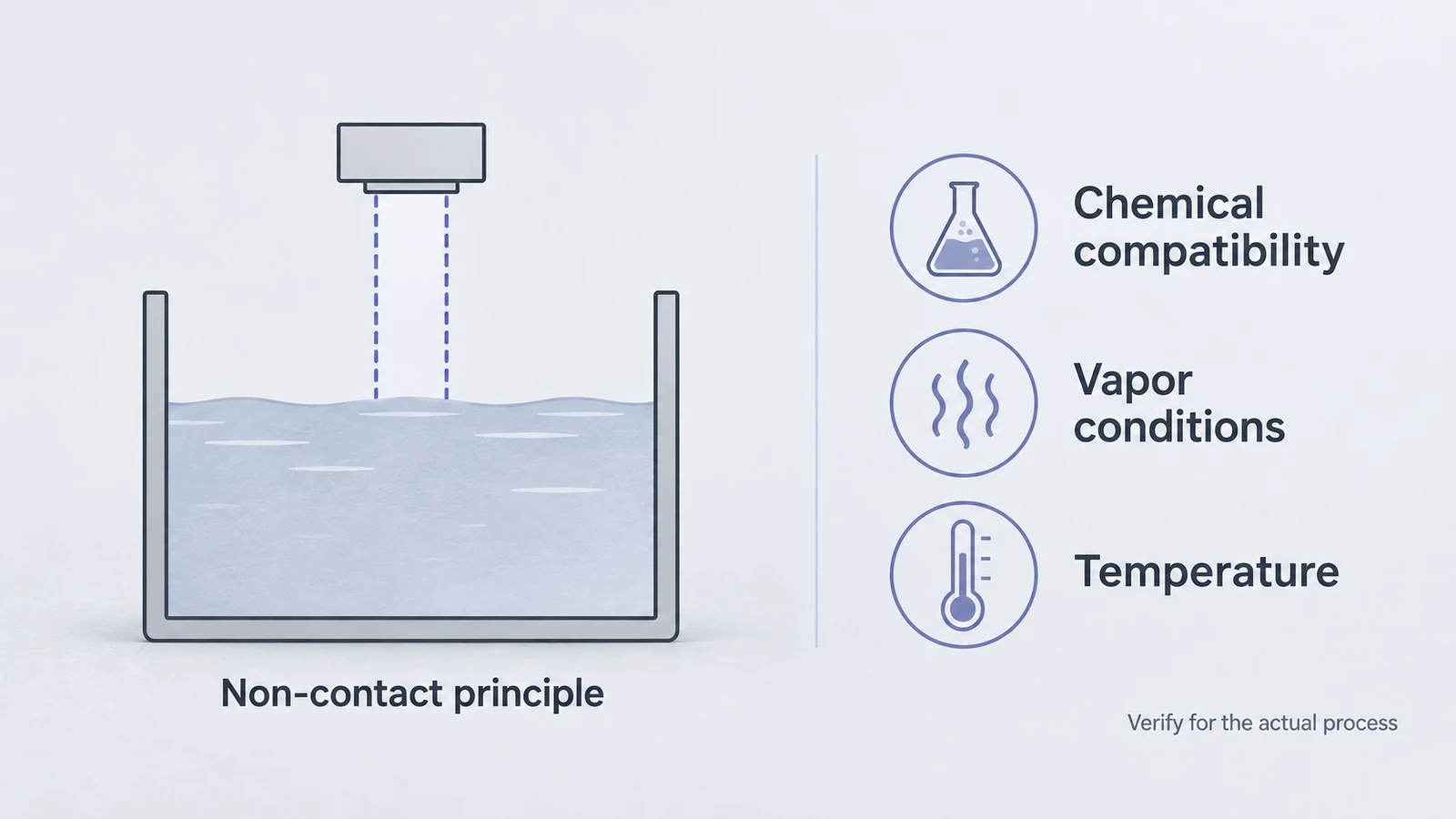
The hierarchy of hazard controls dictates that elimination is the most effective safety strategy. Top-mounted non-contact sensors can reduce wetted-part exposure, but vapors, condensate, aerosols, splash and overfill can still contact the headspace-facing assembly. Qualify materials, seals and site controls for those exposures.
3.1 The Acoustic Principle
Ultrasonic sensors operate on the Time-of-Flight (ToF) principle. The sensor emits an acoustic pulse (typically in the 20 kHz to 80 kHz range) which travels through the air gap, reflects off the liquid surface, and returns to the transducer.
This method ensures that the sensor never touches the acid. The interaction is purely acoustic.
3.2 The Piezoelectric Heart: Yujie Technology
At the core of every ultrasonic sensor is a piezoelectric ceramic element. This is where Yujie Piezo Technology exerts its domain expertise. Yujie manufactures the Lead Zirconate Titanate (PZT) ceramics that serve as the engine of the sensor. These are available in various geometries including discs, rings, and tubes—learn more in our geometry selection guide.
- The Reverse Piezoelectric Effect: When a high-voltage electrical pulse is applied to the Yujie PZT ceramic, the crystal lattice deforms, creating a mechanical vibration. This vibration is coupled to the air to create the sound wave.
- The Direct Piezoelectric Effect: When the echo returns, it vibrates the face of the sensor. The PZT crystal converts this minute mechanical stress back into an electrical signal, which is processed by the microcontroller.
- Why Ceramic Quality Matters: In hazardous applications, signal integrity is paramount. Vapors attenuate (weaken) sound waves. Yujie’s high-quality ceramics are engineered for high electromechanical coupling coefficients, meaning they convert energy more efficiently. Coupling alone does not correct gas-composition sound-speed error or prove performance through an attenuating vapor path. Validate the actual headspace composition, temperature, path and device response.
3.3 Dealing with Vapors: The Speed of Sound Challenge
Critics of ultrasonic technology often cite the effect of vapors on the speed of sound. In an HCl tank, the headspace is a mix of air and HCl gas.
- The Variance: The speed of sound in pure HCl gas is lower than in air. Significant concentrations can cause a measurement error (the sensor thinks the level is lower than it is because the sound travels slower).
- The Mitigation: Modern sensors like the UltraNova1 utilize integrated temperature compensation. For critical accuracy, a reference target (a fixed bar at a known distance) can be installed in the tank neck to continuously calibrate the sound velocity in the actual vapor mix.
4. Material Science Advantage: PVDF and Corrosion Resistance
The success of a non-contact sensor in acid depends entirely on the material facing the chemicals. This is where Polyvinylidene Fluoride (PVDF) becomes the critical differentiator.
4.1 PVDF vs. The World
Standard ultrasonic sensors use epoxy or aluminum faces, which dissolve rapidly in acid fumes. Yujie’s UltraNova1 and acid-ready sensors utilize PVDF (Kynar®) transducer faces.
- Chemical Inertness: PVDF is a fluoropolymer with exceptional resistance to strong acids, weak bases, and salts. It is unaffected by Hydrochloric Acid (up to 37%), Sulfuric Acid (up to 98%), and Nitric Acid.
- Acoustic Impedance Matching: Beyond chemical resistance, PVDF has an acoustic impedance of approximately 3-4 MRayls, which is much closer to air (0.0004 MRayls) and water (1.5 MRayls) than ceramic (30 MRayls) or stainless steel. This physical property allows for more efficient energy transfer from the sensor to the air, resulting in a stronger signal and better reliability in fuming environments.
4.2 Comparative Material Resistance Table
| Material | Hydrochloric Acid (37%) | Sulfuric Acid (98%) | Durability in Vapor |
|---|---|---|---|
| PVDF (Yujie) | Excellent | Excellent | > 10 Years |
| 316 Stainless Steel | Failure (Pitting) | Good | < 6 Months |
| Aluminum | Failure (Dissolves) | Failure | < 1 Month |
| PVC | Good | Poor (Swells) | 2-5 Years |
5. Product Spotlight: Yujie UltraNova1 and MRR1
Yujie Piezo Technology offers a tiered approach to non-contact safety, addressing both heavy industrial processing and smart inventory management.
5.1 UltraNova1: The Industrial Safety Standard
The UltraNova1 is engineered as the primary process control sensor for corrosive environments. It is designed to replace failing submersible and float sensors in the most demanding applications.
- Design Philosophy: Built with a hermetically sealed PVDF face and a robust, chemically resistant housing (NEMA 4X / IP67), the UltraNova1 is immune to the "wicking" failure mode of submersible probes.
- Short Dead Zone: Leveraging Yujie’s high-frequency piezo engineering, the UltraNova1 minimizes the "blind zone" at the top of the tank. This is crucial for small day tanks and chemical feed skids where every gallon of capacity counts.
- Applications: Day Tanks, Scrubber Sumps, IBC Totes.
5.2 MRR1: The IoT Guardian
The MRR1 represents the future of distributed safety. Described as a "Compact IoT smart-city distance sensor", its utility extends deeply into hazardous chemical logistics.
- Remote Level Monitoring: The MRR1 can support "Vendor Managed Inventory" (VMI). Chemical distributors can monitor the level of HCl tanks at customer sites remotely, helping reduce emergency rush deliveries and overfill risk when paired with appropriate operating procedures.
- Independent Alarm Input: In a robust control architecture, the MRR1 can serve as an independent high-level alarm input. Even if the primary control system fails, the battery-operated or LoRaWAN-connected MRR1 can send an alert to the cloud, giving operators additional information for response planning.
- Ease of Deployment: Its compact nature allows it to be retrofitted onto existing tank ports without major structural modifications, instantly upgrading a passive tank to a "smart" asset.
6. Compliance Planning: The Case for Non-Contact
Adopting non-contact measurement is not just a technological upgrade; it can support a facility's compliance strategy. Operators still need to evaluate the applicable workplace, environmental, and tank-gauging requirements for their own site.
6.1 Workplace Hazard Controls
For corrosive chemical storage, employers generally need documented hazard controls, maintenance procedures, and inspection records. Non-contact sensing can reduce direct contact with the liquid, but it does not replace the operator's safety program.
6.2 Spill and Overfill Prevention
Many facilities must maintain overfill prevention, inspection, and spill-response procedures. The MRR1, with digital self-diagnostics, can provide level data for those procedures when the complete system is engineered and verified appropriately.
6.3 API 2350: Tank Gauging Standards
API 2350 addresses overfill prevention in petroleum-facility storage tanks. It is not a general acid-tank standard or evidence of a universal mandate favoring these ultrasonic models over point switches. Establish the applicable site requirements, independent alarms and validated response architecture.
7. Operational Benefits: Maintenance and Total Cost of Ownership (TCO)
While the initial purchase price of an ultrasonic sensor may be higher than a simple float switch, the Total Cost of Ownership can favor non-contact technology when maintenance access, corrosion exposure, and process downtime are included.
- Maintenance Reduction: Contact sensors may require scheduled removal for cleaning and inspection. Non-contact ultrasonic sensing can reduce wetted-part maintenance when the mounting and vapor environment are suitable.
- Risk-Based ROI: ROI should be calculated from the site's actual spill-response, downtime, replacement, and inspection data rather than assumed averages.
8. Installation Best Practices for Hazardous Acids
8.1 Mounting Location
- The 1/6th Rule: Mount the sensor at a distance of at least 1/6th of the tank diameter from the side wall.
- Nozzle Design: For acid tanks, the nozzle must not extend into the "beam angle". The sensor face should ideally protrude slightly into the tank or be mounted on a wide, short flange.
8.2 Dealing with Condensation and Foam
- Angle Mounting: A slight angle (1-3 degrees) can sometimes help direct the echo away from internal obstructions.
- Temperature Stability: Ensure the tank is not exposed to direct tropical sun if possible, or use a sunshade.
9. Comparative Analysis: Radar vs. Ultrasonic
Radar: Unaffected by vapors, good for high-pressure/temp. Expensive.
Ultrasonic (Yujie):
- Cost-Efficiency: Significantly more affordable for standard storage.
- Material Compatibility: The flat face of a PVDF ultrasonic sensor is robust and easy to clean compared to radar antennas.
Conclusion: For atmospheric storage of HCl, Yujie ultrasonic sensors provide the optimal balance of performance and price.
10. Conclusion: The Imperative of Isolation
The tolerance for "acceptable risk" is shrinking. Yujie Piezo Technology stands at the forefront of this shift. By harnessing the piezoelectric effect and wrapping it in chemically inert PVDF armor, the UltraNova1 and MRR1 sensors offer a definitive solution.
They provide the Safety Advantage of isolation: isolation from corrosion, isolation from leakage, and isolation from harm. For the facility manager responsible for hydrochloric acid storage, the choice is clear. The future is non-contact, and the future is appropriate.
Upgrade Your Tank Safety Today
Don't wait for a containment breach to upgrade your instrumentation. Contact Yujie Piezo Technology to specify the UltraNova1 or MRR1 for your next project.
Request a Consultation with our Chemical Application Engineers →
Engineering decision notes
Ultrasonic sensing and detection
Use this article when sensor performance depends on target distance, beam angle, housing material, liquid behavior, or false echo control. For "The Safety Advantage: Non-Contact Measurement for Hazardous Acids", the practical value is in turning the topic into a measurable selection or sourcing decision.
YJ Piezo treats ultrasonic sensing as an acoustic interface problem: transducer frequency, beam shape, housing, drive electronics, and target environment are reviewed together.
Selection checks
- Define target range, dead zone, beam angle, and mounting geometry before choosing the sensor family.
- Check the medium, target surface, temperature swing, foam, vapor, and side-wall risk.
- Separate detection repeatability from ideal lab accuracy when the sensor will operate in a tank, tube, or moving line.
Failure risks
- A sensor can pass bench distance tests and still fail in tanks with foam, agitation, vapor, or narrow geometry.
- Changing only frequency without reviewing beam angle and mounting can increase false echoes.
- Ignoring housing material or sealing requirements can shorten lifetime in washdown or chemical environments.
RFQ details
- What is the minimum and maximum detection distance?
- Is the target liquid, solid, sheet material, air flow, or a moving object?
- What temperature, humidity, IP rating, and output signal does the system require?
Relevant YJ Piezo pages
- Ultrasonic Sensors
Distance, level, and detection sensor portfolio
- Flow Measurement Transducers
Bubble and flow-related ultrasonic sensing paths
- Air Acoustic Transducers
Air-coupled transducers for range and presence detection
Application FAQ
- What makes an ultrasonic sensor page useful for procurement?
- It should connect range, beam angle, output signal, housing, mounting, and environmental limits to a concrete use case. A model name alone is not enough for reliable supplier comparison.
- Which information speeds up an ultrasonic sensor RFQ?
- Send the target material, distance range, installation geometry, output interface, temperature range, IP rating, and whether the application involves foam, vapor, liquid, or moving objects.