
Spherical Cap vs Hemispherical Piezo Ceramics: Why Most Designs Are Not True Hemispheres
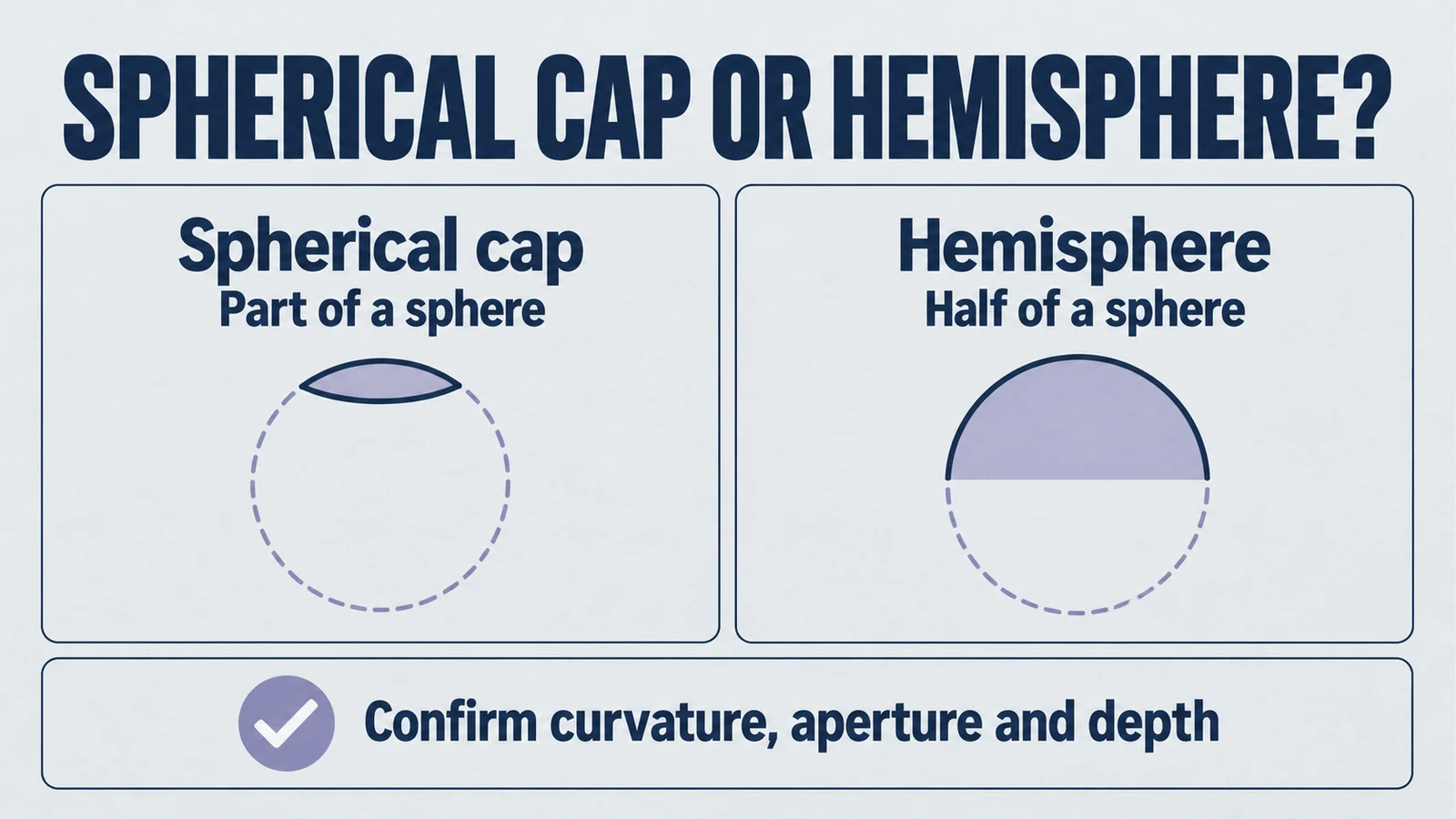
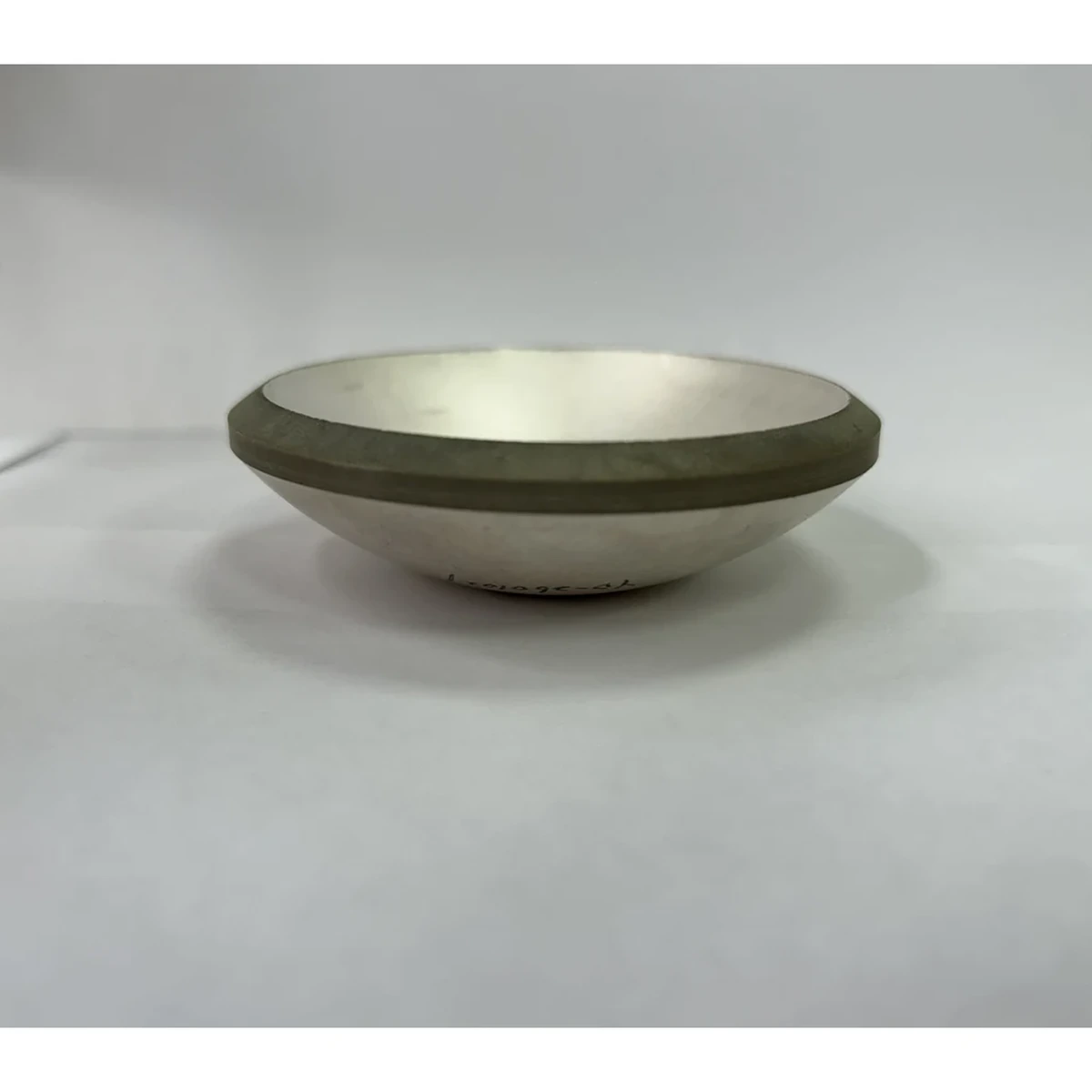
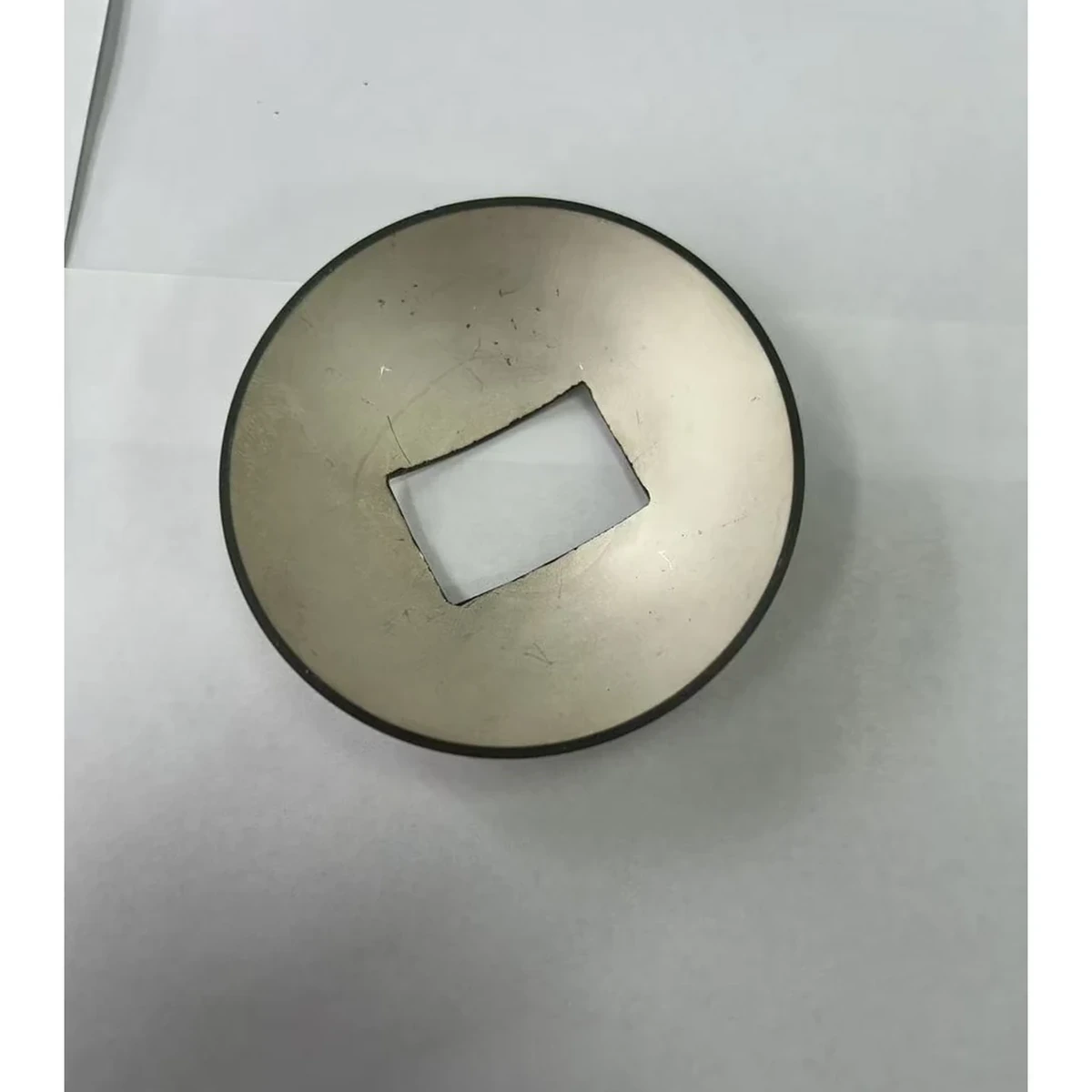
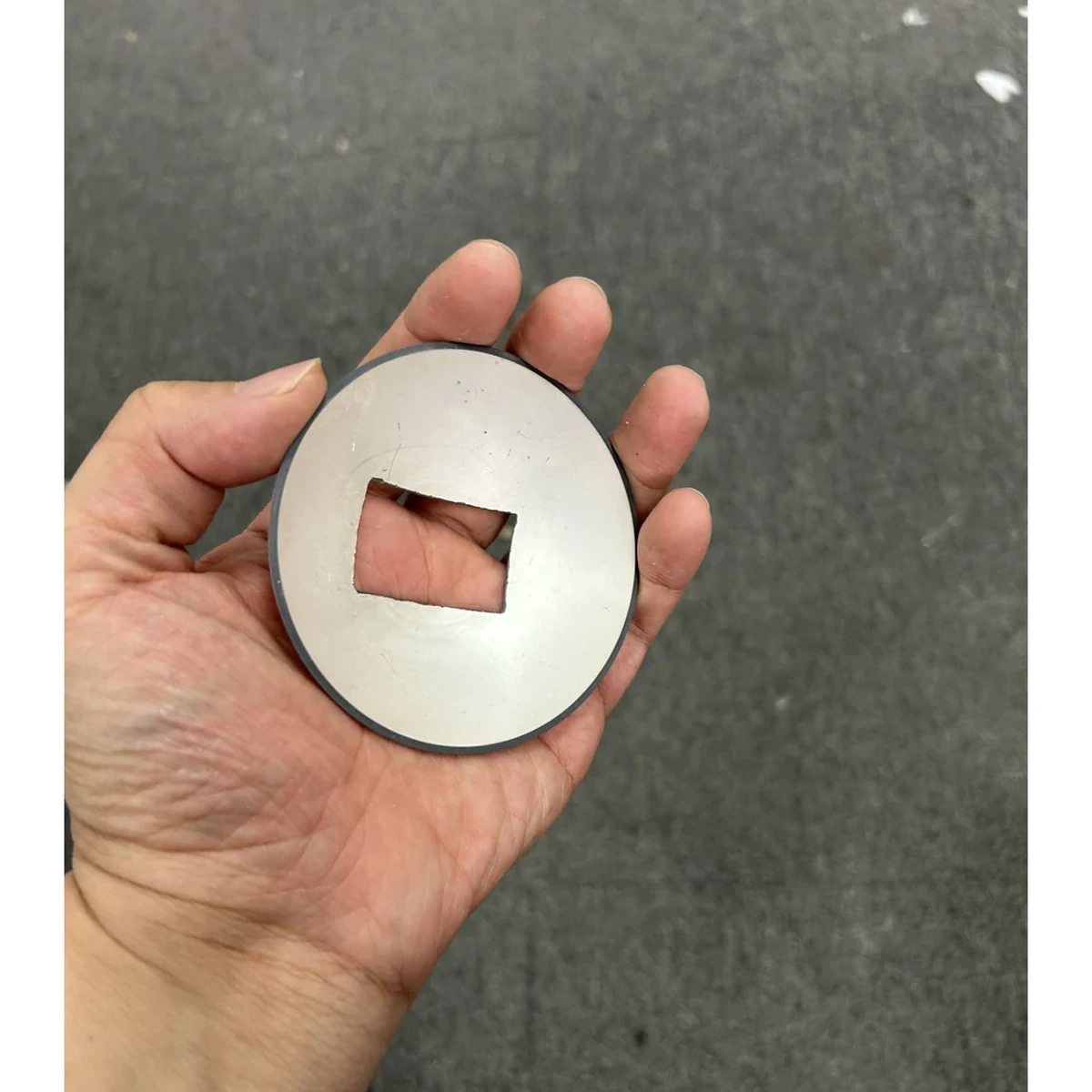
Engineers working with focused ultrasonic elements routinely see drawings, purchase specs, and supplier listings labeled “hemispherical piezo,” “hemisphere ceramic,” or “half-ball transducer.” In practice, most of these parts are custom spherical-cap piezo ceramics (also called spherical segments or bowl-shaped caps), not true hemispheres.
That difference is not semantic nitpicking. It changes how you interpret dimensions on a drawing, how you predict resonance behavior, how you plan electrode coverage and bonding, and what you should expect a factory to reliably manufacture at stable yield.
This article clarifies the terminology and the engineering implications, in a way that helps procurement and design teams communicate precisely. It is not meant to criticize suppliers. Many listings use “hemisphere” as a shorthand for “bowl-shaped.” The goal is simply to prevent a spec from drifting into an unintended geometry and to reduce costly back-and-forth during procurement.
Quick classification in 30 seconds
Product path for this search intent
Match the article topic to the right YJ Piezo product page
Use this article when curved ceramic geometry, focal distance, acoustic intensity, and assembly tolerances matter more than a flat element comparison. For "Spherical Cap vs Hemispherical Piezo Ceramics: Why Most Designs Are Not True Hemispheres", the practical value is in turning the topic into a measurable selection or sourcing decision.
- Spherical Cap Piezoelectric Ceramics
Focused ceramic shapes for OEM ultrasonic assemblies
- Piezoelectric Ceramics
Shape and material options for custom design
- Air Acoustic Transducers
Acoustic interface references for beam behavior
If you only have time for one check, do this.
- If the part is claimed to be a hemisphere, the geometry must satisfy h = R and D = 2R.
- If your drawing shows a radius of curvature R and an aperture diameter D where D < 2R, it is not a hemisphere. It is a custom spherical-cap piezo ceramic.
- If your drawing shows a sag (h) and an R where h < R, it is a spherical cap.
Most industrial “hemispherical” parts fail these checks. That is why “hemisphere” is usually a naming shortcut rather than a true requirement.
1. The two shapes. Same family, different meaning
Both shapes are cut from the same parent geometry: a sphere.
1.1 What is a spherical cap?
A custom spherical-cap piezo ceramic is the portion of a sphere cut off by a plane. Imagine slicing a sphere with a flat plane and keeping the “bowl” portion.
A cap surface can be defined by consistent geometric parameters. Radius R and aperture radius a alone require the minor/major-cap branch to be specified: h = R ± √(R² − a²). For the usual shallow cap, choose the minus branch. A manufactured ceramic also needs thickness and tolerances.
- Sphere radius (radius of curvature)
- Aperture radius (radius of the circular opening)
- Cap height (sagitta) (depth of the bowl)
These are linked by a standard relationship:
Engineers commonly specify caps by diameter (2a) and sag (h), or by diameter and radius of curvature (R).
A practical note. In production, it is often safer to specify D and h because it reduces ambiguity when parts are measured by a profile gauge or CMM. If you specify D and R, you should still include a calculated or implied h on the drawing for inspection.
1.2 What is a hemisphere?
A hemisphere is a special case of a spherical cap where the cut plane passes through the sphere’s center.
That means:
- The aperture diameter equals the sphere diameter.
So a hemisphere is not just “a deep bowl.” It is a precise geometric boundary.
1.3 Why people confuse them
The confusion usually comes from how humans name shapes visually.
- Many spherical caps look like “half a ball” at first glance.
- Marketing photos rarely include the dimensions that reveal whether equals .
- Some catalogs translate “bowl” or “spherical segment” into “hemisphere” as shorthand.
The engineering fix is simple. Treat “hemisphere” as a claim. Verify with , , and .
2. Why terminology matters. It changes what you think the part will do
2.1 Focus is influenced by curvature, but the usable field is set by aperture
For a concave spherical element radiating into a fluid, the curvature strongly influences the nominal focal distance. But the aperture controls how strong the focusing is and how the focal zone is shaped.
A hemisphere has the maximum possible aperture for a given radius. That implies:
- Stronger geometric focusing potential
- A narrower focal region (higher effective numerical aperture)
- Greater sensitivity to alignment, concentricity, and manufacturing tolerances
Most real applications do not need or cannot tolerate that extreme geometry. They choose a cap with a modest sag and aperture, because it is easier to build into a robust transducer stack and easier to keep stable across batches.
2.2 Mode behavior becomes harder to predict as curvature deepens
Piezo ceramics are not purely “piston” radiators. They support coupled electromechanical modes.
As the cap becomes deeper (approaching a hemisphere), several practical issues grow:
- More complex mode coupling. Thickness, radial, and bending-related modes can interact.
- Greater non-uniform strain distribution across the surface.
- Higher risk of parasitic resonances near the operating band.
A shallow spherical cap is not automatically simple, but it is generally easier to engineer into a predictable impedance curve, especially when the assembly includes bonding layers, backing, and housing compliance.
2.3 Thickness resonance assumptions can silently break
A common mental model is: “Set the center thickness. The thickness mode lands where we want.” That is only partially true for curved ceramics.
- If thickness varies across the cap, different regions can contribute different local resonance tendencies.
- If curvature is deep, bending compliance increases and can pull energy into non-thickness motion.
Result. Two parts with the same center thickness can behave differently if one is a shallow cap and the other approaches hemispherical depth.
2.4 Electrode coverage and electric field uniformity are not trivial on a deep bowl
Many designs require:
- Wrap-around electrodes
- Defined active and inactive regions
- Controlled edge fields to avoid arcing or depoling
These become more difficult as the curvature deepens. A hemisphere intensifies the practical constraints on metallization, masking, and lead attachment. It also increases the probability that a nominally “simple” electrode drawing becomes expensive or yield-limited in production.
3. Manufacturing reality. Why true hemispheres are rare
A true hemispherical piezo ceramic is possible. It is just rarely the best answer when cost, yield, and integration constraints are considered.
3.1 Forming and sintering challenges scale sharply with depth
Typical ceramic shaping routes for curved parts include:
- Green machining of a pressed compact
- Isostatic pressing followed by machining
- Slip casting or gel casting (less common for production caps)
As you approach hemispherical geometry:
- Wall thickness control becomes more difficult across the surface.
- Shrinkage gradients during sintering can introduce distortion.
- The likelihood of warpage, microcracking, or dimensional drift rises.
A spherical cap with modest sag gives factories much more process margin. This directly translates into better repeatability of , , and rim conditions.
3.2 Machining access and edge integrity become harder
Deep bowls restrict tooling access.
- Internal surfaces are harder to machine without chatter or local damage.
- Rim edges become more fragile during handling, fixturing, and inspection.
- Small edge defects can evolve into cracks during poling or during assembly thermal cycles.
This is one reason “deep” shapes often get simplified into shallower caps in production, even if early prototypes were more aggressive.
3.3 Poling deep concave parts is harder than most drawings suggest
Poling requires a strong electric field through the thickness, typically at elevated temperature.
For deep bowls:
- Electrode geometry is harder to apply consistently.
- Electric field distribution can become non-uniform.
- Handling and fixturing can damage edges and introduce defects.
Even if a hemisphere can be made once, repeating it at high yield is a different question.
3.4 “True hemisphere” often conflicts with assembly constraints
Most ultrasonic stacks need:
- A backing mass or damping structure
- Matching layers (in many cases)
- A housing, seal, or acoustic window
- Robust cable strain relief
A hemisphere consumes envelope space and complicates mechanical mounting. Many systems cannot afford that geometry without sacrificing other requirements such as cooling, sealing, mechanical strength, or manufacturability.
4. Modal and system implications engineers should watch for
This section is not a full modeling tutorial. It is a checklist of what tends to change as you move from a shallow cap toward a hemisphere.
4.1 Resonance control and bandwidth
- Deeper curvature can increase coupling between thickness and flexural behavior.
- Broadband designs are often easier with shallower curvature plus careful damping.
- If you see unexpected peaks in impedance or acoustic output, geometry is a usual suspect.
Practical guidance. If your electrical drive or control loop assumes a single dominant resonance, avoid specifying deep curvature unless you have a validated model and acceptance test.
4.2 Stress concentration and edge robustness
- The rim region is mechanically sensitive.
- Deep bowls can concentrate stress during clamping, bonding, or thermal cycling.
- A small change in edge radius, chamfer, or electrode termination can matter.
If your design uses a clamp ring, adhesive fillet, or a preloaded housing, specify rim geometry and allowable edge condition. Otherwise you can receive parts that are geometrically correct but mechanically fragile.
4.3 Matching layer practicality
Applying a controlled-thickness matching layer on a curved surface is difficult.
- On shallow caps it is already non-trivial.
- On hemispheres it becomes expensive and yield-limited.
Many “natural focus” designs accept reduced bandwidth or use alternative matching strategies to avoid multilayer coatings on deep curvature.
4.4 Assembly repeatability and acoustic field scatter
As curvature deepens, small errors cause larger acoustic output scatter.
Common contributors include:
- tolerance and concentricity
- Thickness uniformity
- Bond-line thickness variation
- Electrode overlap variation near the rim
If you see unit-to-unit focus shift, do not assume it is only a drive electronics issue. Geometry and assembly tolerances often dominate.
5. Why the word “hemisphere” keeps showing up anyway
It is worth understanding why this naming confusion persists. It is usually not malicious.
- Visual shorthand. “Hemisphere” is an intuitive word for a bowl-like shape.
- Legacy descriptions. Old catalogs and informal industry language propagate.
- Translation drift. In some contexts, the same term is used loosely across languages.
- Procurement compression. Buyers want a short phrase. Sellers want an easy label.
The fix is straightforward. Request the geometry as parameters rather than labels.
6. Common miscommunication patterns. and how to neutralize them
6.1 Pattern A. “Hemispherical” without any , , or
If a listing only says “hemispherical” and shows a photo, assume nothing. Ask for the drawing or a dimensioned sketch.
6.2 Pattern B. The drawing provides and , and they do not match a hemisphere
Example:
- Claim: “Hemisphere”
- Drawing: ,
A true hemisphere with would require . So this is a spherical cap.
6.3 Pattern C. The drawing provides and , but nobody checks what becomes
If you specify and , you implicitly specify . If is small, becomes large. That means the part is a shallow cap, even if someone calls it “half-ball.”
7. How to specify correctly. a procurement-ready checklist
If you want to prevent miscommunication, specify the part as geometry, not as a name.
7.1 Minimum geometric parameters to request
At minimum, include one of these sets:
Option A (common in drawings):
- Aperture diameter
- Sag
Option B (common in supplier catalogs):
- Aperture diameter
- Radius of curvature
If you provide and , the supplier can calculate . If you provide and , they can calculate .
Recommendation. Put all three on the drawing when possible. Use two as primary requirements and one as a derived reference. That reduces disputes at incoming inspection.
7.2 Thickness definition. be explicit
Curved parts create ambiguity if thickness is not specified clearly:
- Is thickness measured at the center, at the rim, or as an average?
- Are there intentional thickness gradients?
For frequency targeting, center thickness is often the key driver for thickness-mode resonance, but do not assume. Put it on the drawing. If thickness uniformity matters, add a maximum allowable variation across the cap.
7.3 Electrode definition. specify what matters for performance
Do not rely on “standard electrode” for curved parts. Specify:
- Electrode material system (Ag, AgPd, Ni, Au, etc. as applicable)
- Wrap-around requirement and width, if needed
- Active area boundaries, if masking is required
- Lead attachment location constraints
If your design is sensitive to edge fields or depoling risk, specify minimum margin from electrode edge to ceramic edge.
7.4 Tolerances matter more than labels
Instead of arguing “cap vs hemisphere,” focus on:
- Tolerance on , , and
- Roundness and symmetry
- Rim flatness or edge condition
- Electrode continuity and pattern placement
If your system is focus-sensitive, add acceptance criteria tied to focal distance spread or an acoustic field validation test.
7.5 Acceptance testing. what to ask for when focus matters
If you care about the acoustic field, geometry alone is not enough. Consider adding one of these:
- Electrical impedance sweep with acceptance windows
- Resonant frequency and anti-resonant frequency limits
- Simple hydrophone scan at a defined distance in water, with a defined drive condition
- Relative output measurement against a reference part
This is often cheaper than attempting to tighten geometry tolerances beyond what the process can hold.
7.6 A simple phrase that avoids conflict
When correcting a spec internally or with a vendor, a calm phrasing helps:
“To avoid ambiguity, we will specify this as a spherical cap defined by aperture diameter and radius of curvature (or sag). We are not requiring a true hemisphere unless is explicitly stated.”
8. When a true hemisphere actually makes sense
There are real cases where a hemisphere can be justified. For example:
- Research setups exploring extreme numerical aperture
- Highly space-constrained focusing where maximum aperture is required
- Specialized acoustic field shaping with tight tolerances and a supportive budget
Even then, the hemisphere is typically part of a larger engineered structure, not a standalone “ceramic bowl” bought from a catalog. You should expect higher cost, longer lead time, tighter process controls, and a stronger need for validation testing.
9. Takeaway
Most “hemispherical” piezo ceramics used in industrial ultrasonics are custom spherical-cap piezo ceramics, because caps deliver the needed focusing effect with far better manufacturability, yield, integration flexibility, and more predictable modal behavior.
If you want to prevent procurement and engineering miscommunication, avoid relying on the label. Specify the geometry using aperture diameter, sag or radius of curvature, plus an explicit thickness definition and tolerances. When performance is focus-sensitive, pair the geometry with an acceptance test that reflects how the part is actually used.
That small change in language prevents a supplier from building the wrong part while still being technically “compliant.” It also prevents internal teams from modeling or integrating the part based on an incorrect mental picture.
About Yujie Piezo
Yujie Piezo supplies custom piezoelectric ceramic components for ultrasonic transducers, including spherical-cap piezo ceramics for manufacturability review with controlled curvature and electrode patterns. If you have a drawing or target acoustic behavior and want a manufacturability review, we can help translate the spec into production-appropriate parameters and propose inspection and acceptance criteria that match your use case.
Engineering decision notes
Focused and curved piezo ceramics
Use this article when curved ceramic geometry, focal distance, acoustic intensity, and assembly tolerances matter more than a flat element comparison. For "Spherical Cap vs Hemispherical Piezo Ceramics: Why Most Designs Are Not True Hemispheres", the practical value is in turning the topic into a measurable selection or sourcing decision.
YJ Piezo reviews curved ceramics as geometry-sensitive acoustic components, where aperture, curvature, thickness, electrode layout, and mounting boundary all affect the usable focus.
Selection checks
- Define focal distance, aperture, medium, and allowable package depth before selecting curvature.
- Review resonance behavior with the intended mounting boundary, not only as a loose ceramic.
- Plan sample validation around beam behavior, impedance spread, and thermal drift.
Failure risks
- A curved part can meet dimensional drawings but miss the intended acoustic focus if the boundary condition changes.
- Mode coupling can create unstable frequency behavior after assembly or thermal loading.
- Over-optimizing peak intensity can reduce practical tolerance to alignment and field conditions.
RFQ details
- What focal distance, aperture, and working medium are required?
- Is the ceramic bonded, clamped, housed, or used as a bare focused element?
- Do you need impedance spread, acoustic validation, or geometry tolerance records?
Relevant YJ Piezo pages
- Spherical Cap Piezoelectric Ceramics
Focused ceramic shapes for OEM ultrasonic assemblies
- Piezoelectric Ceramics
Shape and material options for custom design
- Air Acoustic Transducers
Acoustic interface references for beam behavior
Application FAQ
- Why are curved piezo ceramics harder to specify than flat ceramics?
- Curvature changes the acoustic field and can interact with mounting, bonding, and drive conditions. The useful specification must include geometry, focus, medium, resonance behavior, and assembly boundary.
- What should be validated before buying focused piezo ceramics in volume?
- Validate focal distance, impedance spread, frequency stability after assembly, thermal behavior, and the tolerance stack between ceramic geometry and the final housing.