
The Strategic Advantages of Collaborating with an OEM Manufacturer for Piezoelectric Components
Introduction
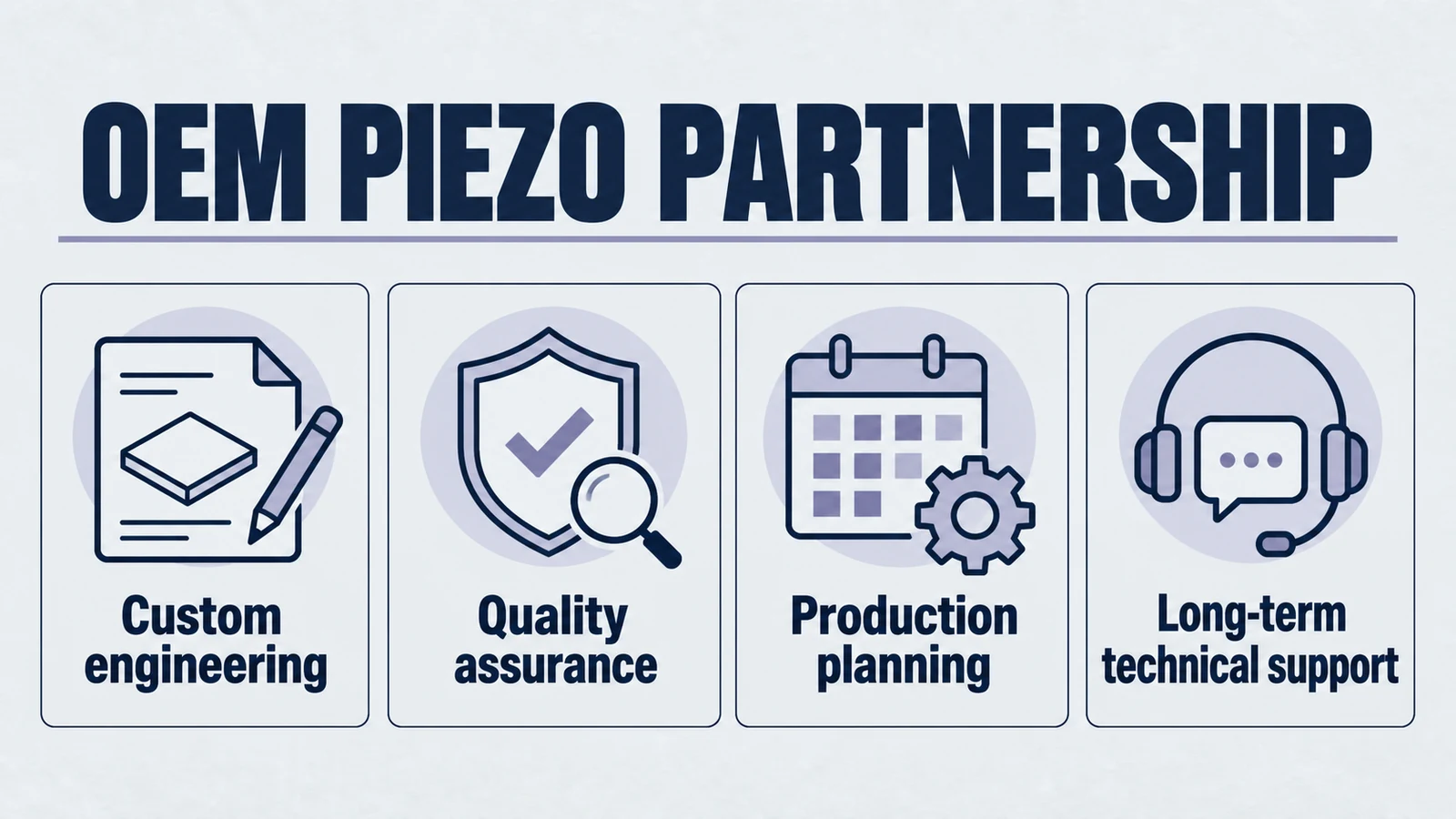
Selecting the right manufacturing partner for piezoelectric components significantly influences not only product quality and performance but also operational effectiveness and long-term competitiveness. Collaborating with an Original Equipment Manufacturer (OEM) provides numerous strategic advantages that extend beyond those offered by conventional suppliers. This comprehensive analysis details six critical benefits provided by OEM manufacturers specifically within the domain of piezoelectric components, emphasizing their broader implications for industrial research, product innovation, and competitive market positioning.
1. Tailored Engineering and Customized Solutions
Engaging an OEM manufacturer enables the design and production of customized piezoelectric components precisely tailored to specific application requirements. OEMs utilize advanced engineering techniques, comprehensive collaborative processes, and rigorous prototyping and testing phases to produce components aligned closely with client specifications. This customized approach optimizes integration into existing systems, enhances functional performance, reduces integration challenges, and accelerates overall product development cycles.
Product path for this search intent
Match the article topic to the right YJ Piezo product page
Use this article when the risk is supplier selection, engineering support, validation evidence, integration reliability, and whether the manufacturer can scale from sample to production. For "The Strategic Advantages of Collaborating with an OEM Manufacturer for Piezoelectric Co...", the practical value is in turning the topic into a measurable selection or sourcing decision.
- Ultrasonic Transducer Supplier Hub
OEM sourcing and engineering collaboration
- PZT Material Supplier Hub
Material control and grade selection
- Piezoelectric Ceramics
Ceramic manufacturing and custom shapes
Furthermore, OEMs frequently employ specialized simulation software and advanced analytical techniques, facilitating virtual testing and design optimization prior to physical prototyping. Such methodologies significantly reduce development risks and lead times, enabling businesses to rapidly adapt to evolving technological demands.
2. Stringent Quality Assurance and Regulatory Compliance
OEM manufacturers consistently maintain rigorous quality control systems that frequently exceed standard industry expectations. By employing comprehensive validation protocols, rigorous testing methodologies, and stringent quality assurance procedures, OEMs ensure component reliability, longevity, and optimal performance.
Verify the supplier’s current certificates, issuer, scope, covered facility and validity. ISO 9001 concerns quality management and ISO 14001 concerns environmental management; neither alone certifies an individual transducer’s performance, reliability or application suitability. Evaluate controlled product specifications and acceptance-test evidence alongside management-system records.
3. Enhanced Cost-Efficiency and Economies of Scale
A primary advantage of OEM collaboration is achieving substantial cost savings through optimized manufacturing processes and economies of scale. OEMs possess sophisticated infrastructure and established procurement strategies, allowing them to streamline production processes, minimize material wastage, and enhance resource allocation efficiency.
Additionally, OEMs' long-term supplier relationships and bulk procurement capabilities provide favorable cost structures, benefiting client organizations through competitive pricing. Consequently, enterprises partnering with OEMs enjoy significant reductions in overall operational expenses, higher profitability margins, and the ability to allocate resources toward further innovation and growth initiatives.
4. Robust and Predictable Supply Chain Management
OEM manufacturers offer highly reliable and resilient supply chain frameworks essential for industries where continuous production is vital. Through long-term collaboration and strategic partnership development, OEMs proactively forecast demand, manage inventory meticulously, and mitigate risks related to supply disruptions and shortages.
OEMs' advanced supply chain analytics, forecasting techniques, and proactive logistical planning enable continuous component availability and minimize operational disruptions. This robust supply chain management significantly reduces uncertainty, stabilizes production schedules, and enhances overall operational resilience, thereby maintaining competitive advantage in rapidly evolving markets.
5. Advanced Technical Expertise and Continuous Innovation
Selecting an OEM manufacturer grants organizations access to specialized technical knowledge, extensive engineering support, and a continual stream of innovation driven by ongoing research and development (R&D). OEMs typically invest substantially in R&D, continuously refining manufacturing processes, exploring novel materials and technologies, and implementing industry-leading best practices.
OEMs' expert engineering teams provide essential guidance and assistance in addressing complex technical challenges, facilitating prompt problem resolution, and enabling rapid adaptation to emerging market and technology trends. This advanced technical expertise is instrumental in achieving and sustaining competitive differentiation and fostering continuous product innovation.
6. Collaborative Long-Term Partnership and Strategic Alignment
Beyond the immediate technical and operational advantages, partnering with an OEM fosters a collaborative long-term relationship strategically aligned with the organization's broader goals and market vision. OEMs invest in understanding client-specific challenges and objectives, proactively suggesting product enhancements, improvements, and future-oriented solutions.
These collaborative partnerships encourage open communication, shared objectives, and mutual success, resulting in sustained innovation, reduced strategic risks, and enhanced adaptability to future technological shifts. Organizations benefit immensely from OEMs' willingness to collaborate closely, aligning technological capabilities and product strategies to deliver long-term value and competitive advantage.
Conclusion
Collaborating with an OEM manufacturer for piezoelectric components offers numerous strategic advantages, including tailored solutions, stringent quality management, cost-efficiency, robust supply chain operations, expert technical support, and innovation-driven growth. Such partnerships empower organizations to optimize performance, mitigate risks, and sustain long-term competitiveness in dynamic industrial landscapes.
Interested in forming strategic partnerships with an OEM manufacturer for advanced piezoelectric components? Contact our team today to explore customized solutions designed specifically to elevate your technical capabilities and market leadership.
Related Technical Resources
Use these internal references to compare geometry, material selection, reliability testing, and sourcing decisions.
- Selecting Piezo Ceramics for Continuous Duty Applications
- Common Mistakes Integrating Ultrasonic Transducers into OEM Systems
- Piezoelectric Ceramics Geometry and Shape Guide
- Supplier Vetting Standard for high-reliability Programs
- Application-Specific Engineering Challenges Beyond the Spec Sheet
- When a Custom Ultrasonic Transducer Program Is the Better Choice
- Understanding Ultrasonic Transducers: Types and Uses
- How to Test and Measure Piezoelectric Materials
- Understanding Piezoelectric Constants d33, k, and Qm
- Ensuring Quality of Piezoelectric Components
- Troubleshooting Piezo Devices: Common Failures and Prevention
Engineering decision notes
OEM integration and supplier qualification
Use this article when the risk is supplier selection, engineering support, validation evidence, integration reliability, and whether the manufacturer can scale from sample to production. For "The Strategic Advantages of Collaborating with an OEM Manufacturer for Piezoelectric Co...", the practical value is in turning the topic into a measurable selection or sourcing decision.
YJ Piezo combines direct project coordination with ceramic manufacturing support, so procurement and engineering teams can evaluate material control, application review, sample validation, and production consistency together.
Selection checks
- Ask whether the supplier controls ceramic manufacturing or only assembles purchased elements.
- Review sample policy, inspection records, engineering response quality, and production lead-time stability.
- Compare suppliers and integration paths by validation evidence, not only by unit price and datasheet similarity.
Failure risks
- A low-price sample can pass early tests but fail when batch variation, thermal load, or assembly stress appears.
- A supplier without material control may not explain why impedance, capacitance, or resonance drift occurs.
- Weak RFQ information leads to quotes that are fast but not technically comparable.
RFQ details
- What application, operating environment, and failure cost should the supplier design around?
- Which sample tests and outgoing records are required before pilot production?
- What customization, MOQ, tooling, and delivery constraints must be known before quotation?
Relevant YJ Piezo pages
- Ultrasonic Transducer Supplier Hub
OEM sourcing and engineering collaboration
- PZT Material Supplier Hub
Material control and grade selection
- Piezoelectric Ceramics
Ceramic manufacturing and custom shapes
Application FAQ
- How should an OEM compare piezoelectric suppliers?
- Compare material control, engineering support, test evidence, customization ability, sample policy, and batch consistency. Unit price matters, but only after the technical risk is understood.
- What makes an RFQ technically useful?
- A useful RFQ includes application, dimensions, target frequency, electrical limits, duty cycle, operating medium, environment, expected quantity, required reports, and current failure or replacement context.