
Engineering Reliable Automation: A Technical Guide to Selecting Yujie Ultrasonic Sensors
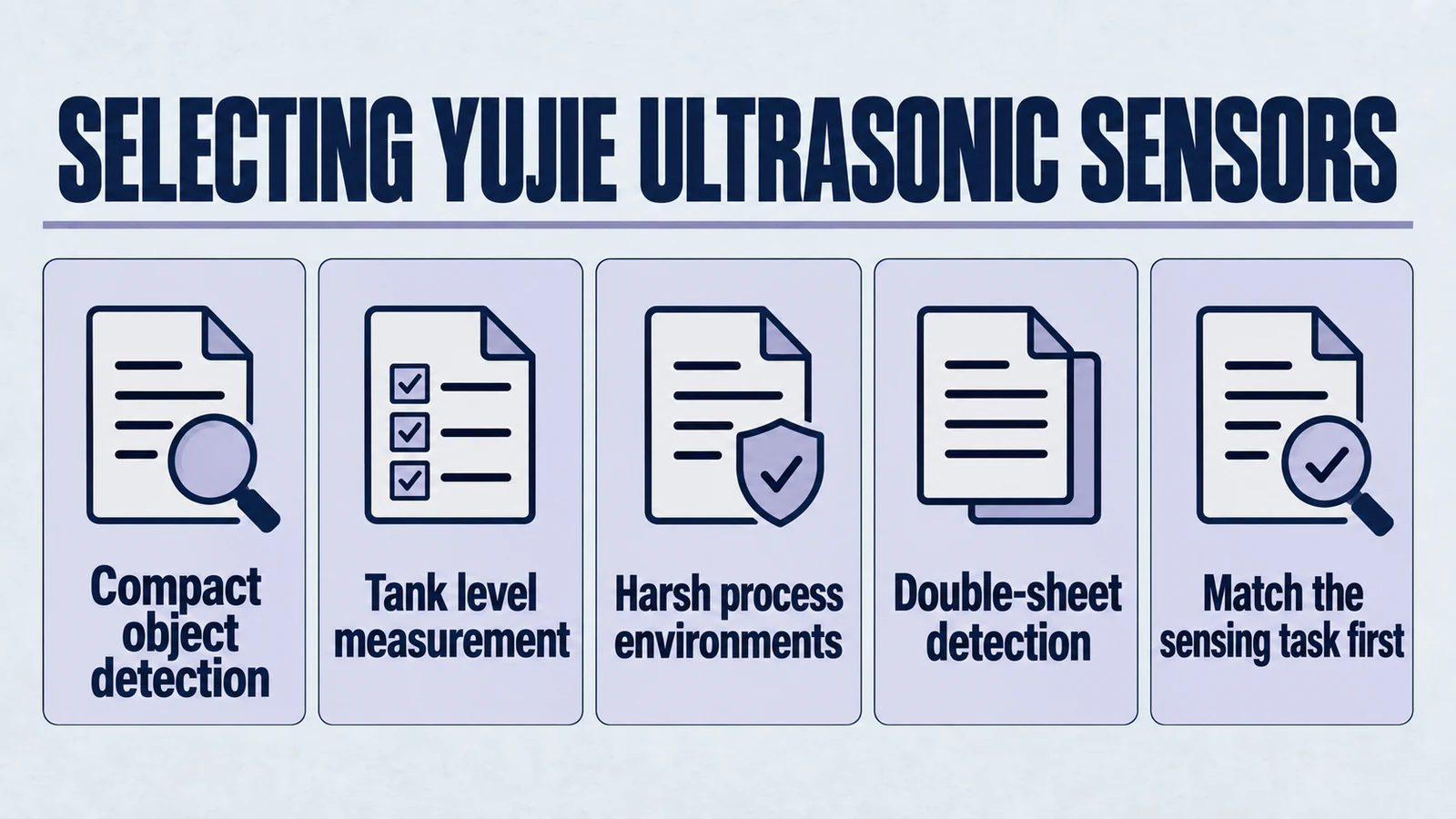
Executive Summary: The Silent Revolution in Sensing
In the intricate tapestry of modern industry, where automation drives efficiency and data fuels decision-making, the humble sensor plays a protagonist’s role. Among the myriad technologies available—optical, inductive, capacitive—ultrasonic sensing stands apart as a versatile titan. Capable of "seeing" with sound, these devices bridge the gap between physical matter and digital control, operating where other sensors fail: in dusty mines, inside corrosive chemical tanks, and within the dark, unlit bellies of smart city waste containers.
This engineering guide covers the ecosystem of ultrasonic sensors manufactured by Yujie Piezo. Anchored by the technical specifications of the MU, SF, SR, UltraNova, MRR, and MDC series, it explains how these devices use the piezoelectric effect to deliver non-contact measurement. It also covers sound propagation, materials like PVDF and stainless steel, and practical application choices across sectors ranging from industrial logistics to the Internet of Things (IoT).
Designed for engineers, system integrators, and procurement specialists, this document is more than a product catalog. It connects parameters from Yujie product documentation with acoustic engineering principles so buyers can decide which Yujie ultrasonic solution fits their automation requirements.
Product path for this search intent
Match the article topic to the right YJ Piezo product page
Use this article when sensor performance depends on target distance, beam angle, housing material, liquid behavior, or false echo control. For "Engineering Reliable Automation: A Technical Guide to Selecting Yujie Ultrasonic Sensors", the practical value is in turning the topic into a measurable selection or sourcing decision.
- Ultrasonic Sensors
Distance, level, and detection sensor portfolio
- Flow Measurement Transducers
Bubble and flow-related ultrasonic sensing paths
- Air Acoustic Transducers
Air-coupled transducers for range and presence detection
Section 1: The Physics of Acoustic Measurement
To truly appreciate the engineering behind the Yujie sensor lines—whether it’s the compact MU18 or the long-range SR-80—one must first master the fundamental physics that govern their operation. Ultrasonic sensors are not magic; they are precision instruments that manipulate the mechanics of sound waves.
1.1 The Nature of Ultrasound
Ultrasound refers to sound waves with frequencies higher than the upper audible limit of human hearing, typically above 20 kHz. Yujie’s sensors operate in this ultrasonic domain, utilizing frequencies that allow for distinct propagation characteristics.
1.1.1 Longitudinal Waves and Propagation
Unlike electromagnetic radiation (light, radar), which can travel through a vacuum, sound requires a medium. The ultrasonic pulses emitted by Yujie sensors are longitudinal mechanical waves. As the transducer surface vibrates, it compresses the air molecules in front of it (compression) and pulls them apart (rarefaction). This chain reaction travels through the air at the speed of sound.
- Implication for Industry: Because sound requires a medium, these sensors work exceptionally well in air, liquids, and solids, but they cannot function in a vacuum. However, their reliance on physical molecular interaction makes them immune to visual interference. Smoke, dust, and fog, which scatter light and blind optical sensors, are largely transparent to the longer wavelengths of ultrasound.
1.1.2 Frequency vs. Resolution and Range
The frequency of the sensor is a critical design parameter that dictates its performance envelope.
- High-Frequency Selection: Shorter wavelength can affect target/beam behavior, but double-sheet detection classifies transmitted amplitude and attenuation. It does not spatially resolve a microscopic air gap using a 400 kHz wavelength. Verify actual product frequency and classification conditions.
- Low Frequency (e.g., 40 kHz): Lower frequencies have longer wavelengths, which attenuate (fade) less as they travel through the air. This is why the SR-80 Series, designed for long-range outdoor measurements up to 10 meters, operates at a lower frequency. It sacrifices some resolution for the raw power needed to punch through 20 meters of round-trip air travel.
1.2 The Piezoelectric Effect: The Heart of the Transducer
At the core of every Yujie sensor lies a piezoelectric ceramic element, typically PZT (Lead Zirconate Titanate). This material acts as the bridge between the electrical world of the control system and the physical world of sound.
1.2.1 Inverse Piezoelectricity (Transmission)
When the sensor's microcontroller initiates a measurement, it sends a burst of high-frequency AC voltage to the PZT ceramic. Due to the inverse piezoelectric effect, the ceramic crystal lattice deforms physically in sync with the voltage. This rapid expansion and contraction of the ceramic face acts like a speaker cone, pushing against the air to generate the ultrasonic pulse.
1.2.2 Direct Piezoelectricity (Reception)
Once the pulse is emitted, the sensor switches to "listening" mode. When the echo returns from the target object, the sound wave strikes the face of the transducer. The mechanical pressure of the sound wave compresses the PZT ceramic. This physical deformation disturbs the dipole moments within the crystal, generating a minute voltage spike—the direct piezoelectric effect. This voltage is amplified, filtered, and processed to confirm the detection of an object.
1.3 Time-of-Flight (ToF) Calculation
The fundamental principle of distance measurement for the MU, UltraNova, and SR series is Time-of-Flight (ToF). The distance (D) is calculated using the formula:
D = (t × c) / 2
Where:
- t is the time elapsed between the transmission of the pulse and the reception of the echo.
- c is the speed of sound in the medium.
- The division by 2 accounts for the fact that the sound travels to the target and back again.
1.3.1 The Variable Speed of Sound
Precision is not just about measuring time; it's about knowing the speed of sound (c) accurately. c is not a constant. In dry air, it is approximated by:
c ≈ 331.3 + (0.606 × T)
Where T is the temperature in degrees Celsius.
- At 0°C, sound travels at ~331 m/s.
- At 40°C, sound travels at ~355 m/s.
This variance is substantial. Without correction, a 10°C temperature shift introduces a measurement error of approximately 1.7%. For a tank level sensor measuring 5 meters, that is an 8.5 cm error—unacceptable for precision process control.
Yujie Engineering: This is why the "Temperature Compensation" feature listed for the MU, UltraNova, and SR series in the specification PDF is critical. These sensors contain an internal temperature probe (thermistor) that actively monitors ambient thermal conditions and adjusts the value of c in the microprocessor's calculation, ensuring millimeter-level accuracy regardless of the weather.
1.4 The Physics of the "Blind Zone"
One unavoidable characteristic of ultrasonic sensors, noted in the spec sheets as the minimum sensing range (e.g., 100mm for MU18), is the "blind zone" or "dead band". When the PZT ceramic is excited with high voltage to create a pulse, it rings like a bell. It takes a finite amount of time for this mechanical vibration to dampen out. If an echo returns while the sensor is still ringing (i.e., the object is very close), the sensor cannot distinguish the echo from its own transmission noise.
Yujie Engineering: The SF-2 and UltraNova-2 series are explicitly marketed with "minimal dead bands". This is achieved through advanced acoustic damping materials bonded to the transducer and sophisticated signal processing algorithms that can filter out the transmission ring-down faster, allowing these sensors to detect objects much closer to the sensor face.
Section 2: Comprehensive Product Analysis – The Yujie Portfolio
Yujie Piezo’s product lineup is not a "one size fits all" solution. It is a segmented portfolio where each series is engineered to solve specific industrial challenges. We will now analyze each series based strictly on the provided PDF parameters, extrapolating the engineering implications of these specs.
2.1 The Industrial Workhorses: MU18 and MU30 Series
The MU series represents the standard for factory automation. These are the sensors that keep conveyor belts moving and assembly lines synchronized.
| Feature | MU18 Series | MU30 Series |
|---|---|---|
| Housing Style | M18 Threaded Cylindrical | M30 Threaded Cylindrical |
| Sensing Range | 100 mm – 1000 mm | 200 mm – 6000 mm |
| Operating Voltage | 10-30V DC | 10-30V DC |
| Outputs | PNP, Analog (V/I), RS232/485/TTL | PNP, Analog (V/I), RS232/485/TTL |
Engineering Analysis:
- Form Factor Dominance: The M18 and M30 designations refer to the metric thread size (18mm and 30mm diameter). These are industry-standard sizes, meaning Yujie sensors can be drop-in replacements for existing lines without re-tooling mounting brackets.
- Power vs. Size: The physics of ultrasound dictate that a larger transducer face can emit more energy. This is why the MU30, with its larger diameter, achieves a massive 6-meter range, whereas the MU18 is limited to 1 meter. Engineers should select the MU30 for large area monitoring and the MU18 for close-range precision on machinery.
- Teach-In Functionality: The inclusion of "TECH-IN" (Teach-in) is a major usability advantage. Instead of requiring a laptop and software to set switching points, a technician can typically set the "full" and "empty" points by placing a target and pulsing a control wire. This reduces setup time from hours to minutes.
- Output Versatility: The availability of Analog outputs (voltage or current) allows these sensors to provide continuous level monitoring (e.g., "The tank is 60% full"), whereas the Switching (PNP) output is ideal for simple logic (e.g., "Stop the pump, the tank is full"). The Digital (RS232/485) option opens the door to smart factories where sensor data is logged for predictive maintenance.
2.2 The Hygiene and Corrosion Specialists: Stainless Steel & PVDF Series
Evaluate material chemical compatibility, cleanability and the actual food-contact obligations. Food-safety rules do not categorically ban plastics; neither brass, polymer nor stainless housing guarantees suitability for every environment.
The Stainless Steel Series:
- Housing: "High grade stainless steel".
- Application: "Designed for use in food contact zones".
- Food-Process Qualification: Validate assembly cleanability, seals, corrosion resistance and actual cleaning/sanitation exposures. Stainless material alone does not establish HACCP compliance or immunity to chemicals and bacteria.
- Range: Up to 3000mm, suitable for large mixing tanks in breweries or dairies.
The UltraNova-1 (PVDF Variant):
- Material: PVDF (Polyvinylidene Fluoride).
- Chemical Resistance: PVDF is a fluoropolymer with exceptional resistance to strong acids, solvents, and oxidants.
- Implication: In chemical processing plants, a sensor monitoring a tank of Hydrochloric Acid or Sulfuric Acid would dissolve if made of standard plastic. The PVDF housing makes the UltraNova-1 immune to chemical attack, ensuring long operational life in aggressive environments.
2.3 The Smart City & IoT Pioneers: SF-2 and UltraNova Series
The rise of the Internet of Things (IoT) demands a new breed of sensor: one that is low power, compact, and weather-proof.
| Feature | SF-2 Series | UltraNova-1 | UltraNova-2 |
|---|---|---|---|
| Housing | Surface Mount (Flat) | Thru-Hole (Compact) | Surface Mount |
| IP Rating | IP68 | IP68 | IP68 |
| Reason for IoT | Battery Powered Capable | Battery Powered Capable | Battery Powered Capable |
Engineering Analysis:
- Battery Compatibility: The datasheet explicitly states "Can be applied to the field of low power consumption powered by batteries". This is critical for smart waste bins or remote river level monitors where grid power is unavailable. These sensors likely feature low quiescent current modes to maximize battery life (often lasting 5-10 years).
- IP68 Protection: Unlike IP67 (temporary immersion), IP68 indicates protection against continuous submersion under defined test conditions. This can be important for sensors installed in sewers, outdoor waste bins subject to rain and pressure washing, or flood warning systems.
- Surface Mount Design: The SF-2’s flat profile allows it to be mounted unobtrusively on the underside of a bin lid or a chassis, maximizing available space and reducing the risk of mechanical damage from falling trash.
2.4 The Long-Range Titans: SR-55 and SR-80 Series
When the target is far away, or the environment is rugged, the SR series takes the stage.
SR-80 Series:
- Range: Up to 10 meters.
- Application: "Coal bin measurement, crane anti-collision".
- Power: Uniquely supports AC Power (110-230V AC) alongside DC.
- Outputs: Includes Relay contact, Analog, and Digital.
Engineering Analysis:
- Power to Punch Through: Detecting an object at 10 meters requires significant acoustic energy. The SR-80’s design likely utilizes a lower frequency and higher drive voltage to achieve this. The ability to punch through dust (common in coal bins) is a direct function of this high acoustic power and the physics of longer wavelengths.
- Retrofit Friendly: The AC power option and Relay output are game-changers for retrofitting older heavy machinery. A crane operator can install an SR-80 to trigger a warning light directly via the relay, without needing to install a new low-voltage DC power supply or a PLC. This "standalone" capability simplifies safety upgrades in mines and ports.
2.5 The Precision Specialist: MDC Double Sheet Series
This series is a departure from distance measurement, focusing on material transmission.
- Function: Detects Single Sheet, Double Sheet, or No Sheet.
- Technology: Uses two different transducer frequencies (400 kHz and 255 kHz).
- Material: "Can handle wide range of materials... thin metal... plastic film."
- Usability: "No teach-in required."
Engineering Analysis:
- The Physics of Double Sheets: When two sheets of paper stick together, a microscopic layer of air is trapped between them. This air layer acts as a massive acoustic impedance mismatch, blocking the transmission of high-frequency ultrasound.
- Dual Frequency: Different materials (thick cardboard vs. thin plastic) absorb sound differently. By utilizing two distinct frequencies, the MDC series can characterize the material more robustly, ensuring that a "double sheet" of thin plastic isn't mistaken for a "single sheet" of thick cardboard. The "no teach-in" feature implies sophisticated internal algorithms that auto-calibrate to the material stream, reducing machine downtime.
Section 3: Strategic Applications – Where Yujie Sensors Drive Value
The specifications found in the Yujie PDF are not abstract numbers; they are solutions to specific, high-value industrial problems. This section explores the application of these sensors in real-world scenarios, detailing the operational logic and benefits.
3.1 Smart Waste Management: Improving Urban Logistics
Target Product: SF-2 Series, UltraNova Series
The Challenge:
Traditional waste collection is inefficient. Garbage trucks follow static routes, emptying bins that are often half-empty while ignoring overflowing ones that attract pests. This results in wasted fuel, unnecessary carbon emissions, and poor sanitation.
The Yujie Solution:
Municipalities and waste management companies are deploying IoT-enabled smart bins. The SF-2 sensor is mounted inside the lid of the dumpster, facing downward.
- Measurement: The sensor wakes up periodically (conserving battery) and fires an ultrasonic pulse to measure the distance to the trash pile.
- Calculation: Fill Level = (Bin Height - Measured Distance).
- Communication: The digital output (TTL) sends this data to a wireless module (LoRaWAN/NB-IoT), which transmits it to the cloud.
- Action: Route optimization software directs trucks only to bins that are >85% full.
Why Yujie?
- Optical Failure: Optical sensors fail in trash bins because trash is heterogeneous—black bags absorb light, shiny cartons scatter it, and flies/dirt block the lens. Ultrasound reflects reliably off all these surfaces.
- Washdown: IP68 concerns immersion under specified conditions; it does not establish high-pressure steam-wash resistance. Obtain tests for actual jet pressure, temperature, chemicals and cycles before specifying a sensor.
- Energy: The low-power design ensures the smart bin device doesn't require battery changes for years, vital for city-scale deployments.
3.2 Industrial Liquid Level & Chemical Processing
Target Product: UltraNova-1 (PVDF), MU30, SR-55
The Challenge:
Managing inventory in storage tanks is critical. In chemical plants, these tanks often contain aggressive acids, solvents, or slurries that would destroy contact-based sensors (like float switches) or corrode standard metal housings.
The Yujie Solution:
- Corrosive Liquids: For a tank containing Hydrochloric Acid, the UltraNova-1 with PVDF housing is the ideal choice. PVDF is chemically inert to most acids. The non-contact nature means the sensor never touches the acid, eliminating the risk of contamination or sensor degradation.
- Water Treatment: In open channel flow measurement (weirs and flumes), the SR-55 (4m range) provides the necessary standoff distance. Its IP68 rating protects it from the humidity and corrosive gases (hydrogen sulfide) often present in sewage treatment plants.
- Inventory Control: The Analog Output (4-20mA) of the MU30 allows for continuous monitoring. This signal feeds into the plant's SCADA system, allowing automated pump control (e.g., "Slow down input pump when tank is 90% full").
3.3 Heavy Industry & Collision Avoidance
Target Product: SR-80, SR-55, MU30
The Challenge:
Overhead cranes in steel mills and gantry cranes in ports operate massive loads with high momentum. Collisions between cranes or with end-walls can cause severe damage and injury. Visibility is often poor due to dust or obstruction.
The Yujie Solution:
- Crane-to-Crane Safety: An SR-80 sensor (10m range) is mounted on the bridge of Crane A, facing Crane B. As the cranes approach, the sensor detects the distance.
Zone 1 (10m - 5m): The sensor's analog output informs the drive to reduce speed.
Zone 2 (< 5m): The sensor's Relay Output triggers, cutting power to the forward motor and engaging the brakes. - Coal & Grain Bins: In power plants, coal silos generate massive dust clouds during filling. Optical lasers are blinded by this dust. The SR-80’s low-frequency, high-power acoustic pulse penetrates the dust cloud to accurately measure the coal level, preventing overfilling.
- Outdoor Reliability: The IP68 and wide temperature range (-40°C to 70°C) ensure the SR-80 functions reliably in unheated warehouses or outdoor storage yards, regardless of rain or snow.
3.4 Factory Automation & Packaging
Target Product: MU18, MDC Series
The Challenge:
High-speed manufacturing requires split-second detection. In printing presses, feeding two sheets of paper inadvertently (double feed) can damage the delicate offset cylinders.
The Yujie Solution:
- Double Sheet Detection: The MDC Series is installed at the feeder intake. Its dual-frequency transmission instantly identifies double feeds or splices in the paper roll. The "No teach-in" feature means the operator doesn't need to recalibrate when switching from printing brochures (thick paper) to flyers (thin paper), significantly boosting uptime.
- Conveyor Monitoring: The MU18 is the standard for detecting boxes on a conveyor. Its fast response time and reliable detection of varying colors (cardboard vs. plastic wrap) make it superior to photoelectric sensors which might struggle with transparent or reflective packaging.
Section 4: Technical Guide – Installation and Integration
The difference between a successful sensor deployment and a failure often lies in the installation. This section provides a technical guide based on the physical constraints and features of the Yujie series.
4.1 Mounting Geometry and Beam Angles
Ultrasonic sensors do not measure a single point; they measure the closest object within their sound cone (beam angle).
- Clearance: When mounting an MU30 or SR-80 on a tank, it is vital to ensure the beam path is clear. Ladders, agitators, or internal pipes must not intrude into the cone. If they do, the sensor will lock onto them as the "level," reporting a constantly full tank.
- Perpendicularity: The sensor face must be parallel to the target surface (liquid or solid). If the sensor is angled significantly, the sound wave will deflect away from the sensor (specular reflection) and no echo will be received. For solids like grain which form an angle of repose, the sensor should be aimed at the average surface level, often requiring a gimbal mount.
4.2 Handling the Blind Zone
Every Yujie sensor has a blind zone (e.g., the first 100-200mm).
- The Mistake: Mounting the sensor flush with the tank lid. When the tank fills to 100%, the liquid enters the blind zone, and the sensor reading becomes erratic or fails.
- The Solution: Use a "standpipe" or riser to mount the sensor 200mm above the maximum possible liquid level. This ensures the target is always within the valid sensing range. The UltraNova-2 and SF-2 series feature "minimal dead bands," allowing for lower-profile mounting in space-constrained machinery.
4.3 Wiring and Output Integration
- Analog (4-20mA vs 0-10V):
- Use 4-20mA (Current Loop) for long cable runs (e.g., SR-80 on a tall silo). Current signals are immune to voltage drop over long wires and offer better noise immunity in industrial environments.
- Use 0-10V (Voltage) for short runs inside a control cabinet (e.g., MU18 on a machine). - Digital (RS485): For large sensor networks (e.g., a tank farm), RS485 is superior. It allows multiple sensors to be daisy-chained on a single bus, and the digital transmission eliminates signal degradation.
- Battery Power (IoT): When using the SF-2 or UltraNova with batteries, ensure the polling rate is optimized. Measuring level every 10 seconds drains the battery; measuring every 4 hours allows for multi-year lifespans.
4.4 Environmental Considerations
- Temperature: Ensure the sensor is exposed to the same ambient temperature as the air path it is measuring. If the sensor is in direct sunlight but the tank is cold, the internal temperature compensation might read high, causing a slight error. Sunshades are recommended for outdoor SR-80 installations.
- Chemical Compatibility: Always verify the chemical compatibility of the housing. Use PVDF (UltraNova-1) for acids, oxidants, and aromatics. Use Stainless Steel for food and hygiene. Use standard Brass/Plastic for water and non-corrosive solids.
Section 5: Comparative Analysis and Selection Matrix
Choosing the right sensor from the Yujie catalog requires balancing range, environment, and form factor.
5.1 Range vs. Resolution
- Short Range High Precision: Choose MU18 or UltraNova-2. Best for machine parts, small tanks, fluid dispensers.
- Mid Range: Choose MU30 or UltraNova-1. The standard for 2-4 meter chemical tanks or waste bins.
- Long Range: Choose SR-80. The only option for 10-meter silos or crane safety.
5.2 Environmental Resilience
- Indoor / Clean: MU18/30 (Plastic/Brass, IP67).
- Outdoor / Wet: SF-2, SR-55, UltraNova (IP68).
- Corrosive / Chemical: UltraNova-1 (PVDF).
- Hygienic / Food: Stainless Steel Series.
5.3 Power and Output
- Grid Powered Automation: MU Series, SR Series (DC or AC).
- Battery Powered IoT: SF-2, UltraNova (Low power consumption).
- Retrofit Safety: SR-80 (AC Power + Relay Output).
Section 6: Future Trends and Conclusion
6.1 The Future is Wireless and Autonomous
The features highlighted in the Yujie PDF—specifically the SF-2 and UltraNova series' focus on battery power and low consumption—align perfectly with the trajectory of Industry 4.0. We are moving away from hard-wired, centralized control systems toward distributed, wireless intelligence.
- Smart Cities: As cities digitize, the demand for low-cost, rugged sensors like the SF-2 for waste and flood monitoring will explode.
- Predictive Maintenance: With digital outputs (RS485), sensors can report not just the level, but their own health status, signal strength, and temperature, allowing for predictive maintenance before a failure occurs.
6.2 Conclusion
Yujie Piezo has curated a sensor portfolio that is both broad in scope and deep in capability. By adhering to the rigorous principles of acoustic engineering and utilizing high-performance materials like PVDF and PZT ceramics, these sensors solve the fundamental challenges of industrial sensing: seeing the invisible, resisting the corrosive, and enduring the elements.
From the MDC series preventing jams in high-speed printing presses to the SR-80 preventing collisions between massive cranes, Yujie’s technology is the silent guardian of industrial efficiency. For engineers tasked with selecting a sensing solution, the Yujie range offers a specific, engineered answer to almost any non-contact measurement question. Whether the application demands the application-specific chemical compatibility of PVDF, the outdoor ruggedness of IP68, or the battery-sipping efficiency of IoT, Yujie Piezo provides the tools to measure the world with precision.
Need a Custom Sensor Solution?
Contact Yujie Piezo today to discuss your specific requirements. Our engineering team can assist with selecting the perfect ultrasonic sensor for your unique application.
Contact UsAppendix: Technical Specification Summary (Derived from PDF)
| Product Series | Range (Max) | Blind Zone | Housing Material | IP Rating | Primary Feature |
|---|---|---|---|---|---|
| MU18 | 1000 mm | Small | Nickel-Brass / Plastic | IP67 | Teach-in, LED |
| MU30 | 6000 mm | 200 mm | Nickel-Brass / Plastic | IP67 | High Power, Long Range |
| Stainless | 3000 mm | - | Stainless Steel | IP67 | Food Grade, Durable |
| UltraNova-1 | 4000 mm | - | PVDF / PVC | IP68 | Chemical Resistance (PVDF) |
| UltraNova-2 | 1000 mm | Minimal | PVC / PVDF | IP68 | Minimal Dead Band, IoT Ready |
| SF-2 | 1000 mm | Minimal | Plastic (Surface) | IP68 | Low Profile, Battery Power |
| SR-55 | 4000 mm | - | Plastic (Surface) | IP68 | Outdoor, Surface Mount |
| SR-80 | 10000 mm | - | Plastic (Surface) | IP68 | 10m Range, AC Power Option |
| MDC | - | - | ABS | IP67 | Double Sheet Detection |
Engineering decision notes
Ultrasonic sensing and detection
Use this article when sensor performance depends on target distance, beam angle, housing material, liquid behavior, or false echo control. For "Engineering Reliable Automation: A Technical Guide to Selecting Yujie Ultrasonic Sensors", the practical value is in turning the topic into a measurable selection or sourcing decision.
YJ Piezo treats ultrasonic sensing as an acoustic interface problem: transducer frequency, beam shape, housing, drive electronics, and target environment are reviewed together.
Selection checks
- Define target range, dead zone, beam angle, and mounting geometry before choosing the sensor family.
- Check the medium, target surface, temperature swing, foam, vapor, and side-wall risk.
- Separate detection repeatability from ideal lab accuracy when the sensor will operate in a tank, tube, or moving line.
Failure risks
- A sensor can pass bench distance tests and still fail in tanks with foam, agitation, vapor, or narrow geometry.
- Changing only frequency without reviewing beam angle and mounting can increase false echoes.
- Ignoring housing material or sealing requirements can shorten lifetime in washdown or chemical environments.
RFQ details
- What is the minimum and maximum detection distance?
- Is the target liquid, solid, sheet material, air flow, or a moving object?
- What temperature, humidity, IP rating, and output signal does the system require?
Relevant YJ Piezo pages
- Ultrasonic Sensors
Distance, level, and detection sensor portfolio
- Flow Measurement Transducers
Bubble and flow-related ultrasonic sensing paths
- Air Acoustic Transducers
Air-coupled transducers for range and presence detection
Application FAQ
- What makes an ultrasonic sensor page useful for procurement?
- It should connect range, beam angle, output signal, housing, mounting, and environmental limits to a concrete use case. A model name alone is not enough for reliable supplier comparison.
- Which information speeds up an ultrasonic sensor RFQ?
- Send the target material, distance range, installation geometry, output interface, temperature range, IP rating, and whether the application involves foam, vapor, liquid, or moving objects.