
The Ultimate Guide to Piezoelectric Rings: Powering the Next Wave of Ultrasonic Systems
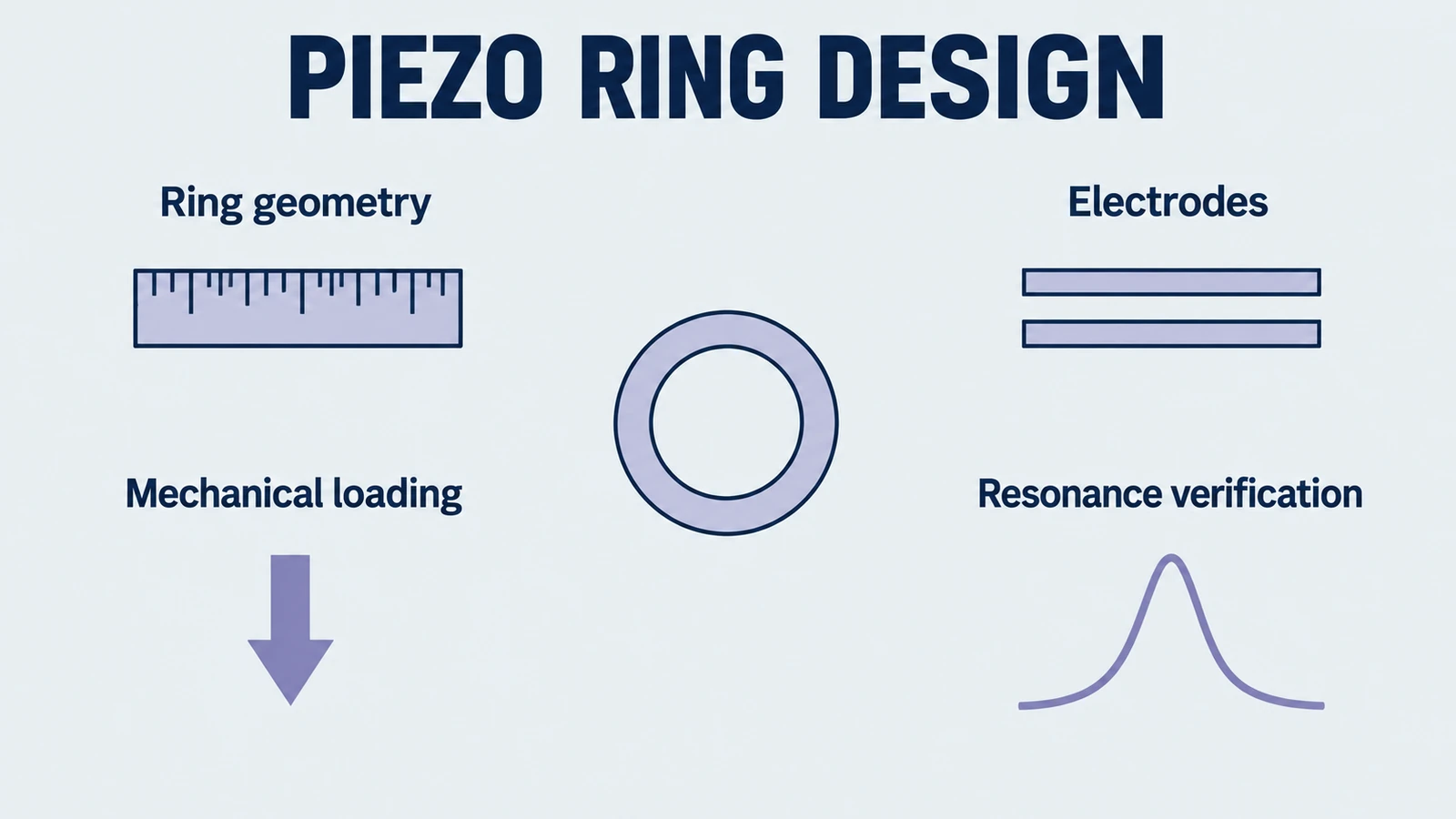
At the core of the most advanced ultrasonic systems—from medical device programs to high-power industrial welders—lies a component of remarkable precision and power: the piezoelectric ring. This unassuming ceramic element is the engine that converts electrical energy into high-frequency mechanical vibrations with strong efficiency and control.
Its unique geometry and the advanced materials from which it is crafted are not just design choices; they are fundamental enablers of modern ultrasonic technology. The piezoelectric ring serves as the cornerstone for applications ranging from industrial cleaning systems to medical imaging devices.
This guide explains the piezoelectric ring, including its foundational principles, key performance benefits, and common applications across industries. It covers the material science that affects performance and provides a framework for selecting a component for a specific engineering challenge.
The Heart of High-Performance Ultrasound: Deconstructing the Piezoelectric Ring
Product path for this search intent
Match the article topic to the right YJ Piezo product page
Use this article when the choice is not just a shape, but a material tradeoff between sensitivity, loss, coupling, stability, and operating field. For "The Ultimate Guide to Piezoelectric Rings: Powering the Next Wave of Ultrasonic Systems", the practical value is in turning the topic into a measurable selection or sourcing decision.
- PZT Material Hub
Material grades and application tradeoffs
- Piezoelectric Ceramics
Shapes and ceramic manufacturing options
- PZT Material Supplier Hub
Material control, grade selection, and sourcing support
To appreciate the role of the piezoelectric ring, one must first understand the remarkable physical phenomenon that governs its function and the critical engineering problem that its specific shape solves.
The Piezoelectric Effect: A Duality of Energy Conversion
The operation of a piezoelectric ring is rooted in the piezoelectric effect, a property of certain crystalline materials to exhibit a reversible relationship between mechanical stress and electrical charge. This duality is expressed in two distinct modes:
The Direct Piezoelectric Effect (Sensor Mode): When a mechanical force, such as pressure or vibration, is applied to the material, it generates a proportional electrical voltage across its surfaces. This principle is the foundation for sensors, from accelerometers to acoustic hydrophones.
The Inverse Piezoelectric Effect (Actuator Mode): When an electric field is applied across the material, it undergoes physical deformation, changing its shape and dimensions. If an alternating voltage is applied, the material vibrates at the same frequency, generating high-frequency mechanical waves that power all ultrasonic transducers.
The most common material used for high-performance piezoelectric rings is Lead Zirconate Titanate, better known as PZT ceramics. PZT belongs to a class of materials called ferroelectrics. Through a critical manufacturing step called "poling," a strong electric field aligns the microscopic electric dipoles, creating net polarization and unlocking the material's powerful piezoelectric response.
Why a Ring? The Unique Geometric Advantage
While piezoelectric components come in many shapes, the ring geometry dominates high-power ultrasonic applications for a crucial reason: it solves a fundamental material limitation of ceramics. Piezoceramics, like PZT, are exceptionally strong under compression but are brittle with very low tensile strength.
High-power ultrasonic applications, such as ultrasonic welding or industrial cleaning, require the ceramic to vibrate with large amplitudes. These vibrations would generate significant internal tensile stresses during expansion cycles, causing brittle ceramic failure.
The Ring Solution:
The ring shape provides an elegant solution. The central hole allows a high-strength tensioning bolt to pass through, clamping one or more piezoelectric rings between two metal masses—typically a heavy tail mass and a shaped front driver (or horn). This assembly, known as a bolt-clamped Langevin transducer, is the workhorse of power ultrasonics.
The bolt applies significant static compressive force (pre-stress) to the ceramic rings. This pre-stress is calculated to exceed the maximum tensile stress during operation, ensuring the ceramic elements remain in compression across the validated operating range, even at peak vibrational cycles.
Modes of Operation: Generating Precise Motion
The versatility of the piezoelectric ring extends to different types of motion generation. By controlling the electrical field and poling direction of the ceramic, engineers can induce several distinct vibration modes:
- Axial and Radial Displacement: Standard rings with electrodes on flat faces change in both thickness (axial) and diameter (radial) when voltage is applied. This is the most common mode in Langevin transducers for longitudinal waves.
- Shear and Torsional Displacement: Advanced applications require complex movements. By segmenting rings and polarizing each segment in specific patterns, it's possible to generate shear or torsional (twisting) motions for precision positioning and rotary ultrasonic motors.
The Pillars of Performance: Unpacking the Benefits of Piezoelectric Rings
The effectiveness of an ultrasonic system is directly tied to the performance of its core piezoelectric ring components. The benefits of using high-quality rings can be understood through four pillars of performance: efficiency, power handling, amplification, and reliability.
High Energy Conversion Efficiency
The primary function of a piezoelectric ring is energy conversion. The efficiency of this conversion is quantified by a key material property: the electromechanical coupling factor (k).
A material with a higher coupling factor converts a larger fraction of supplied electrical energy into stored mechanical energy, resulting in more powerful acoustic waves for the same electrical input. This leads to superior overall system efficiency, reducing wasted energy and lowering power consumption—critical for battery-operated devices or industrial applications where energy costs matter.
Performance Advantage: High-performance piezoelectric rings are engineered with optimized material formulations to maximize coupling factors, with planar coupling factors (k_p) often reaching values around 0.42 and higher, ensuring efficient energy transfer.
High Power Density and Thermal Stability
In high-power applications like ultrasonic welding or surgery, transducers may operate continuously at high drive levels. This generates internal heat within the piezoelectric ring, and excessive heat can degrade performance, cause frequency shifts, and lead to device failure.
The material property governing this self-heating is dielectric loss (dissipation factor or tanδ). For high-power applications, it's essential to use piezoelectric materials with the lowest possible dielectric loss. This is the primary distinction between "hard" and "soft" PZT materials:
Material Classifications:
"Hard" PZT (PZT-4, PZT-8): Engineered with dopants that reduce dielectric loss and increase stability under high electrical drive. Ideal for continuous high-power applications.
"Soft" PZT (PZT-5): Designed for maximum sensitivity with higher coupling factors, perfect for sensor applications and medical imaging where detecting faint signals is paramount.
Amplified Power Through Stacking
While a single piezoelectric ring can generate ultrasonic vibrations, many applications require power levels far beyond single-element capacity. The ring geometry and Langevin transducer design provide a straightforward method for power amplification: stacking.
Mechanically series-connected rings can add unloaded displacement at a stated per-layer voltage. Acoustic power depends on active volume, circuit, field, preload, mode, acoustic load and losses. Stacking alone does not establish greater output than every larger single element.
This amplified power enables industrial processes requiring intense energy, such as creating cavitation for ultrasonic cleaning or generating frictional melt for ultrasonic welding.
Precision, Speed, and Reliability
Beyond power and efficiency, piezoelectric rings offer performance characteristics essential for modern high-tech systems:
- Frequency Response: Usable ultrasonic frequency depends on the element/assembly resonance, bandwidth, drive electronics and load. A microsecond-scale step response does not establish 20 MHz operation, whose period is 50 ns. Identify a validated device response instead.
- Durability: Piezo ceramics deform mechanically and can fatigue or crack; bonds, electrodes and wiring can also degrade. They may avoid conventional sliding mechanisms, but life and maintenance depend on the validated design and duty.
Transforming Industries: Piezoelectric Rings in Action
The unique combination of power, precision, and reliability offered by piezoelectric rings has made them cornerstone technology across diverse critical industries. From non-invasive medical diagnostics to heavy industrial manufacturing and deep-sea exploration, these components drive innovation.
Medical Technology: Imaging, Sensing, and Device-Level Validation
In the medical field, where precision and reliability can mean the difference between life and death, piezoelectric rings are integral to diagnostic and device-level ultrasound equipment.
Diagnostic Ultrasound Imaging
Diagnostic ultrasound probes can use linear or matrix arrays of rectangular/square elements, annular arrays, single elements and other architectures. Do not generalize every prenatal or cardiology probe as an array of piezoelectric rings; identify the actual probe design.
High-Power Surgical Tools
Stacked piezoelectric rings power minimally invasive surgical instruments:
- Ultrasonic Scalpels: Generate intense vibrations (20-80 kHz) in small blades for precise tissue cutting with simultaneous cauterization
- Phacoemulsification: Standard cataract surgery procedure using ultrasonic probes to emulsify clouded eye lenses
- Dental Scaling: High-frequency vibrations for efficient plaque and tartar removal without enamel damage
Industrial Automation: Power, Efficiency, and Control
In industrial settings, the raw power and efficiency of piezoelectric rings perform tasks difficult or impossible with conventional methods.
Ultrasonic Cleaning
High-power piezoelectric ring transducers bonded to tank bottoms generate intense ultrasonic waves causing acoustic cavitation—the formation and violent collapse of millions of microscopic bubbles. Each bubble implosion creates powerful micro-jets and localized shockwaves that dislodge contaminants from intricate surfaces.
Our professional cleaning transducers are specifically designed for demanding industrial applications.
Ultrasonic Welding
This technique joins materials without adhesives, screws, or external heat. Stacked piezoelectric ring transducers generate high-amplitude vibrations channeled through specialized horns to create intense, localized friction that melts materials in fractions of seconds.
Our precision welding transducers deliver consistency required for high-volume production.
Underwater Acoustics: The Eyes and Ears of the Ocean
Piezoelectric rings are core components in SONAR systems due to their high efficiency and sensitivity. In sonar applications, transducers act as both projectors (transmitting acoustic "pings") and hydrophones (listening for returning echoes).
Marine Applications:
- Commercial/Recreational: Fish finders and depth sounders for seafloor mapping
- Defense/Military: Submarine detection, underwater navigation, mine hunting
- Scientific Research: High-resolution ocean floor mapping and marine ecosystem studies
Our underwater transducers are engineered specifically for marine applications, using materials like Barium Titanate or specialized single-crystal PZT for superior underwater performance.
Engineering Success: Selecting the Optimal Piezoelectric Ring
Choosing the right piezoelectric ring is a critical decision directly impacting ultrasonic system performance, reliability, and cost-effectiveness. This selection process requires deep understanding of material properties and application demands.
Material Selection: "Hard" vs. "Soft" PZT
PZT ceramic formulations are broadly classified into two categories with distinct properties for different applications:
| Material Type | Key Characteristics | Best Applications |
|---|---|---|
| "Hard" PZT (PZT-4, PZT-8) | Lower dielectric loss, higher mechanical quality factor, excellent stability under high electrical drive | Ultrasonic welding, cleaning, sonar projectors, surgical tools |
| "Soft" PZT (PZT-5) | Higher piezoelectric charge constants, higher coupling factors, higher dielectric constant | Sensor applications, low-power actuators, hydrophones, medical imaging probes |
Key Specifications for Your Application
Engineers must consider several key specifications to ensure optimal piezoelectric ring integration and performance:
- Resonant Frequency: Determined by physical dimensions—diameter for radial mode, thickness for thickness mode vibration
- Electrical Properties: Low resonant impedance for efficient power transfer, appropriate capacitance for driver circuit design
- Performance Metrics: High electromechanical coupling factor (k) for efficiency, low dielectric loss (tanδ) for power handling capability
Yujie Piezo: Your Partner in Piezoelectric Ring Innovation
Achieving peak performance in sophisticated ultrasonic systems depends on more than selecting components with correct datasheet specifications. It requires components manufactured with high-quality materials, strong consistency, and backed by deep engineering expertise.
The performance of ultrasonic systems is extremely sensitive to subtle variations in material properties not always apparent from standard datasheets. Components made with inferior materials or inconsistent manufacturing may exhibit excessive heat generation, frequency drift under load, or premature mechanical failure.
The Yujie Advantage:
- Material Mastery: Advanced PZT formulations with industry-leading performance metrics (tanδ≤0.004, d₁₅ up to 950 pC/N)
- High Consistency: Rigorous quality control ensuring every piezoelectric ring performs identically
- Customization Partnership: Unique geometries, specialized formulations, complete transducer assemblies
- Decades of Expertise: Founded in 1996 with practical engineering experience in piezoelectric applications
Conclusion: The Future of Ultrasonic Innovation
The piezoelectric ring is far more than a simple ceramic component. It is a sophisticated, powerful, and precise engine driving innovation across the world's most demanding industries. Its unique geometry masterfully overcomes inherent material limitations of piezoceramics, unlocking immense ultrasonic technology power for medicine, manufacturing, and marine exploration.
The success of any ultrasonic system is fundamentally tied to its core transducer quality. Performance is not dictated by a single parameter, but by optimized balance of electromechanical coupling, dielectric loss, and mechanical stability achieved through advanced material science and precision manufacturing.
Whether you're designing next-generation medical imaging devices, developing high-power industrial welding systems, or engineering advanced sonar for underwater exploration, your system's performance begins with core component quality.
PZT Rings: Quotes & Volume Pricing
Catalog models are examples. We also make common ceramic shapes in the dimensions you need. For simple shapes, send dimensions and quantity; no drawing is needed to start an enquiry.
Ask for volume pricing on larger orders or annual requirements. Samples, custom designs and development enquiries are welcome too.
Engineering decision notes
PZT material and ceramic selection
Use this article when the choice is not just a shape, but a material tradeoff between sensitivity, loss, coupling, stability, and operating field. For "The Ultimate Guide to Piezoelectric Rings: Powering the Next Wave of Ultrasonic Systems", the practical value is in turning the topic into a measurable selection or sourcing decision.
YJ Piezo coordinates PZT ceramic projects with manufacturing support, so material formulation, sintering, polarization, electrode process, and outgoing inspection can be reviewed against the final application.
Selection checks
- Separate sensing needs from high-power actuation needs before comparing d33 or coupling values.
- Check dielectric loss, Qm, Curie temperature, aging behavior, and operating field against the real duty cycle.
- Confirm whether the application needs standard PZT grades or a custom formulation and geometry.
Failure risks
- Choosing only the highest d33 can create heat, drift, or depolarization risk in power ultrasonics.
- A ceramic that performs well in free measurement can fail once bonded, clamped, or loaded.
- Material substitutions without batch testing can change capacitance, resonance, and system tuning.
RFQ details
- Is the part used for sensing, actuation, atomization, cleaning, welding, or measurement?
- What field strength, temperature, duty cycle, and mechanical load will the ceramic see?
- Which values must be controlled: d33, capacitance, resonance, impedance, Qm, or dimensional tolerance?
Relevant YJ Piezo pages
- PZT Material Hub
Material grades and application tradeoffs
- Piezoelectric Ceramics
Shapes and ceramic manufacturing options
- PZT Material Supplier Hub
Material control, grade selection, and sourcing support
Application FAQ
- Is the highest d33 always the best PZT choice?
- No. High d33 can be useful for sensitivity, but high-power ultrasonic systems often need lower loss, higher Qm, better thermal stability, and safer operation under field and stress.
- What makes PZT material selection different from catalog buying?
- The right PZT choice depends on geometry, load, drive field, duty cycle, temperature, and inspection targets. A catalog value is only useful when it is tied to the final assembly conditions.