
The UltraNova2 Ultrasonic Sensor: Redefining Precision Level Measurement in the Age of Automation
1. Introduction: The Imperative of Precision in the Industrial IoT Era
The global industrial landscape is moving from mechanical, manual operational models toward digitized, automated ecosystems. At the foundational layer of this shift lies the sensor. Data quality affects industrial efficiency, and the accuracy, reliability, and durability of the devices gathering this data are important. Among the metrics required for process control—temperature, pressure, flow—level measurement is often challenging. Whether managing aggressive chemical reagents, monitoring a wastewater lift station, or optimizing grain reserves, the ability to determine vessel level needs to be reliable and documented.
Into this demanding arena, Yujie Piezo introduces the UltraNova2 Ultrasonic Sensor. This device is not merely an iteration of existing distance measuring technology; it represents a convergence of advanced materials science, acoustic engineering, and digital signal processing. Engineered with a fully enclosed PVDF (Polyvinylidene Fluoride) housing and boasting an IP68 ingress protection rating, the UltraNova2 is designed to thrive in environments where traditional sensors fail. It addresses the twin pillars of modern industrial sensing: chemical resistance and non-contact precision.
This guide explains the UltraNova2 by covering ultrasonic physics, time-of-flight distance measurement, temperature compensation, and the engineering decisions behind its construction. It also explains why piezoelectric fluoropolymers can be useful in corrosive environments and where the technology may fit, from smart-city waste monitoring to agricultural level measurement. Engineering professionals and system integrators can use these points to decide what needs to be verified in their own installation.
Product path for this search intent
Match the article topic to the right YJ Piezo product page
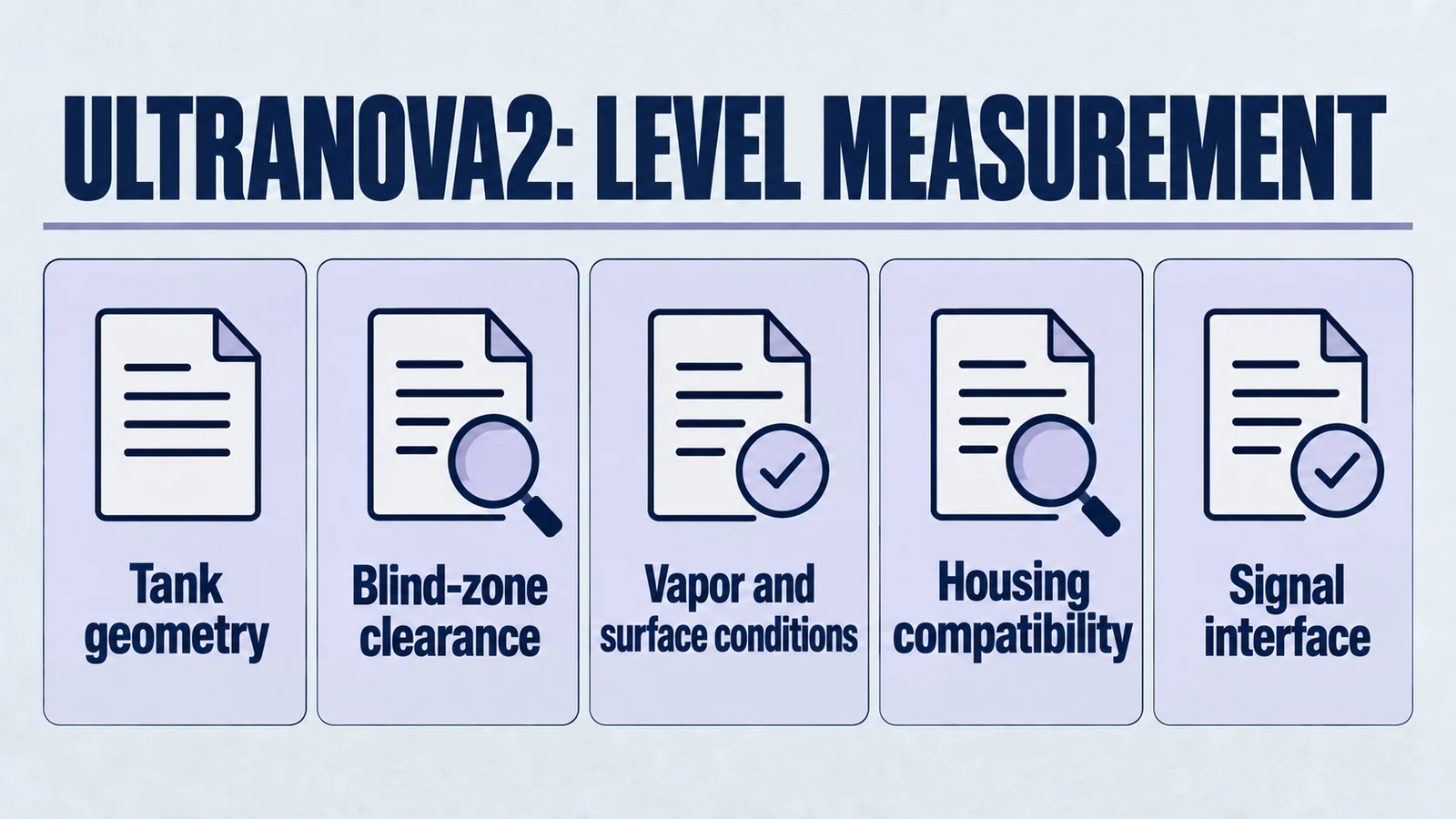
Use this article when sensor performance depends on target distance, beam angle, housing material, liquid behavior, or false echo control. For "The UltraNova2 Ultrasonic Sensor: Redefining Precision Level Measurement in the Age of...", the practical value is in turning the topic into a measurable selection or sourcing decision.
- Ultrasonic Sensors
Distance, level, and detection sensor portfolio
- Flow Measurement Transducers
Bubble and flow-related ultrasonic sensing paths
- Air Acoustic Transducers
Air-coupled transducers for range and presence detection
2. The Physics of Ultrasound: A Deep Dive into Acoustic Sensing
To fully appreciate the capabilities of the UltraNova2, one must first understand the fundamental physical principles that govern its operation. Unlike optical sensors (LiDAR) or electromagnetic sensors (Radar), ultrasonic sensors operate in the mechanical domain. They utilize the propagation of mechanical stress waves—sound—through a medium to interrogate the environment.
2.1 The Nature of Sound Waves and Propagation
"Ultrasonic" refers to acoustic waves with frequencies exceeding the upper limit of human hearing, typically above 20 kHz (20,000 cycles per second). The UltraNova2 operates within this ultrasonic spectrum, likely utilizing frequencies in the range of 40 kHz to 200 kHz depending on the specific model configuration.
Sound is a longitudinal wave. As the transducer of the UltraNova2 vibrates, it creates alternating layers of high pressure (compression) and low pressure (rarefaction) in the air column directly in front of it. These pressure disturbances travel away from the source at the speed of sound (c).
The propagation of these waves is governed by the wave equation:
Where:
- (Lambda) is the wavelength.
- is the speed of sound in the medium.
- is the frequency of the wave.
For a 40 kHz sensor operating in air at room temperature (c ≈ 343 m/s), the wavelength is approximately 8.5 millimeters. This wavelength is a critical parameter; it dictates the resolution of the sensor (the smallest detectable change in distance) and its interaction with objects. A shorter wavelength (higher frequency) allows for better resolution but suffers from higher attenuation (absorption) in the air, reducing the maximum range. The UltraNova2 strikes an engineering balance, selecting frequencies that maximize range while maintaining the precision necessary for tank level gauging.
2.2 The Speed of Sound: The Environmental Variable
The accuracy of any ultrasonic sensor is intrinsically linked to the speed of sound in the propagation medium. In the context of the UltraNova2, this medium is typically the air gap above the liquid in a tank. The speed of sound in a gas is defined by the thermodynamic properties of that gas:
Where:
- (Gamma) is the adiabatic index (1.4 for dry air).
- is the specific gas constant (287 J/kg·K for dry air).
- is the absolute temperature in Kelvin.
In practical terms, this simplifies to the approximation for dry air in degrees Celsius ():
This equation reveals a critical dependency: Temperature. As the temperature rises, air molecules possess higher kinetic energy, transmitting the sound wave faster. A shift from 0°C to 40°C increases the speed of sound from 331 m/s to 355 m/s—a variation of over 7%.
The UltraNova2 Advantage: Without correction, a 7% change in sound speed would result in a 7% error in the calculated distance. For a 5-meter tank, this could mean an error of 35 centimeters—unacceptable for inventory control. The UltraNova2 incorporates an integrated temperature compensation system. A thermistor embedded near the transducer face continuously monitors the ambient air temperature. The sensor’s microprocessor uses this real-time data to adjust the value of c in its calculations, ensuring that the distance reading remains accurate regardless of diurnal temperature cycles or process heat.
2.3 Acoustic Impedance and the Mechanics of Reflection
Why does the sound wave return to the UltraNova2? The phenomenon is known as reflection, and it occurs at the boundary between two materials with different Acoustic Impedances (Z).
Acoustic Impedance is the resistance of a medium to the flow of sound, defined as:
Where is the density of the medium and is the sound speed.
- Air: Extremely low density (≈ 1.2 kg/m3), resulting in very low impedance (Zair ≈ 400 Rayls).
- Water/Liquid: High density (≈ 1000 kg/m3), resulting in high impedance (Zwater ≈ 1,500,000 Rayls).
When the ultrasonic pulse traveling through the air () hits the liquid surface (), the vast mismatch in impedance causes a "hard" reflection. The Reflection Coefficient (R) determines how much energy bounces back:
Because Zwater ≫ Zair, R approaches 1 (or 100%). This means nearly all the acoustic energy is reflected off the liquid surface back toward the sensor.
Implications for UltraNova2:
- Liquid Level: This physics makes the UltraNova2 exceptionally good at detecting liquids. The surface of water, oil, or acid acts like an "acoustic mirror."
- Solids: For solids like grain or sand, the surface is uneven, causing scattering. Instead of a coherent echo, the energy is scattered in many directions. The UltraNova2 utilizes high-sensitivity piezoelectric receivers and advanced gain control algorithms to detect even these weaker, scattered signals, making it suitable for smart agriculture applications (silos).
- Foam: Foam represents a mixture of air and liquid, creating a gradual change in impedance rather than a sharp boundary. This can absorb the sound energy. The UltraNova2’s high-power transmission capability helps punch through light foam, although heavy industrial foam remains a challenge for all acoustic technologies.
2.4 Time-of-Flight (ToF) Calculation
The core logic of the UltraNova2 is the Time-of-Flight (ToF) principle. The sequence of events for a single measurement is as follows:
- Pulse Generation: The microcontroller triggers the piezoelectric transducer to emit a "burst" (typically 8-16 cycles) of ultrasonic waves.
- Clock Start: A high-precision internal timer (t=0) starts simultaneously.
- Propagation: The wave travels distance d to the target.
- Reflection: The wave bounces off the target.
- Return: The echo travels distance d back to the sensor.
- Detection: The transducer vibrates upon impact, generating a voltage. The analog front-end detects this voltage spike.
- Clock Stop: The timer stops (ttotal).
The distance is then calculated:
The division by 2 is necessary because the sound has traveled the path twice (round trip).
While the math is simple, the implementation in the UltraNova2 is sophisticated. Real-world environments are noisy. Pumps cause vibrations; agitators create false echoes; tank walls cause multipath reflections. The UltraNova2 employs Digital Signal Processing (DSP) to analyze the "echo profile," distinguishing the true liquid surface echo from noise. It likely uses Kalman filtering or moving average algorithms to smooth the output data, providing a stable reading even when the liquid surface is turbulent.
3. Product Anatomy: Engineering the UltraNova2
The UltraNova2 is not a generic "hobbyist" sensor; it is an instrument engineered for industrial survival. Its design choices reflect a deep understanding of the failure modes common in harsh environments.
3.1 The Transducer: Piezoelectric Precision
The beating heart of the UltraNova2 is its piezoelectric transducer. Yujie Piezo, as a specialized manufacturer, leverages advanced Lead Zirconate Titanate (PZT) ceramics or Piezo-Polymers (PVDF) in the transducer construction.
- The Piezoelectric Effect: The transducer operates on the principle of electromechanical coupling. When a voltage is applied, the crystal lattice deforms (Inverse Piezoelectric Effect), generating the sound. When sound pressure hits the crystal, it generates a charge (Direct Piezoelectric Effect).
- Material Selection: The UltraNova2 utilizes high-grade piezo materials with a high electromechanical coupling coefficient (k). This efficiency means more electrical energy is converted into sound (stronger pulse) and more returning sound is converted into electricity (better sensitivity). This allows the UltraNova2 to detect targets at longer ranges or with poorer reflectivity compared to standard sensors.
3.2 The Housing: The PVDF Fortress
The most distinctive feature of the UltraNova2 is its PVDF (Polyvinylidene Fluoride) fully enclosed housing. In the world of industrial plastics, PVDF is a titan.
Why PVDF?
- Chemical Resistance: Standard ABS or PVC sensors dissolve or crack when exposed to aggressive industrial chemicals like Sulfuric Acid (H2SO4), Hydrochloric Acid (HCl), Nitric Acid (HNO3), or strong oxidizers like Sodium Hypochlorite (Bleach). PVDF is a fluoropolymer with a stable carbon-fluorine bond, rendering it chemically inert to most acids, bases, and solvents. This allows the UltraNova2 to be installed directly inside chemical storage tanks without risk of corrosion.
- UV Stability: Unlike PVC, which degrades and becomes brittle under sunlight, PVDF is UV stable. This makes the UltraNova2 ideal for outdoor applications, such as open-air wastewater basins or agricultural silos exposed to direct sun.
- High Purity: PVDF is inherently pure and does not leach additives. This is critical for the Food & Beverage and Semiconductor industries, where the sensor must not contaminate the process fluid (e.g., ultrapure water or dairy products).
3.3 Ingress Protection: IP68 Rating
Industrial environments are wet, dirty, and dusty. The UltraNova2 carries an IP68 rating.
- Dust Tight (6): The enclosure rating addresses dust ingress under specified test conditions. It does not establish vacuum-tightness or immunity to every contaminated environment.
- Submersible (8): The "8" signifies protection against continuous immersion in water. While the UltraNova2 is an air-firing sensor, this rating is a fault-default. In wastewater applications, "surcharging" (overflowing) of sewers is common. The UltraNova2 can be submerged by rising floodwaters and will survive, resuming operation immediately once the water recedes. This reliability is critical for unattended remote monitoring sites.
3.4 Versatile Output Interfaces
The UltraNova2 is designed to integrate into diverse control architectures, from legacy analog systems to modern IoT networks. It offers multiple output configurations:
| Output Type | Protocol | Application Use Case |
|---|---|---|
| Analog Current | 4-20 mA | The industrial standard. Highly immune to electrical noise over long cable runs (up to 1km). Used for continuous level monitoring in PLCs (Programmable Logic Controllers). A broken wire is instantly detected (0 mA vs 4 mA). |
| Analog Voltage | 0-10 V | Common in HVAC and Building Management Systems (BMS). Connect only to a compatible analog input; 0–10 V may require scaling, protection and grounding for an Arduino/ESP32. |
| Digital Serial | RS485 electrical interface; verify the supported protocol for the variant | The backbone of IIoT. Allows bi-directional communication. A central computer can read the distance and configure the sensor (e.g., change the address, adjust sensitivity, read temperature). Enables "daisy-chaining" multiple sensors on a single pair of wires. |
| Switching | NPN / PNP | Discrete On/Off control. Used for simple automation: "Turn on pump when tank is full" or "Trigger alarm when tank is empty." No complex controller required. |
4. Operational Mechanics and Installation Strategy
To extract the maximum performance from the UltraNova2, users must understand not just the sensor, but how to install it correctly.
4.1 The Blind Zone (Dead Band)
Every ultrasonic sensor has a minimum distance it cannot measure, known as the Blind Zone. When the piezoelectric crystal pulses, it rings like a bell. During this ringing (decay time), it cannot detect a returning echo. The UltraNova2 is engineered with advanced damping materials to minimize this ringing, typically achieving a blind zone as small as 20-30 cm.
Installation Tip: If the tank needs to be filled to the very top, the UltraNova2 should be mounted on a standpipe (nozzle) that raises the sensor face 30 cm above the maximum liquid level. This ensures the liquid never enters the blind zone, maintaining continuous measurement range.
4.2 Beam Angle and Interference
The UltraNova2 emits sound in a cone shape, typically with a beam angle of 7° to 10°. This narrow beam is a feature, not a bug. It focuses the energy on the liquid surface and avoids hitting the side walls of the tank or internal obstructions like ladders, agitators, or heating coils.
Installation Tip: The sensor must be mounted in a location where its beam path is clear. If an obstruction is unavoidable, the UltraNova2 likely supports "False Echo Suppression" or "Tank Mapping". This feature allows the user to take a "snapshot" of the empty tank. The sensor learns the location of fixed obstructions (like a ladder rung at 2 meters) and memorizes them as "noise" to be ignored, tracking only the moving liquid level.
4.3 Mounting Orientation
Ultrasonic waves behave like light rays hitting a mirror. If the sensor is mounted at an angle, the sound wave will hit the flat liquid surface and bounce away from the sensor, resulting in signal loss.
Requirement: The UltraNova2 must be mounted perpendicular (90°) to the liquid surface. For solid materials (grain, sand) which form a repose angle (a pile), the UltraNova2’s high sensitivity helps, but aiming the sensor at the center of the pile is often best to capture the scattered reflections.
5. Applications: Where the UltraNova2 Transforms Industry
The unique combination of the UltraNova2’s chemically resistant PVDF body and its intelligent digital processing opens up a vast array of application sectors.
5.1 Chemical Processing and Storage
The chemical industry faces a paradox: the liquids that need the most careful monitoring are often the ones that destroy the monitoring equipment.
- The Challenge: Acids like Hydrochloric (HCl) and Hydrofluoric (HF) emit corrosive vapors that attack metals and standard plastics. Contact sensors (floats, pressure transmitters) corrode or get coated in crystals.
- The UltraNova2 Solution: The non-contact nature of the UltraNova2 is the primary safety barrier. It never touches the acid. The PVDF housing is immune to the vapors. By providing continuous 4-20mA level data, the sensor enables Automated Inventory Management—reordering chemicals automatically when tanks get low—and Overfill Protection, preventing hazardous spills that could lead to environmental fines and worker injury.
5.2 Water and Wastewater Treatment
Water is the lifeblood of civilization, and managing it requires robust telemetry.
- Lift Stations: Municipal sewage is collected in lift stations. These deep pits are harsh—high humidity, methane gas, grease, and floating debris. Submersible pressure sensors often clog or fail due to cable damage. The UltraNova2, mounted safely at the top of the well, monitors the level without touching the sewage. Its IP68 rating ensures it survives the corrosive, condensing atmosphere. Its output controls the pump alternation logic, ensuring pumps run efficiently and don't run dry.
- Open Channel Flow: treatment plants measure effluent flow using weirs and flumes. The flow rate (Q) is mathematically related to the head height (H). The UltraNova2 measures this height with millimeter precision. Integrated with a PLC, it provides the totalized flow volume required for regulatory reporting.
5.3 Smart Agriculture and Precision Farming
Farming is becoming a data-driven enterprise.
- Silo Monitoring: Feed and fertilizer are significant costs. Climbing a 20-meter silo to check the level with a tape measure is dangerous and inefficient. The UltraNova2 penetrates the dust in the silo to measure the level of grain or pellets. Connected via LoRaWAN or Cellular IoT gateways (using its RS485 or analog output), it sends data to the cloud. Farmers can view feed levels on their smartphones and optimize delivery truck routing, reducing logistics costs.
- Irrigation Automation: In hydroponics and drip irrigation, nutrient tank levels must be maintained precisely. The UltraNova2 provides the feedback loop for dosing pumps, ensuring crops receive consistent water and nutrients without manual intervention.
5.4 Smart Cities and Environmental Monitoring
- Waste Management: Cities are deploying "Smart Bins." An UltraNova2 mounted inside a trash dumpster measures the fill level. Instead of collecting trash on a fixed schedule (even if the bin is empty), trucks are routed dynamically to collect only full bins. This Route Optimization reduces fuel consumption, traffic congestion, and carbon emissions.
- Flood Warning Systems: UltraNova2 sensors are installed under bridges and in culverts to monitor river levels. Solar-powered and connected wirelessly, they provide early warning of rising waters, allowing authorities to close roads and evacuate areas before flooding occurs.
5.5 Food and Beverage Production
Hygiene is paramount.
- Sanitary Compliance: In food tanks (milk, juice, oils), contact sensors are contamination risks. They have crevices where bacteria (Listeria) can hide. The UltraNova2 is non-contact. It hangs above the food, measuring level without risk of contamination.
- CIP (Clean-In-Place) Stability: Food tanks are washed with hot caustic soda and acid. The PVDF housing of the UltraNova2 withstands these thermal shocks and chemical attacks, ensuring long operational life in hygienic zones.
6. Competitive Analysis: The UltraNova2 Value Proposition
Why choose the UltraNova2 over other technologies?
| Feature | UltraNova2 (Ultrasonic) | Radar (Guided Wave / Free Air) | Capacitive / Conductive | Float / Mechanical |
|---|---|---|---|---|
| Measurement Principle | Acoustic Time-of-Flight | Electromagnetic Time-of-Flight | Dielectric Change | Buoyancy (Mechanical) |
| Contact | Non-Contact | Non-Contact or Contact (Rod) | Contact (Probe) | Contact (Float) |
| Cost | Economical / Moderate | High to Very High | Low to Moderate | Low |
| Chemical Resistance | Excellent (PVDF) | Good (Depends on antenna) | Poor (Probe corrosion) | Poor (Moving parts seize) |
| Foam Handling | Limited (Absorbs sound) | Excellent (Penetrates foam) | Variable | Good |
| Maintenance | Zero (Self-cleaning face) | Low | High (Coating/Buildup) | High (Jamming/Sticking) |
| Reliability | High (Solid State) | High | Moderate | Low |
Analysis:
- Vs. Radar: Radar is the "heavy artillery" of level sensing. It cuts through heavy foam and works in vacuum. However, it is expensive (often 5x-10x the price of ultrasonic). For 90% of liquid applications—water, acids, oils, chemicals—the UltraNova2 provides the same non-contact reliability as radar but at a fraction of the cost, offering a far superior Return on Investment (ROI).
- Vs. Floats: Floats are simple but prone to failure. In dirty or viscous liquids (glue, wastewater), floats get stuck. The UltraNova2 has no moving parts to jam, wear out, or seize. It is a "install and forget" solution.
- Vs. Capacitive: Capacitive sensors rely on the dielectric constant of the liquid. If the liquid changes (e.g., switching a tank from oil to water), the sensor must be recalibrated. The UltraNova2 is independent of the liquid's dielectric properties; it simply measures the distance to the surface, making it versatile for multi-use tanks.
7. Future Outlook: The UltraNova2 in the AI Era
As industries move toward AI-driven decision-making, the role of the UltraNova2 evolves from a simple gauge to a smart data node.
- Predictive Maintenance: By analyzing the rate of change in tank levels, AI algorithms can detect anomalies. For example, a "sawtooth" pattern in a tank level that changes frequency might indicate a leak in the downstream piping or a failing pump. The UltraNova2 provides the high-resolution data needed for this analysis.
- Digital Twins: In the concept of the "Digital Twin," a virtual replica of a factory exists in software. The UltraNova2 provides the real-time physical state of the liquid inventory, ensuring the Digital Twin matches reality.
- Wireless Autonomy: The low power consumption of the UltraNova2 (especially in its digital configurations) makes it ideal for battery-powered, wireless IoT nodes. We will see increasing deployment of UltraNova2 sensors in remote environmental monitoring, powered by small solar panels, transmitting data via satellite or LPWAN to global dashboards.
8. Conclusion
The UltraNova2 Ultrasonic Sensor turns piezoelectricity and acoustics into a practical industrial tool. By addressing chemical compatibility with PVDF, environmental ingress with IP68 sealing, and signal stability with onboard processing, the UltraNova2 can support modern level measurement projects when the installation conditions are verified.
For the chemical engineer, it is a safety device. For the municipal operator, it is an efficiency tool. For the smart city planner, it is a logistics optimizer. In a world that demands data, precision, and durability, the UltraNova2 delivers, proving that the future of industry is not just digital—it is ultrasonic.
Ready to upgrade your industrial sensing capabilities? Contact Yujie Piezo today for precision ultrasonic solutions.
Related Technical Resources
Use these internal references to compare geometry, material selection, reliability testing, and sourcing decisions.
- Spherical Cap vs Hemispherical Piezo Ceramics
- When Not to Use Focused Piezoelectric Ceramics
- How to Choose Radius of Curvature for Focused Piezo Ceramics
- Key Design Parameters for Curved Piezo Elements
- Focused Piezo Ceramics in Medical Ultrasound: Engineering Constraints
- Mode Coupling Risk in Piezo Ceramic Geometry
- Selecting Piezo Ceramics for Continuous Duty Applications
- Common Mistakes Integrating Ultrasonic Transducers into OEM Systems
Engineering decision notes
Ultrasonic sensing and detection
Use this article when sensor performance depends on target distance, beam angle, housing material, liquid behavior, or false echo control. For "The UltraNova2 Ultrasonic Sensor: Redefining Precision Level Measurement in the Age of...", the practical value is in turning the topic into a measurable selection or sourcing decision.
YJ Piezo treats ultrasonic sensing as an acoustic interface problem: transducer frequency, beam shape, housing, drive electronics, and target environment are reviewed together.
Selection checks
- Define target range, dead zone, beam angle, and mounting geometry before choosing the sensor family.
- Check the medium, target surface, temperature swing, foam, vapor, and side-wall risk.
- Separate detection repeatability from ideal lab accuracy when the sensor will operate in a tank, tube, or moving line.
Failure risks
- A sensor can pass bench distance tests and still fail in tanks with foam, agitation, vapor, or narrow geometry.
- Changing only frequency without reviewing beam angle and mounting can increase false echoes.
- Ignoring housing material or sealing requirements can shorten lifetime in washdown or chemical environments.
RFQ details
- What is the minimum and maximum detection distance?
- Is the target liquid, solid, sheet material, air flow, or a moving object?
- What temperature, humidity, IP rating, and output signal does the system require?
Relevant YJ Piezo pages
- Ultrasonic Sensors
Distance, level, and detection sensor portfolio
- Flow Measurement Transducers
Bubble and flow-related ultrasonic sensing paths
- Air Acoustic Transducers
Air-coupled transducers for range and presence detection
Application FAQ
- What makes an ultrasonic sensor page useful for procurement?
- It should connect range, beam angle, output signal, housing, mounting, and environmental limits to a concrete use case. A model name alone is not enough for reliable supplier comparison.
- Which information speeds up an ultrasonic sensor RFQ?
- Send the target material, distance range, installation geometry, output interface, temperature range, IP rating, and whether the application involves foam, vapor, liquid, or moving objects.