
Ultrasonic Bubble Sensors for Medical Devices: Ensuring Fluid Delivery Safety
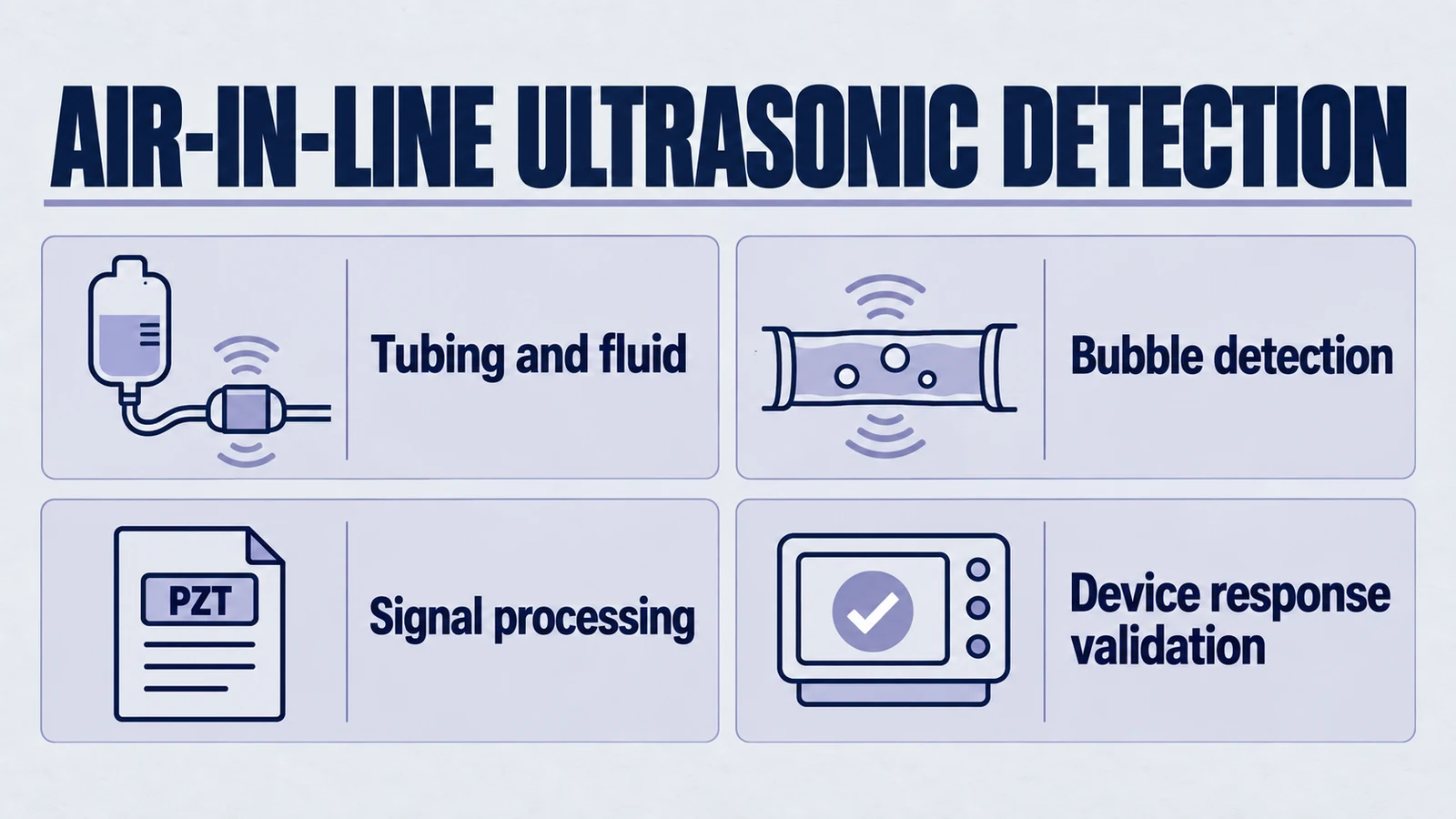
Medical devices that administer fluids, such as infusion pumps and dialysis machines, require documented fluid-path risk controls and finished-device validation. One component that can support this architecture is the ultrasonic bubble sensor, also known as an ultrasonic air bubble detector. This guide explains how these sensors work, what they can contribute at the component level, and what device manufacturers still need to validate in their own systems.
How Ultrasonic Bubble Sensors Work
Ultrasonic bubble sensors leverage advanced ultrasonic technology to detect air bubbles within fluid-filled tubing through completely non-invasive methods. The detection principle operates on acoustic impedance differences:
Detection Mechanism:
- • Ultrasonic Wave Transmission: The sensor transmits high-frequency ultrasonic waves (typically 1-5 MHz) through the tubing wall. Transmission depends on tubing, coupling and fluid; air–liquid interfaces can strongly change the received signal.
- • Real-Time Detection: When an air bubble passes through the sensor's detection zone, the dramatic acoustic impedance mismatch causes wave reflection, changing the received signal; calibrated thresholds, finite response time and host logic determine detection and any alarm or shutdown.
Key Benefits of Ultrasonic Bubble Sensors
1. Non-Invasive Detection
Ultrasonic sensors can operate outside the tubing, helping device designers keep the sensing element out of the fluid path when the tube material and coupling method are properly specified.
2. Immediate Response
Fast detection and clear electrical outputs can help the finished device trigger alarms, pump stops, or control logic according to the manufacturer's validated risk-control strategy.
3. Application-Specific Tubing Compatibility
Compatible with diverse medical tubing materials including PFA, FEP, silicone, PVC, and Tygon. Ultrasonic air bubble detectors require verification for actual tubing material, OD/ID, wall thickness, surface, fluid, temperature, mounting and electronics.
4. Precision Detection
Detection thresholds depend on tubing, fluid, coupling, electronics, and calibration. A sensor can be specified for small air-in-line events only after the target conditions are defined and tested.
Integration Advantages
Compact designs with standardized digital and analog output signals can simplify electrical integration, but host development and system verification remain necessary.
Applications in Medical Device Fluid Systems
Infusion Pumps & IV Therapy
Infusion pumps require careful air-in-line detection, alarm logic, and tubing validation. Ultrasonic bubble sensors can provide non-contact monitoring data without interrupting the fluid path.
- ✓ Detects air-in-line events for the device control system
- ✓ Nonwetted sensing avoids adding wetted parts; sterility remains a validated fluid-path requirement
- ✓ Supports documented fluid-delivery validation
Hemodialysis & Renal Therapy
Dialysis equipment requires controlled blood and dialysate circulation. Ultrasonic detection can support continuous bubble monitoring when the sensor, tubing, and electronics are validated together.
- ✓ Monitors both arterial and venous blood lines
- ✓ Detects micro-bubbles in dialysate circuits
- ✓ Supports alarm and shutdown logic in the finished device
ECMO & Life Support Systems
Extracorporeal circulation systems require meticulous air bubble monitoring as part of a broader validated safety architecture. Ultrasonic air bubble detectors can provide component-level detection input for that architecture.
- ✓ Monitors oxygenator blood circuits
- ✓ Provides air-in-line detection data for validated device response
- ✓ Supports extracorporeal support equipment design reviews
Chemotherapy & Drug Delivery
Advanced drug delivery systems may use ultrasonic sensors to monitor fluid-line conditions and provide feedback to the device controller.
- ✓ Provides sensor input for delivery-system checks
- ✓ Detects air-in-line conditions during fluid delivery
- ✓ Supports validation of fluid-path monitoring logic
Implementation Best Practices
Critical Implementation Guidelines
📋 Material Compatibility Assessment
Verify tubing material acoustic properties for optimal ultrasonic transmission. Consider wall thickness, material density, and acoustic impedance matching.
📍 Strategic Sensor Positioning
Position sensors at optimal locations along fluid pathways to maximize detection accuracy while minimizing false positives from turbulence or flow irregularities.
🔧 Calibration & Maintenance
Implement regular calibration protocols and preventive maintenance schedules according to a justified verification and maintenance plan; calibration alone does not establish regulatory compliance or finished-device safety.
Conclusion: Supporting Medical Device Fluid Monitoring
Ultrasonic bubble sensors are useful components in modern medical fluid systems. Their non-invasive operating principle, fast response, and sensitivity to acoustic impedance changes can support air-in-line monitoring when the complete device architecture is properly validated.
By integrating ultrasonic bubble sensors into medical devices, manufacturers can add a measurable air-in-line signal to their fluid delivery design and verification plan.
Need Bubble Detection Components for a Fluid-Line Design?
Our technical team can discuss piezo ceramic element selection, sensor geometry, tubing fit, and supporting documentation for your evaluation.
Product path for this search intent
Match the article topic to the right YJ Piezo product page
Use this article when sensor performance depends on target distance, beam angle, housing material, liquid behavior, or false echo control. For "Ultrasonic Bubble Sensors for Medical Devices: Ensuring Fluid Delivery Safety", the practical value is in turning the topic into a measurable selection or sourcing decision.
- Ultrasonic Sensors
Distance, level, and detection sensor portfolio
- Flow Measurement Transducers
Bubble and flow-related ultrasonic sensing paths
- Air Acoustic Transducers
Air-coupled transducers for range and presence detection
Engineering decision notes
Ultrasonic sensing and detection
Use this article when sensor performance depends on target distance, beam angle, housing material, liquid behavior, or false echo control. For "Ultrasonic Bubble Sensors for Medical Devices: Ensuring Fluid Delivery Safety", the practical value is in turning the topic into a measurable selection or sourcing decision.
YJ Piezo treats ultrasonic sensing as an acoustic interface problem: transducer frequency, beam shape, housing, drive electronics, and target environment are reviewed together.
Selection checks
- Define target range, dead zone, beam angle, and mounting geometry before choosing the sensor family.
- Check the medium, target surface, temperature swing, foam, vapor, and side-wall risk.
- Separate detection repeatability from ideal lab accuracy when the sensor will operate in a tank, tube, or moving line.
Failure risks
- A sensor can pass bench distance tests and still fail in tanks with foam, agitation, vapor, or narrow geometry.
- Changing only frequency without reviewing beam angle and mounting can increase false echoes.
- Ignoring housing material or sealing requirements can shorten lifetime in washdown or chemical environments.
RFQ details
- What is the minimum and maximum detection distance?
- Is the target liquid, solid, sheet material, air flow, or a moving object?
- What temperature, humidity, IP rating, and output signal does the system require?
Relevant YJ Piezo pages
- Ultrasonic Sensors
Distance, level, and detection sensor portfolio
- Flow Measurement Transducers
Bubble and flow-related ultrasonic sensing paths
- Air Acoustic Transducers
Air-coupled transducers for range and presence detection
Application FAQ
- What makes an ultrasonic sensor page useful for procurement?
- It should connect range, beam angle, output signal, housing, mounting, and environmental limits to a concrete use case. A model name alone is not enough for reliable supplier comparison.
- Which information speeds up an ultrasonic sensor RFQ?
- Send the target material, distance range, installation geometry, output interface, temperature range, IP rating, and whether the application involves foam, vapor, liquid, or moving objects.