
The Unforgiving Washdown: An Engineering Analysis of Sensor Survival in Chemical and Hygienic Environments
Introduction: The Washdown Reliability Problem
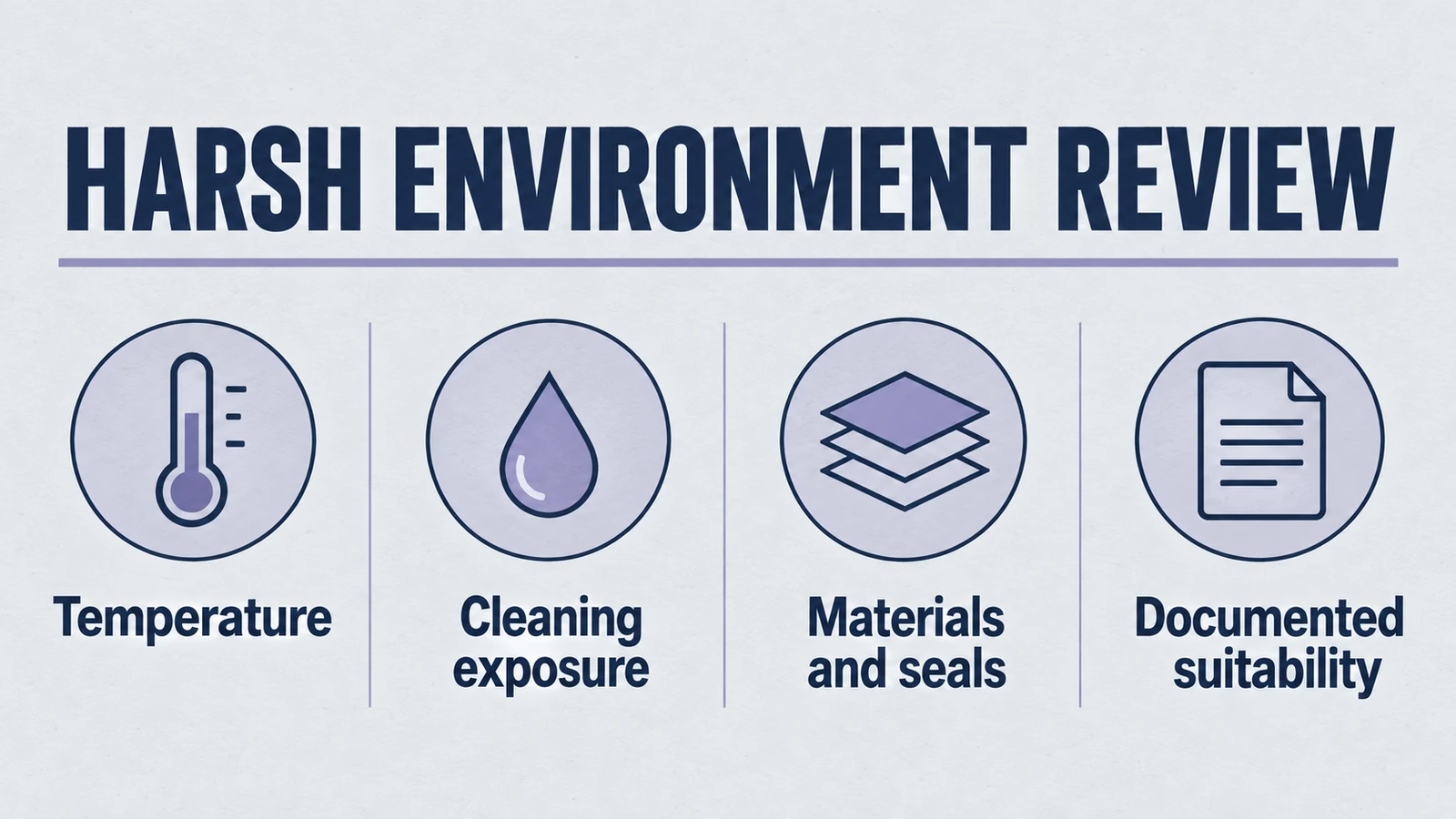
In food, beverage, and hygienic production lines, sensors may be exposed to steam, detergents, high-pressure spray, and rapid thermal cycling. A sensor that looks acceptable on a datasheet can still fail if the housing material, seal design, acoustic face, and cleaning chemistry are not matched to the real environment.
One common failure mode is a level sensor that reports the wrong tank state after repeated washdown exposure. The root cause may not be the electronics alone; it can be material degradation, seal movement, moisture ingress, or acoustic-face damage.
On inspection, the issue may appear as cracked plastic, chalking, embrittlement, adhesive failure, or moisture ingress around the acoustic face. Even when the sensor carries an IP rating, repeated exposure to caustic wash, acid rinse, sanitizer, hot water, and cold rinse cycles can stress materials in ways that a short laboratory water test does not fully represent.
Product path for this search intent
Match the article topic to the right YJ Piezo product page
Use this article when sensor performance depends on target distance, beam angle, housing material, liquid behavior, or false echo control. For "The Unforgiving Washdown: An Engineering Analysis of Sensor Survival in Chemical and Hy...", the practical value is in turning the topic into a measurable selection or sourcing decision.
- Ultrasonic Sensors
Distance, level, and detection sensor portfolio
- Flow Measurement Transducers
Bubble and flow-related ultrasonic sensing paths
- Air Acoustic Transducers
Air-coupled transducers for range and presence detection
Why does this happen? IP69K and chemical-resistance statements are useful starting points, but they do not replace compatibility review for the actual cleaning agents, concentration, temperature, exposure time, mounting angle, and maintenance cycle.
The reliability of washdown sensors is therefore not just about water. It combines polymer chemistry, seal design, acoustic coupling, thermal shock, hydrolysis, and oxidative stress. In a datasheet, "waterproof" is a rating. In a CIP environment, durability is an operating-envelope question.
This guide explains why many "waterproof" plastics fail in washdown environments. It covers hydrolysis, environmental stress cracking, and why stainless steel—especially 316L alloy—is often selected for sensors in these zones. It also addresses the engineering challenge of making ultrasonic sound waves travel through solid steel, the chemical interactions of the cleaning process, and a practical roadmap for selecting components that can survive repeated washdown. For more on sensor materials, see our piezoelectric material specifications and explore how piezoelectric ceramic geometries affect performance.
The sections below separate the rating language from the engineering checks that usually matter in washdown service.
Part I: The Illusion of Protection – Deconstructing and Debunking IP Ratings
To understand why sensors fail, we must first rigorously examine the yardstick we use to measure them: the Ingress Protection (IP) rating system. In the industrial world, IP67, IP68, and IP69K are the gold standards, frequently cited in procurement specifications. However, they are frequently misunderstood by engineers and purchasers alike as a linear progression of "better." They are not. They are fundamentally different tests designed to simulate different threats, and passing one does not by itself confirm survival against another.
1.1 IP67: The Static Immersion Standard
The IP67 rating, defined by the International Electrotechnical Commission (IEC) standard 60529, combines dust-tight enclosure protection with protection against harmful effects of temporary water immersion. IPX7 is the immersion designation alone; IP67 does not by itself establish resistance to hot pressure jets or cleaning chemicals. The code itself is a two-digit indicator. The first digit, '6', indicates total protection against the ingress of dust. This means that under a vacuum depression, no dust particles are permitted to enter the enclosure. The second digit, '7', indicates protection against the effects of temporary immersion in water.
The Test Protocol:
The device is submerged in a tank of fresh water. The lowest point of the enclosure is located 1000 mm below the surface of the water, and the highest point is located at least 150 mm below the surface. The duration of the test is 30 minutes.
The Engineering Reality:
Think of IP67 as a "still water" rating. It simulates a sensor falling into a puddle, being dropped into a toilet, or being submerged in a calm tank during a flood. From a mechanical sealing perspective, this test relies on static seals—O-rings, gaskets, and potting compounds—maintaining their integrity under relatively low, constant hydrostatic pressure (approximately 0.1 bar at 1 meter depth). It is a test of the seal's ability to resist passive water entry. It says absolutely nothing about high pressure, high temperature, dynamic impact, or chemical compatibility. A sensor can be perfectly IP67 rated and fail within seconds of being hit by a garden hose, let alone an industrial pressure washer.
1.2 IP68: The Continuous Submersion Standard
IP68 is often cited as "better" than IP67, but it is actually just an extension of the immersion principle. The test conditions for IP68 are subject to agreement between the manufacturer and the user, but they must be more severe than IP67. Typically, this implies continuous immersion at a depth greater than 1 meter.
The Misconception:
Crucially, simply seeing "IP68" does not by itself confirm a specific depth or duration unless specified. It addresses water ingress under the specified immersion conditions; it does not establish gas-tight or hermetic sealing. However, like IP67, it is a static test. It does not account for the dynamic violence of a washdown. A sensor sitting at the bottom of a 10-meter deep tank (1 bar pressure) is under a very different stress load than a sensor being blasted by a 100-bar water jet. The former is a crushing force; the latter is an impact force.
1.3 IP69K: The Violence of Washdown
Distinguish the applicable standard and edition: DIN 40050-9 is withdrawn; ISO 20653 addresses road-vehicle enclosure protection using K designations, while IEC 60529 includes high-pressure/high-temperature water-jet testing with its own designation and requirements. Do not assume the tests are identical from the shorthand label. Request the exact test report for the complete sensor.
The Test Protocol:
The rigors of the IP69K test are designed to simulate the worst-case scenario of a sanitation worker cleaning equipment with specified hot-water jets. An 80°C water test is not steam exposure or chemical-process qualification.
- Pressure: The water jet is pressurized to between 80 and 100 bar (1160 to 1450 psi). To put this in perspective, a standard car tire is 30 psi. This is a force capable of stripping paint and cutting through soft materials.
- Temperature: The water is heated to 80°C (176°F). This introduces significant thermal stress, expanding the air inside the sensor and softening the sealing materials.
- Flow Rate: 14 to 16 liters per minute.
- Distance: The nozzle is held merely 100 to 150 mm (4 to 6 inches) from the sensor.
- Angles: The spray attacks from 0°, 30°, 60°, and 90° relative to the horizontal.
- Rotation: The device sits on a turntable rotating at 5 RPM to ensuring every seam and crevice is bombarded.
The Engineering Implications:
This test evaluates the mechanical strength of the housing and the ability of the seals to resist deflection under high kinetic energy. A rubber gasket that holds back 1 meter of static water (IP67) might deform and gap open under the 100-bar impact of an IP69K jet. The housing itself must be rigid enough not to flex and break the seal line.
1.4 The "Gap" in the Standards: Why Rated Sensors Still Fail
Here lies the critical insight that explains the 3:00 AM failure: Neither IP67, IP68, nor IP69K tests for chemical compatibility or long-term thermal cycling.
The IP ratings are purely physical tests conducted with fresh water. They verify that the mechanical design can seal. They do not verify that the materials used to build that seal will survive the environment.
- Chemical Blindness: A sensor can pass IP69K under the specified fresh-water jet test conditions. But in a dairy plant, that sensor isn't exposed to fresh water for minutes; it is exposed to 2% Sodium Hydroxide (Caustic Soda) at 80°C for 45 minutes, followed immediately by a cold water rinse, followed by a Nitric Acid wash, followed by a Peracetic Acid sanitizer. This happens every single day, often multiple times a day.
- Time Blindness: The IP tests are short-term. They do not account for the cumulative degradation of polymers. A seal might hold for the first week, but after 100 hours of exposure to caustic soda, the elastomer may harden and crack. The next time the pressure washer hits it, the water breaches the compromised seal.
- Thermal Shock Blindness: While IP69K uses hot water, it does not simulate the rapid cooling of a post-cleaning rinse. The sudden contraction of a hot plastic housing against a cooler metal connector or epoxy potting can create a momentary gap—a "breathing" effect—that sucks moisture into the unit.
When a plastic sensor fails in a washdown zone, it is rarely because the mechanical design wasn't "tight" enough. It is because the material itself degraded, chemically and physically, until the IP rating became irrelevant. The seal didn't leak; the wall holding the seal disintegrated.
Part II: The Chemistry of Failure – Why Plastics Surrender
In the pursuit of cost-effectiveness and mass production, many "washdown-rated" sensors are housed in engineering thermoplastics like PBT (Polybutylene Terephthalate) or ABS (Acrylonitrile Butadiene Styrene). While these materials are robust in dry, room-temperature assembly lines, they suffer severe failure modes in the presence of the "Sinners Circle" of cleaning: Time, Action, Chemicals, and Temperature. To understand these failures, we must delve into the polymer chemistry.
2.1 PBT and the Scourge of Hydrolysis
PBT is a crystalline polyester, widely chosen for sensor housings because of its excellent electrical properties, mechanical strength, and general resistance to solvents. It molds well and holds tight tolerances. However, PBT has a fatal Achilles' heel in wet, hot environments: Hydrolysis.
The Molecular Mechanism:
Hydrolysis is, quite literally, "water-splitting." The PBT polymer chain is held together by ester linkages (−CO−O−). These linkages are chemically similar to fats. Under conditions of high humidity and high temperature—conditions that define a steam clean or a hot CIP cycle—water molecules act as a nucleophile. They attack the carbonyl carbon of the ester group, cleaving the polymer chain.
The reaction can be summarized as:
R-COO-R' + H₂O → R-COOH + R'-OH
The long polymer chain is split into two shorter chains: one ending in a carboxylic acid group (−COOH) and the other in an alcohol group (−OH).
The Autocatalytic Spiral:
Crucially, the carboxylic acid group formed by this split is acidic. It lowers the local pH within the polymer matrix. Since acid catalyzes hydrolysis, the presence of this breakdown product accelerates the degradation of the remaining chains. This creates an autocatalytic effect: once hydrolysis starts, it proceeds faster and faster.
The Visible Symptoms:
- Embrittlement: As the molecular weight of the polymer drops due to chain scission, the material loses its ability to stretch and absorb energy. The housing, once tough and ductile, becomes glass-like and brittle.
- Crumbing: In advanced stages, the surface of the sensor housing may literally turn to powder. You might wipe a finger across the sensor face and come away with white dust. This is the polymer matrix disintegrating.
- Loss of Dielectric Strength: Water molecules, now chemically integrated into the matrix or occupying the voids left by degradation, change the electrical properties of the housing. This can lead to internal tracking and short circuits, even if no liquid water is visible inside the unit.
2.2 ABS and Environmental Stress Cracking (ESC)
ABS is another common plastic, often used in cheaper sensors, mounting brackets, or peripheral components. Unlike PBT, ABS is an amorphous polymer. Its molecular chains are randomly arranged, like a bowl of cooked spaghetti, creating pockets of "free volume" between them. This structure gives ABS its impact resistance but makes it particularly susceptible to Environmental Stress Cracking (ESC).
ESC is the leading cause of plastic part failure, estimated to account for 25% to 40% of all plastic failures in the field. It is an insidious failure mode because it is not a chemical reaction that changes the polymer's identity (like hydrolysis); rather, it is a physical interaction that breaks the material apart.
The Mechanism of Crazing:
ESC requires three simultaneous factors:
- A Susceptible Polymer (e.g., ABS, Polycarbonate, Polystyrene).
- A Chemical Agent (e.g., surfactants, oils, organic solvents, alcohols).
- Tensile Stress (e.g., from molding, screw torque, thermal expansion, or interference fits).
When a cleaning agent (especially one containing surfactants or organic solvents) contacts the surface of ABS under tension, the fluid penetrates the microscopic "free volume" between the polymer chains. The chemical acts as a localized plasticizer, lubricating the chains and allowing them to slide past each other more easily. This effectively lowers the yield strength of the material at that specific point.
Under the influence of the tensile stress, microscopic voids form in the plasticized regions. These voids align perpendicular to the stress vector. They coalesce into a network of fine, fibrillar bridges known as "crazes". Crazes are capable of load-bearing for a time, but they are the precursors to cracks.
The "Time Bomb" Effect:
Unlike a brittle fracture which happens instantly upon impact, crazing is a slow-growth process. A sensor might look perfect for months. The cleaning agents are slowly penetrating; the stress is constant. Then, one day, the accumulated effect reaches a critical threshold. The crazes yield, the fibrils snap, and a macroscopic crack opens up. The housing splits, water enters, and the sensor dies. This is often why sensors fail "for no reason" after a year of service.
2.3 The Verdict on Plastics
While high-performance plastics like PEEK or PVDF offer excellent resistance to this chemistry, they are expensive and typically reserved for specialized applications. The vast majority of standard "industrial" sensors use PBT, ABS, or PC housings. These rely on "chemical resistance charts" that often show data for 24-hour exposure at room temperature. These charts are dangerously misleading for CIP applications. They do not account for the cumulative, synergistic effect of high temperature, dynamic pressure, and daily thermal shock over a period of years.
For true reliability in a heavy washdown zone, we must move away from the vulnerability of long-chain polymers and look to the crystalline stability of metals.
Part III: The Stainless Sanctuary – Metallurgy for Hygiene
Stainless steel is the undisputed standard-bearer for hygienic design. It is the material of choice for tanks, pipes, and valves. But in the world of industrial sensors, simply specifying "stainless steel" is insufficient. The distinction between the common 304 grade and the superior 316L grade is the difference between a sensor that lasts ten years and one that rusts into failure in six months.
3.1 304 vs. 316L: The Molybdenum Difference
Standard stainless steel, known as 304 grade (UNS S30400), is an austenitic alloy containing Iron, Chromium (~18%), and Nickel (~8%). Its corrosion resistance comes from the Chromium, which reacts with oxygen in the air to form a passive, invisible layer of Chromium Oxide (Cr₂O₃). This layer seals the surface and prevents the iron from oxidizing (rusting).
However, in the food industry, we frequently deal with chlorides. Chlorides are present in saltwater brines, in sodium hypochlorite (bleach), and in many water sources. Chloride ions are aggressive; they have the ability to penetrate the passive chromium oxide layer, creating microscopic pits. Once a pit forms, it creates a localized galvanic cell, leading to rapid, burrowing corrosion known as pitting corrosion. 304 stainless steel is highly susceptible to this in chloride-rich environments.
Enter 316L Stainless Steel:
To combat this, metallurgists developed the 316 grade. The key difference is the addition of Molybdenum (2-3%) to the alloy recipe. Molybdenum drastically improves the stability of the passive film and, crucially, increases its ability to reform quickly if damaged. It acts as a fortress builder against chloride attack.
The "L" Factor:
The "L" in 316L stands for "Low Carbon" (Carbon content < 0.03%, compared to 0.08% in standard 316). This is vital for welded components, such as the seams of a sensor body. In standard 316 steel, high temperatures (like those during welding) can cause carbon to migrate to the grain boundaries and bind with chromium, forming chromium carbides. This "precipitation" depletes the chromium available to form the passive layer at the weld, leading to intergranular corrosion. By lowering the carbon content, 316L prevents this sensitization, ensuring the weld is as corrosion-resistant as the rest of the body.
Part IV: The Physics of Sound in Solids – The Core Engineering Challenge
If 316L stainless steel is the perfect material for survival, why aren't all ultrasonic sensors made of it? Why do we still see so many plastic or foam-faced sensors in the field?
The answer lies in the fundamental physics of acoustics. Specifically, the problem of Acoustic Impedance Mismatch.
Inductive sensors (which detect metal targets) can easily work through a steel face because magnetic fields can penetrate stainless steel. Photoelectric sensors can use glass or sapphire windows sealed into the steel. But Ultrasonic Sensors—which use sound waves to measure level and distance—face a massive, almost insurmountable hurdle when trying to transmit through steel.
4.1 The Piezoelectric Heart
Ultrasonic sensors operate by generating a high-frequency sound wave (typically 40 kHz to 400 kHz) using a Piezoelectric Transducer. This transducer is typically a ceramic disk made of PZT (Lead Zirconate Titanate). When an electrical voltage is applied across the PZT crystal, its dipole domains align, causing the crystal to physically deform. If an alternating voltage is applied, the crystal vibrates, generating a sound wave.
4.2 The Impedance Wall
For the sensor to function, the sound energy must transfer from the PZT crystal, through the sensor face (the housing), into the air, and then back again. Sound travels differently through different materials. The resistance a material offers to the passage of sound is called its Acoustic Impedance (Z). It is defined as the product of the material's density (ρ) and the speed of sound in that material (c).
Z = ρ · c
- Air: Z ≈ 0.0004 MRayls
- Water: Z ≈ 1.48 MRayls
- PZT (Ceramic): Z ≈ 30 to 35 MRayls
- Stainless Steel (316L): Z ≈ 45 to 46 MRayls
The Physics of Reflection:
When sound moves from one medium to another, the amount of energy reflected at the boundary depends on the difference in impedance. If we try to transmit sound from a solid Stainless Steel face (Z=46) directly into Air (Z=0.0004), approximately 99.996% of the sound energy is reflected back into the sensor face. Only 0.004% of the energy escapes into the air. Reciprocally, when the echo returns, only 0.004% of that tiny signal makes it back into the steel face. The total two-way transmission efficiency is infinitesimally small. The sensor is effectively deaf and mute. This is the "Impedance Wall."
4.3 Breaking the Wall: The "Full Metal" Solution
To build a sensor that is both "Full Metal" (for survival) and functional (for sensing), engineers must employ advanced physics tricks: Resonance Tuning and Acoustic Matching Layers.
The Half-Wave Design (λ/2):
In "Full Metal" sensors, the stainless steel face is not just a protective cover; it is an active acoustic element. The thickness of the steel face is machined with extreme precision to exactly one-half of the wavelength (λ/2) of the sound wave in steel at the resonant frequency. At resonance, a plate that is λ/2 thick becomes "acoustically transparent." The wave reflections from the front and back surfaces of the plate cancel each other out, allowing the transmission to pass through.
The Supply Chain: Yujie and Component Engineering
Companies like Yujie Piezo play a critical role here. They manufacture the raw piezoelectric ceramic elements and specialized transducers that go into these industrial sensors. They produce PZT elements with specific resonant frequencies and geometries (rings, discs) to match the specific resonant modes of the stainless steel housings designed by sensor integrators. Building a 316L ultrasonic sensor is not just about machining a piece of steel; it is about tuning a complex electromechanical system where the housing, the glue, and the ceramic must sing in perfect harmony.
Part V: The Chemical Deep Dive – Understanding the "Sinners Circle"
We have established that plastics fail and steel survives. But to fully protect a plant, we must understand the specific chemical agents involved in the Clean-in-Place (CIP) and Sterilize-in-Place (SIP) cycles.
5.1 The Dairy Cycle: Fighting Fat
- The Enemy: Milk fat and denatured protein.
- The Weapon: High-Alkalinity Caustic Soda (Sodium Hydroxide, NaOH).
- Impact on Sensors:
- Plastics: Hot caustic hydrolyzes polyesters (PBT) and attacks glues.
- Steel: 316L is highly resistant to caustic corrosion. The passive layer holds up well in high pH.
5.2 The Brewery Cycle: Fighting Stone
- The Enemy: Mineral scale (Beerstone).
- The Weapon: Acid Blend (Nitric Acid + Phosphoric Acid).
- Impact on Sensors:
- Plastics: Nitric acid is an oxidizer. It can degrade ABS and standard rubber seals.
- Steel: Paradoxically, Nitric Acid is beneficial for 316L steel. It is the very chemical used to passivate steel. Regular acid cycles in a brewery actually help maintain the corrosion resistance of 316L sensors, provided they are rinsed properly.
5.3 The Meat & Poultry Cycle: The Pressure & Sanitizer
- The Weapon: High-pressure manual washdown followed by Peracetic Acid (PAA).
- The Connector Weak Point: In these zones, the sensor head might survive, but the cable fails. PAA attacks the polyurethane (PUR) or PVC cable jacket, causing it to swell or crack. Once the jacket breaches, the sanitizer wicks down the copper wire via capillary action, entering the sensor from the back and corroding the PCB.
- Solution: Use IP69K rated cables with PP (Polypropylene) or specialized TPE jackets, and 316L stainless steel coupling nuts on the connectors.
Part VI: Application & Troubleshooting – Managing the Assets
6.1 Installation Best Practices
Even a 316L sensor can fail if installed poorly.
- Mounting Torque: When installing a sensor into a tank, do not over-torque the nuts. Even on a steel sensor, excessive torque can distort the piezoelectric element inside, shifting its resonant frequency and killing the signal. Use a torque wrench set to the manufacturer's spec.
- Drainage Angle: Never mount a sensor perfectly flat if it can be avoided. Mount it at a slight angle (1-3 degrees) or use a housing with a convex face. This allows condensation droplets (which form during the cool-down after CIP) to roll off. A water droplet on the face of an ultrasonic bubble detection sensor changes the acoustic impedance and can cause false readings.
- Cable Loops: Always include a "drip loop" in the cable before it enters the sensor. This ensures that water running down the cable drips off the bottom of the loop rather than being funneled directly into the connector nut.
6.2 Visual Troubleshooting Guide
| Symptom | Diagnosis | Mechanism |
|---|---|---|
| Yellowing / Chalking | Chemical Attack | Polymer oxidation. Surface porosity increased. |
| Spiderweb Cracks | Environmental Stress Cracking (ESC) | Chemical agent + Tensile stress (torque). |
| Swollen Cable Jacket | Chemical Absorption | Sanitizer (PAA) absorption into PVC/PUR. |
Conclusion: The Economics of "Fit and Forget"
In food and beverage manufacturing, the initial purchase price of a component can be a misleading metric if the environment is chemically aggressive. A standard plastic-faced ultrasonic sensor may have a lower purchase price than a specialized full-metal 316L ultrasonic sensor, but purchase price is only one part of the comparison.
To a procurement officer, the plastic sensor may look like the better buy. However, a Total Cost of Ownership (TCO) comparison should include replacement labor, cleaning interruption, downtime risk, product loss, and qualification work. If stainless steel improves compatibility with the cleaning environment, its higher purchase price can be justified by fewer replacement events.
The science is irrefutable. The combination of hydrolytic degradation, environmental stress cracking, and the brutal mechanics of IP69K washdown makes standard plastics a liability in hygienic zones. By understanding the physics of acoustic impedance matching and the metallurgy of molybdenum-alloyed steel, reliability engineers can justify the investment in "Full Metal" technology.
It is time to stop treating sensors as cheap consumables and start treating them as permanent, critical plant infrastructure. The next time you are designing a tank level system or replacing a cracked unit, look past the "IP69K" sticker. Look at the material. Look at the chemistry. And when in doubt, choose steel.
Your 3:00 AM self will thank you.
Engineering decision notes
Ultrasonic sensing and detection
Use this article when sensor performance depends on target distance, beam angle, housing material, liquid behavior, or false echo control. For "The Unforgiving Washdown: An Engineering Analysis of Sensor Survival in Chemical and Hy...", the practical value is in turning the topic into a measurable selection or sourcing decision.
YJ Piezo treats ultrasonic sensing as an acoustic interface problem: transducer frequency, beam shape, housing, drive electronics, and target environment are reviewed together.
Selection checks
- Define target range, dead zone, beam angle, and mounting geometry before choosing the sensor family.
- Check the medium, target surface, temperature swing, foam, vapor, and side-wall risk.
- Separate detection repeatability from ideal lab accuracy when the sensor will operate in a tank, tube, or moving line.
Failure risks
- A sensor can pass bench distance tests and still fail in tanks with foam, agitation, vapor, or narrow geometry.
- Changing only frequency without reviewing beam angle and mounting can increase false echoes.
- Ignoring housing material or sealing requirements can shorten lifetime in washdown or chemical environments.
RFQ details
- What is the minimum and maximum detection distance?
- Is the target liquid, solid, sheet material, air flow, or a moving object?
- What temperature, humidity, IP rating, and output signal does the system require?
Relevant YJ Piezo pages
- Ultrasonic Sensors
Distance, level, and detection sensor portfolio
- Flow Measurement Transducers
Bubble and flow-related ultrasonic sensing paths
- Air Acoustic Transducers
Air-coupled transducers for range and presence detection
Application FAQ
- What makes an ultrasonic sensor page useful for procurement?
- It should connect range, beam angle, output signal, housing, mounting, and environmental limits to a concrete use case. A model name alone is not enough for reliable supplier comparison.
- Which information speeds up an ultrasonic sensor RFQ?
- Send the target material, distance range, installation geometry, output interface, temperature range, IP rating, and whether the application involves foam, vapor, liquid, or moving objects.