
Ultrasonic Transducers in Agriculture: Pest Control and Crop Monitoring
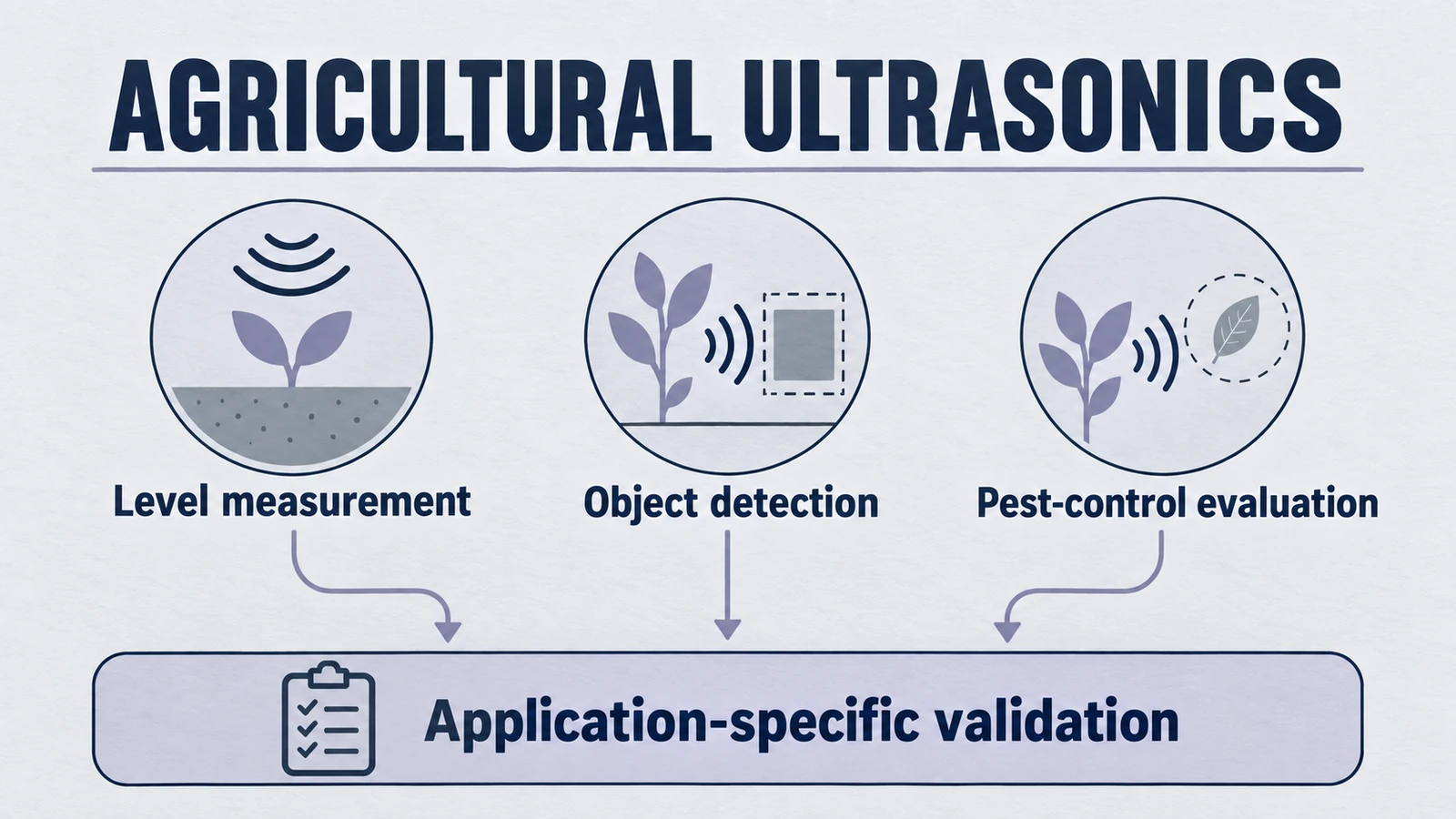
Agriculture is adding more sensor-driven tools for monitoring, automation, and resource control. Ultrasonic transducers convert electrical signals into ultrasonic waves and can be used in some pest deterrence and crop monitoring systems. Their usefulness depends on the target species, installation geometry, weather exposure, and field validation.
What Are Ultrasonic Transducers?
An ultrasonic transducer is a device that emits and receives high-frequency sound waves, typically above 20 kHz, which are beyond the range of human hearing. In agricultural applications, these devices are designed to:
- Repel or disrupt pests using targeted ultrasonic frequencies.
- Monitor crop conditions through precise sensing of growth, density, or even water levels in soil and plants.
Product path for this search intent
Match the article topic to the right YJ Piezo product page
Use this article when sensor performance depends on target distance, beam angle, housing material, liquid behavior, or false echo control. For "Ultrasonic Transducers in Agriculture: Pest Control and Crop Monitoring", the practical value is in turning the topic into a measurable selection or sourcing decision.
- Ultrasonic Sensors
Distance, level, and detection sensor portfolio
- Flow Measurement Transducers
Bubble and flow-related ultrasonic sensing paths
- Air Acoustic Transducers
Air-coupled transducers for range and presence detection
The versatility of ultrasonic transducer agriculture applications makes them a useful element in some precision farming systems. For those interested in the fundamental technology, our guide to PZT piezoelectric ceramics explains the core materials used in many ultrasonic devices.
Ultrasonic Pest Control: A Sustainable Approach
Traditional pest control relies heavily on chemical pesticides, which can cause long-term damage to the environment, soil quality, and human health. Ultrasonic pest control provides an alternative by using sound waves to deter pests.
1. How It Works
Ultrasonic pest deterrence requires species-, device- and environment-specific controlled trials, including habituation and non-target effects. Do not present ultrasound as an established bird deterrent; audible sonic/bioacoustic bird methods are different. Piezoelectric sensing components do not themselves demonstrate pest-control efficacy.
2. Advantages of Ultrasonic Pest Control
- Reduced Chemical Use: Can help reduce pesticide dependence in a broader integrated pest-management plan.
- Non-Contact: Can be deployed without direct crop contact; field safety and ecological impact still require application-level validation.
- Cost-Effective: Once installed, these devices require minimal maintenance compared to repeated pesticide applications.
By integrating ultrasonic pest control systems, farmers can enhance crop protection while aligning with sustainable agriculture goals. Learn more about the underlying principles in our article on ultrasonic transducer working principles.
Crop Monitoring with Ultrasonic Transducers
Beyond pest control, ultrasonic transducers play a vital role in monitoring crop health and growth conditions.
1. Applications in Crop Monitoring
- Plant Growth Measurement: Ultrasonic sensors can measure plant height and density, providing real-time insights into crop development.
- Irrigation Management: By assessing soil moisture levels indirectly, ultrasonic systems help optimize water use, ensuring efficient irrigation.
- Yield Prediction: Ultrasonic measurements of canopy structure contribute to accurate yield forecasting.
- Precision Agriculture Integration: When combined with drones or automated systems, ultrasonic sensors deliver valuable data for decision-making.
For applications requiring high-precision measurements, our precision distance measurement guide provides detailed insights into maximizing sensor accuracy in agricultural environments.
Yujie's compact MU18 and MU30 ultrasonic distance sensors, together with the SF2 ultrasonic sensor, serve typical short-range automation tasks.
2. Benefits for Farmers
- Data-Driven Farming: Enables farmers to make informed decisions based on real-time data.
- Resource Efficiency: Optimizes the use of water, fertilizers, and other inputs.
- Yield Management: Supports decisions that can improve growing conditions when paired with agronomic validation.
Challenges and Considerations
While ultrasonic transducers present promising applications, several challenges remain:
1. Environmental Factors
Wind, rain, and temperature can affect ultrasonic signal accuracy. Proper system design and calibration are essential to maintain consistent performance in varying weather conditions.
2. Calibration Requirements
Regular calibration is essential for consistent performance. Our piezoelectric disc transducers are designed for stability and minimal drift over time.
3. Initial Investment Considerations
Although cost-effective long term, the upfront expense may deter small-scale farmers. However, the return on investment through reduced chemical costs and improved yields often justifies the initial expenditure.
To address these challenges, proper maintenance is crucial. Our comprehensive guide on maximizing transducer lifespan provides essential maintenance tips for agricultural ultrasonic equipment.
Types of Ultrasonic Transducers for Agricultural Use
1. Pest Deterrent Transducers
Specialized transducers designed to emit specific frequencies that effectively repel agricultural pests without harming beneficial insects.
2. Crop Monitoring Sensors
High-precision sensors for measuring plant parameters, soil conditions, and environmental factors. Our ring transducers are available for OEM teams evaluating custom acoustic geometries.
3. Weather-Resistant Models
Rugged transducers designed to withstand harsh outdoor conditions while maintaining accuracy and reliability in agricultural environments.
The Future of Ultrasonic Transducer Agriculture
As agricultural technology continues to evolve, ultrasonic transducers are poised to play an even greater role. Integration with IoT, AI, and automated systems will expand their capabilities, making ultrasonic transducer agriculture solutions more precise and accessible.
1. Smart Pest Control Systems
Future developments may include smart pest control systems that adapt frequencies dynamically based on real-time pest detection and behavior analysis.
2. Advanced Monitoring Networks
Advanced monitoring networks capable of predicting diseases before visible symptoms appear, enabling proactive crop management. The evolution of Industry 4.0 and smart systems will further enhance the integration of ultrasonic technology in modern farming.
3. Integration with Precision Agriculture
Seamless integration with GPS systems, drones, and automated machinery will create comprehensive agricultural management systems powered by ultrasonic technology.
Choosing the Right Ultrasonic Transducer for Agriculture
1. Frequency Selection
Different agricultural applications require specific frequency ranges. Pest control typically uses frequencies between 20-40 kHz, while crop monitoring may require higher frequencies for precision measurements.
2. Power Requirements
Consider the power needs based on coverage area and application intensity. Our tube transducers offer excellent power efficiency for large-scale applications.
3. Environmental Durability
Agricultural environments demand robust, weather-resistant transducers. Look for IP-rated enclosures and materials that can withstand temperature variations, moisture, and chemical exposure.
Conclusion
Ultrasonic transducers can support modern farming systems by adding non-contact sensing and selected acoustic functions for ultrasonic pest control and crop monitoring. Their value depends on correct frequency selection, rugged enclosure design, and field validation under real agricultural conditions.
For expert guidance on selecting ultrasonic transducers for agricultural applications or to explore our range of piezoelectric disc transducers, ring transducers, and other industrial-grade ultrasonic solutions, contact our team at Yujie. We provide high-quality piezoelectric transducers designed for durability, efficiency, and exceptional performance in demanding agricultural environments.
Ready to explore ultrasonic solutions for your agricultural needs? Contact us for expert recommendations and custom solutions tailored to your farming requirements.
Engineering decision notes
Ultrasonic sensing and detection
Use this article when sensor performance depends on target distance, beam angle, housing material, liquid behavior, or false echo control. For "Ultrasonic Transducers in Agriculture: Pest Control and Crop Monitoring", the practical value is in turning the topic into a measurable selection or sourcing decision.
YJ Piezo treats ultrasonic sensing as an acoustic interface problem: transducer frequency, beam shape, housing, drive electronics, and target environment are reviewed together.
Selection checks
- Define target range, dead zone, beam angle, and mounting geometry before choosing the sensor family.
- Check the medium, target surface, temperature swing, foam, vapor, and side-wall risk.
- Separate detection repeatability from ideal lab accuracy when the sensor will operate in a tank, tube, or moving line.
Failure risks
- A sensor can pass bench distance tests and still fail in tanks with foam, agitation, vapor, or narrow geometry.
- Changing only frequency without reviewing beam angle and mounting can increase false echoes.
- Ignoring housing material or sealing requirements can shorten lifetime in washdown or chemical environments.
RFQ details
- What is the minimum and maximum detection distance?
- Is the target liquid, solid, sheet material, air flow, or a moving object?
- What temperature, humidity, IP rating, and output signal does the system require?
Relevant YJ Piezo pages
- Ultrasonic Sensors
Distance, level, and detection sensor portfolio
- Flow Measurement Transducers
Bubble and flow-related ultrasonic sensing paths
- Air Acoustic Transducers
Air-coupled transducers for range and presence detection
Application FAQ
- What makes an ultrasonic sensor page useful for procurement?
- It should connect range, beam angle, output signal, housing, mounting, and environmental limits to a concrete use case. A model name alone is not enough for reliable supplier comparison.
- Which information speeds up an ultrasonic sensor RFQ?
- Send the target material, distance range, installation geometry, output interface, temperature range, IP rating, and whether the application involves foam, vapor, liquid, or moving objects.