
Ultrasonic vs. Pressure Level Sensors: Choosing the Right Tank Monitoring Solution
Accurate and reliable tank level monitoring is essential across industries ranging from water treatment and chemical processing to oil & gas, pharmaceuticals, and food production. Tanks store critical materials, and an error in level measurement can lead to production downtime, safety hazards, or costly product losses. The choice of sensor technology therefore plays a vital role in operational efficiency, environmental compliance, and safety assurance. Among the many solutions available, two of the most widely used technologies are ultrasonic level sensors and pressure level sensors.
Understanding the differences between these two approaches is crucial for engineers, plant managers, and procurement teams tasked with designing or upgrading a tank monitoring system. In this article, we provide an in-depth tank level sensor comparison of ultrasonic vs pressure sensors, exploring how they work, their unique benefits, drawbacks, and the specific situations in which each type performs best.
Working Principles in Detail
Ultrasonic Level Sensors
Product path for this search intent
Match the article topic to the right YJ Piezo product page
Use this article when sensor performance depends on target distance, beam angle, housing material, liquid behavior, or false echo control. For "Ultrasonic vs. Pressure Level Sensors: Choosing the Right Tank Monitoring Solution", the practical value is in turning the topic into a measurable selection or sourcing decision.
- Ultrasonic Sensors
Distance, level, and detection sensor portfolio
- Flow Measurement Transducers
Bubble and flow-related ultrasonic sensing paths
- Air Acoustic Transducers
Air-coupled transducers for range and presence detection
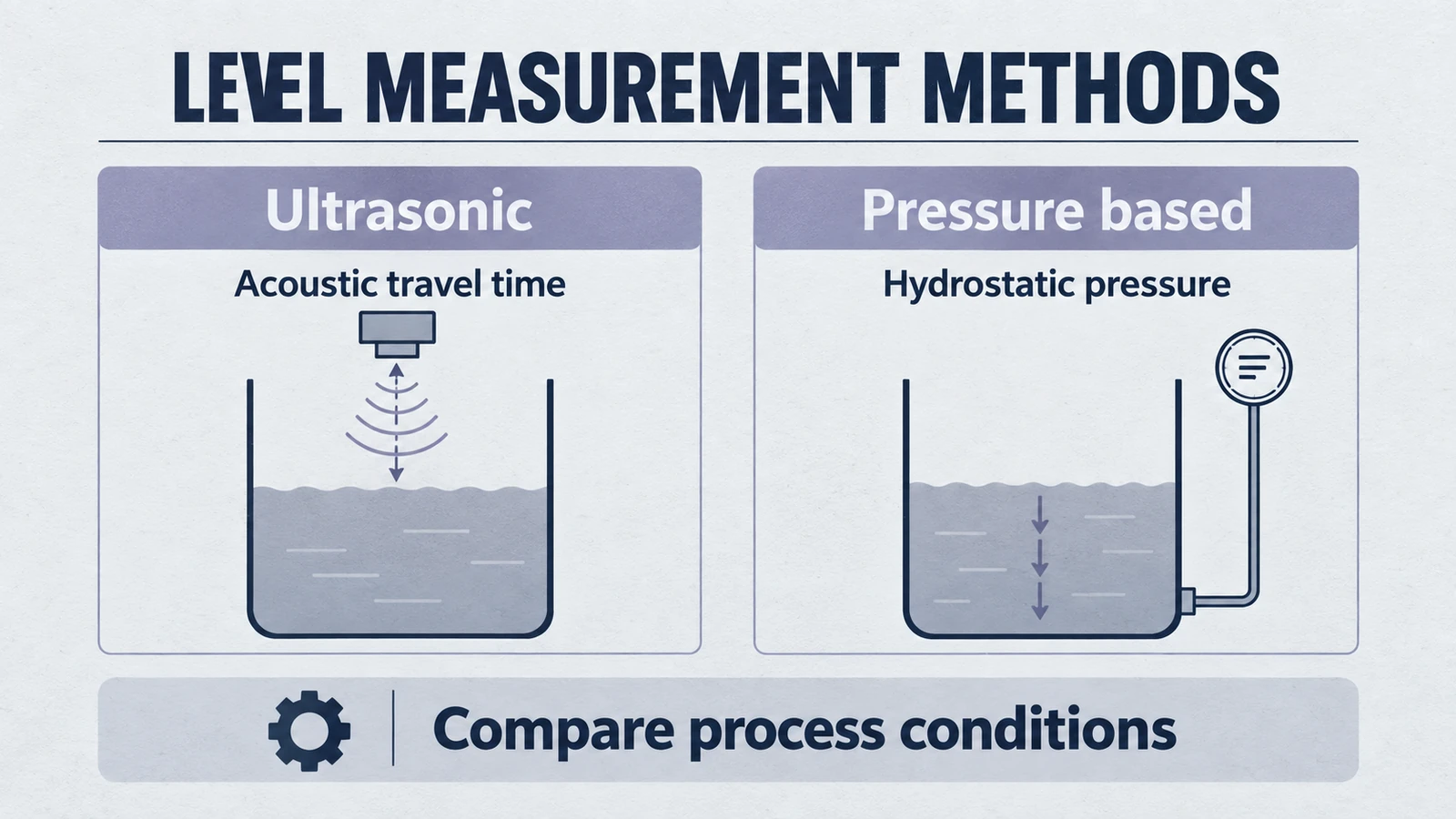
Ultrasonic sensors operate by transmitting high-frequency sound waves that travel through the air until they hit the liquid surface. The sensor then measures the time taken for the sound waves (echo) to return. By applying the time-of-flight principle, the sensor calculates the distance to the surface, which corresponds to the liquid level.
- Non-contact measurement – The sensor is typically installed on the top of the tank and does not physically touch the liquid. This makes it highly suitable for corrosive, volatile, or hazardous fluids.
- Echo-based calculation – The sensor's microprocessor interprets the signal and adjusts for tank geometry, ensuring that readings are converted into accurate level values.
This non-contact approach is especially useful in environments where contamination must be minimized or where materials could damage traditional contact sensors.
Pressure Level Sensors
Hydrostatic level measurement derives height from the bottom-to-headspace pressure difference divided by liquid density and gravitational acceleration. Account for density changes with composition and temperature and for the pressure reference; changing headspace pressure in a closed tank cannot simply be ignored. Gauge, absolute-with-reference and differential arrangements have different installation requirements.
- Hydrostatic principle – The denser the liquid and the taller the column, the higher the pressure reading.
- Direct measurement – Because it directly measures the pressure exerted by the liquid, this approach is generally stable and unaffected by environmental conditions like dust or vapor.
Pressure sensors are widely regarded as robust and dependable, particularly in industries where tanks hold liquids with foam, turbulence, or vapor layers that would interfere with ultrasonic measurement.
Key Differences: Ultrasonic vs Pressure Sensor
| Feature | Ultrasonic Level Sensor | Pressure Level Sensor |
|---|---|---|
| Measurement Method | Non-contact (sound waves) | Contact (hydrostatic pressure) |
| Accuracy | ±0.25% of range, but influenced by temperature, vapors, and foam | ±0.1–0.25% of range, stable in varying conditions |
| Installation | Top-mounted, minimal tank modification | Bottom-mounted (submersible or external piping) |
| Maintenance | Very low, no moving parts | Moderate, requires cleaning and calibration |
| Fluid Compatibility | Excellent for corrosive/volatile liquids | Works with most liquids, needs correct material compatibility |
| Environmental Sensitivity | Affected by condensation, dust, and turbulence | Generally unaffected by environment |
| Cost | Typically higher initial investment | Usually lower upfront cost |
Advantages and Limitations Explained
Ultrasonic Level Sensors
Advantages:
- Non-contact operation prevents contamination and sensor wear.
- Excellent choice for aggressive chemicals and hazardous or toxic fluids.
- Easy to retrofit, since top-mounting avoids tank draining or major modification.
- Remote monitoring capability, with some models supporting wireless integration.
Limitations:
- Readings may be distorted by foam, vapors, or heavy turbulence.
- Extreme temperature changes can influence sound wave velocity.
- Requires an unobstructed acoustic path inside the tank.
- Generally more expensive, both in purchase price and advanced features.
Pressure Level Sensors
Advantages:
- Proven, time-tested technology that works well in most industrial settings.
- Consistent and reliable readings, even with turbulence or foam.
- Can achieve high accuracy in both static and dynamic tank environments.
- Cost-effective and widely available.
Limitations:
- Requires direct contact with liquid, making it susceptible to corrosion, clogging, or fouling.
- Regular maintenance is needed, especially in tanks with solids or contaminants.
- Special materials or coatings are required for aggressive or corrosive fluids, which increases cost.
- In very tall tanks, cabling and installation complexity may increase.
Practical Considerations for Sensor Selection
Choosing between ultrasonic vs pressure sensors goes beyond technical specifications—it requires assessing the operational context:
- For corrosive or hazardous liquids → Ultrasonic sensors are safer since they remain outside the liquid and do not degrade in harsh chemical conditions.
- For foamy, viscous, or turbulent liquids → Pressure sensors offer greater accuracy because they measure hydrostatic pressure, unaffected by surface disturbances.
- For remote or automated monitoring → Ultrasonic sensors integrate well with digital systems and wireless IoT platforms.
- For cost-sensitive projects → Pressure sensors typically have a lower purchase cost and remain the default choice for many industries.
- For hygienic or contamination-sensitive applications → Ultrasonic sensors reduce risk by avoiding contact with the stored material.
In practice, some facilities even use both technologies together—ultrasonic for general monitoring and pressure sensors as a redundant safeguard.
Application Examples
- Water & Wastewater Treatment: Ultrasonic sensors excel in non-contact monitoring of large basins or chemical tanks, while pressure sensors are common in sludge or turbulent flow areas.
- Oil & Gas: Pressure sensors dominate due to foam and vapor presence in crude tanks, but ultrasonic sensors are chosen for corrosive chemicals.
- Food & Beverage: Ultrasonic sensors are used where cleanliness is critical, such as in syrup or dairy tanks, while pressure sensors work in mixing or agitation tanks.
- Pharmaceuticals: Ultrasonic technology ensures non-contaminating measurement in sterile environments.
Conclusion
When performing a tank level sensor comparison, it becomes clear that ultrasonic and pressure sensors each bring distinct strengths to tank monitoring applications. Ultrasonic sensors are ideal for non-contact measurement in hazardous or hygienic environments, while pressure sensors provide robust, cost-effective reliability across a broad range of liquids and operating conditions.
Selecting the right technology requires balancing several factors: measurement accuracy, upfront cost, long-term maintenance, fluid properties, and environmental influences. By aligning sensor selection with application-specific demands, industries can achieve appropriate, efficient, and precise tank monitoring.
Looking for a tailored solution? Yujie specializes in advanced ultrasonic and piezoelectric sensor technologies, offering both standard and custom-engineered tank monitoring solutions. Contact us today to learn how we can help optimize your industrial processes with our comprehensive sensor portfolio.
Engineering decision notes
Ultrasonic sensing and detection
Use this article when sensor performance depends on target distance, beam angle, housing material, liquid behavior, or false echo control. For "Ultrasonic vs. Pressure Level Sensors: Choosing the Right Tank Monitoring Solution", the practical value is in turning the topic into a measurable selection or sourcing decision.
YJ Piezo treats ultrasonic sensing as an acoustic interface problem: transducer frequency, beam shape, housing, drive electronics, and target environment are reviewed together.
Selection checks
- Define target range, dead zone, beam angle, and mounting geometry before choosing the sensor family.
- Check the medium, target surface, temperature swing, foam, vapor, and side-wall risk.
- Separate detection repeatability from ideal lab accuracy when the sensor will operate in a tank, tube, or moving line.
Failure risks
- A sensor can pass bench distance tests and still fail in tanks with foam, agitation, vapor, or narrow geometry.
- Changing only frequency without reviewing beam angle and mounting can increase false echoes.
- Ignoring housing material or sealing requirements can shorten lifetime in washdown or chemical environments.
RFQ details
- What is the minimum and maximum detection distance?
- Is the target liquid, solid, sheet material, air flow, or a moving object?
- What temperature, humidity, IP rating, and output signal does the system require?
Relevant YJ Piezo pages
- Ultrasonic Sensors
Distance, level, and detection sensor portfolio
- Flow Measurement Transducers
Bubble and flow-related ultrasonic sensing paths
- Air Acoustic Transducers
Air-coupled transducers for range and presence detection
Application FAQ
- What makes an ultrasonic sensor page useful for procurement?
- It should connect range, beam angle, output signal, housing, mounting, and environmental limits to a concrete use case. A model name alone is not enough for reliable supplier comparison.
- Which information speeds up an ultrasonic sensor RFQ?
- Send the target material, distance range, installation geometry, output interface, temperature range, IP rating, and whether the application involves foam, vapor, liquid, or moving objects.