
PZT Material Types: Soft vs Hard Piezoelectric Ceramics
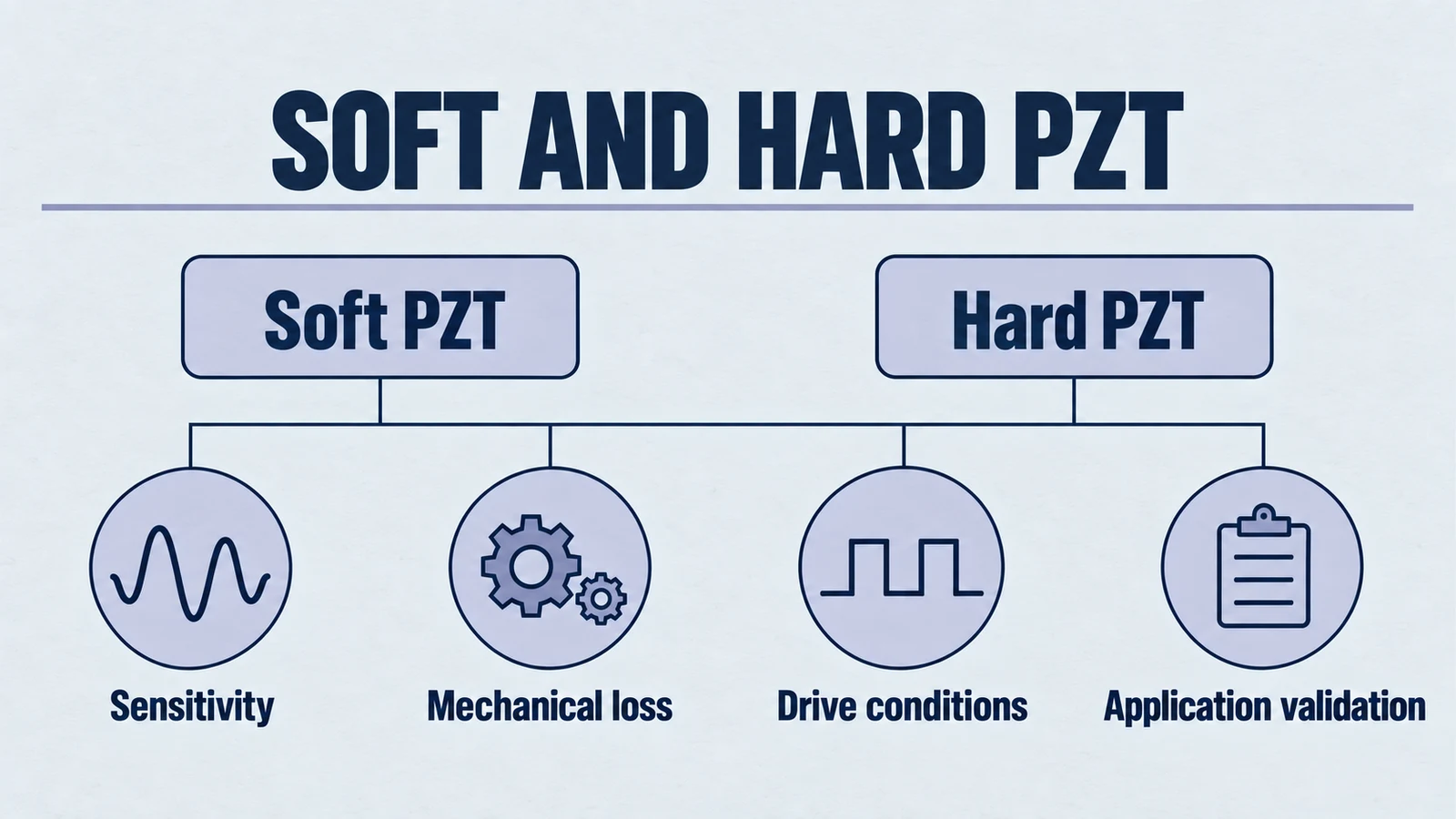
Quick answer: PZT material types are usually grouped as soft PZT for sensitivity and displacement, and hard PZT for lower loss, higher Qm, and stronger high-power stability. This page is a compact primer; for detailed PZT-4, PZT-5A, PZT-5H, and PZT-8 trade-offs, use the full soft vs hard PZT engineering guide.
New to the material name? Start with what PZT stands for. Need constants? See d33, k, and Qm explained.
For component sourcing, compare PZT discs, ceramic rings, tubes and rectangular plates. If your process starts with powder, review PZT powder supply.
Piezoelectric materials, particularly PZT (lead zirconate titanate) ceramics, play a crucial role in various applications, from sensors and actuators to medical devices and consumer electronics. Understanding the different types of PZT materials is essential for selecting the right material for your specific needs. This guide provides a comprehensive overview of PZT material types, their characteristics, and applications.
What is PZT?
PZT, or lead zirconate titanate, is a piezoelectric ceramic material known for its excellent piezoelectric properties. It is a solid solution of lead zirconate (PbZrO3) and lead titanate (PbTiO3). The composition of PZT can be modified to achieve different properties, making it suitable for a wide range of applications.
Product path for this search intent
Match the article topic to the right YJ Piezo product page
Use this article when the choice is not just a shape, but a material tradeoff between sensitivity, loss, coupling, stability, and operating field. For "PZT Material Types: Soft vs Hard Piezoelectric Ceramics", the practical value is in turning the topic into a measurable selection or sourcing decision.
- PZT Material Hub
Material grades and application tradeoffs
- Piezoelectric Ceramics
Shapes and ceramic manufacturing options
- PZT Material Supplier Hub
Material control, grade selection, and sourcing support
Types of PZT Materials
PZT materials are generally classified into two main categories: soft PZT and hard PZT. These categories are based on their piezoelectric and ferroelectric properties.
1. Soft PZT
Soft PZT materials are characterized by their high piezoelectric coefficients, high dielectric constants, and low coercive fields. They are easy to pole and depole, making them suitable for applications requiring high sensitivity and large displacements.
- Characteristics:
- High piezoelectric coefficients (d33, d31)
- High dielectric constant
- Low coercive field
- High sensitivity
- Large displacement
- Applications:
- Sensors
- Hydrophones
- Ultrasonic transducers
- Energy harvesting
2. Hard PZT
Hard PZT materials, on the other hand, have low piezoelectric coefficients, low dielectric constants, and high coercive fields. They are difficult to pole and depole, making them suitable for high-power applications and stable devices.
- Characteristics:
- Low piezoelectric coefficients (d33, d31)
- Low dielectric constant
- High coercive field
- High mechanical quality factor (Qm)
- High stability
- Applications:
- High-power ultrasonic transducers
- Actuators
- Piezoelectric transformers
- Buzzers
Doping Effects on PZT Materials
The properties of PZT materials can be further modified by doping with various elements. Dopants can alter the piezoelectric, dielectric, and mechanical properties of PZT. Classify substitutions by oxidation state and occupied lattice site. Sr2+ on the Pb2+ site is isovalent and should be discussed separately from donor doping; composition and processing influence its effects.
- Acceptor Doping (Hardening):
- Examples: Fe3+ replacing Zr4+/Ti4+ on the B-site
- Increases mechanical quality factor (Qm)
- Decreases dielectric loss
- Improves stability
- Donor Doping (Softening):
- Examples: Nb5+ replacing Zr4+/Ti4+ on the B-site, or La3+ replacing Pb2+ on the A-site
- Increases piezoelectric coefficients
- Increases dielectric constant
- Decreases coercive field
Applications of Different PZT Types
The choice of PZT material depends on the specific requirements of the application. Here are some examples of how different PZT types are used in various industries:
- Medical Devices: Soft PZT is used in ultrasonic imaging transducers due to its high sensitivity, while hard PZT is used in surgical tools for its high power output.
- Automotive: Hard PZT is used in fuel injectors and knock sensors for its stability and reliability under harsh conditions.
- Consumer Electronics: Soft PZT is used in microphones and speakers for its high sensitivity and ability to produce clear sound.
- Industrial: Hard PZT is used in ultrasonic cleaning equipment and welding transducers for its high power and durability.
Selecting the Right PZT Material
When selecting a PZT material, consider the following factors:
- Piezoelectric Coefficients: Determine the required sensitivity and displacement.
- Dielectric Constant: Consider the impact on impedance and energy storage.
- Coercive Field: Evaluate the stability and poling requirements.
- Mechanical Quality Factor: Assess the need for high power output and low losses.
- Operating Conditions: Consider temperature, pressure, and other environmental factors.
Yujie Technology: Your Partner in PZT Materials
At Yujie Technology, we offer a wide range of PZT materials tailored to meet your specific application needs. Our team of experts can help you select the right material and provide custom solutions to optimize your device performance.
Contact us today to learn more about our PZT materials and how we can support your project:
📩 business@szyujie.com
🌐 yujiepiezo.com
Related Technical Resources
Use these internal references to compare geometry, material selection, reliability testing, and sourcing decisions.
Engineering decision notes
PZT material and ceramic selection
Use this article when the choice is not just a shape, but a material tradeoff between sensitivity, loss, coupling, stability, and operating field. For "PZT Material Types: Soft vs Hard Piezoelectric Ceramics", the practical value is in turning the topic into a measurable selection or sourcing decision.
YJ Piezo coordinates PZT ceramic projects with manufacturing support, so material formulation, sintering, polarization, electrode process, and outgoing inspection can be reviewed against the final application.
Selection checks
- Separate sensing needs from high-power actuation needs before comparing d33 or coupling values.
- Check dielectric loss, Qm, Curie temperature, aging behavior, and operating field against the real duty cycle.
- Confirm whether the application needs standard PZT grades or a custom formulation and geometry.
Failure risks
- Choosing only the highest d33 can create heat, drift, or depolarization risk in power ultrasonics.
- A ceramic that performs well in free measurement can fail once bonded, clamped, or loaded.
- Material substitutions without batch testing can change capacitance, resonance, and system tuning.
RFQ details
- Is the part used for sensing, actuation, atomization, cleaning, welding, or measurement?
- What field strength, temperature, duty cycle, and mechanical load will the ceramic see?
- Which values must be controlled: d33, capacitance, resonance, impedance, Qm, or dimensional tolerance?
Relevant YJ Piezo pages
- PZT Material Hub
Material grades and application tradeoffs
- Piezoelectric Ceramics
Shapes and ceramic manufacturing options
- PZT Material Supplier Hub
Material control, grade selection, and sourcing support
Application FAQ
- Is the highest d33 always the best PZT choice?
- No. High d33 can be useful for sensitivity, but high-power ultrasonic systems often need lower loss, higher Qm, better thermal stability, and safer operation under field and stress.
- What makes PZT material selection different from catalog buying?
- The right PZT choice depends on geometry, load, drive field, duty cycle, temperature, and inspection targets. A catalog value is only useful when it is tied to the final assembly conditions.