
Underwater Ultrasonic Sensors: Sonar Selection for Marine Use
Underwater ultrasonic sensors, commonly known as sonar transducers, are critical devices utilized extensively within marine industries. Leveraging ultrasonic technology, these sensors detect and measure underwater objects, terrain, and marine life, providing important information for various marine applications. This blog post explores the capabilities, applications, and advantages of underwater ultrasonic sensors in detail, emphasizing why sonar transducers are pivotal in enhancing marine operations.
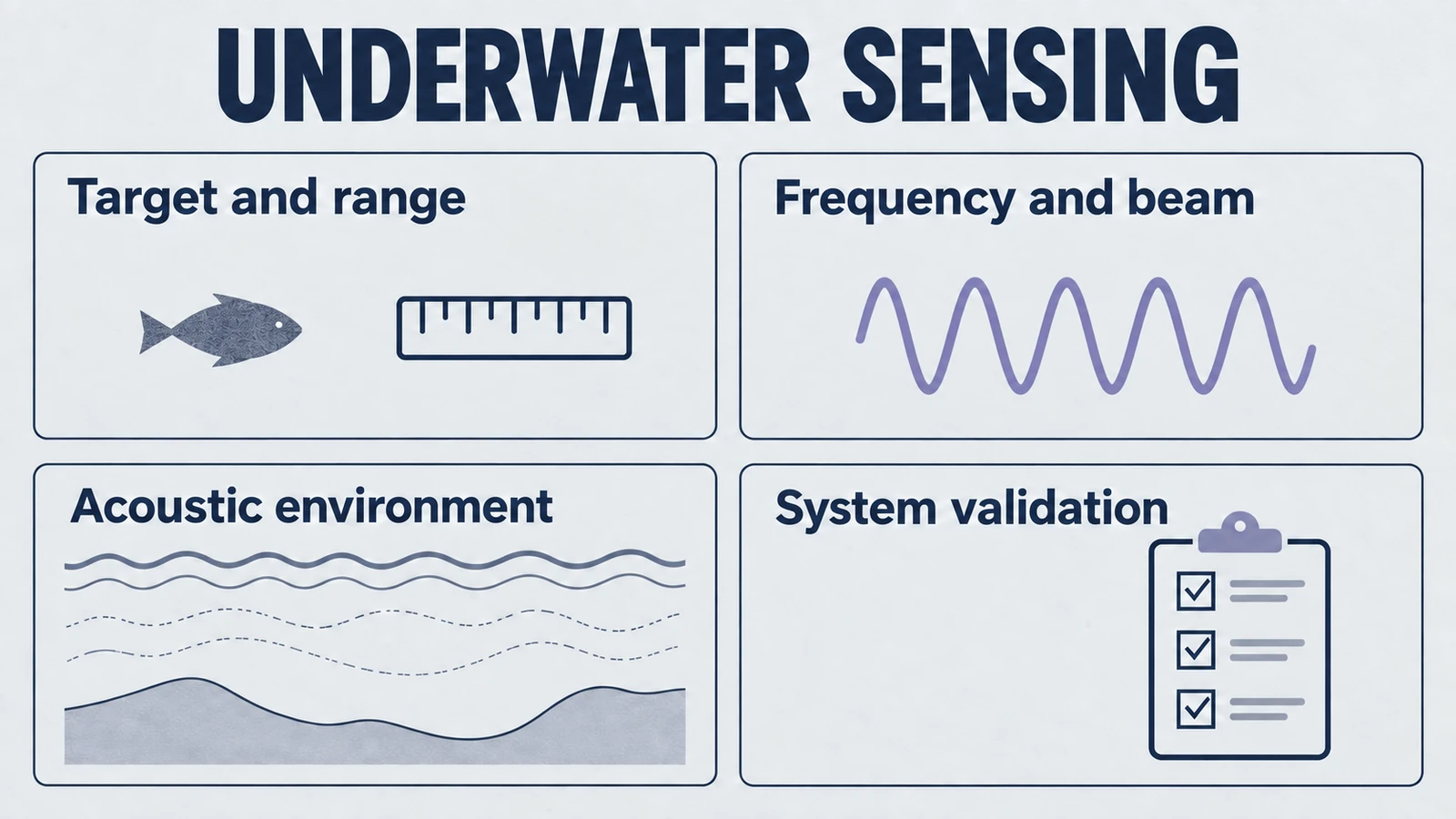
Engineering decision focus: Set frequency band, encapsulation strategy, and range target based on seawater loading, pressure depth, and mounting constraints before selecting the transducer stack.
Understanding Underwater Ultrasonic Sensors
Underwater ultrasonic sensors operate by emitting high-frequency sound pulses underwater and measuring the echo reflected from objects or the seabed. These sensors function based on the sonar principle (Sound Navigation and Ranging), which calculates distances by measuring the time interval between pulse emission and echo reception. They are designed to withstand challenging underwater environments, including extreme pressure, temperature variations, and corrosive saltwater conditions.
Product path for this search intent
Match the article topic to the right YJ Piezo product page
Use this article when sensor performance depends on target distance, beam angle, housing material, liquid behavior, or false echo control. For "Underwater Ultrasonic Sensors: Sonar Selection for Marine Use", the practical value is in turning the topic into a measurable selection or sourcing decision.
- Ultrasonic Sensors
Distance, level, and detection sensor portfolio
- Flow Measurement Transducers
Bubble and flow-related ultrasonic sensing paths
- Air Acoustic Transducers
Air-coupled transducers for range and presence detection
At Yujie Technology, we manufacture specialized submersible transducers and deep-water transducers that deliver exceptional performance in marine applications. Our underwater ultrasonic sensor solutions are engineered with high-quality PZT materials to ensure reliability in the most demanding marine environments.
Key Applications in Marine Industries
1. Navigation and Obstacle Avoidance
Underwater ultrasonic sensors are vital in navigating marine vessels safely. They detect underwater obstacles such as reefs, rocks, and debris, significantly reducing the risk of collisions and improving maritime safety. Advanced sonar transducers provide real-time feedback, enabling quick and accurate navigational decisions.
2. Underwater Mapping and Bathymetric Surveys
Sonar transducers are extensively employed for detailed underwater mapping and bathymetric surveys. These sensors facilitate precise measurement of seafloor topography, aiding in oceanographic research, coastal management, and the construction of offshore structures such as wind farms, oil rigs, and submarine cables.
3. Fish and Marine Life Monitoring
In fisheries and marine biology, sonar transducers play a crucial role in tracking fish populations and marine life activities. High-resolution ultrasonic sensors help monitor migration patterns, population densities, and behaviors of aquatic organisms, contributing to sustainable fishery management and conservation efforts.
4. Submarine and Underwater Vehicle Operations
Submarines and remotely operated vehicles (ROVs) utilize underwater ultrasonic sensors for reliable and efficient operations. These sensors ensure accurate depth measurements, obstacle avoidance, and precise positioning, essential for underwater exploration, military surveillance, and deep-sea research missions.
Our HJ-200KH-P submersible transducer is specifically designed for such applications, offering superior performance in deep-water environments. For even more demanding conditions, our CS-220KH deep-water transducer provides exceptional reliability and accuracy.
5. Environmental Monitoring
Marine environmental monitoring heavily relies on underwater ultrasonic sensors for tracking sediment movement, assessing erosion rates, and detecting changes in underwater habitats. Accurate and consistent data provided by these sensors enable environmentalists to understand and mitigate the impacts of climate change and human activities on marine ecosystems.
Understanding the differences between piezoelectric and ultrasonic transducers is crucial for selecting the right sensor technology for specific marine monitoring applications.
Advantages of Sonar Transducers Underwater
- Reliability: Underwater ultrasonic sensors are robust and reliable, capable of operating effectively in harsh marine conditions.
- High Accuracy: They offer precise measurements and high-resolution imaging essential for critical marine operations and research.
- Non-Invasive Technology: Ultrasonic sensing is non-intrusive, minimizing disturbance to marine life and underwater ecosystems during data collection.
- Versatility: Applicable across various sectors within the marine industry, sonar transducers are adaptable to diverse tasks ranging from commercial fishing to military applications.
When selecting underwater ultrasonic sensors, it's important to consider factors such as operating depth, frequency range, and environmental conditions. Our guide on ensuring quality in piezoelectric components provides valuable insights for engineers working with marine sensor applications.
Technical Considerations for Marine Applications
The performance of underwater ultrasonic sensors depends heavily on the quality of the piezoelectric materials used in their construction. PZT powder quality directly impacts the sensor's sensitivity and longevity in marine environments. Additionally, understanding piezoelectric constants is essential for optimizing sensor performance in specific underwater applications.
Conclusion
Underwater ultrasonic sensors (sonar transducers) are integral to modern marine industries, significantly improving navigational safety, facilitating precise underwater mapping, enhancing marine resource management, and enabling robust environmental monitoring. Their reliability, accuracy, and versatility underscore their indispensability in advancing marine technology and sustainable oceanic practices. Embracing these advanced sensors is essential for organizations striving for excellence in marine operations and environmental stewardship.
Related Engineering Reading
- Understand PZT transducer fundamentals for marine systems
- Compare ultrasonic sensing options by environment
- Review underwater transducer product options
- Contact engineering for marine project support
For more information about our underwater ultrasonic sensor solutions and how they can benefit your marine applications, explore our complete range of piezoelectric products or contact our technical team for personalized assistance.
Engineering decision notes
Ultrasonic sensing and detection
Use this article when sensor performance depends on target distance, beam angle, housing material, liquid behavior, or false echo control. For "Underwater Ultrasonic Sensors: Sonar Selection for Marine Use", the practical value is in turning the topic into a measurable selection or sourcing decision.
YJ Piezo treats ultrasonic sensing as an acoustic interface problem: transducer frequency, beam shape, housing, drive electronics, and target environment are reviewed together.
Selection checks
- Define target range, dead zone, beam angle, and mounting geometry before choosing the sensor family.
- Check the medium, target surface, temperature swing, foam, vapor, and side-wall risk.
- Separate detection repeatability from ideal lab accuracy when the sensor will operate in a tank, tube, or moving line.
Failure risks
- A sensor can pass bench distance tests and still fail in tanks with foam, agitation, vapor, or narrow geometry.
- Changing only frequency without reviewing beam angle and mounting can increase false echoes.
- Ignoring housing material or sealing requirements can shorten lifetime in washdown or chemical environments.
RFQ details
- What is the minimum and maximum detection distance?
- Is the target liquid, solid, sheet material, air flow, or a moving object?
- What temperature, humidity, IP rating, and output signal does the system require?
Relevant YJ Piezo pages
- Ultrasonic Sensors
Distance, level, and detection sensor portfolio
- Flow Measurement Transducers
Bubble and flow-related ultrasonic sensing paths
- Air Acoustic Transducers
Air-coupled transducers for range and presence detection
Application FAQ
- What makes an ultrasonic sensor page useful for procurement?
- It should connect range, beam angle, output signal, housing, mounting, and environmental limits to a concrete use case. A model name alone is not enough for reliable supplier comparison.
- Which information speeds up an ultrasonic sensor RFQ?
- Send the target material, distance range, installation geometry, output interface, temperature range, IP rating, and whether the application involves foam, vapor, liquid, or moving objects.