
The Versatile Ultrasonic Sensor: From Parking Aids to Industrial Automation
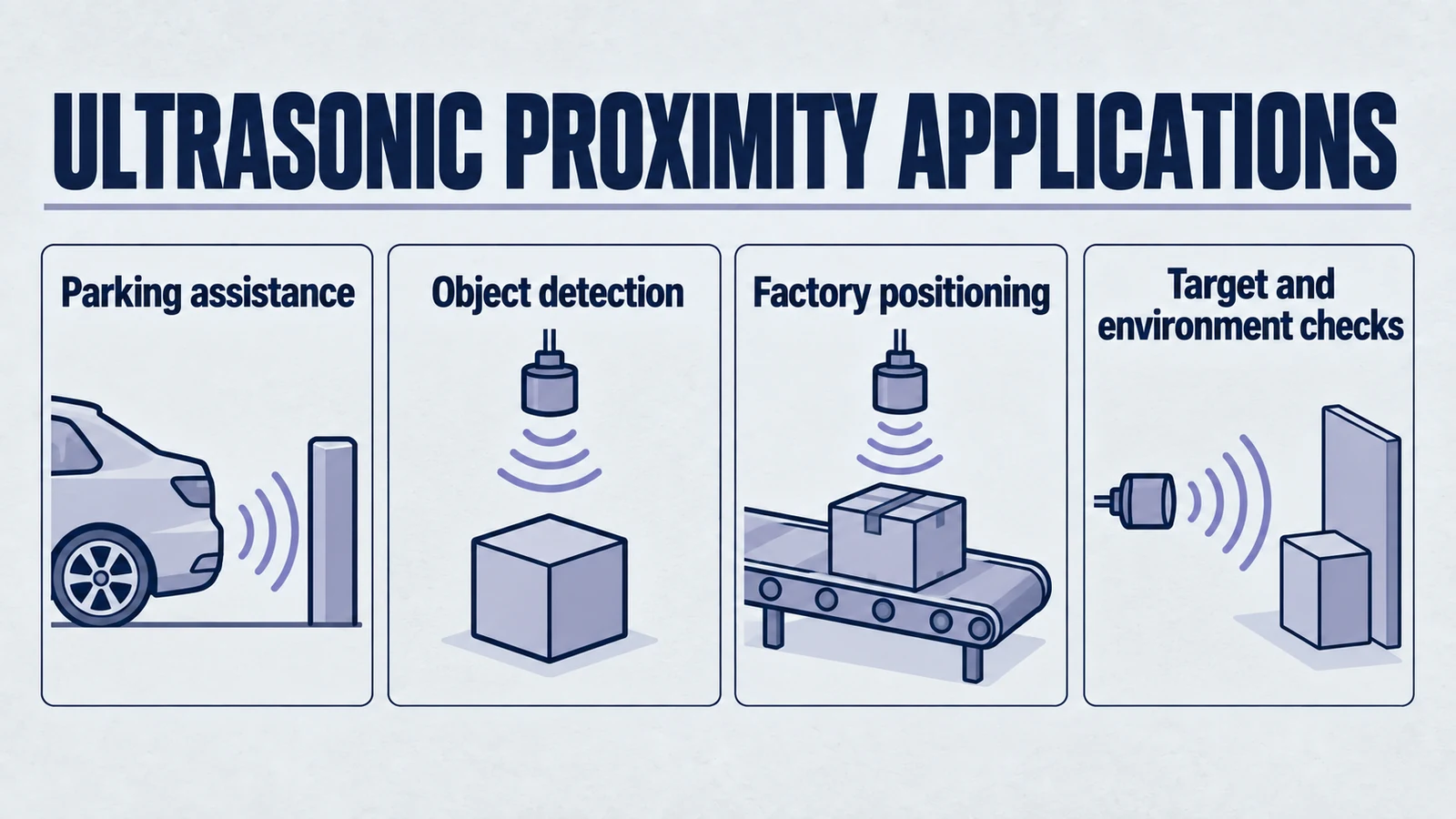
Ultrasonic sensors, known for their reliability and precision, have become important tools across numerous industries. By emitting sound waves at frequencies higher than human hearing and measuring the echo that bounces back from objects, these sensors deliver accurate distance measurements. This capability makes ultrasonic sensors highly effective as proximity sensors, vital for safety, navigation, and automation applications.
Understanding Ultrasonic Sensors
Ultrasonic sensors operate on the principle of echo-location. The sensor emits an ultrasonic pulse, typically in the frequency range of 40 kHz to 250 kHz. When the pulse encounters an object, it reflects back to the sensor. The sensor measures the time interval between emission and reception, calculating the object's distance based on the speed of sound.
Ultrasonic Proximity Sensors in Everyday Life
Product path for this search intent
Match the article topic to the right YJ Piezo product page
Use this article when sensor performance depends on target distance, beam angle, housing material, liquid behavior, or false echo control. For "The Versatile Ultrasonic Sensor: From Parking Aids to Industrial Automation", the practical value is in turning the topic into a measurable selection or sourcing decision.
- Ultrasonic Sensors
Distance, level, and detection sensor portfolio
- Flow Measurement Transducers
Bubble and flow-related ultrasonic sensing paths
- Air Acoustic Transducers
Air-coupled transducers for range and presence detection
One of the most common applications of ultrasonic proximity sensors is in automotive parking aids. These sensors help drivers by alerting them to nearby obstacles during parking maneuvers. Positioned at the vehicle's front and rear bumpers, these sensors measure proximity accurately, providing both audio and visual warnings to prevent collisions.
Ultrasonic sensors also enhance safety features in residential and commercial automatic doors, elevators, and escalators. They detect when a person or object is nearby, triggering the system to halt or slow its operation, thus preventing accidents and injuries. For specialized detection applications, our ultrasonic bubble detection sensor provides precise monitoring capabilities in liquid systems.
Industrial Automation: Precision and Efficiency
In industrial settings, ultrasonic sensors play a crucial role in automation systems. They monitor fill levels in tanks, detect and measure objects on conveyor belts, and assist robots in navigating complex environments.
- Fill Level Measurement: Ultrasonic sensors reliably measure the levels of liquids, solids, and powders in tanks and silos. This non-contact method ensures accuracy, hygiene, and safety, essential for chemical, food processing, and pharmaceutical industries. For liquid flow applications, our liquid flow transducer provides accurate measurement capabilities.
- Material Handling and Detection: These sensors facilitate precise object detection on conveyor systems, enabling automated sorting, packaging, and quality control. Their ability to operate effectively in dusty or smoky conditions makes them suitable for harsh industrial environments. For gas flow monitoring, consider our gas flow transducer designed for precise gas measurement.
- Robot Navigation: Ultrasonic proximity sensors assist robots in obstacle detection and avoidance, ensuring reliable and efficient operations. Their reliability in diverse conditions supports flexible automation in warehouses, manufacturing plants, and logistics centers. For underwater applications, our submersible transducer offers reliable performance in challenging aquatic environments.
Benefits of Ultrasonic Sensors
- Accuracy and Reliability: Ultrasonic sensors deliver precise distance measurements and object detection, making them ideal for critical safety applications.
- Versatility: Applicable in various mediums (solid, liquid, powder) and conditions (dusty, smoky, wet), these sensors are versatile across industries.
- Low Maintenance: With no moving parts and minimal wear, ultrasonic sensors require little maintenance, offering a long operational life.
Best Practices for Optimizing Ultrasonic Sensor Performance
- Proper Mounting: Position sensors away from reflective surfaces and sources of interference to avoid erroneous readings.
- Regular Calibration: Periodically calibrate ultrasonic sensors to maintain accuracy and reliability, especially in critical industrial applications.
- Environment Consideration: Select sensor models designed specifically for the operational environment, ensuring robust performance under challenging conditions.
Future Trends in Ultrasonic Sensor Technology
Advancements in ultrasonic sensor technology continue to expand their capabilities. Emerging trends include miniaturization for more compact applications, integration with IoT for remote monitoring, and enhanced signal processing for improved accuracy in noisy environments. For high-frequency applications, our high-frequency transducer delivers exceptional precision and performance.
In conclusion, ultrasonic sensors, particularly ultrasonic proximity sensors, offer exceptional value through their precision, versatility, and reliability. From aiding appropriate vehicle parking to ensuring efficiency in automated industrial processes, their broad applicability underscores their vital role across multiple sectors. For specialized industrial applications, explore our ultrasonic flowmeter transducer for precise flow measurement solutions. By understanding and leveraging their capabilities, industries can significantly enhance safety, productivity, and operational efficiency.
Engineering decision notes
Ultrasonic sensing and detection
Use this article when sensor performance depends on target distance, beam angle, housing material, liquid behavior, or false echo control. For "The Versatile Ultrasonic Sensor: From Parking Aids to Industrial Automation", the practical value is in turning the topic into a measurable selection or sourcing decision.
YJ Piezo treats ultrasonic sensing as an acoustic interface problem: transducer frequency, beam shape, housing, drive electronics, and target environment are reviewed together.
Selection checks
- Define target range, dead zone, beam angle, and mounting geometry before choosing the sensor family.
- Check the medium, target surface, temperature swing, foam, vapor, and side-wall risk.
- Separate detection repeatability from ideal lab accuracy when the sensor will operate in a tank, tube, or moving line.
Failure risks
- A sensor can pass bench distance tests and still fail in tanks with foam, agitation, vapor, or narrow geometry.
- Changing only frequency without reviewing beam angle and mounting can increase false echoes.
- Ignoring housing material or sealing requirements can shorten lifetime in washdown or chemical environments.
RFQ details
- What is the minimum and maximum detection distance?
- Is the target liquid, solid, sheet material, air flow, or a moving object?
- What temperature, humidity, IP rating, and output signal does the system require?
Relevant YJ Piezo pages
- Ultrasonic Sensors
Distance, level, and detection sensor portfolio
- Flow Measurement Transducers
Bubble and flow-related ultrasonic sensing paths
- Air Acoustic Transducers
Air-coupled transducers for range and presence detection
Application FAQ
- What makes an ultrasonic sensor page useful for procurement?
- It should connect range, beam angle, output signal, housing, mounting, and environmental limits to a concrete use case. A model name alone is not enough for reliable supplier comparison.
- Which information speeds up an ultrasonic sensor RFQ?
- Send the target material, distance range, installation geometry, output interface, temperature range, IP rating, and whether the application involves foam, vapor, liquid, or moving objects.