
Beyond the Component: Why the PZT Disc Partner Defines Application Success
The PZT Disc: A Critical Component Demanding a Specialist Partner
In the landscape of advanced technology, where the performance of a final product is determined by its most critical components, the selection process transcends a simple review of datasheets. For engineers developing next-generation medical ultrasound probes, high-power industrial transducers, or precision actuators, component failure is not merely an inconvenience; it represents a significant setback that can derail project timelines and compromise brand reputation. At the core of countless modern electromechanical systems lies the PZT disc, a highly engineered component responsible for the critical conversion of mechanical and electrical energy. This component is not a commodity but the functional heart of the device it powers.
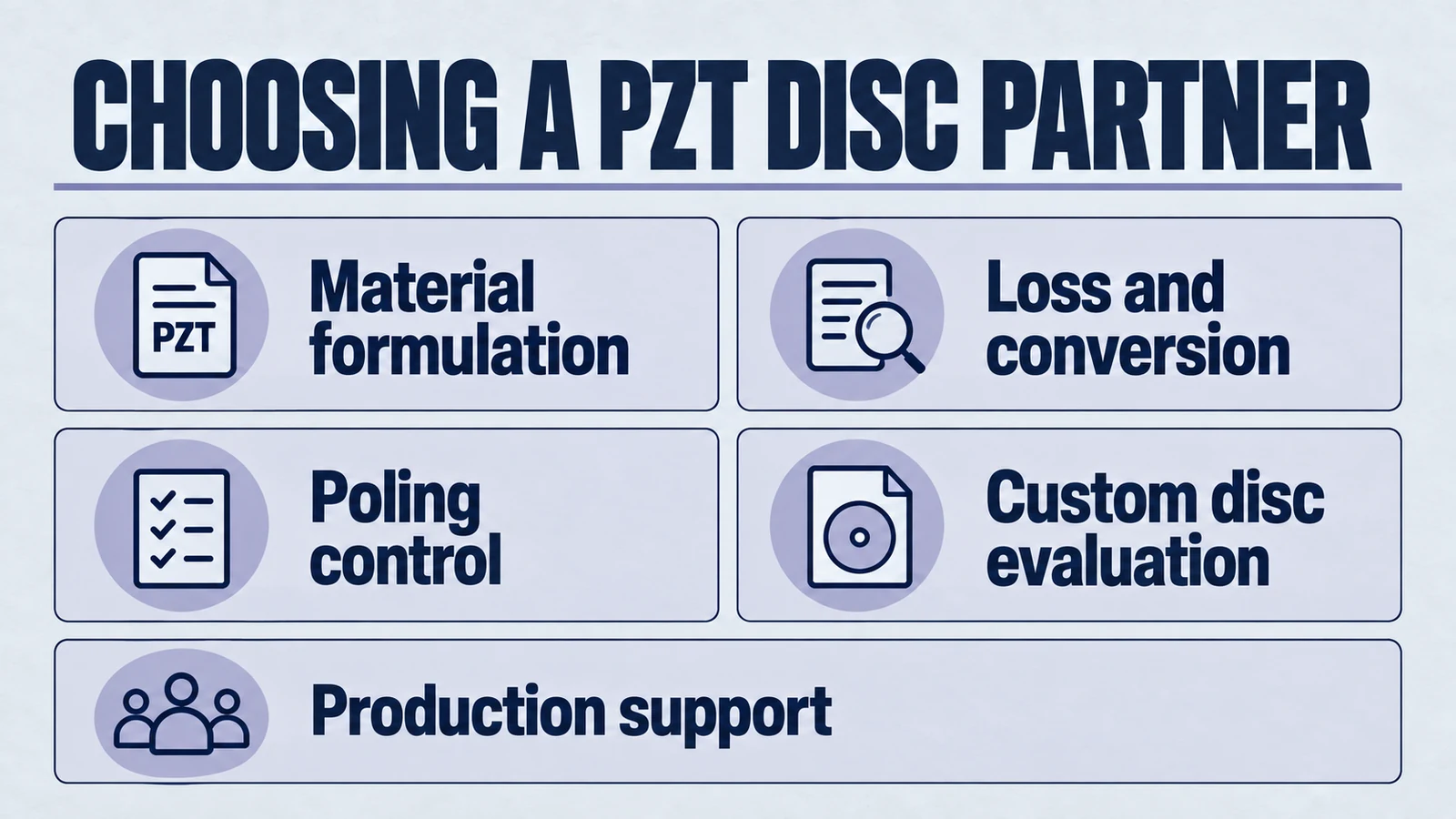
The success of any project leveraging this technology—its performance, long-term reliability, and time-to-market—is therefore inextricably linked to the capabilities of the PZT disc supplier. The commoditization of many electronic components has created a hidden risk for original equipment manufacturers (OEMs). While standard parts are easily sourced, highly specialized components like PZT discs carry a disproportionate amount of project risk. A failure in a PZT disc is not just a component failure; it is a systemic failure. This reality elevates the supplier selection process from a procurement function to a strategic engineering and risk management decision. The right partner offers more than a component; they provide a decisive competitive advantage through deep expertise in material science, dedicated engineering support, and manufacturing excellence. With dedicated experience in this specialized field built since 1996, specialist suppliers like Yujie guide clients through the entire product lifecycle, from initial concept to mass production, de-risking the entire endeavor.
The Anatomy of Performance: What Separates a Standard PZT Disc from a High-Performance Solution?
Product path for this search intent
Match the article topic to the right YJ Piezo product page
Use this article when the risk is supplier selection, engineering support, validation evidence, integration reliability, and whether the manufacturer can scale from sample to production. For "Beyond the Component: Why the PZT Disc Partner Defines Application Success", the practical value is in turning the topic into a measurable selection or sourcing decision.
- Ultrasonic Transducer Supplier Hub
OEM sourcing and engineering collaboration
- PZT Material Supplier Hub
Material control and grade selection
- Piezoelectric Ceramics
Ceramic manufacturing and custom shapes
Understanding the key performance indicators of a PZT disc is essential, but it is more important to connect each technical parameter to a tangible application benefit and the manufacturing excellence required to achieve it. This deconstruction reveals the vast difference between a standard component and a solution engineered for superior, reliable performance in the real world.
The Foundation: Material Purity and Formulation
PZT is not a monolithic material but a sophisticated family of ferroelectric ceramics. The final properties are meticulously tuned by adjusting the lead zirconate to lead titanate ratio and introducing specific dopants. This complex process, from the formulation of raw powders to the precise control of sintering temperatures and times, dictates the ultimate performance of the disc. An excessively high sintering temperature can cause uneven crystal growth, while a temperature that is too low results in incomplete crystal development, both of which degrade piezoelectric performance. It is within this foundational stage of material science that a manufacturer's experience becomes a critical asset. Decades of expertise, such as Yujie's 25+ years in the industry, translate into proprietary formulations and process controls that yield consistently superior materials.
Superior Electromechanical Conversion (The d33 Coefficient)
The piezoelectric charge coefficient, denoted as d33, is a primary measure of a PZT material's effectiveness. It quantifies the mechanical strain (deformation) generated per unit of an applied electric field in actuator applications, or conversely, the electrical charge generated per unit of applied mechanical force in sensor applications.
This coefficient has a direct impact on real-world performance. In industrial settings, a higher d33 value can support stronger ultrasonic output for cleaning and welding applications, when the full transducer design is matched to the material. In medical-device designs, it can support precision actuators or diagnostic sensing elements, but final device performance depends on the complete validated system. While typical industry values for the d33 coefficient range from 200 to 600 picocoulombs per Newton (pC/N), specialized formulations can push this boundary significantly. Yujie, for example, has developed materials that achieve a d33 value of up to 950 pC/N, delivering a strong level of response and sensitivity for demanding applications.
High Energy Efficiency (The Loss Tangent tanδ)
The dielectric loss tangent, or tanδ, is a critical parameter that measures the inherent energy dissipated as heat within the ceramic during its operational cycle. While often overlooked in low-power scenarios, it becomes a defining factor for reliability in high-power, high-frequency applications. A high loss tangent leads to excessive heat generation, which can cause thermal runaway, performance degradation, and ultimately, premature failure of the component.
For applications like high-power ultrasonic transducers used in welding or sonar, minimizing this internal loss is paramount for maintaining stability and extending operational life. An ultra-low loss tangent helps ensure that the maximum amount of electrical energy is converted into useful mechanical work, rather than wasted as heat. Yujie's advanced materials are engineered to achieve an exceptionally low loss tangent of just 0.004, supporting superior energy efficiency, minimal heat generation, and remarkable long-term stability even under the most strenuous high-drive conditions.
The Critical Poling Process: Activating Performance
In its raw, post-sintered state, a PZT ceramic is composed of randomly oriented crystal domains and exhibits no net piezoelectric effect. The component is functionally inert until it undergoes a crucial manufacturing step known as "poling." During this process, the ceramic is subjected to a strong, high-voltage DC electric field, typically at an elevated temperature, which aligns the electric dipoles within the domains along the field's direction. This alignment imparts the macroscopic piezoelectric properties to the disc, making it functionally active.
The uniformity and completeness of the poling process—governed by precise control over temperature, electric field strength, and duration—directly determine the consistency and reliability of every single disc produced. This is a "hidden" quality factor that separates expert manufacturers from standard suppliers. Rigorous process control during poling is essential for ensuring exceptional batch-to-batch consistency, a important requirement for OEMs producing thousands or millions of identical devices. While datasheet specifications are typically measured under ideal, low-field conditions, the true test of a PZT component is its stability and consistency under the high-stress, dynamic conditions of an actual application. The manufacturing expertise that goes into formulation, sintering, and poling is specifically aimed at producing components that are robust enough to handle the real-world operational stresses that cause lesser parts to degrade or fail.
Engineering for Excellence: Custom PZT Discs in Action
The selection of the right PZT material is the starting point for a complex, system-level design process. The performance of a PZT disc is heavily influenced by its integration into the larger assembly, including its housing, backing and matching layers, and the electronics used to drive it. An expert supplier provides not just a component, but also the application-specific knowledge to ensure its potential is fully realized. The fundamental choice begins with two main categories of PZT ceramics: "soft" and "hard."
- Soft PZT: These materials are characterized by higher sensitivity (larger d33 coefficients), high electromechanical coupling factors, and greater domain mobility, making them easier to polarize. They are ideal for sensor applications, low-power actuators, and receivers where high charge sensitivity is paramount. Common applications include medical imaging probes, ultrasonic flow meters, acoustic transducers, and vibration sensors used in beauty devices.
- Hard PZT: These materials are engineered for durability and stability under high electrical and mechanical loads. They exhibit a high mechanical quality factor (Qm), lower dielectric loss (tanδ), and a higher tolerance for high-drive fields. This makes them the material of choice for high-power transducers used in ultrasonic cleaning, welding, sonar, and industrial actuators. The use of PZT-8 discs, a type of hard PZT, in ultrasonic diagnostic equipment is a testament to their capability in demanding roles. Various piezoelectric ceramic geometries are available—learn more in our shape selection guide.
Medical and Diagnostics
The medical device industry demands extreme precision, unwavering reliability, and often, material-contact validation. PZT discs are integral to a wide range of medical technologies, from high-resolution ultrasound imaging transducers that provide clear diagnostics to nebulizers that atomize medication into fine mists for inhalation. They also power precision micro-dosing equipment and ultrasonic surgical instruments. For this sector, trust signals are paramount. Suppliers must operate within a stringent quality framework, underscored by certifications such as applicable quality documentation and device-level regulatory evidence requested by the finished-device manufacturer.
Industrial Automation and NDT
In industrial environments, the focus shifts to durability, power handling, and consistency. PZT discs are the engines behind high-power ultrasonic systems for welding plastics and cleaning industrial parts. They are also essential for non-destructive testing (NDT), where they generate and receive ultrasonic waves to inspect materials for flaws without causing damage. Hard PZT can be suitable for selected high-drive modes. Diagnostic/NDT receive bandwidth, sensitivity and loaded loss may require different grades or assemblies; qualify each application rather than infer universal lifetime from hard-PZT classification. Other shapes like rings, tubes, and rectangular plates are also commonly used in industrial transducer stacks.
Consumer and Automotive Electronics
The consumer and automotive electronics markets present unique challenges, including miniaturization, production repeatability, and cost-effectiveness. PZT discs are found in devices ranging from haptic actuators and knock sensors to buzzers and alarms. Production capacity for these programs must be reviewed against the selected geometry, material, process, inspection throughput, and forecast demand.
| Feature | Soft PZT (e.g., PZT-5A/5H Types) | Hard PZT (e.g., PZT-4/8 Types) | The Yujie Advantage |
|---|---|---|---|
| Piezoelectric Coefficient (d33) | High (High Sensitivity) | Moderate | Superior performance with specialized formulations achieving up to 950 pC/N. |
| Mechanical Quality Factor (Qm) | Low | High (Low Mechanical Loss) | Optimized materials for both high-sensitivity and high-power applications, ensuring low mechanical loss where needed. |
| Curie Temperature (Tc) | Lower | Higher | High-temperature formulations available for stable operation in demanding environments. |
| Dielectric Loss (tanδ) | Higher | Low (High Power Stability) | Ultra-low loss tangent of 0.004 for exceptional energy efficiency and minimal heat generation under high drive. |
| Primary Applications | Sensors, Medical Imaging, Low-Power Actuators, Receivers. | High-Power Transducers (Ultrasonic Cleaning/Welding), Sonar, High-Force Actuators. | Application support across multiple sectors, with product and quality requirements reviewed for each project. |
The Yujie Partnership Model: From Concept to Scale
Beyond technical specifications, the business value delivered by a PZT disc supplier is measured in its ability to support a client's journey from initial concept to full-scale production. This requires a partnership model built on agility, scalability, and an unwavering commitment to quality. The ability to bridge the gap between R&D prototyping and mass production is a significant strategic advantage. Many suppliers specialize in one area or the other, creating a potential "valley of death" where a component that works in a prototype cannot be manufactured reliably or cost-effectively at scale, forcing costly redesigns. A partner who excels at both provides immense value by ensuring a seamless transition, reducing project risk, and accelerating time-to-market.
The Agile Customization Cycle
Many cutting-edge applications require PZT discs with unique geometries, custom electrode patterns, or specific performance characteristics that are not available in off-the-shelf catalogs. The ability to review custom solutions is therefore an important supplier capability. Development timing depends on material selection, tooling, geometry, inspection needs, and validation steps, so the schedule should be confirmed after technical review.
Scalable Manufacturing for Every Stage
A truly valuable partner can support a project at different stages of its lifecycle. Prototype quantity, MOQ, tooling, and production capacity should be reviewed together because they vary by geometry, material, process, and forecast. A documented ramp plan is more useful than applying one minimum or one annual capacity figure to every product family.
Quality as a Non-Negotiable Evidence
In B2B partnerships, trust is the ultimate currency, and it is built on a foundation of verifiable quality. Tangible credentials provide objective proof of a supplier's commitment to excellence. Key certifications include:
- ISO 9001:2015 Certification: Demonstrates robust and repeatable quality management processes.
- RoHS Compliance: Supports adherence to environmental standards for hazardous substances.
- Applicable CE Marking: Identify the legislation, product scope and required declaration/technical documentation. CE marking is not a generic supplier-quality award, and obligations depend on the actual product.
- Regulatory Documentation: A critical requirement for suppliers providing components for medical devices marketed in the United States.
These certifications, combined with a commitment to exceptional batch-to-batch consistency, provide the quality assurance that is essential for customers producing high volumes of high-reliability products.
| Capability | Yujie's Commitment |
|---|---|
| Custom Project Experience | Project-specific review for geometry, material, electrical targets, and application conditions. |
| Prototyping Lead Time | Confirmed after design, tooling, sampling, inspection, and validation requirements are reviewed. |
| Minimum Order Quantity (MOQ) | Confirmed by product, process, tooling, and order scope. |
| Annual Production Capacity | Reviewed against the selected component, process constraints, and forecast demand. |
| Key Certifications | Applicable compliance and quality-system documents reviewed for the product, entity, order, and destination. |
| Technical Support Response | Most inquiries received on business days are reviewed within 24 hours. |
De-Risking the Supply Chain: Reliability, Support, and Long-Term Value
Sourcing critical components involves inherent risks, including component failure, a lack of adequate technical support, and supply chain instability. A strategic partner actively works to mitigate these risks through proactive engineering, robust quality control, and a support system designed to function as an extension of the client's own team.
Proactively Engineering Against Failure
Understanding and designing against common failure modes is a hallmark of an expert manufacturer. PZT discs can fail for several reasons, and a premier supplier's materials and processes are engineered to prevent them:
- Mechanical Failure: Cracking can occur from being electrically over-driven, from thermal shock, or from improper mounting that causes localized "edge squeezing" stress. The selection of appropriate materials (e.g., hard PZT for high-power applications) and manufacturing to tight dimensional tolerances helps mitigate these risks from the outset.
- Electrical Failure: The primary electrical failure mode is depolarization, where the ceramic loses its piezoelectric properties. This can be caused by operating the disc above its Curie temperature or by applying an excessive DC voltage or a strong reverse electric field. Superior material formulations with high Curie temperatures and robust quality control during the poling process create components with greater resistance to depolarization.
- Integration Failure: Failures often occur during assembly. Poor soldering technique, for example, can cause the thin silver electrode to dissolve into the solder, leading to a weak or failed connection. Using the wrong type of wire or placing large solder joints near the center of the disc can dampen its vibration and reduce performance. While the supplier does not control final integration, providing complete documentation and expert engineering support helps clients avoid these common and costly mistakes.
Direct Access to Engineering Expertise
A critical differentiator among suppliers is the accessibility and quality of technical support. Most inquiries received on business days are reviewed within 24 hours, but a useful technical answer still depends on the drawing, application, operating conditions, quantity, and validation needs supplied by the customer. Clear information at the RFQ stage helps both teams reach the next practical decision faster.
Conclusion: Choose a Partner, Not Just a Part
In the realm of complex engineering, a component is inseparable from the expertise, processes, and support of the partner who creates it. The selection of a PZT disc is not merely a line item on a bill of materials; it is a strategic decision that has a profound impact on a product's performance, reliability, and market success. The difference between a standard part and a high-performance solution lies in superior material science that translates to measurable real-world advantages, a proven and agile process for both custom development and scalable manufacturing, and a partnership model built on unwavering quality evidences and direct access to expert engineering support.
A high-stakes project deserves more than just a component supplier; it deserves a specialist partner. OEMs and R&D teams are encouraged to contact the Yujie engineering team to discuss their application's unique challenges and explore how a specialist partnership can unlock peak performance.
Explore our complete range of PZT disc products, PZT rings, and rectangular elements, or learn more about our proprietary PZT materials to see the Yujie advantage for yourself.
Engineering decision notes
OEM integration and supplier qualification
Use this article when the risk is supplier selection, engineering support, validation evidence, integration reliability, and whether the manufacturer can scale from sample to production. For "Beyond the Component: Why the PZT Disc Partner Defines Application Success", the practical value is in turning the topic into a measurable selection or sourcing decision.
YJ Piezo combines direct project coordination with ceramic manufacturing support, so procurement and engineering teams can evaluate material control, application review, sample validation, and production consistency together.
Selection checks
- Ask whether the supplier controls ceramic manufacturing or only assembles purchased elements.
- Review sample policy, inspection records, engineering response quality, and production lead-time stability.
- Compare suppliers and integration paths by validation evidence, not only by unit price and datasheet similarity.
Failure risks
- A low-price sample can pass early tests but fail when batch variation, thermal load, or assembly stress appears.
- A supplier without material control may not explain why impedance, capacitance, or resonance drift occurs.
- Weak RFQ information leads to quotes that are fast but not technically comparable.
RFQ details
- What application, operating environment, and failure cost should the supplier design around?
- Which sample tests and outgoing records are required before pilot production?
- What customization, MOQ, tooling, and delivery constraints must be known before quotation?
Relevant YJ Piezo pages
- Ultrasonic Transducer Supplier Hub
OEM sourcing and engineering collaboration
- PZT Material Supplier Hub
Material control and grade selection
- Piezoelectric Ceramics
Ceramic manufacturing and custom shapes
Application FAQ
- How should an OEM compare piezoelectric suppliers?
- Compare material control, engineering support, test evidence, customization ability, sample policy, and batch consistency. Unit price matters, but only after the technical risk is understood.
- What makes an RFQ technically useful?
- A useful RFQ includes application, dimensions, target frequency, electrical limits, duty cycle, operating medium, environment, expected quantity, required reports, and current failure or replacement context.