
From Concept to Component: How Yujie Piezo Engineers Custom PZT Shapes for Peak Performance
Introduction: Choose the Shape That Fits the Requirement
PZT ceramics convert mechanical energy into electrical signals and vice versa. Common discs, rings, rectangular plates and tubes can be suitable starting points for many designs. A special geometry is worth reviewing when the required acoustic field, mounting envelope or vibration mode cannot be met by a simple shape. Material and geometry are evaluated together; a custom shape is not automatically the better choice.
This exploration delves into the strategic importance of custom PZT shapes, details the complex manufacturing process required to create them, and showcases how a dedicated manufacturing partner transforms a design concept into a high-performance reality. Since its founding in 1996, Yujie Piezo has operated as a pioneer in application-specific piezoelectric solutions, moving beyond the role of a simple supplier to become an essential engineering partner for global innovators.
Choosing Between Common Shapes and Special Geometry
Product path for this search intent
Match the article topic to the right YJ Piezo product page
For common discs, rings, plates and tubes, start with dimensions and this order’s quantity. A drawing is optional; special geometry has a separate engineering path. Material selection is supporting information.
- Common PZT Discs
Diameter, thickness and this order’s quantity
- Common PZT Rings
Outer diameter, inner diameter, thickness and this order’s quantity
- Common PZT Plates
Length, width, thickness and this order’s quantity
- Common PZT Tubes
Outer diameter, inner diameter, length and this order’s quantity
- Special Geometry and Custom Component Review
Discuss special shape, electrode or polarization requirements
- Material Selection Reference
Supporting information if the material is known
Choose the geometry from the dimensions, mounting and operating requirements. Common shapes can be quoted in the dimensions needed; special geometry calls for additional engineering review when the design requires it.
Common Shapes Are a Practical Starting Point
For a disc, ring, rectangular plate or tube, send the dimensions and the quantity for this order to start an enquiry. A drawing is optional for a simple shape. Material, electrodes, application details and an annual forecast can be added if known. Use the custom component path for special geometry, electrode patterns or polarization requirements; feasibility and inspection requirements are reviewed for the project.
Geometry as a Primary Performance Driver
An element's physical shape is intrinsically linked to its electromechanical behavior. It is a fundamental design parameter that dictates how the component will function within a system. For a detailed comparison, see our piezoelectric ceramic shapes guide.
- Resonant Frequency: The dimensions of a PZT component, particularly its thickness, directly control the resonant frequency at which it operates with maximum efficiency. This is critical for ultrasonic devices where precise frequency control is essential for performance.
- Vibration Mode: The shape determines whether the element vibrates in thickness, radial, shear, or bending modes. This choice is fundamental to its role as a sensor (detecting a specific type of stress) or an actuator (producing a specific type of motion).
- Acoustic Beam Shaping: In ultrasonic applications, the geometry of the transducer face dictates the characteristics of the sound beam. A flat disc produces a relatively unfocused beam, whereas a custom-shaped bowl or hemisphere can concentrate acoustic energy toward a designed focal zone, which is important in advanced applications such as focused ultrasound systems.
Yujie Piezo was founded on the principle that every high-performance application deserves a component engineered specifically for its unique challenges. Since 1996, the company has focused on providing custom piezoelectric solutions that empower, rather than limit, technological advancement.
The Yujie Philosophy: Engineering PZT from the Material Up
A perfectly machined component made from the wrong material will inevitably fail. Yujie Piezo's approach to custom PZT shapes manufacturing begins at the most fundamental level: the material science of the ceramic itself. This foundational expertise is the first and most critical step in creating a component that meets and exceeds performance expectations.
PZT is Not a Monolith
"PZT" is not a single substance but a family of ceramic materials, each with distinct properties tailored for different functions. These are broadly categorized into "Hard" and "Soft" types, analogous to the difference between high-carbon tool steel and flexible spring steel—both are steel, but they are engineered for vastly different purposes.
- Hard PZT: Materials like Yujie's P-81 (equivalent to PZT-8) are characterized by a high mechanical quality factor ($Q_m$), a high coercive field, and low dielectric loss ($tan\delta$). These properties make them exceptionally durable and efficient under high electrical and mechanical loads. They are the ideal choice for high-power, continuous-duty applications such as ultrasonic welding, industrial cleaning, and focused ultrasound, where minimizing self-heating and resisting depolarization under intense fields is critical for reliability and longevity. These materials are also used in underwater sonar systems.
- Soft PZT: Materials like Yujie's P-51 (PZT-5A) and P-52 (PZT-5H) exhibit high piezoelectric charge coefficients ($d_{33}$), high dielectric constants, and strong sensitivity. They are engineered to excel in applications where the primary goal is to detect minute mechanical stresses or produce highly precise, controlled displacements. This makes them useful for precision sensors, medical ultrasound imaging probes, acoustic transducers, hydrophones, and low-power actuators. They are also widely used in beauty device applications.
The Power of Proprietary Formulations
Standard industry designations like PZT-4 or PZT-5H are starting points. Manufacturing expertise lies in developing proprietary formulations through the controlled addition of doping agents to fine-tune electromechanical properties. With practical engineering experience built since 1996, Yujie's team has developed a portfolio of specialized material grades, such as P-41, an optimized PZT-4 type material engineered for high-stress drivers. This allows Yujie to move beyond generic datasheets and engineer a material composition that matches a customer's application requirements.
The selection of the right material is a data-driven engineering decision. Yujie provides a transparent portfolio of engineered solutions, allowing designers to map their application needs directly to a proven material grade.
| Yujie Grade | Equivalent Type | Category | Key Characteristics | Ideal Applications |
|---|---|---|---|---|
| P-81 | PZT-8 | Hard | Very High $Q_m$, Low Loss, High Power Stability | Ultrasonic Welding/Cleaning, focused ultrasound, High-Power Sonar |
| P-41 | PZT-4 | Hard | High Coercive Field, Excellent for High-Stress Drivers | Power Transducers, Industrial Actuators |
| P-51 | PZT-5A | Soft | High Sensitivity ($d_{33}$), Balanced Properties | General Sensors, Actuators, Flow Meters, NDT |
| P-52 | PZT-5H | Soft | Highest Permittivity & Sensitivity ($d_{33}$) | Medical Ultrasound Imaging, Hydrophones, Precision Accelerometers |
The Manufacturing Blueprint: Yujie's Process for Precision Custom PZT Shapes
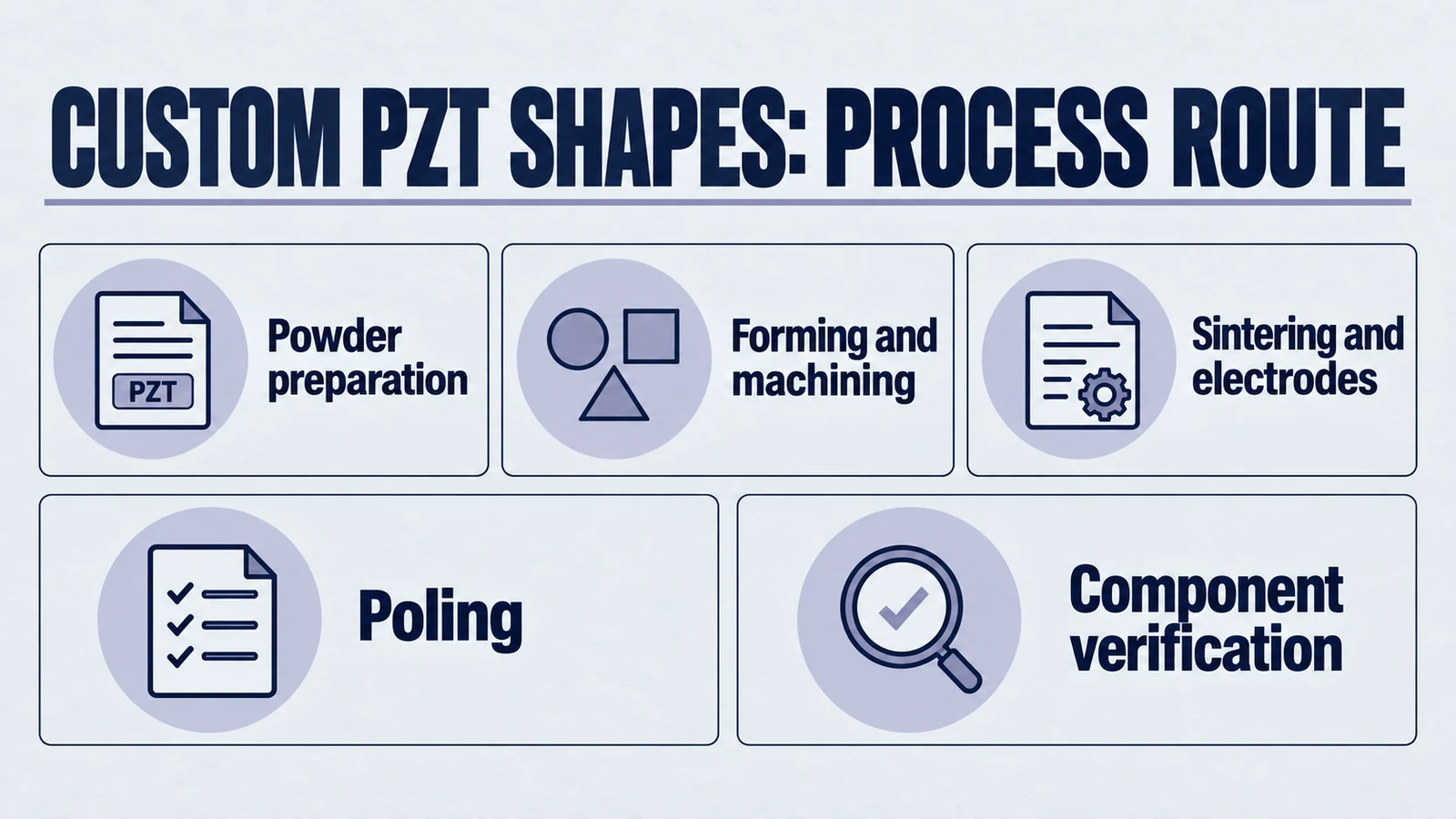
Creating a custom PZT component is a multi-stage process where precision and control at every step are important. A flaw in any single stage—from powder preparation to poling—can compromise the final component. This "chain of quality" is why Yujie's Wuxi manufacturing operations connect material preparation, ceramic processing, machining, and agreed inspection instead of treating final inspection as the only control point.
Step 1: Raw Material Formulation & Powder Preparation
The process begins with weighing and mixing high-purity metal oxides, including lead, zirconium, and titanium oxides, along with proprietary doping agents. This mixture is milled and then calcined in a furnace at approximately 1000°C to trigger the chemical reaction that forms the PZT crystalline structure. The resulting powder is milled again and mixed with an organic binder before being spray-dried. This creates uniform, free-flowing spherical granules, which are essential for consistent die filling in the subsequent pressing stage. Yujie's rigorous control over this foundational step ensures the chemical homogeneity and particle size distribution required for predictable performance in the final product.
Step 2: Precision Forming & Machining
The prepared granules are compacted into a "green" (unfired) shape using powerful hydraulic presses. While simple shapes can be pressed directly, more complex geometries require advanced machining. This can be done on the softer green part or, for the highest precision, on the final sintered ceramic. However, sintered PZT is extremely hard and brittle, so machining must control micro-cracks, chipping, and dimensional drift. Yujie uses experience built since 1996 and specialized diamond-tipped tools to machine complex shapes—including tubes, hemispheres, and components with fine holes or intricate contours—to tight dimensional tolerances.
Step 3: Sintering & Metallization
The green parts are placed in a high-temperature furnace for sintering. During this carefully controlled heating process, the binder is burned out, and the ceramic grains grow and fuse together, forming a dense, hard, polycrystalline structure. The temperature profile—including ramp rates, hold times, and atmospheric conditions—is precisely managed, as it directly determines the final density and grain structure, which in turn influence the ceramic's mechanical strength and electrical properties. After sintering and cooling, conductive electrodes, typically of fired-on silver, are applied to the designated surfaces via screen-printing to serve as the electrical interface.
Step 4: The Critical Poling Process
In its sintered state, the PZT ceramic's internal crystal domains are randomly oriented, resulting in no net piezoelectric effect. The poling process "activates" the material. The component is submerged in a heated silicone oil bath, and a very strong DC electric field (up to several kilovolts per millimeter) is applied across its electrodes. This intense field forces the microscopic electric dipoles within the domains to align with the field. When the field is removed, most of the dipoles remain locked in this alignment, creating a permanent remanent polarization that gives the ceramic its powerful piezoelectric properties. Improper poling is a common source of failure, resulting in weak or inconsistent components. Yujie's mastery of this highly sensitive process ensures that every custom component achieves its maximum piezoelectric activity, delivering the reliable performance required for high-reliability applications.
Application-Driven Design: Real-World Problems Solved by Custom PZT Shapes
The true value of custom PZT manufacturing is demonstrated not in a lab, but in its ability to solve real-world engineering challenges and enable technologies that were previously impossible. In many advanced applications, the custom geometry of the piezoelectric component is not just a part *of* the device; it is the core enabling technology *for* the device's primary function.
Medical Technology: The Power of Focus and Miniaturization
- focused ultrasound systems: Validated focused ultrasound systems require focused ultrasonic energy to be delivered to a defined treatment zone. The acoustic design challenge is difficult to solve with a standard flat transducer alone.
- The Custom Solution: Yujie manufactures custom PZT focus bowls and spherical sections made from high-power "hard" PZT materials like P-81. This specific geometry helps converge acoustic energy toward the intended focal region, while the robust material supports demanding power and heat-control requirements. Final medical performance and safety depend on the complete device design, validation, and intended device-validation use.
- Intravascular Ultrasound (IVUS): IVUS systems use a miniature ultrasound probe mounted on a catheter to generate real-time images inside an end user's arteries, providing diagnostic information. The primary engineering challenge is extreme miniaturization.
- The Custom Solution: The manufacturing of miniaturized PZT tubes or tiny diced single elements, sometimes with cross-sections as small as 0.5 mm x 0.5 mm. This custom form factor is one practical route for integrating an ultrasonic transducer into the tip of a catheter. The custom shape is a key part of the imaging tool's miniaturized architecture.
Industrial Automation: Engineering for Endurance and Efficiency
- Ultrasonic Welding: This process joins plastics and metals using high-frequency vibrations generated by a powerful transducer. The system's efficiency, weld strength, and operational lifespan are directly tied to maximizing the transfer of acoustic energy from the PZT element to the welding horn.
- The Custom Solution: Yujie manufactures custom PZT-8 rings (such as the P-81 grade) with an exceptionally high Mechanical Quality Factor ($Q_m$). The ring shape is ideal for assembly in high-power transducers, while the high-$Q_m$ material minimizes the portion of energy lost as waste heat. This results in more energy being delivered to the weld, leading to stronger bonds, faster cycle times, and a significantly longer-lasting transducer.
Aerospace & Defense: Reliability in Extreme Conditions
- Advanced Sonar Arrays: Naval sonar systems depend on transducers that can project powerful, wide-angle acoustic signals to detect and track underwater objects. These systems must operate reliably under immense hydrostatic pressure and extreme mechanical shock.
- The Custom Solution: The manufacturing of large PZT hemispheres or spherical segments from robust, high-power hard PZT formulations. This custom geometry can support wide beam patterns in sonar architectures. The material and shape are co-engineered so the finished system has a stronger basis for environmental and acoustic validation.
Partnering with Yujie: A Collaborative Approach to Custom PZT Manufacturing
For engineers and procurement managers tasked with developing high-performance systems, the primary concern when sourcing a critical custom component is risk—the risk of poor performance, inconsistent quality, supply chain disruptions, and project delays. A transactional vendor relationship, focused solely on price and a final drawing, fails to address these concerns. Yujie Piezo operates on a strategic partnership model designed to de-risk the entire development and production lifecycle.
From Vendor to Partner
Yujie's engagement model transforms the supplier relationship from a simple transaction to a collaborative engineering partnership. The process is designed to ensure success from the initial concept through to full-scale production.
- Deep-Dive Consultation: The process begins with Yujie's engineering team, which has practical piezoelectric experience built since 1996. They work directly with clients to understand the true requirements of the application—the operational environment, the performance goals, and the system-level challenges—not just the dimensions on a print.
- Material & Design Optimization: Leveraging deep material science expertise and advanced simulation tools like Finite Element Analysis (FEA), Yujie's team helps select the optimal PZT formulation and refine the component's geometry. This collaborative design phase ensures manufacturability and optimizes performance *before* any investment is made in costly tooling or prototypes.
- Rapid Prototyping & Validation: Yujie provides rapid prototyping and small-batch production services, allowing clients to conduct real-world testing and validate the custom design in their own systems. This iterative step is crucial for confirming performance and refining the design before committing to mass production.
- Scalable, Quality-Planned Production: Once a design is validated, production quantity and timing are reviewed against tooling, process, inspection throughput, and forecast demand. Where a program requires PPAP-style records, batch data, or traceability, the applicable deliverables are confirmed during quotation.
The Yujie Advantage Summarized
- Experience: Piezoelectric manufacturing and OEM coordination experience built since 1996.
- Connected Manufacturing: Material preparation, ceramic processing, machining, and inspection can be coordinated through our Wuxi operations.
- Quality Commitment: Product-specific acceptance limits, inspection scope, and agreed documentation.
- International Coordination: English-language technical and commercial support for overseas OEM projects.
Conclusion: Engineering Your Next Performance Breakthrough
Your next performance breakthrough is waiting. It will not be found in a catalog; it will be engineered. Partner with Yujie Piezo to transform your concept into a high-performance component.
Contact our engineering team today to start the conversation about your custom PZT manufacturing needs and discover how application-specific piezoelectric solutions can unlock peak performance in your next project.
Engineering decision notes
PZT material and ceramic selection
For common discs, rings, plates and tubes, start with dimensions and this order’s quantity. A drawing is optional; special geometry has a separate engineering path. Material selection is supporting information.
YJ Piezo coordinates PZT ceramic projects with manufacturing support, so material formulation, sintering, polarization, electrode process, and outgoing inspection can be reviewed against the final application.
Selection checks
- Separate sensing needs from high-power actuation needs before comparing d33 or coupling values.
- Check dielectric loss, Qm, Curie temperature, aging behavior, and operating field against the real duty cycle.
- Confirm whether the application needs standard PZT grades or a custom formulation and geometry.
Failure risks
- Choosing only the highest d33 can create heat, drift, or depolarization risk in power ultrasonics.
- A ceramic that performs well in free measurement can fail once bonded, clamped, or loaded.
- Material substitutions without batch testing can change capacitance, resonance, and system tuning.
RFQ details
- What dimensions and quantity are needed for this order?
- Optional: material, electrodes, drawing, application and annual forecast if known.
Relevant YJ Piezo pages
- Common PZT Discs
Diameter, thickness and this order’s quantity
- Common PZT Rings
Outer diameter, inner diameter, thickness and this order’s quantity
- Common PZT Plates
Length, width, thickness and this order’s quantity
- Common PZT Tubes
Outer diameter, inner diameter, length and this order’s quantity
- Special Geometry and Custom Component Review
Discuss special shape, electrode or polarization requirements
- Material Selection Reference
Supporting information if the material is known
Application FAQ
- Is the highest d33 always the best PZT choice?
- No. High d33 can be useful for sensitivity, but high-power ultrasonic systems often need lower loss, higher Qm, better thermal stability, and safer operation under field and stress.
- What makes PZT material selection different from catalog buying?
- The right PZT choice depends on geometry, load, drive field, duty cycle, temperature, and inspection targets. A catalog value is only useful when it is tied to the final assembly conditions.