
High-Performance Piezo Actuators for Precision Engineering
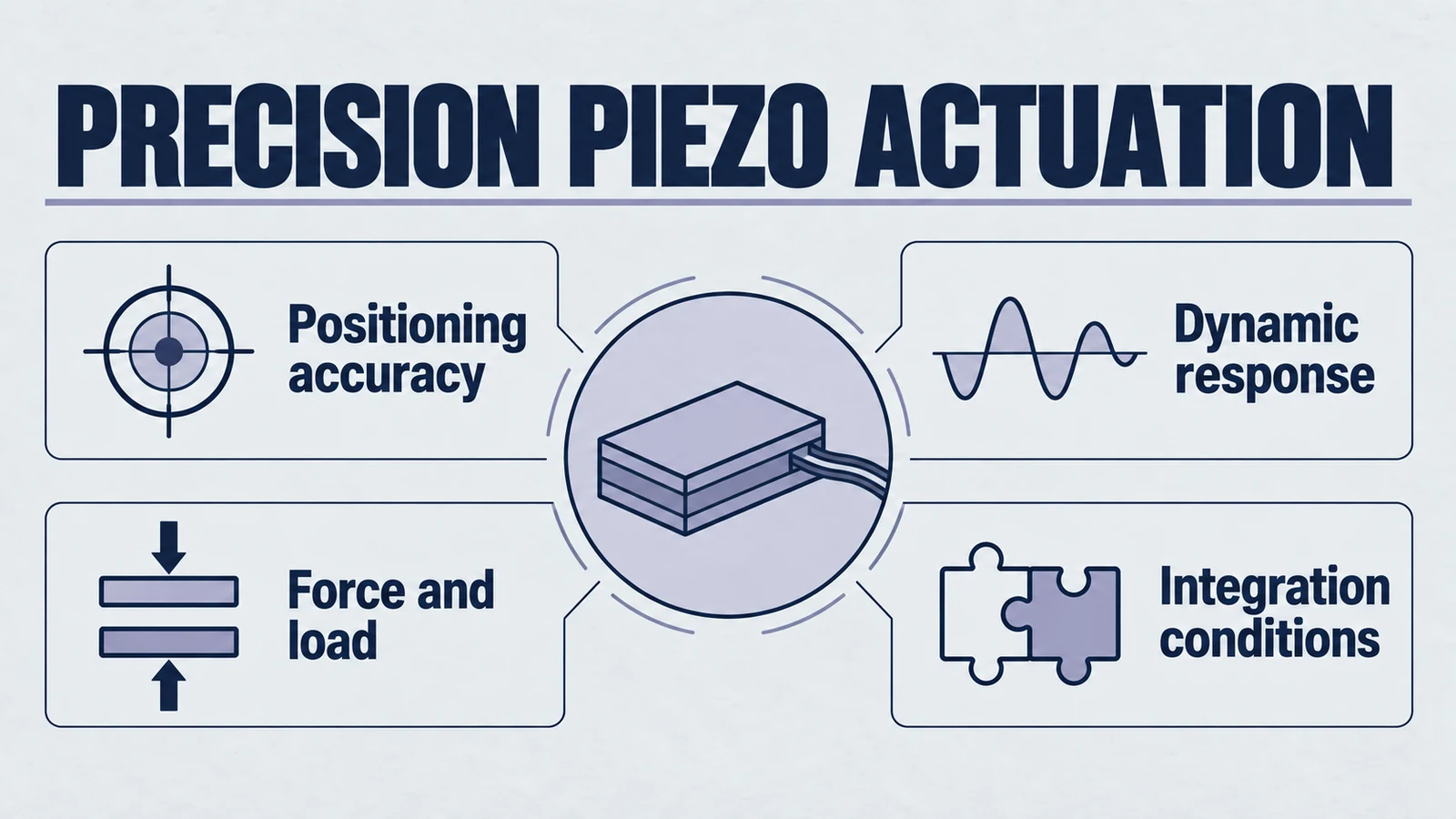
Piezo actuators have become important components in modern precision engineering, enabling sub-micron accuracy, fast response, and exceptional reliability in critical applications. As industries demand increasingly compact and high-performance motion control systems, piezoelectric actuators stand out for their unique combination of speed, force, and precision.
In this article, we explore the working principles of piezo actuators, key advantages over conventional actuators, typical application areas, and how to select the right actuator for your engineering needs.
What Are Piezo Actuators?
Piezo actuators are motion-generating devices that use the piezoelectric effect—a property of certain ceramic materials that deform when an electric field is applied. This deformation can be used to produce precise mechanical motion in response to electrical input.
Product path for this search intent
Match the article topic to the right YJ Piezo product page
Use this article when the choice is not just a shape, but a material tradeoff between sensitivity, loss, coupling, stability, and operating field. For "High-Performance Piezo Actuators for Precision Engineering", the practical value is in turning the topic into a measurable selection or sourcing decision.
- PZT Material Hub
Material grades and application tradeoffs
- Piezoelectric Ceramics
Shapes and ceramic manufacturing options
- PZT Material Supplier Hub
Material control, grade selection, and sourcing support
There are various types of piezo actuators, including:
- Stack actuators – composed of multiple piezo layers, ideal for generating high force with short travel.
- Bending actuators (bimorphs) – produce larger displacements, suitable for scanning and micropositioning.
- Shear actuators – provide lateral motion, often used in active vibration control.
- Tube actuators – used in fiber alignment and scanning probe systems with tube series components.
Piezo actuators can be compact and avoid conventional sliding mechanisms, while producing motion through ceramic deformation. Acoustic noise, fatigue and long-term stability depend on drive, mounting and the complete design.
Moreover, recent innovations have introduced hybrid actuators that integrate piezo elements with strain amplification mechanisms or flexure structures to increase travel range while maintaining resolution. These new designs have opened the door to broader applications in nanotechnology and adaptive systems.
Key Advantages of Piezo Actuators
Compared to electromagnetic, hydraulic, or pneumatic actuators, piezo actuators offer several compelling benefits:
1. Sub-Nanometer Precision
Piezo actuators are capable of achieving motion resolutions in the nanometer to sub-nanometer range, critical for applications like AFM (atomic force microscopy), semiconductor lithography, or interferometry.
2. Fast Response Time
Thanks to their direct conversion of electrical energy to mechanical displacement, piezo actuators feature microsecond-level response times, enabling high-frequency control and dynamic positioning.
3. High Force Output
Despite their compact size, piezo actuators can generate forces up to several kilonewtons, making them suitable for load-bearing or dynamic force applications.
4. No Mechanical Wear
Direct piezo drive can avoid backlash from gears and sliding contacts. The complete assembly can still suffer fatigue, bond, electrode or environmental failure; lifetime and repeatability require the selected model’s validation.
5. Vacuum and Cryogenic Compatibility
Piezo actuators can operate in ultra-high vacuum and cryogenic environments, supporting use in electron microscopy, space optics, and scientific instrumentation.
6. Energy Efficiency
Static holding generally requires little power in the ceramic, but leakage and driver/feedback electronics are part of the system budget. Dynamic power depends on capacitance, drive, frequency, load and dissipative losses.
Applications in Precision Engineering
High-performance piezo actuators are widely used across industries that require ultra-precise motion control. Here are some of the most common applications:
✦ Semiconductor Manufacturing
Used in wafer alignment, mask positioning, and lithography systems to achieve nanometer-level control.
✦ Optics and Photonics
Enable mirror positioning, laser tuning, and fiber alignment in optical communication and imaging systems using high-frequency transducers.
✦ Medical Devices
Used in micro-pumps, drug delivery systems, and high-resolution scanning for medical imaging technologies.
✦ Aerospace and Defense
Piezo actuators are integrated into flight control surfaces, adaptive optics, and active vibration damping systems.
✦ Industrial Metrology
Provide high-stability scanning motion in coordinate measuring machines (CMMs) and interferometers.
✦ Micro-Robotics and Precision Assembly
Piezo actuators power micromanipulators and nano-positioning stages in microelectronics and MEMS device manufacturing.
✦ Scientific Instrumentation
In laboratory research and particle physics, piezo actuators facilitate highly accurate positioning and beam alignment tasks.
Selecting the Right Piezo Actuator
Choosing the right actuator involves understanding both the technical requirements of your application and the performance characteristics of available actuator models.
Consider the following key parameters:
| Parameter | Typical Range | Considerations |
|---|---|---|
| Displacement (Stroke) | 10 nm – 250 μm (stack), up to mm (bender) | Balance between travel range and resolution |
| Blocking Force | Up to several kN | Depends on stack size and material composition |
| Resonant Frequency | 1 kHz – 100 kHz+ | Higher frequency = faster response |
| Drive Voltage | 30 V – 150 V (low-voltage stacks) | Compatible with compact drivers |
| Capacitance | 100 nF – 100 μF | Impacts amplifier selection |
| Operating Environment | -273°C to 150°C, vacuum-compatible | Application-specific constraints |
Also take into account the mounting method, thermal stability, and feedback control integration. For demanding systems, piezo actuators may be combined with closed-loop control systems using strain gauge or capacitive sensors to ensure nanometer-accurate positioning.
At Yujie, we offer both standard and custom-designed piezo actuators tailored to your needs. Our materials are engineered for high stability, strong electromechanical coupling, and excellent thermal resistance—perfect for demanding precision engineering environments.
Why Choose Yujie Piezo Actuators?
With piezoelectric ceramics experience built since 1996, Yujie provides OEM and ODM solutions trusted by global leaders in semiconductors, ultrasonics, medical imaging, and industrial automation. Our actuators are:
- Made from in-house formulated high-performance piezoceramics (e.g., PZT-8 equivalents)
- Tested under stringent quality control for reliability and consistency
- Available with customization options for dimensions, electrode pattern, and stack configurations
- Supported by expert engineers ready to help with application-specific modeling and integration
Whether you're developing a high-precision optical system or a next-generation sensor array, Yujie can provide the right actuator with the right performance.
Let's Work Together
Need help selecting the ideal actuator for your system? Contact us or explore more on our website. Our technical team is ready to provide datasheets, samples, and expert support.
For more insights on piezoelectric technology applications, explore our related articles:
Engineering decision notes
PZT material and ceramic selection
Use this article when the choice is not just a shape, but a material tradeoff between sensitivity, loss, coupling, stability, and operating field. For "High-Performance Piezo Actuators for Precision Engineering", the practical value is in turning the topic into a measurable selection or sourcing decision.
YJ Piezo coordinates PZT ceramic projects with manufacturing support, so material formulation, sintering, polarization, electrode process, and outgoing inspection can be reviewed against the final application.
Selection checks
- Separate sensing needs from high-power actuation needs before comparing d33 or coupling values.
- Check dielectric loss, Qm, Curie temperature, aging behavior, and operating field against the real duty cycle.
- Confirm whether the application needs standard PZT grades or a custom formulation and geometry.
Failure risks
- Choosing only the highest d33 can create heat, drift, or depolarization risk in power ultrasonics.
- A ceramic that performs well in free measurement can fail once bonded, clamped, or loaded.
- Material substitutions without batch testing can change capacitance, resonance, and system tuning.
RFQ details
- Is the part used for sensing, actuation, atomization, cleaning, welding, or measurement?
- What field strength, temperature, duty cycle, and mechanical load will the ceramic see?
- Which values must be controlled: d33, capacitance, resonance, impedance, Qm, or dimensional tolerance?
Relevant YJ Piezo pages
- PZT Material Hub
Material grades and application tradeoffs
- Piezoelectric Ceramics
Shapes and ceramic manufacturing options
- PZT Material Supplier Hub
Material control, grade selection, and sourcing support
Application FAQ
- Is the highest d33 always the best PZT choice?
- No. High d33 can be useful for sensitivity, but high-power ultrasonic systems often need lower loss, higher Qm, better thermal stability, and safer operation under field and stress.
- What makes PZT material selection different from catalog buying?
- The right PZT choice depends on geometry, load, drive field, duty cycle, temperature, and inspection targets. A catalog value is only useful when it is tied to the final assembly conditions.