
Piezo Ring vs. Disc: The Engineer's Guide to Selecting the Right Element for High-Performance Ultrasonic Devices
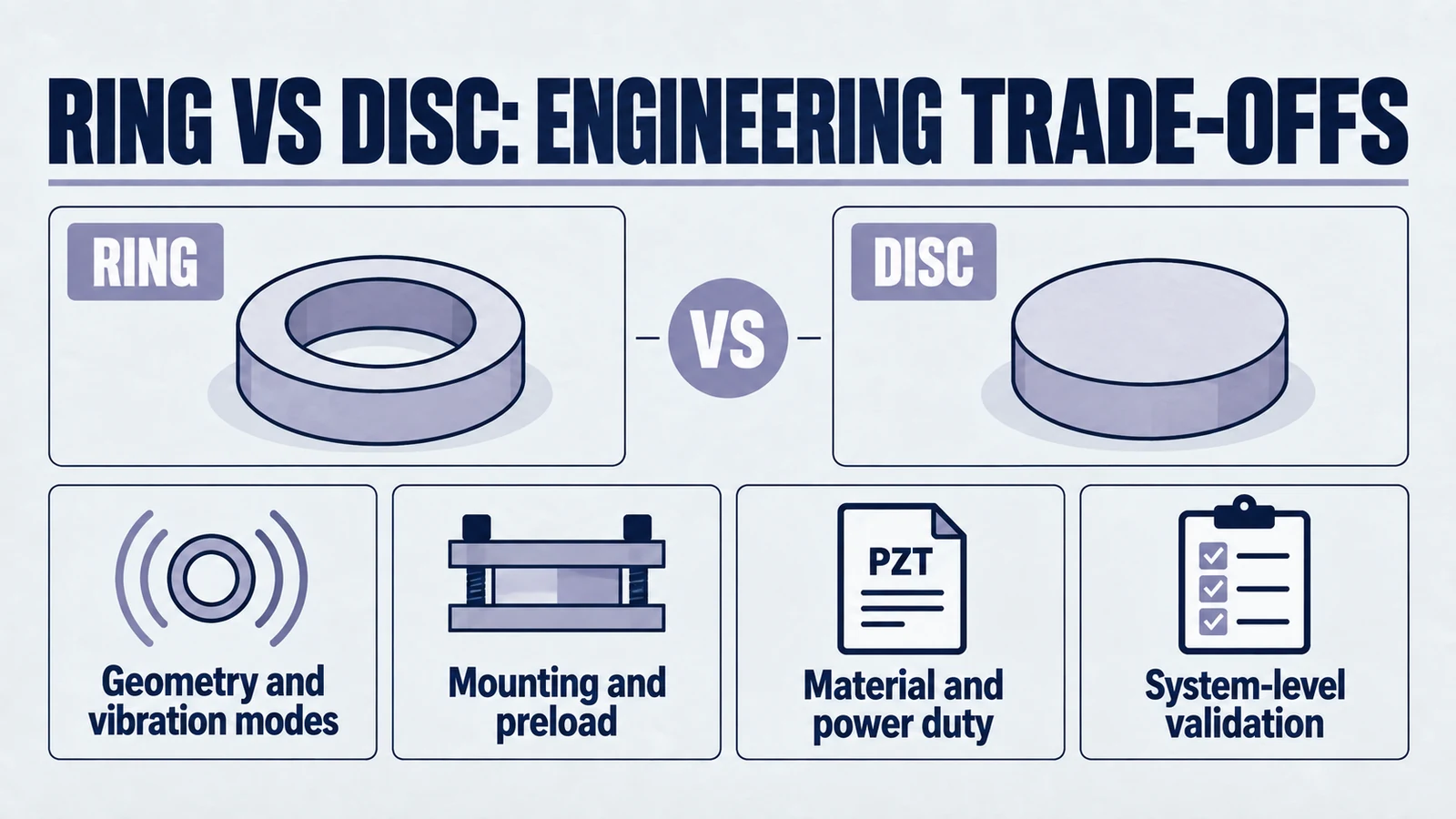
I. Introduction: The Foundational Choice in Ultrasonic Transducer Design
In the design of any high-performance ultrasonic device—whether a powerful industrial welder, a precision medical imaging system, or a highly sensitive hydrophone—success hinges on the performance of its core transducer. Within the intricate process of transducer design, engineers face a series of critical choices. Among the most fundamental, and yet frequently misunderstood, is the selection of the piezoelectric element's geometry. The two dominant contenders for this role are the piezoelectric ring and the piezoelectric disc. While appearing as simple variations of a cylindrical shape, their operational characteristics, performance ceilings, and integration requirements are profoundly different.
This choice is far more than a simple component swap; it represents a pivotal system architecture decision. The selection of a piezo ring over a disc, or vice versa, dictates the entire mechanical mounting strategy, defines the thermal management system, influences the design of the power electronics, and ultimately sets the performance limits of the final device. For instance, the hollow geometry of a piezo ring is not an incidental feature; it is an enabling characteristic that allows for robust bolt-clamping, a mechanical integration method fundamentally different from the adhesive bonding typical for discs. This single difference cascades through the design, impacting everything from power handling to long-term reliability. Similarly, the superior heat dissipation of a piezo ring allows a system's power profile and duty cycle to be pushed to levels that would cause serious failure in a disc-based equivalent.
This guide moves beyond surface-level descriptions to provide a deep, physics-based comparison of piezoelectric rings and discs. It will deconstruct their respective thermal management capabilities, mechanical stability, complex vibrational dynamics, and power handling characteristics. The objective is to equip design engineers and systems integrators with the nuanced understanding required to make the optimal choice, ensuring that this foundational decision serves as a cornerstone for success rather than a bottleneck to performance.
Product path for this search intent
Match the article topic to the right YJ Piezo product page
Use this article when the choice is not just a shape, but a material tradeoff between sensitivity, loss, coupling, stability, and operating field. For "Piezo Ring vs. Disc: The Engineer's Guide to Selecting the Right Element for High-Perfo...", the practical value is in turning the topic into a measurable selection or sourcing decision.
- PZT Material Hub
Material grades and application tradeoffs
- Piezoelectric Ceramics
Shapes and ceramic manufacturing options
- PZT Material Supplier Hub
Material control, grade selection, and sourcing support
II. The Foundation: Why Geometry Governs Piezoelectric Performance
To comprehend the stark differences between a piezoelectric ring and a disc, one must first grasp the fundamental principles that govern their behavior. The performance of these elements is not an arbitrary outcome but a direct consequence of the interaction between their material properties and their physical form.
A Primer on the Piezoelectric Effect
At the heart of these components is the piezoelectric effect, a phenomenon observed in certain crystalline and ceramic materials. This effect manifests in two complementary ways. The direct piezoelectric effect describes the generation of an electrical voltage when the material is subjected to mechanical stress, such as pressure or vibration. This is the principle that enables sensors. Conversely, the inverse piezoelectric effect describes the physical deformation—an expansion or contraction—of the material when an electrical field is applied across it. This is the principle that drives actuators and generates ultrasonic waves.
The Role of PZT Ceramics
While the piezoelectric effect was first discovered in natural crystals like quartz, the industrial breakthrough came with the development of polycrystalline ferroelectric ceramics. Among these, lead zirconate titanate, or PZT, has become the most widely used material due to its high sensitivity, high operating temperatures, and, most importantly, its ability to be chemically tailored for specific applications.
Poling a ferroelectric PZT ceramic establishes remanent polarization using a qualified electric-field, temperature and time schedule. Poling does not universally require heating above or just below the Curie point; room-temperature processes exist. Record the process and polarization direction, typically designated the 3-axis, rather than inferring them from a generic temperature rule.
From Material to Motion: The Importance of Shape
While the specific PZT formulation (e.g., a "hard" PZT for high power versus a "soft" PZT for high sensitivity) defines the material's potential, it is the element's geometry that dictates how that potential is expressed. The shape of the element—a solid disc or a hollow piezo ring—determines how an applied electric field or an external mechanical stress interacts with the material's built-in poling axis.
This interaction is what governs the element's behavior. A standard disc, for example, primarily utilizes the thickness expansion (the d₃₃ effect) and the related radial contraction (the d₃₁ effect). In a solid geometry, these modes are tightly coupled, which can lead to complex and sometimes undesirable vibrations, especially in components where the diameter is not significantly larger than the thickness.
The introduction of a central aperture to create a piezo ring fundamentally changes the boundary conditions of the vibrating body. It does not simply remove material; it decouples and redefines the possible vibrational modes. This allows for the emergence of distinct behaviors, such as a pure radial mode where the inner and outer walls vibrate in-phase, or a wall thickness mode where they vibrate out-of-phase. These new modes are governed more by the ring's diameter and wall thickness than its overall thickness, offering engineers additional degrees of freedom for transducer design. Therefore, the geometry is not a passive characteristic; it is an active participant in shaping the element's electromechanical response, influencing everything from resonant frequency and displacement direction to internal stress distribution and thermal performance.
III. Anatomy of a Piezoelectric Disc: The Solid-State Workhorse
The piezoelectric disc is the most common and fundamental form factor for piezoceramic elements. It is a solid, cylindrical component, typically with electrodes applied to its two flat faces, polarized along its thickness axis. Its simplicity in manufacturing and application has made it a ubiquitous workhorse in countless devices, from consumer electronics to advanced scientific instruments.
Vibrational Dynamics: The "Piston" Myth and the Reality of Coupled Modes
A disc can be approximated as a piston only when its measured/modelled surface velocity is sufficiently uniform for the intended acoustic calculation. Aspect ratio, material, electrodes, mounting and frequency all matter; D/T above 20 alone is not proof of pure motion.
A finite-element analysis of a PZT disc reveals a complicated spectrum of vibrational modes. The primary thickness extensional mode, which produces the desired out-of-plane displacement, is inevitably coupled with other modes, including radial, edge, and thickness shear vibrations. This modal coupling has significant consequences:
- Non-Uniform Displacement: The surface of the disc does not move as a single, flat piston. Instead, the displacement field can be highly non-uniform, with some areas moving more than others, reducing the efficiency of launching a clean, planar acoustic wave into an adjoining medium.
- Spurious Resonances: The presence of these coupled modes, particularly radial modes, can introduce unwanted "ringing" at frequencies other than the intended operational frequency. This can adversely affect the performance of transducers, especially in applications requiring a clean pulse response, such as medical imaging or non-destructive testing.
Strengths and Ideal Applications
Despite these complexities, the piezoelectric disc excels in applications where its specific strengths are leveraged and its limitations are not a primary concern.
High-Sensitivity Sensing: The disc's solid structure provides an excellent surface for converting mechanical energy into an electrical signal. This makes it the ideal choice for a wide range of sensors. Examples include automotive engine knock sensors that detect specific detonation frequencies, accelerometers that measure vibration in industrial machinery, and contact microphones and hydrophones used for acoustic sensing.
Low-Power and Precision Actuation: In applications requiring small, controlled displacements at moderate power levels, the disc is highly effective. It is the core technology in inkjet printer heads, where a voltage pulse causes a disc to deform and eject a tiny droplet of ink. It is also used in micropumps, valves, and some designs of medical nebulizers for aerosol generation.
Medical Diagnostic Imaging: The arrays found in modern ultrasound probes are composed of hundreds or thousands of tiny, individual PZT disc elements. In this application, the small form factor, high sensitivity, and ability to be manufactured in dense arrays are paramount. The power levels for each individual element are low, so the disc's thermal limitations are not a significant factor.
Inherent Limitations: The Achilles' Heel of the Disc
The very characteristics that make the disc simple and effective in some applications become critical liabilities in others, particularly those involving high power.
Thermal Design: A piezoelectric disc requires an application-specific thermal path, as do other geometries. Solid geometry alone does not establish a thermal bottleneck. Evaluate dielectric/mechanical/interface loss, dimensions, mounting, conduction and cooling; suitable disc assemblies have demonstrated high-power continuous operation.
Mechanical Integration: Discs are typically mounted using adhesives or peripheral clamping. Suitable external preload structures can also compress solid elements. For high-power ultrasonic transducers, validate the local static/dynamic stress and interfaces; no mounting category alone proves sufficient or insufficient preload.
Brittleness and Fragility: As a monolithic ceramic, a bare PZT disc is inherently fragile and susceptible to cracking or shattering under mechanical shock, high tensile forces, or shear stress.
Dielectric, mechanical and interface losses can cause heating and alter response. Thermal depolarization risk depends on material, field, stress, temperature and duration; the Curie point is not an assembly operating rating. Some intact ferroelectric ceramics can be repoled under a qualified process, but recovery of a finished device is not guaranteed. Validate the actual electrical, acoustic and thermal limits.
IV. Anatomy of a Piezoelectric Ring: The High-Performance Specialist
The piezoelectric ring is not merely a disc with a hole in it; it is an engineered component specifically designed to overcome the fundamental limitations of its solid counterpart. Its hollow, cylindrical geometry—whether as a single monolithic piece or, more commonly, as a stack of individual rings—unlocks a new tier of performance, particularly in high-power and high-stress applications.
Specialized Vibration Modes for Greater Control
As previously discussed, the piezo ring's unique geometry creates new boundary conditions that allow for a more diverse and controllable set of vibrational modes:
- Radial Mode: The inner and outer cylindrical walls expand and contract in-phase. This is particularly useful for generating pressure waves radially into a surrounding medium or for applications requiring uniform radial displacement.
- Wall Thickness Mode: Wall-thickness motion changes the separation of the inner and outer surfaces. Distinguish this from whole-radius radial breathing and define the displacement coordinate convention.
- Thickness Mode: The top and bottom flat surfaces move in opposite phase, analogous to a disc's primary mode but influenced by the different mechanical constraints of the ring structure.
- Advanced Torsion and Shear Modes: By segmenting the electrodes on the ring's surface, it is possible to generate complex, multi-axis motions like shear and torsion from a single component. This allows for the design of highly specialized actuators and transducers capable of movements that would otherwise require multiple elements.
The Three Pillars of Ring Superiority in High-Power Applications
For demanding ultrasonic applications, the advantages of the piezoelectric ring can be distilled into three critical pillars that directly address the weaknesses of the disc.
Superior Thermal Management: The presence of a central hole and an inner cylindrical wall dramatically increases the total surface area of the component relative to its volume. This enhanced surface area provides a highly efficient pathway for heat to be dissipated, either through natural convection, forced air, or direct conduction to a heatsink or the mounting bolt itself. The bore may assist a particular cooling or mounting design, but it does not guarantee a safe continuous-duty temperature. Validate losses, conduction, coolant paths and the loaded thermal envelope.
High Mechanical Stability and Pre-loading: This is the defining feature of the piezoelectric ring and the key to its dominance in power ultrasonics. The central aperture is a critical design element that enables the construction of a Langevin transducer. A high-tensile steel bolt is passed through the center of a stack of piezo rings, electrodes, and metallic end masses (a head mass and a tail mass). This bolt is then tightened to a specific torque, placing the entire stack of brittle ceramic rings under a high degree of static compressive pre-load.
Enhanced Geometric Stability: For a given volume of PZT material, a piezo ring can be designed with a much larger outer diameter than a solid disc. This larger footprint significantly increases the mechanical stability of the actuator or stack, making it more resistant to off-axis bending or tilting forces that can occur during operation.
The ability to apply this mechanical pre-load does more than just prevent the ceramic from breaking. It fundamentally enhances the electro-acoustic efficiency of the entire transducer. The high clamping force from the bolt supports intimate, void-free contact between every component in the stack—the rings, the thin electrodes, and the metal end masses. Without this pre-load, microscopic gaps or compliant layers (like adhesive) would act as dampers, dissipating vibrational energy as heat and reducing the overall efficiency.
V. Head-to-Head Technical Comparison: Piezo Ring vs. Disc
To consolidate the preceding analysis, a direct comparison across key engineering parameters provides a clear framework for selection. While both geometries are derived from the same fundamental piezoelectric principles, their performance characteristics diverge significantly based on the application's demands for power, precision, and durability.
| Feature | Piezoelectric Ring | Piezoelectric Disc |
|---|---|---|
| Heat Dissipation | A bore may assist a particular thermal path; continuous-duty suitability still requires measured losses, cooling and temperature. | Thermal paths, losses, mounting and cooling determine the limit; solid geometry alone does not establish poor cooling. |
| Power Handling | High: The component of choice for power ultrasonic applications (e.g., welding, cleaning, sonar). | Design-dependent; suitable disc assemblies can operate continuously at high power within validated drive and thermal limits. |
| Mechanical Pre-load | Ideal: Central aperture is designed for bolt-clamping, creating robust, pre-stressed transducer stacks. | Possible with an appropriate external preload structure; a central bore is not required for compression. Validate local static and dynamic stress. |
| Mechanical Stability | High: Larger diameter for a given material volume increases stability and resistance to tilting forces. | Moderate: Stability is highly dependent on the diameter-to-thickness ratio. |
| Primary Vibration | Controllable Modes: Distinct radial, wall thickness, and thickness modes allow for specialized tuning. | Coupled Modes: Prone to complex coupling of radial, edge, and thickness modes, leading to non-uniform motion. |
| Typical Applications | Ultrasonic Welding & Cutting, Industrial Cleaning, High-Power Sonar, Medical Therapy (Lithotripsy), Actuator Stacks. | Vibration Sensors, Accelerometers, Microphones, Medical Imaging Arrays, Low-Power Actuators (Inkjet). |
| System Complexity | Enables simpler thermal management in high-power systems. Mechanical assembly is more complex but robust. | Simpler component, but may require more complex external cooling or power limiting in demanding applications. |
This comparative analysis underscores a central theme: the piezoelectric ring is an engineered solution for high-energy systems, while the piezoelectric disc is a classic component optimized for high-sensitivity measurement and low-energy actuation.
VI. Application Deep Dive: Matching the Element to the Mission
Translating technical specifications into practical design choices is the ultimate goal. The decision between a piezo ring and a disc becomes clear when examined through the lens of specific, real-world applications.
Scenario 1: High-Power Industrial Ultrasonics (Welding, Cleaning, Sonication)
Recommendation: Piezoelectric Ring (in a stacked Langevin configuration).
Justification: These applications are the quintessential domain of the piezoelectric ring. They demand the continuous delivery of high-density acoustic power to perform mechanical work—melting plastics, cavitating liquids, or cutting materials. The operational requirements are important: extreme durability, high electro-acoustic efficiency, and excellent thermal stability. The ring's ability to be mechanically pre-loaded into a robust Langevin transducer is a proven method to withstand the immense internal stresses of such operations. Furthermore, its superior heat dissipation is critical for maintaining performance and preventing thermal failure during prolonged use. A disc-based design requires its own validated stress and thermal envelope; high-power continuous disc operation is possible in suitable assemblies.
Scenario 2: High-Resolution Medical Diagnostic Imaging
Recommendation: Piezoelectric elements matched to the probe architecture; linear/matrix designs often use rectangular/square elements.
Justification: A modern medical ultrasound probe is a marvel of miniaturization, containing an array of hundreds or even thousands of tiny, independent piezoelectric elements. The primary goal is to achieve the highest possible spatial resolution and sensitivity for creating detailed images of internal tissues. In this context, the piezoelectric disc is the ideal choice. Linear and matrix diagnostic arrays commonly use diced rectangular or square elements. Disc, annular and single-element architectures also exist; sensitivity and layout are design-specific.
Scenario 3: Sensitive Vibration and Acoustic Sensing
Recommendation: Piezoelectric Disc.
Justification: The core function here is the efficient conversion of mechanical energy (vibration, pressure waves) into a clean, proportional electrical signal—the direct piezoelectric effect. Power handling is irrelevant. The disc's simple, solid geometry provides a direct and predictable response to incoming forces, making it an excellent and cost-effective sensor. Its uncomplicated structure is easy to mount and integrate into systems like an engine block to detect knock or a hydrophone assembly for underwater sound detection.
Scenario 4: High-Frequency Medical Ultrasound Instruments
Recommendation: Piezoelectric Ring.
Justification: While used on a smaller scale than industrial welders, devices like ultrasonic dental scalers or phacoemulsification handpieces (for cataract surgery) are fundamentally power ultrasonic instruments. They must generate significant mechanical vibration at high frequencies to effectively remove dental plaque or emulsify the eye's lens. This requires a transducer that is both powerful and robust. The pre-loaded, ring-based transducer provides the necessary mechanical amplitude, efficiency, and long-term reliability for these demanding medical applications, ensuring consistent performance and finished-device risk controls.
Scenario 5: Precision Flow Measurement (Ultrasonic Flow Meter)
Recommendation: Either geometry can be used, but Piezo Rings often provide greater design flexibility.
Justification: Ultrasonic flow meters typically operate by sending an acoustic pulse from a transmitting transducer to a receiving transducer and measuring the transit time. The difference in transit time for pulses traveling with and against the flow is proportional to the fluid's velocity. Both discs and rings can serve as the active elements. However, piezo rings offer unique integration advantages. They can be clamped around the outside of a pipe for non-invasive measurement, or if mounted internally, the central hole prevents obstruction of the flow path and can be used to route wiring or accommodate other sensors.
VII. Beyond Geometry: The Critical Role of Material and Customization
Choosing the correct geometry is a critical first step, but achieving peak performance requires a deeper level of optimization. The specific piezoelectric material used to fabricate the ring or disc is just as important as its shape. The synergy between form and material is what unlocks the full potential of an ultrasonic device.
Hard vs. Soft PZT: A Vital Distinction
PZT ceramics are not a single material but a family of formulations, broadly categorized as "hard" and "soft". Each type is engineered with distinct properties to excel in different regimes of operation.
Hard PZT (e.g., PZT-4, PZT-8, APC 840/841/880): These materials are characterized by a high mechanical quality factor (Qm), low dielectric loss, and a high coercive field, which means they resist depolarization under high electrical and mechanical stress. These properties make them exceptionally efficient at converting electrical energy into high-amplitude mechanical vibration with minimal heat generation. They are the undisputed choice for high-power applications and are almost exclusively used to manufacture the piezoelectric rings found in power ultrasonic transducers.
Soft PZT (e.g., PZT-5A, PZT-5H, APC 850/855): These materials exhibit high piezoelectric charge constants (d₃₃), high permittivity, and high electromechanical coupling factors (k). This translates to extreme sensitivity; they produce a large electrical signal for a small mechanical input (for sensors) or a large displacement for a small electrical input (for low-power actuators). They are the go-to material for the piezoelectric discs used in sensing applications, medical imaging, and precision actuators.
The importance of this pairing cannot be overstated. Using a piezo ring made of soft PZT for an ultrasonic welder may increase certain loss or drive risks; measure high-drive output and thermal limits for the actual assembly. Conversely, a hard-PZT sensor’s sensitivity depends on the relevant d/g coefficient, mode and readout; class alone does not establish inadequate sensing. Optimal design is achieved only when the geometry is matched with the appropriate material class.
The Power of Customization: Moving Beyond Standard Components
The increasing complexity of modern technology, from minimally invasive surgical tools to autonomous vehicle sensors, demands components that are precisely tailored to their specific function. The global market for piezoelectric devices is growing rapidly, driven by these advanced applications that push the boundaries of performance. In this environment, relying on standard, off-the-shelf components can mean leaving significant performance, efficiency, and reliability on the table.
True breakthroughs are often achieved through custom solutions. A specialist supplier with deep expertise in materials science and manufacturing can act as a design partner, tailoring every aspect of the piezoelectric element to the application's unique demands. This can include:
- Custom Geometries: Precisely defining the outer diameter, inner diameter, and thickness to tune the resonant frequency and mechanical properties.
- Tailored Material Formulations: Selecting or even developing a PZT formulation with the ideal balance of properties (e.g., Qm, d₃₃, Curie temperature) for the operational environment.
- Specialized Electrode Patterns: Designing segmented or wrap-around electrodes to achieve complex motions like torsion or to simplify electrical connections in tight spaces.
- Integrated Assemblies: Providing fully assembled and wired components to streamline the customer's manufacturing process.
This shift from a component supplier to a collaborative engineering partner is crucial. It allows for the co-development of a piezoelectric element that is not just a part within a system, but a fully optimized core that enables the entire system to achieve its maximum potential.
VIII. Conclusion: Your Blueprint for an Optimized Ultrasonic Device
The selection between a piezoelectric ring and a piezoelectric disc is not a matter of simple preference but a foundational engineering decision that profoundly impacts the performance, reliability, and ultimate success of an ultrasonic device. The evidence clearly shows that each geometry is optimized for a distinct class of applications, and understanding this division is the first step toward an efficient and effective design.
To create a blueprint for the optimal device, the design process should be guided by a clear decision framework based on the application's primary requirements:
- Power Level and Function: Is the element's primary role to generate high-intensity mechanical power (actuator), or is it to detect faint mechanical signals (sensor)? This is the most critical question. High power dictates the use of a piezo ring; high sensitivity points toward a piezo disc.
- Thermal Environment: Will the device operate continuously under a high electrical drive, generating significant internal heat? If so, the superior thermal dissipation of a piezo ring is essential to prevent performance degradation and failure.
- Mechanical Integration and Stress: Does the design involve high-amplitude vibrations that will subject the ceramic to significant dynamic stress? If yes, the robustness afforded by a pre-loaded, bolt-clamped piezo ring assembly is a important requirement for long-term reliability.
- Acoustic and Vibrational Needs: What is the target resonant frequency, and what type of motion (thickness, radial, etc.) is desired? The distinct and controllable vibrational modes of a piezo ring offer greater tuning flexibility for specialized acoustic outputs.
The primary takeaway is unambiguous: the piezoelectric ring is an engineered solution purpose-built for power, durability, and thermal stability. The piezoelectric disc is a classic component valued for its sensitivity, simplicity, and suitability for low-power or sensing roles. Mismatching the component to the application is a direct path to compromised performance.
The journey from concept to a market-leading ultrasonic device is complex, involving the intricate interplay of material science, mechanical engineering, and electronics. Leveraging decades of specialized expertise in piezoelectric ceramics can de-risk the design process, overcome performance bottlenecks, and accelerate time-to-market. To ensure that every ounce of potential performance is realized, collaboration with an expert partner is invaluable.
Don't compromise on power, efficiency, or reliability. Contact our engineering team to discuss your specific application requirements. Partner with us to design the well-matched custom piezoelectric ring or piezoelectric disc that will serve as the high-performance heart of your next device.
Engineering decision notes
PZT material and ceramic selection
Use this article when the choice is not just a shape, but a material tradeoff between sensitivity, loss, coupling, stability, and operating field. For "Piezo Ring vs. Disc: The Engineer's Guide to Selecting the Right Element for High-Perfo...", the practical value is in turning the topic into a measurable selection or sourcing decision.
YJ Piezo coordinates PZT ceramic projects with manufacturing support, so material formulation, sintering, polarization, electrode process, and outgoing inspection can be reviewed against the final application.
Selection checks
- Separate sensing needs from high-power actuation needs before comparing d33 or coupling values.
- Check dielectric loss, Qm, Curie temperature, aging behavior, and operating field against the real duty cycle.
- Confirm whether the application needs standard PZT grades or a custom formulation and geometry.
Failure risks
- Choosing only the highest d33 can create heat, drift, or depolarization risk in power ultrasonics.
- A ceramic that performs well in free measurement can fail once bonded, clamped, or loaded.
- Material substitutions without batch testing can change capacitance, resonance, and system tuning.
RFQ details
- Is the part used for sensing, actuation, atomization, cleaning, welding, or measurement?
- What field strength, temperature, duty cycle, and mechanical load will the ceramic see?
- Which values must be controlled: d33, capacitance, resonance, impedance, Qm, or dimensional tolerance?
Relevant YJ Piezo pages
- PZT Material Hub
Material grades and application tradeoffs
- Piezoelectric Ceramics
Shapes and ceramic manufacturing options
- PZT Material Supplier Hub
Material control, grade selection, and sourcing support
Application FAQ
- Is the highest d33 always the best PZT choice?
- No. High d33 can be useful for sensitivity, but high-power ultrasonic systems often need lower loss, higher Qm, better thermal stability, and safer operation under field and stress.
- What makes PZT material selection different from catalog buying?
- The right PZT choice depends on geometry, load, drive field, duty cycle, temperature, and inspection targets. A catalog value is only useful when it is tied to the final assembly conditions.