
Advanced Ultrasonic Transducer Design Fundamentals: Materials, Resonance, and Integration Limits
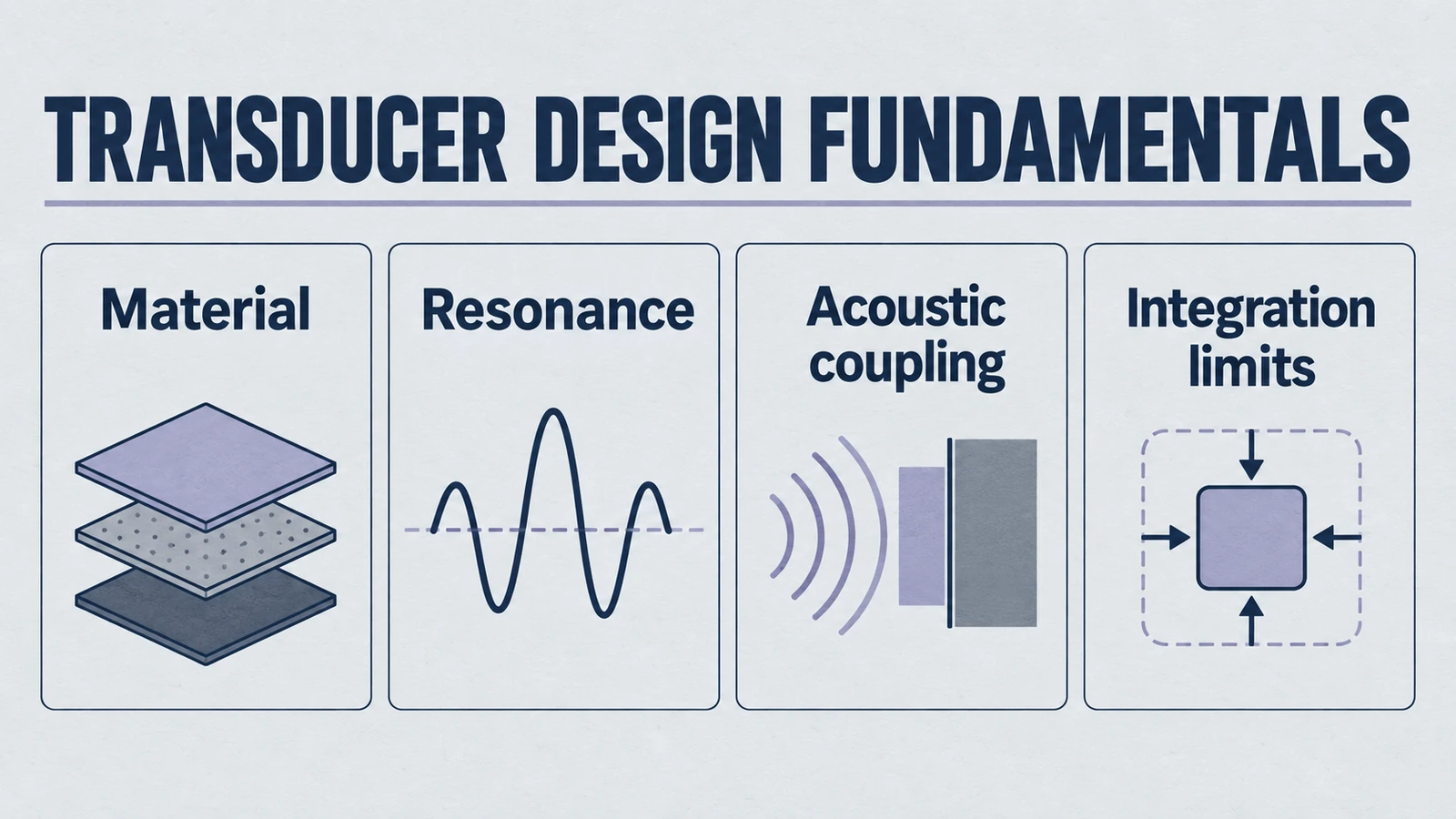
Ultrasonic transducers represent specialized electromechanical devices engineered to interconvert electrical energy and ultrasonic acoustic waves—sound frequencies exceeding the auditory perception limits of humans. These transducers occupy a pivotal role in critical domains such as medical imaging, industrial non-destructive evaluation (NDE), and precision manufacturing processes. A profound comprehension of the theoretical principles, material characteristics, and engineering considerations related to ultrasonic transducers is important for researchers and practicing engineers aiming to optimize their system's efficacy and precision.
From Transducer Design to a Component RFQ
If your design needs a ceramic element with specific dimensions, electrodes, or material targets, start with the custom piezoelectric component review. Share the drawing or dimensional targets, drive conditions, operating medium, and sample and production quantities. For a housed transducer or assembled unit, use the ultrasonic transducer supplier page and identify which parts of the assembly you need supplied. Component checks and performance in the final assembly require separate acceptance criteria.
Advanced Fundamentals: Operating Physics and Integration Boundaries
Product path for this search intent
Match the article topic to the right YJ Piezo product page
Use this article when the risk is supplier selection, engineering support, validation evidence, integration reliability, and whether the manufacturer can scale from sample to production. For "Advanced Ultrasonic Transducer Design Fundamentals: Materials, Resonance, and Integrati...", the practical value is in turning the topic into a measurable selection or sourcing decision.
- Ultrasonic Transducer Manufacturer & Supplier Hub
Published product families, custom OEM review, RFQ inputs, and project-specific validation planning
- PZT Material Supplier Hub
Material control and grade selection
- Piezoelectric Ceramics
Ceramic manufacturing and custom shapes
Ultrasonic transducers operate primarily through the direct and inverse piezoelectric phenomena. Upon the application of an alternating electrical voltage, piezoelectric elements oscillate at ultrasonic frequencies, generating mechanical waves. Conversely, these materials generate an electrical signal upon the reception of ultrasonic waves. Ultrasonic transducers exploit multiple acoustic wave modes—including longitudinal, shear, and surface acoustic waves—tailored to specific application contexts.
Detailed Analysis of Key Components and Design Factors
Advanced Piezoelectric Materials
- Lead Zirconate Titanate (PZT): Predominantly utilized owing to its exceptional electromechanical coupling efficiency and sensitivity.
- Lead-Free Piezoelectric Materials: Gaining prominence driven by regulatory compliance and environmental sustainability objectives.
- Distinct Material Classes: PVDF is a flexible piezoelectric polymer. Bulk BaTiO3 is a brittle ceramic, not inherently a flexible polymer; flexible ceramic-containing devices need a specified thin-film or composite structure.
Resonant Frequency and Bandwidth Optimization
- The resonance frequency is critically selected to match the intended application, typically ranging between 20 kHz to 10 MHz, impacting penetration depth and resolution.
- For an approximately unloaded uniform half-wave thickness-mode element, the resonance frequency can be approximated using: where v is the appropriate thickness-mode velocity under the stated electrical boundary condition and t is thickness. Radial, flexural, shear, bonded and bolt-clamped stack modes require their own model and loaded validation.
Acoustic Coupling Mediums
- The choice of coupling medium—such as water, gel, or air—directly influences ultrasonic wave transmission effectiveness.
- Proper selection minimizes attenuation and maximizes signal fidelity, enhancing overall transducer performance.
Backing and Damping Structures
- Incorporating damping materials effectively mitigates extraneous reverberations, significantly improving the clarity and accuracy of ultrasonic signals.
- Composite backing materials, such as epoxy-metal powder mixtures, efficiently absorb residual ultrasonic energy, reducing ringing and potentially improving pulse resolution, with a tradeoff in output or peak sensitivity. Validate impedance, attenuation and thickness for the required bandwidth and signal budget.
Categorization and Specialized Applications of Ultrasonic Transducers
- Contact Transducers: Primarily deployed in direct-contact non-destructive evaluation scenarios.
- Immersion Transducers: Utilized extensively for precision imaging in fluid media, ideal for detailed surface and subsurface evaluations.
- Air-Coupled Transducers: Facilitate non-contact ultrasonic inspections, particularly valuable for sensitive or complex geometries.
- Medical Imaging Transducers: High-frequency transducers essential for diagnostic applications and specialized ultrasound equipment.
- Power Ultrasonic Transducers: Employed in industrial-scale operations including ultrasonic welding, cutting, and cleaning processes.
Industrial and Technological Applications
Ultrasonic Medical Imaging
Diagnostic ultrasonography utilizing high-frequency transducers produces high-resolution, real-time anatomical and functional imaging, central to modern medical diagnostics.
Non-Destructive Evaluation (NDE)
Ultrasonic techniques provide a non-invasive methodology for flaw detection and structural integrity assessment in critical infrastructure and aerospace components.
Underwater Acoustic Systems (Sonar)
Piezoelectric-based transducers significantly advance sonar capabilities, facilitating precise underwater detection, navigation, and communication.
Industrial Ultrasonic Cleaning and Welding
High-intensity ultrasonic waves significantly enhance industrial cleaning precision and facilitate efficient welding operations, particularly relevant in microelectronics and automotive manufacturing.
Energy Harvesting and IoT Applications
Ultrasonic transducers enable energy harvesting from mechanical vibrations, thus powering autonomous sensors and IoT devices in smart infrastructures.
Addressing Common Design Challenges and Solutions
- Signal Attenuation and Interference Management: Selection of optimal acoustic coupling media and advanced damping strategies effectively mitigate these issues.
- Environmental Sensitivity Mitigation: Employing robust piezoelectric materials and encapsulation techniques maintains stable transducer performance despite variations in temperature and humidity.
- Material Selection Strategies: Tailoring piezoelectric materials for specific operational frequencies, bandwidths, and environmental resilience ensures sustained transducer reliability and efficiency.
Emerging Technological Developments
- Miniaturization and MEMS Ultrasonic Technologies: Advances in micro-electro-mechanical systems (MEMS) enable the development of miniaturized transducers suitable for portable and embedded applications.
- Integration of Artificial Intelligence in Signal Processing: Incorporating machine learning algorithms into ultrasonic inspection significantly enhances diagnostic accuracy, structural integrity analysis, and environmental monitoring capabilities.
- Bio-Compatible and Advanced Functional Materials: Innovations in biocompatible piezoelectric materials promote their integration into medical implants and sophisticated wearable health-monitoring systems.
Conclusion: Advancing Ultrasonic Technology
Ultrasonic transducers remain integral to contemporary scientific and engineering practices, underpinning vital applications across various industries. A sophisticated understanding of ultrasonic transducer science, encompassing materials, acoustics, and application-specific design considerations, positions engineers and researchers to innovate effectively and achieve optimal performance.
Seeking advanced ultrasonic transducer solutions? Consult with our experts for personalized recommendations and specialized development services tailored to your precise engineering needs.
Project Selection Notes
For real projects, teams usually need to connect these design fundamentals to sensor classes, supplier capability, and RFQ preparation.
Application-to-Model Mapping
- Compact automation architecture: MU18
- Plant-level sensing architecture: SR55
- Long-range industrial architecture: SR80
RFQ Checklist
- Target range and acceptable blind-zone limit.
- Environment details: dust, foam, vapor, washdown, or chemicals.
- Output interface: PNP/NPN, relay, analog, or RS485 requirements.
- Power and duty profile for continuous or intermittent operation.
- Annual quantity, sample timing, and delivery expectations.
Start model screening at the ultrasonic sensor hub, review supplier capabilities on ultrasonic transducer supplier overview, and send your requirements through engineering RFQ contact.
Engineering decision notes
OEM integration and supplier qualification
Use this article when the risk is supplier selection, engineering support, validation evidence, integration reliability, and whether the manufacturer can scale from sample to production. For "Advanced Ultrasonic Transducer Design Fundamentals: Materials, Resonance, and Integrati...", the practical value is in turning the topic into a measurable selection or sourcing decision.
YJ Piezo combines direct project coordination with ceramic manufacturing support, so procurement and engineering teams can evaluate material control, application review, sample validation, and production consistency together.
Selection checks
- Ask whether the supplier controls ceramic manufacturing or only assembles purchased elements.
- Review sample policy, inspection records, engineering response quality, and production lead-time stability.
- Compare suppliers and integration paths by validation evidence, not only by unit price and datasheet similarity.
Failure risks
- A low-price sample can pass early tests but fail when batch variation, thermal load, or assembly stress appears.
- A supplier without material control may not explain why impedance, capacitance, or resonance drift occurs.
- Weak RFQ information leads to quotes that are fast but not technically comparable.
RFQ details
- What application, operating environment, and failure cost should the supplier design around?
- Which sample tests and outgoing records are required before pilot production?
- What customization, MOQ, tooling, and delivery constraints must be known before quotation?
Relevant YJ Piezo pages
- Ultrasonic Transducer Manufacturer & Supplier Hub
Published product families, custom OEM review, RFQ inputs, and project-specific validation planning
- PZT Material Supplier Hub
Material control and grade selection
- Piezoelectric Ceramics
Ceramic manufacturing and custom shapes
Application FAQ
- How should an OEM compare piezoelectric suppliers?
- Compare material control, engineering support, test evidence, customization ability, sample policy, and batch consistency. Unit price matters, but only after the technical risk is understood.
- What makes an RFQ technically useful?
- A useful RFQ includes application, dimensions, target frequency, electrical limits, duty cycle, operating medium, environment, expected quantity, required reports, and current failure or replacement context.
Related Products
- Ultrasonic Transducer Manufacturer & Supplier Hub
- Air Acoustic Transducers
- Piezoelectric Ceramic Elements