
The Ultimate Guide to Selecting a Piezo Disc Supplier: 5 Factors You Can't Ignore
1.0 Introduction: The Critical Decision Behind Every High-Performance Application
In the world of advanced technology, piezoelectric discs are foundational components, driving innovation in fields as diverse as medical ultrasound, industrial non-destructive testing (NDT), precision nanopositioning, and automotive sensing. Behind every high-resolution medical image, every flawlessly welded component, and every micro-actuator moving with nanometer precision lies a well-specified and reliably manufactured piezo disc. The selection of a piezo disc supplier, therefore, is not a simple procurement task; it is a strategic decision that profoundly impacts the performance, reliability, and ultimate commercial success of the end product.
The stakes involved in this decision are high. Choosing a suboptimal supplier can contribute to inconsistent product performance, premature component failure, production disruption, and costly field support. Such issues increase cost and can weaken customer confidence. The choice of a supplier is fundamentally about mitigating risk and supporting the long-term viability of a project. This reality encourages a shift in perspective—from transactional vendor relationships toward engineering partnerships where the supplier's specialized knowledge supports the customer's own design team.
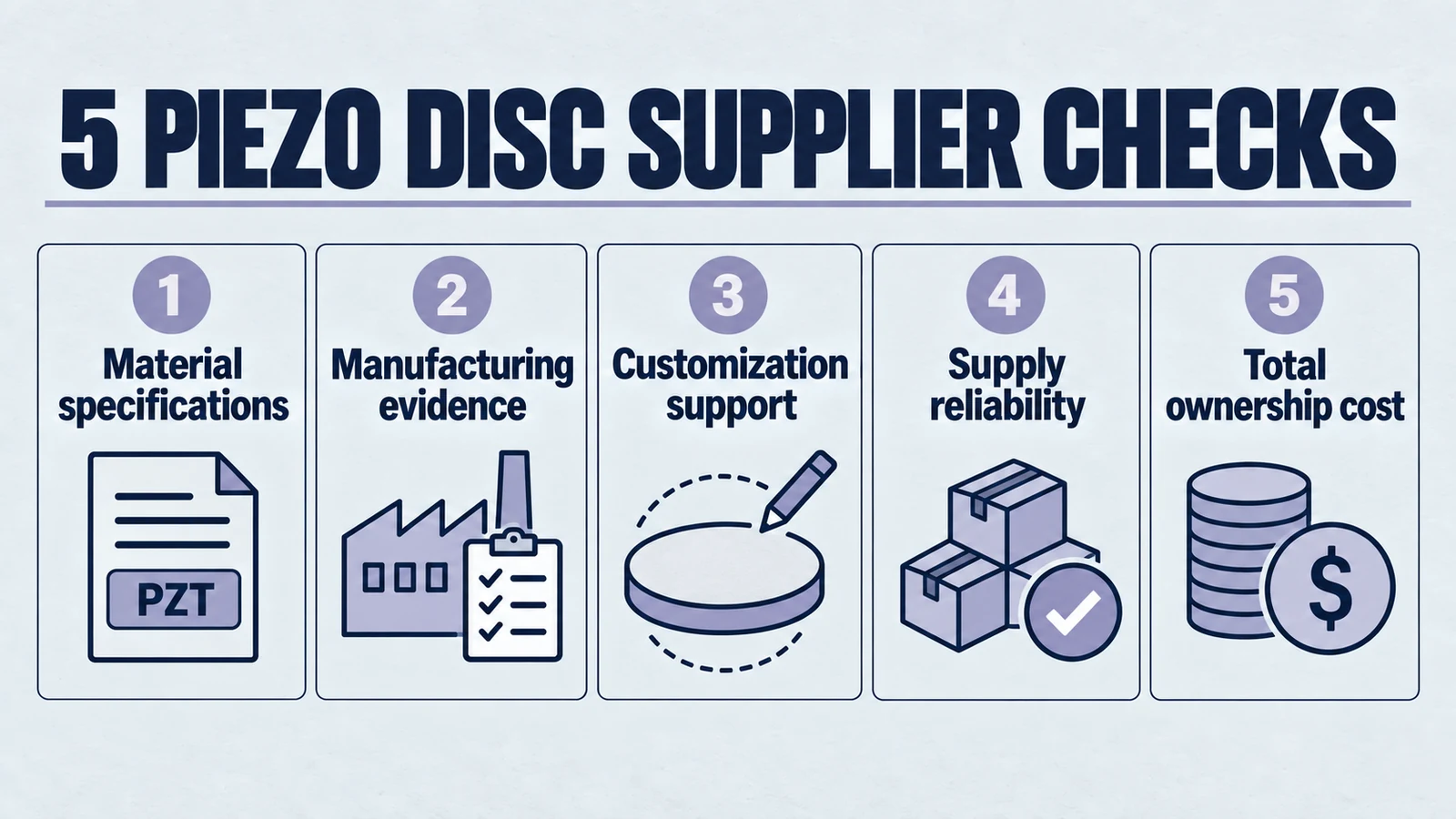
To navigate this critical decision, a systematic framework is essential. This guide presents five key factors that move beyond a superficial price comparison to enable a holistic assessment of a potential piezo disc supplier's technical expertise, manufacturing discipline, and partnership capabilities. These factors are: Material Quality & Performance, Manufacturing Excellence & Quality Control, Customization & Technical Partnership, Supplier Reliability & Supply Chain, and Total Cost of Ownership.
Product path for this search intent
Match the article topic to the right YJ Piezo product page
Use this article when the risk is supplier selection, engineering support, validation evidence, integration reliability, and whether the manufacturer can scale from sample to production. For "The Ultimate Guide to Selecting a Piezo Disc Supplier: 5 Factors You Can't Ignore", the practical value is in turning the topic into a measurable selection or sourcing decision.
- Ultrasonic Transducer Supplier Hub
OEM sourcing and engineering collaboration
- PZT Material Supplier Hub
Material control and grade selection
- Piezoelectric Ceramics
Ceramic manufacturing and custom shapes
2.0 Factor 1: Uncompromising Material Quality and Performance Specifications
The foundation of any high-performance piezo disc is the ceramic material itself. A superior supplier demonstrates comprehensive mastery over material science, providing not just components, but optimized material solutions engineered for the specific physics of an application.
2.1 Beyond the Datasheet: Aligning Material Properties with Application Demands
Not all lead zirconate titanate (PZT) ceramics are created equal. A fundamental distinction exists between "soft" and "hard" PZT formulations, each tailored for different operational demands.
Soft PZT: Materials like PZT-5H and PZT-5A (classified as Navy Type II/VI) are characterized by high sensitivity, large piezoelectric charge constants (d₃₃), and high permittivity. These properties make them ideal for sensing applications, medical imaging transducers, and actuators that require large displacements at relatively low power levels. However, they also have limitations, including lower Curie temperatures and a greater susceptibility to depolarization under high electrical or mechanical stress.
Hard PZT: Materials such as PZT-4 and PZT-8 (PZT-4 = Navy Type I; PZT-8 = Navy Type III) exhibit high mechanical quality factors, excellent stability under high mechanical loads and strong electric fields, and high Curie points. These characteristics are essential for high-power applications, including ultrasonic cleaning transducers, sonar projectors, and high-voltage energy generation systems.
Beyond this basic classification, several key material parameters must be aligned with the application's specific requirements:
- Curie Temperature (Tc): This is the critical temperature at which the material undergoes a phase transition and permanently loses its piezoelectric properties. It represents a important operational ceiling, especially for components used in high-temperature environments.
- Piezoelectric Charge Constant (d₃₃): This coefficient relates the mechanical strain produced to an applied electric field, making it a primary metric for actuator performance and displacement capability.
- Electromechanical Coupling Factor (k): This describes reversible electromechanical coupling for a specified mode and boundary condition. Device power efficiency and sensing performance require separate loss, load and readout measurements.
- Mechanical Quality Factor (Qm): This parameter represents the mechanical losses within the material. A high Qm is vital for resonant, high-power applications, as it minimizes heat generation and allows for more efficient operation.
A critical differentiator emerges when examining a supplier's capabilities: their control over the raw material formulation itself. The significant batch-to-batch variability observed in the industry often stems from inconsistencies in material composition and processing. Suppliers who formulate their own PZT powders in-house—controlling the purity of raw oxides and the precise mixing, milling, and calcination processes—possess a fundamental advantage. This vertical integration allows them to fine-tune material properties and, more importantly, implement rigorous statistical process control from the very start of the value chain.
2.2 The Pitfalls of Performance Variability
Nominal values on a datasheet can be misleading, as they often come with broad tolerances—sometimes as high as ±20%. This can result in significant performance variances not only between different vendors but also from batch to batch from the same supplier. It is crucial to evaluate performance metrics that reflect real-world operation, such as:
- Repeatability vs. Accuracy: It is essential to understand the distinction between these two properties. Accuracy refers to how close a component can position to a true value, while repeatability is its ability to consistently return to the same target position. For many precision applications, high repeatability is more critical than reference accuracy, as systematic errors can often be compensated for through calibration.
- Lifetime and Durability: The operational lifetime of a piezo component can be affected by numerous factors, including ambient humidity, temperature, mechanical preload, and electrical drive conditions. A reliable component must be designed to withstand its intended operational environment over billions of cycles.
3.0 Factor 2: Verifiable Manufacturing Excellence and Rigorous Quality Control
The world's leading piezo disc suppliers operate with a level of precision akin to that of a semiconductor fabricator. For these manufacturers, a commitment to quality is not a mere marketing slogan but a verifiable system embedded in every stage of the production process and validated by internationally recognized standards.
3.1 From Powder to Polarized Part: A Process Demanding Precision
The manufacturing of a piezo disc is a complex journey with numerous stages where quality can be either fortified or compromised. Key steps include:
- Powder Preparation & Pressing: The process begins with the creation of a homogenous granulate to ensure uniform density in the pressed "green" body.
- Sintering: This critical high-temperature firing phase is where the ceramic's final microstructure is formed. Incorrect temperatures or durations can lead to improper crystal growth, severely degrading or even destroying the material's piezoelectric potential.
- Machining & Lapping: Achieving tight dimensional tolerances, often better than ±0.1 mm, requires advanced machining techniques frequently borrowed from the semiconductor industry.
- Electroding: A uniform and strongly adhered metallic electrode (typically silver, nickel, or gold) is applied to the ceramic surfaces. This layer is essential for establishing a reliable electrical connection and ensuring consistent performance.
- Polarization (Poling): In this final, crucial step, the ceramic is heated below its Curie temperature and subjected to a strong DC electric field. This process aligns the material's internal electric domains, inducing its piezoelectric properties. Improper or incomplete poling renders the component useless.
3.2 The Role of Quality Control and Comprehensive Testing
Robust quality control (QC) is not a simple final inspection but a continuous, integrated process. Top-tier suppliers utilize statistical process control (SPC) to monitor key parameters, employ automated testing systems for high-volume production, and maintain comprehensive traceability systems for every batch. A quality-focused supplier will perform a suite of tests, including:
- Physical Inspection: Verifying dimensional accuracy and inspecting for any physical defects such as cracks, chips, or voids.
- Electrical Testing: Measuring key electrical properties such as capacitance, dielectric loss, resonant frequency, and impedance. A direct measurement of the piezoelectric charge constant (d₃₃) using a dedicated meter is a standard QC check for actuator materials.
- Reliability and Stress Testing: Simulating harsh operating conditions—including high temperatures, humidity, and vibration—to validate the component's long-term performance and durability under application-specific stresses.
3.3 Certifications as Proof of Process Discipline
Certifications should not be viewed as mere paperwork but as independent, third-party validation of a supplier's commitment to a formal quality management system (QMS). Key certifications to look for include:
- ISO 9001:2015: This is the international benchmark for a QMS, demonstrating a supplier's dedication to process control, customer satisfaction, and continuous improvement.
- Medical-device documentation: For healthcare applications, confirm which quality-system records, traceability documents, and validation evidence belong to the finished-device program and which component data the supplier can provide.
- AS9100: This is the QMS standard for the aerospace and defense industries, indicating a supplier's ability to meet the rigorous demands of applications where failure is not an option.
4.0 Factor 3: Deep Customization Capabilities and Expert Technical Partnership
The best piezo disc suppliers do not simply sell components from a catalog; they co-create solutions. They function as an extension of their client's engineering team, applying their deep specialization in piezoelectric technology to optimize designs for performance, manufacturability, and cost-effectiveness.
4.1 The Spectrum of Customization
A supplier's true capabilities can be assessed by examining the depth of customization they offer. This can range from simple modifications to fully integrated solutions:
- Level 1 (Standard Customization): This includes custom dimensions (diameter and thickness), a choice of standard PZT materials, and basic wire attachments. Most suppliers can accommodate these requests.
- Level 2 (Advanced Customization): This involves more complex modifications, such as custom electrode patterns (e.g., wrap-around electrodes for simplified wiring), a selection of specific electrode materials (silver, nickel, gold) for environmental compatibility, and the development of unique PZT formulations for specific performance needs.
- Level 3 (Integrated Solutions): This represents the highest level of capability, where the supplier provides value-added assemblies. This can include bonding piezo discs to substrates, integrating components into custom housings, adding acoustic matching layers for ultrasonic transducers, and delivering fully tested, ready-to-install sub-assemblies.
4.2 The Value of a True Engineering Partner
A true partner provides collaborative support throughout the entire product lifecycle. This partnership includes:
- Design & Consulting: Providing expert guidance during the initial design phase to select the optimal material, geometry, and configuration, thereby preventing costly errors and accelerating development.
- Prototyping & Iteration: Offering rapid prototyping services for testing and validation, with the flexibility to make quick modifications based on performance feedback.
- Application-Specific Expertise: Possessing deep knowledge in specific fields such as medical ultrasound equipment, industrial NDT, or automotive systems, which enables them to understand the unique challenges and documentation requirements of the application.
5.0 Factor 4: Proven Supplier Reliability and a Resilient Supply Chain
Technical excellence is rendered meaningless without business stability and operational reliability. A top-tier piezo disc supplier must have a proven track record of performance, transparent communication channels, and robust internal processes that ensure they can deliver the right components, on time, every time.
5.1 Assessing the Supplier's Track Record and Reputation
It is essential to look beyond marketing claims for tangible evidence of a supplier's experience and reliability:
- Industry Experience: A long history in the piezoelectric industry often indicates financial stability and deep institutional knowledge built over many years.
- Client Feedback & Case Studies: Testimonials, reviews, and detailed case studies from companies within a similar industry provide powerful social proof of a supplier's capabilities and their track record of success.
- Production Capacity: An ideal supplier can seamlessly scale production from small prototype runs to high-volume manufacturing without any decline in quality or consistency.
5.2 The Importance of Communication and Transparency
A reliable partner is, by definition, a responsive one. The quality of a supplier's communication protocols is a strong indicator of their overall professionalism. Consider their responsiveness to technical inquiries, their willingness to provide proactive updates on project milestones and delivery schedules, and their transparency regarding realistic lead times.
5.3 Component Reliability in the Real World
A good supplier will provide clear guidance on how to maximize the lifetime and reliability of their components in the final application. Piezoelectric ceramics are inherently brittle and have very low tensile strength. Therefore, a supplier should provide explicit guidelines on:
- Proper Handling and Mounting: To prevent micro-cracks that can lead to failure under cyclic loading.
- Mechanical Preload: For dynamic applications, a mechanical preload is often necessary to ensure the ceramic remains in compression across the validated operating range.
- Environmental Controls: High humidity can lead to electro-migration and electrical breakdown. Protective coatings or advice on environmental sealing may be required.
- Electrical Drive Conditions: Smooth drive signals are crucial. Abrupt voltage spikes can generate large internal accelerations and damage the ceramic structure.
6.0 Factor 5: Evaluating Total Cost of Ownership (TCO) Over Initial Price
In the procurement of critical components, the cheapest option is rarely the least expensive. A sophisticated evaluation must look beyond the per-unit price to calculate the Total Cost of Ownership (TCO), a framework that often reveals that investing in quality from a reputable supplier is the most economically sound decision in the long run.
6.1 Deconstructing the "Lowest Price" Fallacy
Defaulting to the lowest bidder is a common procurement pitfall that can lead to disastrous downstream consequences. TCO provides a strategic financial framework for making a smarter investment by accounting for all costs associated with a component over its entire lifecycle.
6.2 Identifying the Hidden Costs of Low-Quality Components
A simple price comparison ignores the significant downstream costs that are frequently incurred when using low-quality or inconsistent components. These hidden costs include:
- Increased Incoming QC & Testing: The time and resources spent verifying and sorting inconsistent parts upon arrival.
- Lower Production Yields: Components that fail during the assembly or final testing of the end product, leading to costly scrap and rework.
- Higher Field Failure Rates: The enormous expense of product failures after shipping, which includes warranty claims, repairs, replacements, and logistics.
- Product Recalls & Reputational Damage: The ultimate cost of a critical component failure, which can destroy customer trust and inflict lasting damage on a brand's value.
- Increased Maintenance & Downtime: In industrial settings, the failure of a single sensor or actuator can halt an entire production line, incurring costs that dwarf the price of the component itself.
6.3 The Long-Term Value of a Quality Partnership
Reframing the higher initial price of a premium component as an investment in risk reduction and long-term value is key. A high-quality component from a reliable supplier ultimately leads to a faster time-to-market, higher end-product performance, a stronger brand reputation, and lower overall project costs when viewed over the entire product lifecycle.
7.0 Conclusion: Forging a Partnership for Success
The selection of a piezo disc supplier is a decision that requires a comprehensive and intelligent strategy. The five key factors—Material Expertise, Manufacturing Discipline, Partnership-Level Customization, Proven Reliability, and a focus on Total Cost of Ownership—provide a robust framework for this evaluation. Ultimately, the goal is to find more than a component supplier; it is to find a strategic partner who is deeply invested in the success of your project. This partner derisks development, accelerates innovation, and fundamentally enhances the quality and reliability of the final product.
At Yujie Piezo, we apply these principles through material selection, project-specific engineering review, and manufacturing coordination for PZT materials and piezo discs. The applicable quality evidence and inspection scope are confirmed for the selected component and order.
For engineers looking to understand more about piezoelectric technology fundamentals, we recommend exploring our comprehensive guide on What is PZT? which covers the basic principles behind these remarkable materials.
Additionally, you might find value in our detailed article on The Strategic Advantages of Collaborating with an OEM Manufacturer, which provides broader insights into the benefits of working with specialized piezoelectric manufacturers.
Ready to discuss how a true piezoelectric partner can elevate your next project? Contact our engineering team today for a no-obligation consultation. Let's build something remarkable, together.
Engineering decision notes
OEM integration and supplier qualification
Use this article when the risk is supplier selection, engineering support, validation evidence, integration reliability, and whether the manufacturer can scale from sample to production. For "The Ultimate Guide to Selecting a Piezo Disc Supplier: 5 Factors You Can't Ignore", the practical value is in turning the topic into a measurable selection or sourcing decision.
YJ Piezo combines direct project coordination with ceramic manufacturing support, so procurement and engineering teams can evaluate material control, application review, sample validation, and production consistency together.
Selection checks
- Ask whether the supplier controls ceramic manufacturing or only assembles purchased elements.
- Review sample policy, inspection records, engineering response quality, and production lead-time stability.
- Compare suppliers and integration paths by validation evidence, not only by unit price and datasheet similarity.
Failure risks
- A low-price sample can pass early tests but fail when batch variation, thermal load, or assembly stress appears.
- A supplier without material control may not explain why impedance, capacitance, or resonance drift occurs.
- Weak RFQ information leads to quotes that are fast but not technically comparable.
RFQ details
- What application, operating environment, and failure cost should the supplier design around?
- Which sample tests and outgoing records are required before pilot production?
- What customization, MOQ, tooling, and delivery constraints must be known before quotation?
Relevant YJ Piezo pages
- Ultrasonic Transducer Supplier Hub
OEM sourcing and engineering collaboration
- PZT Material Supplier Hub
Material control and grade selection
- Piezoelectric Ceramics
Ceramic manufacturing and custom shapes
Application FAQ
- How should an OEM compare piezoelectric suppliers?
- Compare material control, engineering support, test evidence, customization ability, sample policy, and batch consistency. Unit price matters, but only after the technical risk is understood.
- What makes an RFQ technically useful?
- A useful RFQ includes application, dimensions, target frequency, electrical limits, duty cycle, operating medium, environment, expected quantity, required reports, and current failure or replacement context.