
Ultrasonic vs Infrared Sensors: Engineering Decision and Cost-of-Failure Analysis
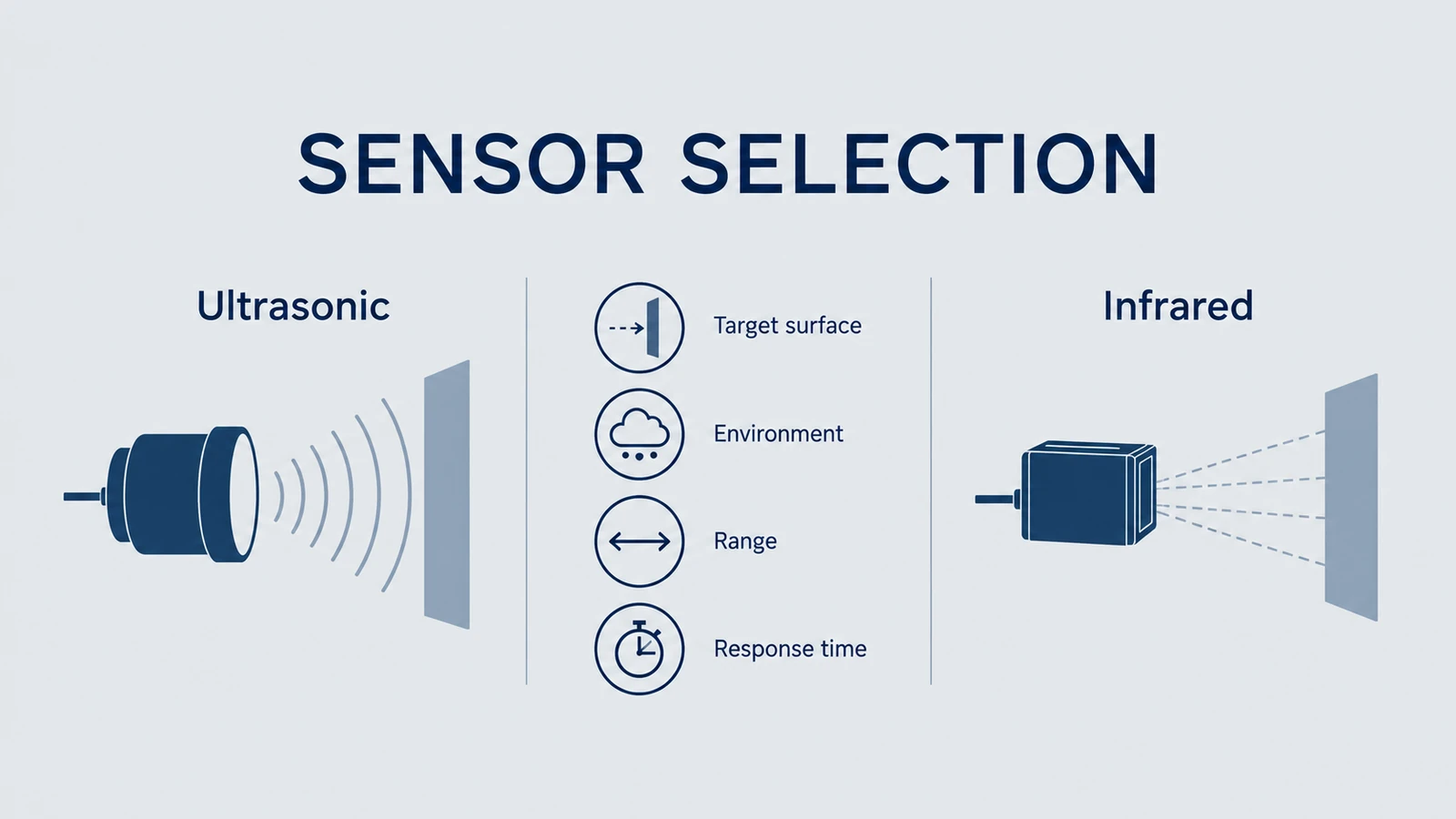
Quick answer: Choose ultrasonic sensors when target color, transparency, dust, vapor, or ambient light may disturb optical sensing. Choose infrared sensors when the target is close, opaque, clean, and fast response matters more than environmental tolerance.
For ultrasonic hardware selection, review ultrasonic sensor options and the piezoelectric vs ultrasonic transducer distinction.
When selecting the appropriate sensor for your application, understanding the differences between ultrasonic and infrared (IR) sensors is crucial. Each sensor type has its unique advantages, limitations, and suitable applications. In this article, we'll explore the key distinctions and help you determine which is the optimal choice for your specific needs.
Engineering decision focus: Select the sensing method based on target surface condition, contamination risk, ambient light/noise, and required detection range before finalizing architecture.
Ultrasonic Sensors: An Overview
Product path for this search intent
Match the article topic to the right YJ Piezo product page
Use this article when sensor performance depends on target distance, beam angle, housing material, liquid behavior, or false echo control. For "Ultrasonic vs Infrared Sensors: Engineering Decision and Cost-of-Failure Analysis", the practical value is in turning the topic into a measurable selection or sourcing decision.
- Ultrasonic Sensors
Distance, level, and detection sensor portfolio
- Flow Measurement Transducers
Bubble and flow-related ultrasonic sensing paths
- Air Acoustic Transducers
Air-coupled transducers for range and presence detection
Ultrasonic sensors operate by emitting high-frequency sound waves and detecting the reflection (echo) from objects. The time taken for the echo to return helps calculate the distance to the object. Our ultrasonic bubble detection sensors demonstrate the precision and reliability of this technology.
Key Advantages:
- Non-contact Measurement: No physical contact is necessary, ideal for delicate or hazardous objects.
- Wide Detection Range: Typically effective from a few centimeters up to several meters.
- Material Independence: Capable of detecting transparent or opaque objects equally well.
- Environmental Robustness: Reliable under varied environmental conditions, including dust, smoke, moisture, and temperature fluctuations.
Limitations:
- Reduced Accuracy for Small or Narrow Objects: Difficult to detect objects smaller than the sensor's sound cone.
- Affected by Surface Angle and Texture: Irregularly shaped or highly absorbent surfaces may cause inaccurate measurements.
For detailed information on ultrasonic sensor accuracy, check our guide on precision distance measurement with ultrasonic sensors.
Infrared Sensors: An Overview
Infrared sensors use different architectures. Active ranging can use time of flight, triangulation or an intensity-based method, while passive infrared devices detect changes in incident thermal radiation and are not generic distance meters. Compare the actual ranging method and specified target conditions.
Key Advantages:
- Precision Measurement: Excellent accuracy at close range, ideal for fine positioning.
- Rapid Response Time: Faster than ultrasonic sensors, useful in dynamic applications.
- Narrow Detection Beam: Allows for precise object targeting in confined spaces.
Limitations:
- Affected by Object Color and Transparency: Dark-colored, transparent, or highly reflective objects can cause inaccuracies.
- Shorter Range: Typically effective only up to a few meters.
- Susceptibility to Environmental Factors: Performance can degrade under direct sunlight or in dusty environments.
Engineering Comparison: Failure Modes and Lifecycle Cost
Range and Accuracy
- Ultrasonic: Long-range detection with moderate accuracy, suitable for broad area sensing. Our ultrasonic level sensors showcase this capability in industrial applications.
- Infrared: Shorter-range, higher accuracy, ideal for precise distance measurement.
Object Detection
- Ultrasonic: Effective regardless of color or transparency, advantageous in diverse scenarios.
- Infrared: Best suited for opaque, reflective, and uniformly colored objects.
Environmental Conditions
- Ultrasonic: More resilient under varying environmental conditions.
- Infrared: Sensitive to direct sunlight, dust, and reflective interference.
Response Time
- Ultrasonic: Slower response due to the sound wave propagation.
- Infrared: Faster response ideal for real-time control systems.
Common Applications
Ultrasonic Sensors:
- Industrial automation: Tank level measurement, obstacle detection using specialized ultrasonic detection systems
- Automotive: Parking assistance, collision avoidance
- Robotics: Navigation, obstacle detection - learn more about ultrasonic sensors in robotics
- Medical devices: Fluid monitoring and bubble detection in medical applications
Infrared Sensors:
- Robotics: Line-following robots, proximity sensing
- Automation: Precision distance measurement, object counting
- Consumer electronics: Gesture recognition, remote controls
Flow Measurement Applications
Both sensor types find applications in flow measurement, though ultrasonic sensors excel in non-invasive applications. Our HJ-2112/1M ultrasonic flowmeter transducer demonstrates how ultrasonic technology enables accurate flow measurement without pipe penetration. Learn more about the technology behind non-invasive ultrasonic flow measurement.
Gas Flow Monitoring
For gas applications, ultrasonic sensors provide excellent accuracy and reliability. Our expertise in ultrasonic gas flow sensors shows how this technology improves HVAC and energy monitoring systems.
Underwater and Marine Applications
In underwater environments, ultrasonic sensors (sonar transducers) are the clear choice over infrared sensors. Explore our comprehensive guide on underwater ultrasonic sensors for marine industries to understand how these sensors enable navigation, object detection, and distance measurement in aquatic environments.
Making the Right Choice
When choosing between ultrasonic and infrared sensors, consider the following:
- Accuracy Needs: Choose infrared for high accuracy in close range, ultrasonic for reliable performance over longer distances.
- Object Characteristics: Opt for ultrasonic if objects are transparent or reflective; choose infrared if objects are opaque and evenly colored.
- Environmental Conditions: Ultrasonic sensors are preferable in harsh environments, whereas infrared sensors excel in controlled indoor settings.
- Response Speed: Select infrared sensors for applications needing quick responsiveness.
Material Considerations
The choice of piezoelectric ceramic materials significantly impacts ultrasonic sensor performance. Understanding PZT characteristics helps in selecting the optimal sensor for your application requirements.
Specialized Applications
For specialized cleaning applications, ultrasonic technology offers unique advantages. Learn about ultrasonic cavitation transducers and their role in industrial cleaning processes.
Technical Considerations
Understanding the fundamental principles behind these sensors helps in making informed decisions. Our detailed guide on PZT ultrasonic transducers explains the working principles and key applications that make ultrasonic sensors versatile across industries.
Beauty and Consumer Applications
Beyond industrial uses, ultrasonic technology finds applications in consumer devices. Our HJ-2804 facial massage transducer demonstrates how ultrasonic technology enhances beauty and wellness applications.
Conclusion
Understanding your application's specific requirements and operating environment is essential for making the right sensor choice. By carefully evaluating these factors, you can ensure optimal sensor performance and system reliability.
Ultrasonic sensors excel in harsh environments, long-range detection, and material-independent sensing, while infrared sensors provide high-precision, fast-response measurements in controlled environments. The choice between ultrasonic sensor vs infrared ultimately depends on your specific application requirements, environmental conditions, and accuracy needs.
Related Engineering Reading
- Compare transducer technologies before selecting a sensor stack
- Validate sensitivity limits under real mounting conditions
- Review sensor products for industrial deployment
- Contact engineering for application-specific guidance
Need help selecting the right sensor for your application?
Contact Yujie Technology for expert guidance and custom sensor solutions.
Get Expert ConsultationProcurement Notes for Real Projects
When this comparison becomes a sourcing decision, teams usually need to connect lifecycle risk to candidate models and RFQ details.
Application-to-Model Mapping
- Short-range flexible integration: MU18
- General-purpose multi-meter sensing: MU30
- Harsh-environment fixed installation: stainless-steel housing sensor
RFQ Checklist
- Target range and acceptable blind-zone limit.
- Environment details: dust, foam, vapor, washdown, or chemicals.
- Output interface: PNP/NPN, relay, analog, or RS485 requirements.
- Power and duty profile for continuous or intermittent operation.
- Annual quantity, sample timing, and delivery expectations.
Start model screening at the ultrasonic sensor hub, review supplier capabilities on PZT material and capability page, and send your requirements through engineering RFQ contact.
Engineering decision notes
Ultrasonic sensing and detection
Use this article when sensor performance depends on target distance, beam angle, housing material, liquid behavior, or false echo control. For "Ultrasonic vs Infrared Sensors: Engineering Decision and Cost-of-Failure Analysis", the practical value is in turning the topic into a measurable selection or sourcing decision.
YJ Piezo treats ultrasonic sensing as an acoustic interface problem: transducer frequency, beam shape, housing, drive electronics, and target environment are reviewed together.
Selection checks
- Define target range, dead zone, beam angle, and mounting geometry before choosing the sensor family.
- Check the medium, target surface, temperature swing, foam, vapor, and side-wall risk.
- Separate detection repeatability from ideal lab accuracy when the sensor will operate in a tank, tube, or moving line.
Failure risks
- A sensor can pass bench distance tests and still fail in tanks with foam, agitation, vapor, or narrow geometry.
- Changing only frequency without reviewing beam angle and mounting can increase false echoes.
- Ignoring housing material or sealing requirements can shorten lifetime in washdown or chemical environments.
RFQ details
- What is the minimum and maximum detection distance?
- Is the target liquid, solid, sheet material, air flow, or a moving object?
- What temperature, humidity, IP rating, and output signal does the system require?
Relevant YJ Piezo pages
- Ultrasonic Sensors
Distance, level, and detection sensor portfolio
- Flow Measurement Transducers
Bubble and flow-related ultrasonic sensing paths
- Air Acoustic Transducers
Air-coupled transducers for range and presence detection
Application FAQ
- What makes an ultrasonic sensor page useful for procurement?
- It should connect range, beam angle, output signal, housing, mounting, and environmental limits to a concrete use case. A model name alone is not enough for reliable supplier comparison.
- Which information speeds up an ultrasonic sensor RFQ?
- Send the target material, distance range, installation geometry, output interface, temperature range, IP rating, and whether the application involves foam, vapor, liquid, or moving objects.