
The Pulse of Precision: Engineering Superiority in Ultrasonic Welding Transducers and the Yujie Advantage
Purchasing for an existing machine model? The OEM welding transducer sourcing guide explains how to describe the component, interfaces and quantities in a supplier enquiry.
Executive Summary: The Silent Engine of Modern Manufacturing
In the intricate and high-stakes landscape of modern industrial assembly, where the demand for speed, sterility, and structural integrity is unyielding, ultrasonic welding stands as a pillar of efficiency. It is a technology that has transcended its origins in simple plastic bonding to become a cornerstone of automotive manufacturing, medical device fabrication, and consumer electronics assembly. At the very core of this technology—hidden within the protective housing of the welding stack—lies the ultrasonic welding transducer. Often referred to as the "heart" of the system, the transducer is the singular component responsible for bridging the gap between electrical potential and physical reality. It is the device that transforms high-frequency electrical signals—oscillating at tens of thousands of times per second—into the high-frequency mechanical vibrations that fuse thermoplastics and non-ferrous metals without the need for adhesives, screws, or external heat sources.
For manufacturers in the automotive, medical, and consumer electronics sectors, the reliability of this component is not merely a matter of operational continuity; it is a direct determinant of product quality, brand reputation, and ultimately, profitability. A failing transducer does not simply stop a machine; it introduces variability, weak bonds, and cosmetic defects that can lead to serious downstream failures and costly recalls. Consequently, the selection of a high-performance transducer—engineered with superior piezoelectric materials and rigorous quality control—is one of the most critical procurement decisions an engineer or technical buyer can make.
Product path for this search intent
Match the article topic to the right YJ Piezo product page
Use this article when the choice is not just a shape, but a material tradeoff between sensitivity, loss, coupling, stability, and operating field. For "The Pulse of Precision: Engineering Superiority in Ultrasonic Welding Transducers and t...", the practical value is in turning the topic into a measurable selection or sourcing decision.
- PZT Material Hub
Material grades and application tradeoffs
- Piezoelectric Ceramics
Shapes and ceramic manufacturing options
- PZT Material Supplier Hub
Material control, grade selection, and sourcing support
This technical guide examines ultrasonic welding transducers, including their electromechanical physics, material composition, and operating behavior. It explores the distinction between "hard" and "soft" piezoelectric ceramics, the nuances of impedance matching, and troubleshooting practices used to maintain stable performance. It also explains how Yujie's PZT-8 material work and documented manufacturing processes support OEM teams evaluating high-power ultrasonic components.
1. The Physics of Ultrasonic Assembly: From Voltage to Vibration
Ultrasonic welding mechanisms depend on the workpiece. Thermoplastic welding involves interfacial friction and viscoelastic heating; metal welding is a solid-state joining process with interfacial deformation and disruption of surface films. The transducer supplies mechanical vibration through the converse piezoelectric effect.
1.1 The Inverse Piezoelectric Effect: The Mechanism of Action
The fundamental mechanism driving an ultrasonic welding transducer is the inverse piezoelectric effect. This phenomenon occurs when an alternating voltage is applied across a piezoelectric material—typically a polarized ceramic disc. The material physically expands and contracts in sync with the frequency of the applied voltage. In an ultrasonic welding context, this is not a random or chaotic vibration. The electrical signal, typically generated by an ultrasonic generator at frequencies ranging from 15 kHz to 70 kHz, forces the ceramic elements within the transducer to oscillate longitudinally. This longitudinal motion is the "heartbeat" of the weld, creating a piston-like action that drives energy into the materials being joined.
The efficiency of this conversion is paramount. Ideally, a perfect transducer would convert 100% of the electrical energy input into mechanical motion. However, in the real world, dielectric losses and mechanical damping dissipate some energy as heat. High-performance transducers, such as those manufactured by Yujie Technology, utilize advanced piezoceramics specifically formulated to minimize these losses. By ensuring that the maximum amount of energy is delivered to the weld interface rather than being wasted as internal heat, these transducers maintain process stability and reduce the thermal stress on the system components. This efficiency is not just a theoretical specification; it translates directly to lower energy consumption and longer equipment life.
1.2 Frequency Spectrums and Application Correlates
The operating frequency of a transducer is a critical parameter that dictates its application scope. The physical size of the transducer is inversely proportional to its frequency; lower frequency transducers are larger and capable of delivering higher amplitude and power, while higher frequency transducers are more compact and offer greater precision. This relationship is fundamental to selecting the right tool for the job.
| Frequency Range | Typical Applications | Characteristics |
|---|---|---|
| 15 kHz | Heavy Industry, Large Automotive Parts | High power, high amplitude, suitable for large, difficult-to-weld parts. Often used for welding large casings or structural components where deep penetration is required. |
| 20 kHz | General Purpose, Automotive, Appliances | The industry standard. Good balance of power and precision. Versatile enough for medium to large parts, widely used in automotive interiors and consumer goods. |
| 30 - 35 kHz | Consumer Electronics, Smaller Parts | Lower amplitude, reduced risk of marking parts. Ideal for smaller assemblies where aesthetics are critical. |
| 40 kHz | Medical Devices, Delicate Electronics | High precision, low stress on components, quieter operation. Essential for sterile medical devices and fragile electronic components. |
| 60 - 70 kHz | Micro-components, Thin Films | Extremely fine detail, minimal material displacement. Used for welding wires, foils, and micro-fluidic devices. |
Yujie Technology caters to this entire spectrum, offering transducers specifically tuned for these distinct resonant frequencies. For instance, the Yujie HJ-6015 model is a 15 kHz heavy-duty transducer designed for high-power applications, capable of handling up to 2100 Watts of power. This specific frequency is often chosen for welding large thermoplastic parts where significant amplitude is required to initiate the melt at the joint interface. Conversely, Yujie also manufactures high-frequency transducers for medical and precision applications, where the violent amplitude of a 15 kHz system would damage delicate internal components or thin walls.
1.3 The Propagation of Longitudinal Waves and Resonance
A ceramic/metal/bolt stack is a coupled resonator. A homogeneous half-wave bar is a useful preliminary model, but a single metal wave speed does not determine the full heterogeneous assembly length. Tune and validate the loaded mode, mounting node and output motion for the actual stack.
Standing-wave modes are normal in resonant acoustic stacks. Detuning changes the loaded vibration, impedance and power transfer and can cause excessive current or heating. Validate tracking, amplitude and thermal limits with the actual booster, horn and workpiece; bandwidth alone does not guarantee stable loaded operation.
2. Anatomy of a High-Performance Transducer
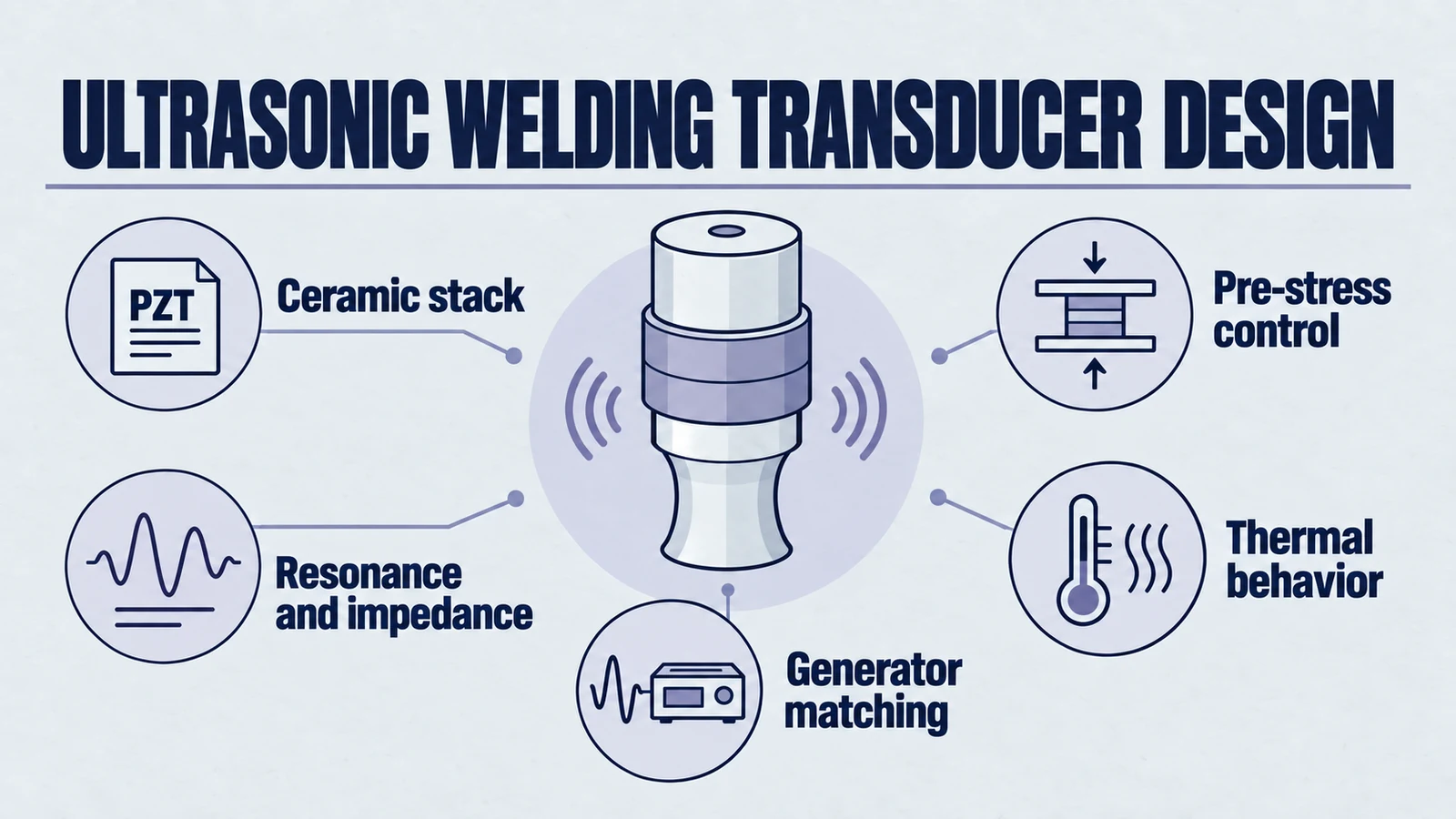
A transducer is not a monolithic block; it is a precision-engineered assembly of stacked components held together under immense tension. The quality of each component, and the precision of their assembly, defines the transducer's lifespan and efficiency. Understanding the anatomy of the transducer reveals why manufacturing precision is so critical.
2.1 The Piezoelectric Ceramic Stack
At the center of the transducer lies a stack of piezoelectric ceramic rings, usually numbering between two and eight depending on the power requirements. The Yujie HJ-6015, for example, utilizes four piezoelectric elements. These ceramics are the engine of the device.
The material composition of these ceramics is the most significant differentiator between a premium transducer and a generic replacement. Yujie utilizes proprietary formulations of Lead Zirconate Titanate (PZT), specifically PZT-8. Ideally, these ceramics must have perfectly flat, parallel faces to ensure uniform contact. Microscopic imperfections or lack of parallelism can create "hot spots" where stress concentrates, leading to cracking and depolarization. The surface finish and flatness of these ceramics are critical quality control points during manufacturing.
2.2 The Backing Driver (Back Mass)
The backing driver is a heavy metal cylinder located behind the ceramic stack. Its function is purely inertial. When the ceramics expand, they push in both directions—forward and backward. To maximize the forward energy output, the backward motion must be resisted. The heavy backing mass acts as a reaction wall, forcing the majority of the vibrational energy to propagate forward into the front driver and towards the weld.
Typically made of steel due to its high density, the backing driver must be machined with high precision. Any misalignment here translates to non-axial vibration (wobble), which reduces weld quality and damages the generator. The mass of the backing driver is carefully calculated to balance the acoustic impedance of the stack, ensuring optimal energy transfer.
2.3 The Front Driver (Front Mass)
The front driver is the component that couples the ceramic stack to the booster or horn. It is typically made of high-strength aluminum or titanium. Titanium is preferred for high-performance and medical applications due to its exceptional fatigue strength and acoustic transmission properties. Aluminum is lighter and cheaper but suffers from lower fatigue limits, making it less suitable for high-duty-cycle industrial welding.
Yujie's focus on industrial durability often favors high-grade alloys that resist the intense cyclical stress of ultrasonic vibration. The front driver also contains the mounting stud (often 1/2-20 or M20 threads) which connects the transducer to the booster. The integrity of these threads is vital; a loose connection absorbs energy and generates heat, rapidly destroying the stack.
2.4 Electrode Plates and Insulation
Between each ceramic ring lies a thin electrode plate, typically made of copper-beryllium or nickel-plated brass. These plates deliver the high-voltage electrical signal to the ceramics. They must be incredibly thin to minimize acoustic damping but robust enough to handle high currents without arcing. The design of these electrodes includes tabs for electrical connection, which must be securely soldered or crimped to the internal wiring.
Proper insulation is also critical. The central bolt that holds the stack together must be electrically isolated from the high-voltage ceramic faces to prevent short circuits. Yujie transducers boast insulated impedance values of ≥ 100 MΩ, indicating superior internal insulation that protects the generator and supports operator safety. This high insulation resistance is a hallmark of quality manufacturing, preventing leakage currents that could degrade performance or pose safety hazards.
2.5 The Pre-Stress Bolt
The entire stack—backing driver, ceramics, electrodes, and front driver—is clamped together by a central high-tensile bolt. This is not merely for structural cohesion; it is for "pre-stressing."
Piezoelectric ceramics are strong in compression but incredibly weak in tension. During the "contraction" phase of the vibration cycle, the ceramics effectively pull inward. Without a compressive pre-load, the rapid acceleration would tear the ceramic crystals apart (tensile failure). The central bolt applies a massive compressive force (often several tons) to ensure that even during maximum vibration amplitude, the ceramics never experience a net tensile force.
The torque applied to this bolt is a closely guarded manufacturing secret. Too loose, and the ceramics shatter. Too tight, and the material's ability to vibrate is dampened, or the bolt itself yields. Yujie's manufacturing process involves precision torque specifications and aging processes to ensure this pre-stress remains stable over years of operation. The bolt itself must be made of high-grade steel to withstand the cyclical loading without fatigue failure.
3. The PZT Factor: Material Science as a Competitive Edge
The soul of the transducer is the ceramic material itself. In the world of power ultrasonics, not all ceramics are created equal. The distinction between "hard" and "soft" piezo materials is the primary determinant of a transducer's efficiency and heat generation. Understanding this material science is crucial for selecting a transducer that can withstand the rigors of industrial welding.
3.1 PZT-4 vs. PZT-8: The Battle for Efficiency
Standard commercial transducers often use generic PZT-4 (Navy Type I) materials. While PZT-4 has a high piezoelectric constant (d33), meaning it moves a lot for a given voltage, it has a significant drawback: high dielectric loss. This means that as it vibrates, it generates a substantial amount of internal heat.
For high-power applications like welding, where duty cycles are fast and power levels are high (2000W+), heat is the enemy. Heat changes the resonant frequency of the ceramic (frequency drift) and, if it exceeds the Curie temperature, will permanently depolarize the ceramic, rendering it useless.
Yujie Technology prioritizes the use of PZT-8 (Navy Type III) ceramics for its welding transducers.
| Feature | PZT-4 (Navy Type I) | PZT-8 (Navy Type III) | Implications for Welding |
|---|---|---|---|
| Classification | Hard PZT family | "Hard" | Hard ceramics are more stable under high stress. |
| Mechanical Quality Factor (Qm) | ~500 - 600 | ~1000 - 1200 | For the same stored modal energy, doubling mechanical Q halves the corresponding mechanical energy loss per cycle. Catalog Qm does not establish half the total assembled-device loss or load-independent amplitude. |
| Dielectric Loss (tan δ) | Low | Very Low | PZT-8 generates significantly less heat during operation. |
| Stability | Moderate | Superior | PZT-8 maintains frequency stability under high preload. |
| Primary Use | Cleaning, Sensors | Welding, Cutting, Sonar | PZT-8 is purpose-built for high-power loads. |
The data clearly indicates that PZT-8 is the superior choice for ultrasonic welding. Its higher Mechanical Quality Factor (Qm) means it is a more efficient resonator—it rings longer and with less energy input. This efficiency translates directly to the bottom line:
- Cooler Operation: Less heat generation means less need for external air cooling and reduced risk of frequency drift. This is particularly important in continuous welding applications or high-speed automated lines where the transducer has little time to cool down between cycles.
- Higher Amplitude Stability: PZT-8 maintains its displacement amplitude even under heavy load, ensuring that the weld quality remains consistent whether the part is soft or rigid. This load independence is vital for achieving consistent weld strength across varying part geometries and material batches.
- Longevity: The reduced thermal stress on the surrounding components (O-rings, electrodes) extends the total life of the transducer. Thermal cycling is a major cause of component fatigue; by running cooler, the entire stack lasts longer.
3.2 Manufacturing Consistency and Aging
Even the best material is useless if manufacturing processes are inconsistent. Piezoelectric ceramics naturally "age" or shift in properties after polarization. A responsible manufacturer like Yujie allows the ceramics to age in a controlled environment before assembly to ensure that the frequency drift has stabilized. This prevents the phenomenon where a new transducer works perfectly for a week and then drifts out of spec.
Yujie's datasheets reflect this precision, offering tight tolerances on capacitance and impedance. Low impedance is particularly critical; it indicates that the transducer presents very little resistance to the flow of current at resonance, maximizing the power transfer from the generator. Consistent capacitance values also simplify the tuning process for ultrasonic generators, ensuring that replacement transducers can be installed with minimal adjustment.
3.3 The Impact of Doping and Formulation
The specific properties of PZT-8 are achieved through precise doping of the ceramic material with acceptor ions like iron (Fe3+) or manganese (Mn2+). These dopants create oxygen vacancies in the crystal lattice, which pin the domain walls and make the material "harder" to reorient. This domain pinning is what gives PZT-8 its high Qm and low dielectric loss. Yujie's ability to control this formulation in-house allows them to fine-tune the material properties for specific applications, optimizing the balance between power handling and sensitivity.
4. Operational Mechanics & System Integration
The transducer never works alone. It is the driver of the "acoustic stack," which also includes the booster and the horn (sonotrode). The interplay between these components is where the science of ultrasonics meets the reality of manufacturing. Understanding how the transducer interacts with the rest of the system is essential for troubleshooting and optimization.
4.1 The Role of the Booster: Gearbox of the System
The transducer converts electricity to vibration, but often the amplitude (physical distance of expansion/contraction) is not sufficient to melt the plastic. The transducer might output 20 microns of amplitude, but the plastic might require 40 microns to melt effectively.
This is where the booster comes in. It acts as a mechanical transformer or gearbox. By changing the cross-sectional area of the metal, the booster amplifies (or reduces) the vibration amplitude. A 1:1.5 booster increases amplitude by 50%; a 1:2.0 doubles it.
Crucially, the transducer must be robust enough to drive this amplified load. A weak transducer coupled with a high-gain booster will "stall" or overload, much like a small car engine trying to pull a heavy trailer up a hill. Yujie's high-power transducers (e.g., 2100W) are designed with the torque and power density necessary to drive high-gain stacks without faltering. The mechanical connection between the transducer and booster must be rigid and perfectly aligned to prevent energy loss and reflected waves.
4.2 Impedance Matching and Resonance
For an ultrasonic system to work, the generator and the transducer must be impedance matched. The generator expects to "see" a specific electrical load. If the transducer's impedance is too high (due to poor design, cracks, or loose bolts), the generator cannot push power into it efficiently.
Check the complete impedance/phase/capacitance behavior, matching requirements, voltage/current limits, tracking/control interface, connector/pinout, mechanical interface and approved stack. Low resonant impedance and matching nominal frequency/power alone do not establish compatibility with another manufacturer’s generator. Use the generator’s specified diagnostics rather than treating VSWR as a universal fault measure.
4.3 The Impact of Heat on Resonance
One of the most pervasive issues in ultrasonic welding is frequency drift caused by heat. As the transducer heats up during a shift, the metal expands and the ceramic properties shift. This causes the resonant frequency to drop.
If a transducer is designed for 20,000 Hz, it might drop to 19,800 Hz when hot. Modern digital generators can track this shift (autotune), but only to a limit (typically +/- 500 Hz). If the transducer is inefficient (using PZT-4 or having poor assembly interfaces), it generates excessive heat, causing the frequency to drift beyond the generator's tracking window. The system then shuts down with an "Overload" alarm.
Yujie's use of thermally stable PZT-8 materials and low-loss titanium/aluminum drivers helps ensure that this frequency drift remains minimal, keeping the system within the generator's control window even during 24/7 operation. Furthermore, proper cooling strategies, such as forced air cooling of the converter housing, are often employed to maintain thermal stability in high-duty-cycle applications.
4.4 Amplitude Profiling and Weld Quality
The amplitude of vibration is a critical process parameter. Too low, and the weld is weak or takes too long. Too high, and the parts may be damaged or flash excessive. Advanced welding systems allow for "amplitude profiling," where the amplitude is changed during the weld cycle—for example, starting high to initiate the melt and then dropping low to control the flow.
This technique places dynamic stress on the transducer. It must respond instantly to the generator's command to change amplitude. Yujie transducers, with their high electromechanical coupling factors, offer the responsiveness required for such advanced control strategies. The ability to faithfully reproduce the generator's amplitude profile is a key indicator of transducer quality.
5. Industry-Specific Applications and Demands
The versatility of ultrasonic transducers allows them to serve diverse industries, each with unique demands on the transducer's performance. Understanding these specific requirements helps in selecting the optimal transducer configuration.
5.1 Automotive: The Heavy Lifters
The automotive industry is the largest user of ultrasonic welding. Applications range from welding tail light lenses and instrument panels to staking bumper sensors and welding wire harnesses.
Requirement: High Power & Durability. Automotive parts are large and often made of engineering resins like ABS, PC, or Nylon. This requires 15 kHz or 20 kHz transducers running at high wattage (2000W - 4000W). The welds must be hermetic and structurally sound to withstand vehicle vibration and environmental exposure.
The Yujie Solution: The HJ-6015 (15 kHz) and related high-power models are specifically engineered for this sector, offering the "grunt" needed to melt large bond lines without stalling. Yujie's transducers are also robust enough to handle the rapid cycle times typical of automotive production lines.
5.2 Medical: Precision and Sterility
Medical device assembly (e.g., catheters, surgical trocars, IV filters) demands absolute precision. Flash (excess molten plastic) is unacceptable as it could detach and enter the the fluid path or use environment. The process must also be compatible with cleanroom environments.
Requirement: Consistency & Cleanliness. 40 kHz or 35 kHz systems are standard to minimize amplitude and prevent part damage. The process data must be recordable for finished-device validation.
The Yujie Approach: Review high-frequency transducer selection, Q-factor, mechanical integration, and electrical matching against the welding process. Cleanliness, process capability (Cpk), and finished-device validation remain program-level requirements that must be confirmed by the equipment and device manufacturer.
5.3 Packaging: Speed is King
In packaging (clamshell sealing, tube filling, zipper bags), the weld cycle must be nearly instantaneous to keep up with filling lines running at hundreds of parts per minute. Reliability is paramount; a single missed seal can result in product spoilage or leakage.
Requirement: Duty Cycle & Thermal Dissipation. The transducer has almost no "off time" to cool down. It must operate continuously or with very short intervals.
The Yujie Solution: PZT-8 ceramics are non-negotiable here. Their low dielectric loss prevents thermal runaway during continuous duty cycles, allowing Yujie transducers to run cooler and longer than competitors using PZT-4. Yujie also offers air-cooled housing options to further manage heat load.
5.4 Electronics: Protecting Sensitive Components
Ultrasonic welding is used to assemble casings for USB drives, chargers, and other consumer electronics. The challenge is to weld the casing without damaging the sensitive internal PCBs or batteries.
Requirement: High Frequency & Low Amplitude. Frequencies of 30 kHz or 40 kHz are preferred to keep mechanical stress on internal components to a minimum.
The Yujie Solution: Yujie provides compact 30/35/40 kHz transducers that deliver precise energy to the joint interface without transmitting damaging vibrations to the electronics inside.
6. Maintenance, Longevity, and ROI
The total cost of ownership (TCO) of an ultrasonic welding transducer is not just its purchase price; it is also affected by service life, tuning stability, maintenance time, and downtime cost. A lower-cost transducer can become more expensive if it fails early or drifts outside the validated process window. Implementing a proactive maintenance strategy is essential for maximizing ROI.
6.1 The Stack Maintenance Ritual
To maximize transducer life, Yujie recommends a strict maintenance protocol. This should be integrated into the factory's preventative maintenance schedule:
- Reconditioning Surfaces: Periodically disassemble the stack and inspect mating surfaces. If fretting is present, lap the surface on a granite plate with fine grit sandpaper (400-600 grit) to restore flatness. This restores the acoustic coupling and prevents further damage.
- Torque Specifications: Always use a torque wrench. Over-tightening strips threads and warps the acoustic path; under-tightening causes heat and fretting. Typical Torque: 15/20 kHz stacks often require ~25-30 ft-lbs (30-40 Nm), while 40 kHz requires significantly less (~20 Nm). Consult the specific datasheet for exact values.
- Cooling Air: Ensure clean, dry, compressed air is cooling the converter. Moisture or oil in the air line creates a conductive sludge inside the converter housing, leading to failure. Install filters and dryers on the cooling air supply.
- Cable Inspection: Regularly inspect the high-voltage cables for fraying or damage. A compromised cable can cause intermittent faults or arcing.
6.2 Troubleshooting with Impedance Analysis
Advanced users can predict failure before it happens using an impedance analyzer. This device sweeps the transducer through its frequency range and plots the impedance curve.
- Healthy Transducer: Shows a sharp, deep "dip" at resonance (minimum impedance) and a sharp peak at anti-resonance. The phase angle transition is smooth.
- Dying Transducer: Shows a shallow, messy curve with "parasitic" resonances (small bumps in the curve). The resonant frequency may have shifted significantly.
Yujie performs this analysis on every unit before shipment, ensuring that the customer receives a component with a perfect "clean" signature. Customers are encouraged to record the baseline impedance of new transducers for future comparison.
6.3 Handling and Storage
Transducers are precision instruments and should be handled with care:
- Shock: Avoid dropping or impacting the transducer. Even a small drop can crack the ceramics.
- Storage: Store spares in a dry, temperature-controlled environment. Silica gel packs can help prevent moisture absorption during long-term storage.
- Protective Caps: Keep the thread protectors on when the transducer is not in use to prevent damage to the mounting stud.
7. The Yujie Technology Advantage: Why the World Chooses Us
YUJIE TECHNOLOGY has supported piezoelectric product development since 1996. Its work with global OEM projects combines material knowledge, component manufacturing, and application-focused engineering review.
7.1 Material Mastery: We Make Our Own PZT
Yujie reviews the piezoelectric material, component geometry, and manufacturing route together so the selected supply path fits the transducer requirements:
- Material Selection: Reviewing Qm, coupling factors, dielectric loss, and temperature stability for high-power welding or sensing applications.
- Replacement Programs: Defining acceptance limits and change-control requirements when drop-in compatibility matters.
- Supply Planning: Confirming material source, quantity, timing, and documentation for the specific order.
7.2 Project-Specific Quality Assurance
The inspection plan depends on the transducer design, application, and order requirements. Available checks can include:
- Stabilization or Aging: When required by the selected design and validation plan.
- Load Testing: When an agreed fixture and operating condition are available.
- Parameter Verification: Resonant frequency (Fr), anti-resonant frequency (Fa), impedance (Zr), capacitance (Cp), and other agreed limits.
- Traceability: Lot or unit-level records when specified for the program.
7.3 Customization and OEM Services
Off-the-shelf isn't always enough. Yujie's engineering team applies practical piezoelectric experience built since 1996 to design custom transducers for unique applications:
- Custom Frequencies: Designing transducers for non-standard frequencies like 28 kHz or 38 kHz.
- Mechanical Integration: Developing custom housing geometries, mounting flanges, or connectors to fit specific machine envelopes or robotic arms.
- Private Labeling: Offering OEM services for machine builders who want to brand the transducers with their own logo.
7.4 International Project Coordination
Yujie supports international projects and coordinates packing, export documentation, and receiving requirements according to the product, destination, and agreed delivery terms. RoHS-related or other compliance documentation can be reviewed for applicable materials and products upon request.
8. Future Trends: The Smart Transducer Era
As manufacturing enters the Industry 4.0 era, the humble transducer is evolving from a passive component to an active participant in the smart factory.
8.1 Digital Integration and AI
Future ultrasonic systems will not just weld; they will "feel." By monitoring the impedance changes and frequency shifts in the transducer in real-time (milliseconds), AI algorithms can detect subtle anomalies:
- Predictive Maintenance: The system can predict when a transducer or horn is about to fail based on trends in the impedance data, allowing for scheduled maintenance before a breakdown occurs.
- Process Control: Detecting if a part is misaligned, if the plastic formulation has changed, or if the clamp force is incorrect, and adjusting the weld parameters on the fly.
Yujie is at the forefront of researching materials that offer even higher sensitivity to facilitate this data feedback loop.
8.2 Welding Advanced Composites
The automotive and aerospace industries' push for lightweighting is introducing carbon fiber composites and bioplastics. These materials dampen ultrasonic energy more than standard ABS. This requires transducers with even higher amplitude capabilities and harder ceramics (like evolved PZT-8 variants) to punch energy through these dissipative materials. Yujie's R&D team is actively developing the next generation of "ultra-hard" drivers to meet these emerging needs.
8.3 The Rise of Servo-Driven Ultrasonics
While pneumatic cylinders are standard, servo-driven welders are gaining ground for their precision control of melt collapse and velocity. These systems place extreme stress on the transducer stack due to the rigid, non-compliant nature of the servo drive. Unlike pneumatic systems that have some "give," servo systems are stiff. Yujie's reinforced front drivers and high-tensile pre-stress designs are perfectly suited for the rigors of servo-ultrasonic welding, offering the structural rigidity required for this high-precision technology.
8.4 Sustainable Manufacturing
As energy efficiency becomes a bigger priority, the efficiency of the transducer becomes more critical. Yujie's high-Q PZT-8 transducers are inherently more energy-efficient, converting more electrical power into useful mechanical work and wasting less as heat. This contributes to the overall sustainability goals of the manufacturing facility.
Conclusion: The Heartbeat of Your Production Line
The ultrasonic welding transducer is a practical electromechanical component where microns of movement matter, material purity dictates efficiency, and manufacturing quality affects the profitability of the production line. It helps drive the assembly of products we use every day, from automotive parts to medical-device housings and other precision assemblies.
In an industry where "good enough" can lead to downtime, recalls, and wasted energy, Yujie Technology offers project-specific engineering review and manufacturing coordination. PZT-8 material selection, mechanical design, electrical matching, and inspection requirements are reviewed together for the intended welding application.
Whether you are upgrading an aging welding line, designing a new medical assembly process, or sourcing reliable OEM components for your own machinery brand, the choice of transducer is foundational. It is a choice between uncertainty and stability, between waste and efficiency. Choose precision. Choose stability. Choose Yujie.
Contact Yujie Technology today to discuss how our advanced ultrasonic welding transducers can optimize your manufacturing process.
Engineering decision notes
PZT material and ceramic selection
Use this article when the choice is not just a shape, but a material tradeoff between sensitivity, loss, coupling, stability, and operating field. For "The Pulse of Precision: Engineering Superiority in Ultrasonic Welding Transducers and t...", the practical value is in turning the topic into a measurable selection or sourcing decision.
YJ Piezo coordinates PZT ceramic projects with manufacturing support, so material formulation, sintering, polarization, electrode process, and outgoing inspection can be reviewed against the final application.
Selection checks
- Separate sensing needs from high-power actuation needs before comparing d33 or coupling values.
- Check dielectric loss, Qm, Curie temperature, aging behavior, and operating field against the real duty cycle.
- Confirm whether the application needs standard PZT grades or a custom formulation and geometry.
Failure risks
- Choosing only the highest d33 can create heat, drift, or depolarization risk in power ultrasonics.
- A ceramic that performs well in free measurement can fail once bonded, clamped, or loaded.
- Material substitutions without batch testing can change capacitance, resonance, and system tuning.
RFQ details
- Is the part used for sensing, actuation, atomization, cleaning, welding, or measurement?
- What field strength, temperature, duty cycle, and mechanical load will the ceramic see?
- Which values must be controlled: d33, capacitance, resonance, impedance, Qm, or dimensional tolerance?
Relevant YJ Piezo pages
- PZT Material Hub
Material grades and application tradeoffs
- Piezoelectric Ceramics
Shapes and ceramic manufacturing options
- PZT Material Supplier Hub
Material control, grade selection, and sourcing support
Application FAQ
- Is the highest d33 always the best PZT choice?
- No. High d33 can be useful for sensitivity, but high-power ultrasonic systems often need lower loss, higher Qm, better thermal stability, and safer operation under field and stress.
- What makes PZT material selection different from catalog buying?
- The right PZT choice depends on geometry, load, drive field, duty cycle, temperature, and inspection targets. A catalog value is only useful when it is tied to the final assembly conditions.