
Underwater Communication with Ultrasonics: How Sonar Transducers Transmit Data
Underwater Communication with Ultrasonics: How Sonar Transducers Transmit Data
Introduction
The question of how to transmit reliable information underwater has engaged scientists, engineers, and strategists for nearly a century. Whether in the service of naval defense operations, deep-sea geophysics, offshore energy infrastructure, or the navigation of autonomous underwater vehicles (AUVs), the fundamental barrier remains the same: seawater is profoundly hostile to conventional radio-frequency (RF) communication. The electrical conductivity of saline water results in rapid attenuation of RF signals, rendering even high-powered transmissions ineffective beyond very limited ranges. Consequently, alternative modalities have been required. Underwater ultrasonic communication represents the most robust solution, relying upon acoustic waves that propagate efficiently through the aqueous medium. Sonar transducers, specifically those configured as acoustic modem transducers, have thus emerged as important elements in the subsea communication ecosystem.
This discussion provides a detailed analysis of the role of acoustic modem transducers. It examines their operating principles, situates them within the broader context of underwater channel physics, outlines the central technical and environmental challenges they face, and finally projects likely trajectories for their further evolution.
Rationale for Ultrasonic Signaling Underwater
The attenuation of electromagnetic radiation in aqueous environments is not merely an inconvenience but a structural limitation: frequencies employed in terrestrial wireless communication diminish almost immediately in seawater. Even optical communication, though capable of high data rates in clear media, becomes impractical over long distances due to scattering, turbidity, and absorption. Acoustic waves, by contrast, traverse kilometers of ocean with relative efficiency, making them the foundation of sonar navigation and now, increasingly, digital communication protocols.
The ultrasonic range, typically defined as >20 kHz, is particularly advantageous for communication applications for several reasons:
- Data throughput potential: Higher acoustic frequencies enable more rapid modulation of signals, allowing increased information density compared to low-frequency acoustic waves.
- Compact transducer geometries: The shorter wavelength inherent to ultrasonic frequencies allows the design of physically smaller and lighter transducers, critical for embedded applications in AUVs or compact sensor nodes.
- Reduced ecological impact: Ultrasonic signaling tends to minimize interference with low-frequency communication channels used by marine mammals, aligning with ecological compliance requirements.
Underwater acoustic communication includes audible-frequency as well as ultrasonic carriers; WHOI documents configurations around 10 kHz. Ultrasound is the above-20-kHz subset. Select the band from required range, usable bandwidth, transducer response and channel conditions rather than assuming every acoustic modem uses ultrasound.
Functional Principles of Acoustic Modem Transducers
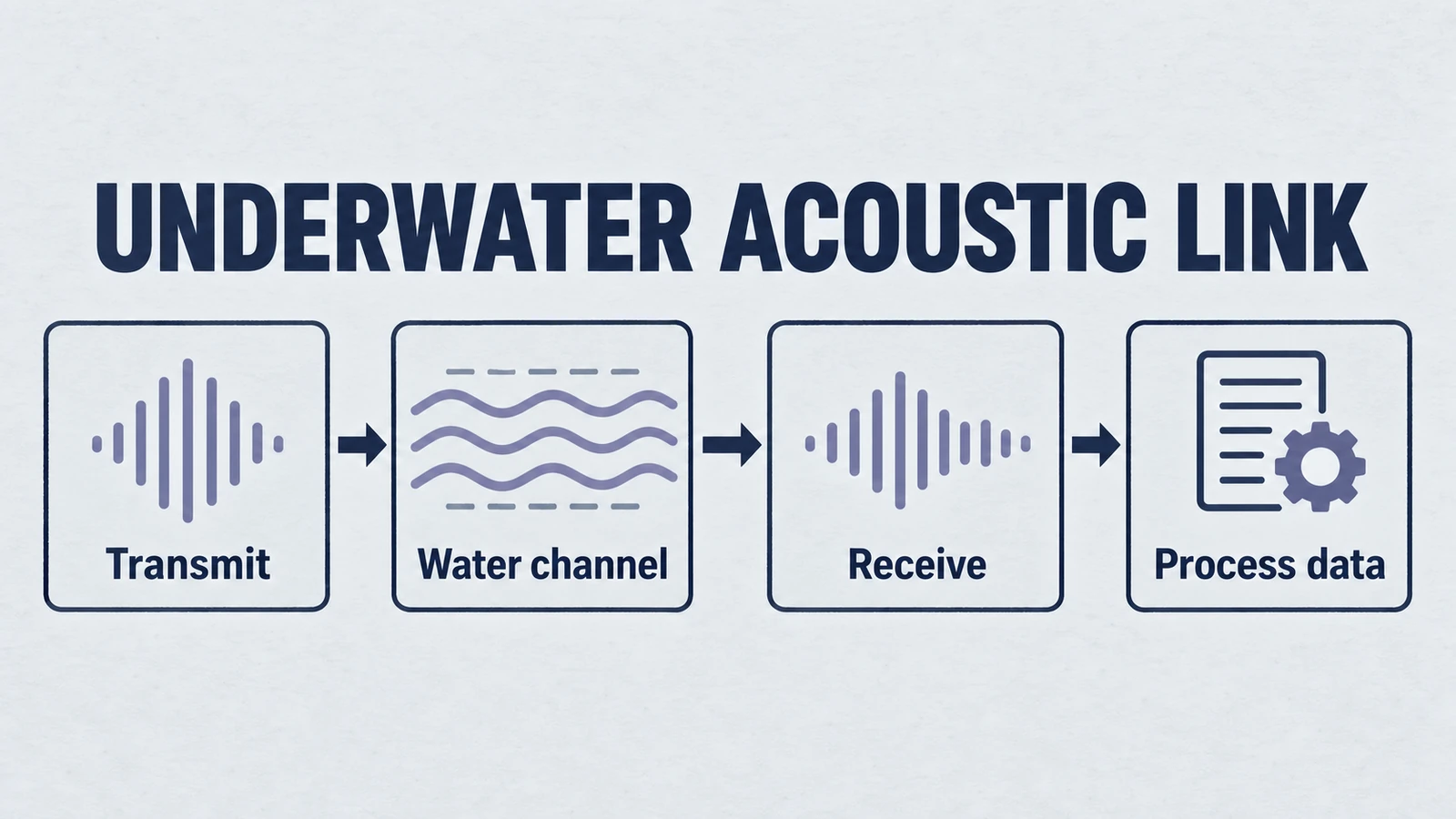
At the technical core of the system resides the acoustic modem transducer, a device that serves as a bidirectional interface between electronic systems and the marine environment. These sophisticated devices, such as our submersible transducer models and deep-water transducers, execute critical electromechanical conversions. Its functional logic can be parsed into two interlocking processes:
1. Signal Emission:
- Electrical signals, generated by onboard communication electronics, are applied to a piezoelectric ceramic element.
- The piezoelectric crystal undergoes mechanical oscillation, thereby launching ultrasonic acoustic waves into the surrounding fluid.
- Information is encoded onto these waves using digital modulation techniques, ensuring that abstract binary data streams are represented as physical oscillations in the aqueous medium.
2. Signal Reception:
- Acoustic waves, incident upon the transducer, induce mechanical stresses within the piezoelectric substrate.
- These stresses are reconverted into corresponding electrical signals.
- Downstream circuitry demodulates and decodes these signals, reconstructing the transmitted bitstream for higher-level processing.
Robust implementations typically employ modulation strategies including frequency-shift keying (FSK), phase-shift keying (PSK), quadrature amplitude modulation (QAM), or spread-spectrum encoding. These approaches mitigate interference, extend channel robustness, and improve reliability under adverse environmental conditions.
Inherent Constraints and Propagation Challenges
Although underwater ultrasonic communication is markedly more effective than its RF or optical counterparts, it remains subject to severe constraints imposed by the physical environment:
- Multipath Propagation: Reflection phenomena at the ocean surface, seabed, and other boundaries create multiple delayed versions of the transmitted signal, introducing intersymbol interference and reducing intelligibility.
- Frequency-Dependent Attenuation: While higher ultrasonic frequencies support increased data rates, they are rapidly attenuated, often confining their useful range to a few hundred meters.
- Ambient Noise: Biological activity (e.g., cetacean vocalizations, crustacean snapping), anthropogenic sources (shipping, drilling, and seismic surveys), and geophysical background noise establish a dynamic and often elevated noise floor.
- Restricted Bandwidth: The available spectrum for underwater acoustic communication is narrow relative to terrestrial wireless systems, constraining throughput.
- Latency: Acoustic propagation velocities (~1500 m/s in seawater) are significantly slower than RF propagation, leading to latency effects that complicate synchronization and real-time control.
Engineers address these limitations through algorithmic sophistication and hardware optimization: adaptive equalization techniques counteract multipath distortion; forward error correction and interleaving reduce error rates; and multicarrier modulation frameworks such as orthogonal frequency-division multiplexing (OFDM) allow efficient spectral utilization. Advanced ultrasonic sensor systems incorporate these sophisticated processing capabilities.
Applications Across Domains
The application space for acoustic modem transducers is both extensive and rapidly expanding:
- Naval Operations: Secure and stealth-capable communication links between submarines, unmanned underwater vehicles (UUVs), and surface command vessels are critical to modern defense strategies. Military-grade acoustic transducers provide reliable communications in challenging environments.
- Oceanographic Science: Distributed sensor platforms collect and transmit physical, chemical, and biological data to surface buoys or research vessels, enabling longitudinal studies of climate and ecosystems. Environmental monitoring sensors with acoustic capability facilitate real-time data collection.
- Energy Sector: ROVs are typically tethered for communication and control. Acoustic links support AUVs, instruments and selected backup or specialized vehicle functions; they are not a universal substitute for a tethered high-bandwidth link. Underwater flow transducers monitor pipeline integrity and flow rates.
- Environmental Monitoring: Networks of autonomous sensors use acoustic channels to report in situ measurements of water quality, pollution dispersion, or seismic activity in near real time. Water level sensors and chemical detection sensors form the backbone of these monitoring networks.
- Autonomous Systems: AUVs, operating singly or in coordinated swarms, rely on acoustic signaling for mission coordination, navigation, and cooperative data gathering in the absence of GPS. Proximity detection sensors enable collision avoidance in swarm operations.
- Disaster Response: Post-disaster scenarios such as subsea earthquakes or industrial accidents employ rapid-deployment acoustic communication nodes to relay situational data where other channels are unavailable.
Prospective Developments
The trajectory of research and industrial investment points toward significant innovations that will redefine the efficiency and reach of ultrasonic communication systems:
- Hybrid Modalities: Future networks are expected to integrate acoustics with optical communication for short-range, high-throughput links and with very low-frequency RF for penetrating extreme depths, thereby optimizing the trade-off between range and data rate.
- Machine Learning Integration: Adaptive modulation, equalization, and noise cancellation are increasingly informed by machine learning algorithms capable of real-time optimization under dynamic environmental conditions. Smart sensor arrays incorporate AI-driven signal processing.
- Miniaturization and Energy Efficiency: Advances in nano-scale piezoelectric materials and composite structures are enabling smaller, more energy-efficient transducers with extended operational lifetimes, ideal for deployment in dense sensor networks.
- Standardization and Protocol Development: The emergence of subsea internet protocols and cross-platform compatibility frameworks will facilitate a scalable Internet of Underwater Things (IoUT), with applications spanning scientific, industrial, and military domains.
- Resilience and Durability: New encapsulation and housing technologies are improving the resilience of acoustic modem transducers to pressure, corrosion, and biofouling, ensuring sustained function in deep-sea environments. Marine-grade transducers exemplify these durability advances.
Collectively, these directions suggest a future in which underwater communication systems approach the ubiquity and reliability of terrestrial wireless networks, albeit with physics-imposed constraints.
Technical Implementation Considerations
When implementing underwater ultrasonic communication systems, several technical factors must be carefully considered:
Transducer Selection and Design
The choice of transducer technology significantly impacts system performance. High-power PZT ceramics provide excellent efficiency for long-range communication, while low-profile ceramic designs offer advantages in compact applications. The composite transducer arrays enable beamforming capabilities that improve signal-to-noise ratios and reduce interference.
Frequency Band Optimization
Different frequency bands serve different purposes in underwater communication. Low frequencies (1-10 kHz) achieve maximum range but limited bandwidth, while higher frequencies (50-100 kHz) provide increased data rates over shorter distances. Wide-band acoustic transducers offer the flexibility to adapt frequency selection based on operational requirements.
Power Management
Energy efficiency is critical for battery-powered underwater systems. Low-power sensor modules and energy-efficient transducers enable extended operational periods without battery replacement, crucial for long-term deployments in remote ocean locations.
Integration with Existing Marine Systems
Modern underwater communication systems must integrate seamlessly with existing marine infrastructure. Marine flow measurement systems benefit from acoustic telemetry for real-time data transmission, while multi-parameter sensors can consolidate multiple measurements into single acoustic transmissions, reducing bandwidth requirements and improving efficiency.
The integration extends to surface vessels and offshore platforms, where surface-mounted transceivers provide the critical link between underwater acoustic networks and satellite communication systems, enabling global connectivity for subsea operations.
Conclusion
Sonar transducers represent the technological linchpin of underwater ultrasonic communication, executing the fundamental electromechanical conversions that make subsea data exchange possible. Though constrained by multipath propagation, spectral attenuation, ambient noise, and latency, ongoing research into material science, adaptive modulation techniques, and multi-modal communication architectures continues to expand the boundaries of feasibility. The growing scope of applications—from naval defense to climate science—underscores their centrality.
Looking forward, acoustic modem systems are poised to serve as foundational infrastructure for an intelligent and interconnected marine environment, where oceans themselves become platforms for continuous monitoring, data gathering, and coordinated machine activity. The convergence of advanced piezoelectric materials, sophisticated signal processing, and robust underwater transducer designs positions underwater ultrasonic communication as a critical enabler of future ocean exploration and exploitation.
As we advance toward more sophisticated underwater networks, the role of acoustic modem transducers will only grow in importance, bridging the gap between terrestrial communications infrastructure and the vast, largely unconnected underwater world. This technology promises to unlock new possibilities in marine science, defense, resource extraction, and environmental monitoring, making the ocean as connected and observable as the land and atmosphere above.
Product path for this search intent
Match the article topic to the right YJ Piezo product page
Use this article as an application note that connects piezoelectric material behavior, transducer design, and OEM sourcing decisions. For "Underwater Communication with Ultrasonics: How Sonar Transducers Transmit Data", the practical value is in turning the topic into a measurable selection or sourcing decision.
- Piezoelectric Ceramics
PZT shapes, materials, and custom manufacturing
- PZT Material Hub
Material property tradeoffs and grade selection
- Ultrasonic Transducer Supplier Hub
OEM transducer development and sourcing
Engineering decision notes
Piezoelectric application engineering
Use this article as an application note that connects piezoelectric material behavior, transducer design, and OEM sourcing decisions. For "Underwater Communication with Ultrasonics: How Sonar Transducers Transmit Data", the practical value is in turning the topic into a measurable selection or sourcing decision.
YJ Piezo reviews piezoelectric projects from material, geometry, electrode, assembly, and outgoing inspection together so the final part fits the real operating condition.
Selection checks
- Clarify whether the design is primarily sensing, actuation, power ultrasonics, atomization, or acoustic measurement.
- Connect the article topic to geometry, material grade, tolerance, operating field, and validation method.
- Define which measurements matter before comparing suppliers: resonance, impedance, capacitance, d33, Qm, or acoustic output.
Failure risks
- A component can meet a simple datasheet value and still fail after bonding, clamping, heat, or acoustic loading.
- Generic material selection can create drift, heating, weak output, or unstable resonance.
- Insufficient RFQ detail forces suppliers to quote assumptions instead of the real engineering requirement.
RFQ details
- What is the operating mode and target application?
- Which electrical, mechanical, and environmental limits must be controlled?
- What sample evidence or outgoing reports are needed before production approval?
Relevant YJ Piezo pages
- Piezoelectric Ceramics
PZT shapes, materials, and custom manufacturing
- PZT Material Hub
Material property tradeoffs and grade selection
- Ultrasonic Transducer Supplier Hub
OEM transducer development and sourcing
Application FAQ
- What extra detail makes a piezoelectric article more useful for engineers?
- Useful detail connects the topic to material choice, geometry, operating load, measurable acceptance criteria, and supplier evidence. That helps readers move from background knowledge to a sourcing or design decision.
- What information should I send YJ Piezo for application guidance?
- Send the application, target dimensions, frequency or sensitivity target, operating medium, duty cycle, temperature range, expected quantity, and any current test data or failure symptoms.