
Piezo Sensor Sensitivity: 7 Engineering Factors That Matter
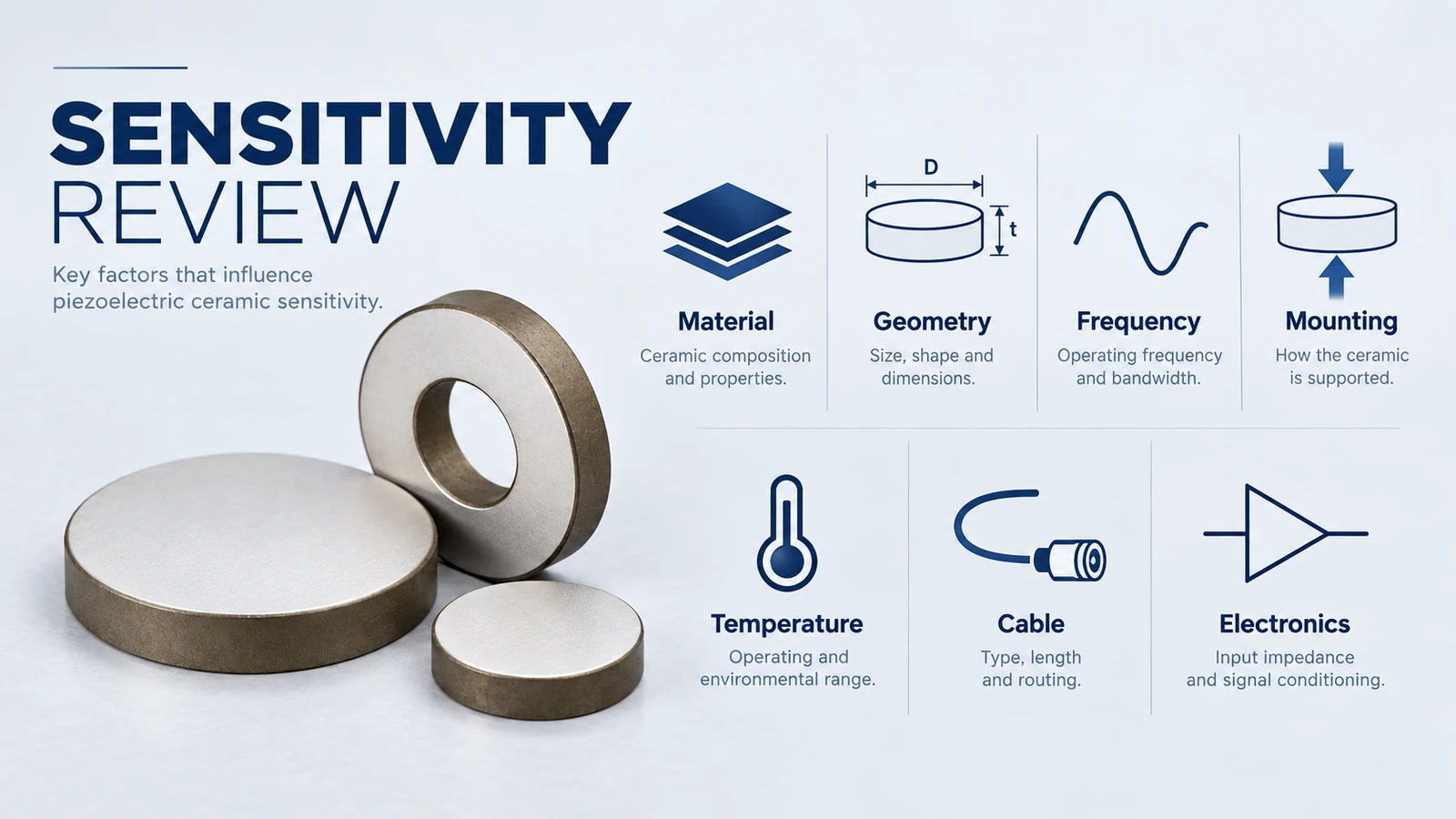
Piezoelectric sensors are widely used in industrial, medical, and consumer applications due to their fast response, compact size, and ability to convert mechanical stress into electrical signals. However, the sensitivity of these sensors—how effectively they can detect and respond to small mechanical changes—varies significantly based on multiple factors.
Engineering decision focus: Prioritize which variables to tune first—material constants, mounting boundary, or signal chain—to improve sensitivity without sacrificing stability.
In this article, we explore the key elements that influence the sensitivity of piezoelectric sensors, and how engineers and designers can optimize sensor performance for their specific applications.
1. Material Properties of the Piezoelectric Element
Product path for this search intent
Match the article topic to the right YJ Piezo product page
Use this article when the choice is not just a shape, but a material tradeoff between sensitivity, loss, coupling, stability, and operating field. For "Piezo Sensor Sensitivity: 7 Engineering Factors That Matter", the practical value is in turning the topic into a measurable selection or sourcing decision.
- PZT Material Hub
Material grades and application tradeoffs
- Piezoelectric Ceramics
Shapes and ceramic manufacturing options
- PZT Material Supplier Hub
Material control, grade selection, and sourcing support
The piezoelectric material at the heart of the sensor plays a crucial role in determining sensitivity. Common materials include:
- Lead zirconate titanate (PZT): Offers high sensitivity and is widely used in industrial applications.
- Quartz: Naturally piezoelectric but with lower sensitivity.
- Polyvinylidene fluoride (PVDF): A flexible polymer with lower piezoelectric coefficients but suitable for wearable and flexible devices.
Key parameters affecting sensitivity:
- Piezoelectric charge constant (d₃₃, d₃₁): Higher values mean more charge generation per unit force.
- Dielectric constant (εᵣ): Influences voltage output; a balance between high charge and manageable capacitance is ideal.
- Electromechanical coupling coefficient (k): Describes coupling for the specified mode and boundary conditions; it is not assembled-device conversion efficiency.
Material selection is the foundation for optimizing sensor performance. Engineers must weigh trade-offs between mechanical robustness, charge generation, and environmental compatibility.
2. Geometry and Dimensions of the Sensor
The size and shape of the piezoelectric element significantly affect its output signal.
- Thickness and signal: For ideal uniform longitudinal loading at fixed stress and electrode area, short-circuit charge is Q = d33 × stress × area and does not increase simply with thickness. Open-circuit voltage is approximately V = g33 × stress × thickness; loading, mode, and the readout circuit must also be specified.
- Area and readout: Electrode area affects force collection, charge, capacitance, resonance, and electrical loading. Compare signal and noise for the complete geometry and readout; greater area alone does not guarantee better signal-to-noise ratio.
- Aspect ratio (length to thickness) influences resonant behavior and mode shape.
Proper mechanical design—such as beam-like cantilevers or membrane structures for dynamic measurements—can amplify stress and improve response.
Higher thickness-mode frequencies generally require thinner active elements. Design the acoustic matching layers, backing, aperture and electrical readout separately to meet bandwidth, resolution and sensitivity targets. Thinning homogeneous active ceramic does not itself change its characteristic acoustic impedance, density times sound speed, or imply a universal amplitude penalty.
3. Mounting Conditions and Mechanical Boundary Constraints
How the sensor is mounted can either enhance or suppress sensitivity:
- Clamped edges may restrict strain, reducing effective sensitivity.
- Free boundary conditions allow more deformation and higher signal generation.
- Preload force or initial mechanical stress can shift the sensor's linear operating range and improve resolution for small signals.
Adhesive type, mounting plate stiffness, and housing design all influence mechanical stress transfer. For dynamic sensing, choose damping for the required bandwidth, sensitivity, and ring-down time.
4. Resonant Frequency and Operating Bandwidth
Piezoelectric sensors exhibit peak sensitivity near their resonant frequency. This is both an opportunity and a limitation:
- At resonance: Maximum sensitivity but narrow bandwidth.
- Below resonance: More linear behavior and broader frequency response.
Designers must balance between high sensitivity and wide operational bandwidth depending on the application, e.g., ultrasonic imaging vs. vibration monitoring.
Finite element analysis (FEA) and impedance analysis are often used to model and fine-tune resonant behavior in sensor prototypes.
5. Temperature Effects
Temperature can significantly impact piezoelectric performance:
- Thermal transitions: Conventional ferroelectric PZT loses its poled linear piezoelectric response at the ferroelectric-to-paraelectric transition; depoling and drift can limit use earlier. Quartz is nonferroelectric and needs a cut- and phase-dependent assessment: not every coefficient vanishes at its alpha-to-beta transition. PVDF formulations and processing have their own thermal limits. Use the complete sensor’s validated temperature rating.
- Thermal drift: Affects the piezoelectric constant and dielectric properties, reducing sensitivity over time or in extreme environments.
- Material selection must consider the operating temperature range to ensure stable sensitivity.
High-temperature sensing requires an exact material grade and a qualified complete assembly. A family name such as PZT-8 or bismuth titanate does not establish an assembled sensor rating above 150°C. Verify electrodes, insulation, bonds, exposure duration, drive, stress and measured stability.
6. Electrical Load and Circuit Design
The load connected to the piezoelectric sensor affects signal quality:
- High input resistance: Reduces loading of a raw piezoelectric charge source and can extend its low-frequency voltage response. It does not passively amplify the voltage.
- Input versus output impedance: Shunting a raw sensor with lower resistance raises its low-frequency cutoff. This differs from a buffered low-impedance output, which can drive cables and downstream electronics. For a resistive voltage readout, the approximate time constant is total resistance × total capacitance; charge-amplifier behavior depends on its feedback network.
Impedance matching, use of charge amplifiers, and proper shielding are essential for preserving the true signal and avoiding noise contamination.
Designers should also consider parasitic capacitance and noise coupling in PCB layout and cable selection.
7. Environmental and Application Factors
- Humidity and moisture can degrade sensor materials and insulation resistance, leading to signal loss or drift.
- Mechanical shock and fatigue reduce sensitivity over time due to microcracks or depolarization.
- Contamination on the electrode surface can affect charge collection.
Proper packaging, sealing, and environmental protection are essential to maintain long-term sensitivity in harsh conditions.
For example, hermetically sealed metal housings or conformal coatings can improve long-term performance in biomedical or underwater applications.
8. Aging and Depolarization Over Time
Piezoelectric materials are subject to aging, particularly in high-load or high-temperature environments:
- Aging reduces dielectric and piezoelectric constants gradually.
- Depolarization due to overvoltage or excessive temperature can lead to partial or complete loss of sensitivity.
Regular recalibration or use of materials with lower aging rates (e.g., doped PZT) can help maintain consistent performance.
Conclusion
The sensitivity of piezoelectric sensors is influenced by a complex interplay of material science, mechanical design, electrical engineering, and environmental conditions. By understanding and controlling these factors, engineers can design sensors that offer high precision, reliability, and stability for their specific application.
Whether you're working on precision ultrasonic transducers, industrial monitoring systems, or flexible biomedical devices, optimizing sensitivity is the key to unlocking the full potential of piezoelectric technology.
Looking for high-performance piezoelectric materials or custom sensor solutions?
Contact Yujie today to learn how our tailored piezoelectric ceramics can enhance your product's sensitivity and performance.
Related Engineering Reading
Engineering decision notes
PZT material and ceramic selection
Use this article when the choice is not just a shape, but a material tradeoff between sensitivity, loss, coupling, stability, and operating field. For "Piezo Sensor Sensitivity: 7 Engineering Factors That Matter", the practical value is in turning the topic into a measurable selection or sourcing decision.
YJ Piezo coordinates PZT ceramic projects with manufacturing support, so material formulation, sintering, polarization, electrode process, and outgoing inspection can be reviewed against the final application.
Selection checks
- Separate sensing needs from high-power actuation needs before comparing d33 or coupling values.
- Check dielectric loss, Qm, Curie temperature, aging behavior, and operating field against the real duty cycle.
- Confirm whether the application needs standard PZT grades or a custom formulation and geometry.
Failure risks
- Choosing only the highest d33 can create heat, drift, or depolarization risk in power ultrasonics.
- A ceramic that performs well in free measurement can fail once bonded, clamped, or loaded.
- Material substitutions without batch testing can change capacitance, resonance, and system tuning.
RFQ details
- Is the part used for sensing, actuation, atomization, cleaning, welding, or measurement?
- What field strength, temperature, duty cycle, and mechanical load will the ceramic see?
- Which values must be controlled: d33, capacitance, resonance, impedance, Qm, or dimensional tolerance?
Relevant YJ Piezo pages
- PZT Material Hub
Material grades and application tradeoffs
- Piezoelectric Ceramics
Shapes and ceramic manufacturing options
- PZT Material Supplier Hub
Material control, grade selection, and sourcing support
Application FAQ
- Is the highest d33 always the best PZT choice?
- No. High d33 can be useful for sensitivity, but high-power ultrasonic systems often need lower loss, higher Qm, better thermal stability, and safer operation under field and stress.
- What makes PZT material selection different from catalog buying?
- The right PZT choice depends on geometry, load, drive field, duty cycle, temperature, and inspection targets. A catalog value is only useful when it is tied to the final assembly conditions.