
Piezoelectric Energy Harvesting: Converting Mechanical Energy into Electrical Power
In today's interconnected and sensor-rich world, the demand for self-powered devices is rapidly increasing. Piezoelectric energy harvesting stands out as one of the most efficient methods for converting mechanical vibrations into usable electrical power. This technology not only reduces dependency on batteries but also enables sustainable and maintenance-free operation for decades, making it ideal for IoT sensor networks and remote monitoring systems.
What is Piezoelectric Energy Harvesting?
Piezoelectric energy harvesting is the process of capturing ambient mechanical energy — such as vibrations, pressure changes, or mechanical impacts — and converting it into electrical energy using piezoelectric materials. This renewable energy source enables autonomous operation of low-power electronic devices without battery replacement for years or even decades.
The technology leverages the piezoelectric effect, where certain crystalline materials generate electric charge when mechanically stressed. Common piezoelectric materials used in energy harvesting include lead zirconate titanate (PZT) ceramics, polyvinylidene fluoride (PVDF) polymers, and emerging lead-free alternatives.
Product path for this search intent
Match the article topic to the right YJ Piezo product page
Use this article when sensor performance depends on target distance, beam angle, housing material, liquid behavior, or false echo control. For "Piezoelectric Energy Harvesting: Converting Mechanical Energy into Electrical Power", the practical value is in turning the topic into a measurable selection or sourcing decision.
- Ultrasonic Sensors
Distance, level, and detection sensor portfolio
- Flow Measurement Transducers
Bubble and flow-related ultrasonic sensing paths
- Air Acoustic Transducers
Air-coupled transducers for range and presence detection
How Piezoelectric Energy Harvesting Works
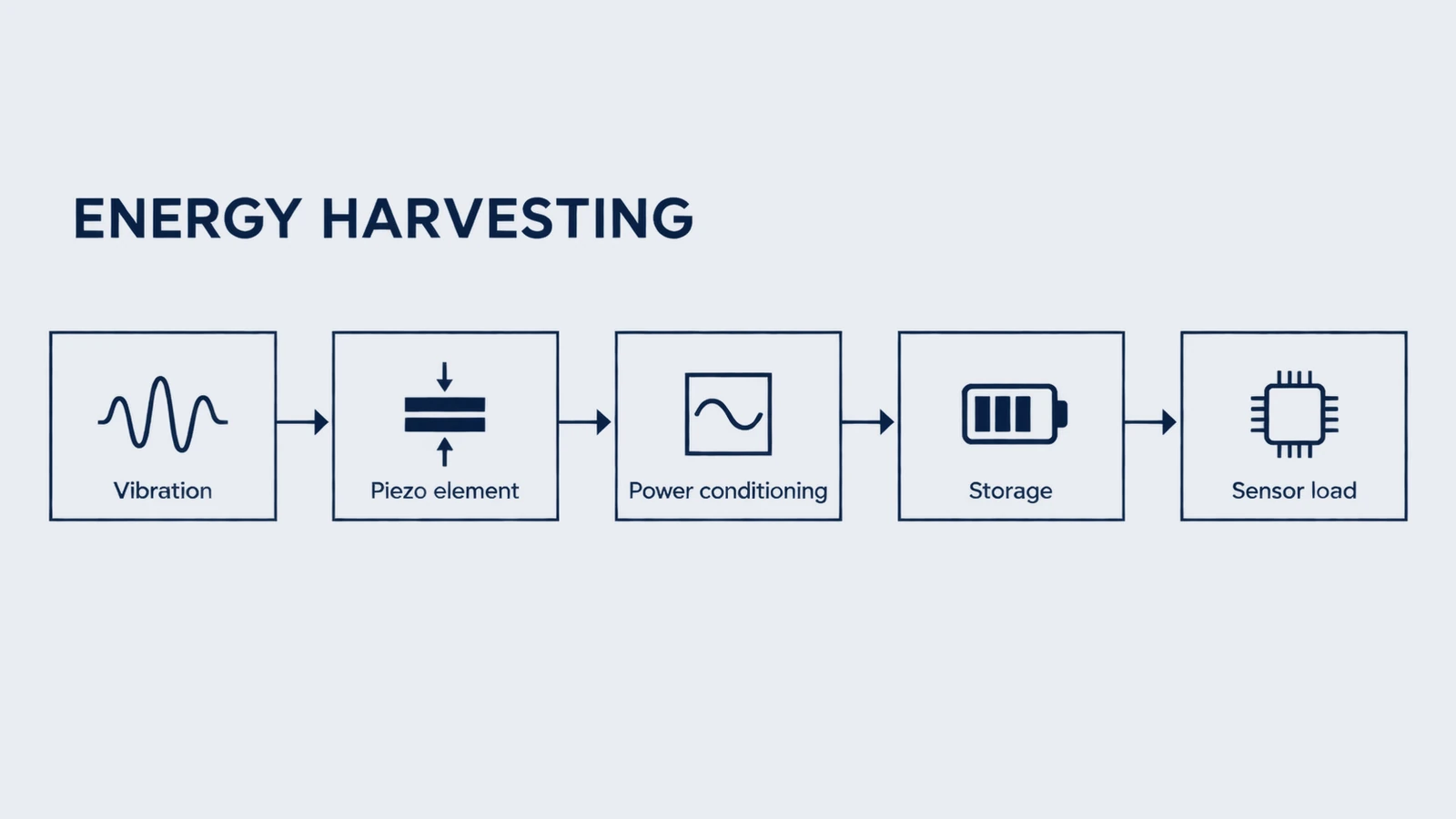
A complete piezoelectric energy harvesting system consists of several key components working together to convert ambient vibrations into usable electrical power:
1. Mechanical Input and Energy Capture
External vibrations or movements create mechanical stress in the piezoelectric material. The harvester's mechanical structure must be designed to efficiently couple with the vibration source. Resonant frequency matching between the harvester and vibration source dramatically improves energy capture efficiency — sometimes by 10x or more compared to off-resonance operation.
2. Electrical Signal Generation
Due to the piezoelectric effect, mechanical deformation generates an alternating voltage across the material's electrodes. For an ideal open-circuit longitudinal specimen, voltage depends on the voltage coefficient g33 = d33/ε33, stress and thickness. Actual output and deliverable power also depend on mode, loading, capacitance, leakage and electronics; d33 alone does not predict terminal voltage.
3. AC-to-DC Rectification
The AC voltage generated by the piezoelectric element must be converted to DC for practical use. Full-bridge rectifiers are commonly used, though they introduce voltage drops (typically 0.6-1.4V). Advanced rectification circuits like synchronized switching harvesting on inductor (SSHI) or active rectifiers can improve conversion efficiency by 200-400% compared to standard diode bridges.
4. Energy Storage and Management
The rectified DC power is stored in capacitors or rechargeable batteries. Ultra-low leakage supercapacitors are often preferred for maintenance-free operation. Power management ICs regulate voltage levels and implement maximum power point tracking (MPPT) algorithms to optimize energy extraction under varying vibration conditions.
5. Load Powering
The stored energy powers low-power devices such as wireless sensor nodes, RF transmitters, or microcontrollers operating in ultra-low-power modes. Modern systems can support duty-cycled operation where sensors wake up periodically, take measurements, transmit data, and return to sleep mode.
Piezoelectric Materials for Energy Harvesting
Material selection is critical for optimizing energy harvesting performance. Different applications require different material properties:
PZT Ceramics (Lead Zirconate Titanate)
PZT materials are established energy-harvesting materials. Compare mode-specific d/g/k, losses and the source/load design; PZT is not a universal maximum of coupling or assembled harvesting efficiency. Our PZT disc components and ring elements are optimized for energy harvesting applications.
PVDF Polymers
Flexible polyvinylidene fluoride (PVDF) films excel in applications requiring large deformations or conformable installations. While offering lower energy density than PZT, PVDF's flexibility makes it ideal for wearable applications and energy harvesting from human motion or textile integration.
Lead-Free Alternatives
Environmental regulations drive development of lead-free piezoelectric materials such as potassium sodium niobate (KNN) and barium calcium zirconate titanate (BCZT). While performance currently lags behind PZT, ongoing research continues to narrow this gap, particularly for moderate power density applications.
Applications of Piezoelectric Energy Harvesting
Industrial Monitoring and Predictive Maintenance
Piezoelectric harvesters power vibration sensors on rotating machinery, enabling continuous condition monitoring without battery maintenance. Energy harvesting from machine vibrations provides 0.1-10 mW of power — sufficient for wireless sensor systems that monitor bearing health, detect anomalies, and predict failures before they occur.
Structural health monitoring systems in bridges and buildings use piezoelectric energy harvesting to power distributed sensor networks that detect cracks, corrosion, and structural degradation. Installation in remote or difficult-to-access locations eliminates costly battery replacement.
IoT and Smart City Infrastructure
The Internet of Things revolution depends on self-powered sensor nodes. Piezoelectric energy harvesters enable:
- Environmental Monitoring: Temperature, humidity, and air quality sensors powered by ambient vibrations
- Smart Buildings: HVAC optimization through self-powered occupancy and environmental sensors
- Traffic Monitoring: Road-embedded harvesters power vehicle detection and counting systems
- Asset Tracking: Container and shipment monitoring for logistics applications
Medical and Wearable Electronics
Medical implants like pacemakers can harvest energy from heartbeats and body movements, potentially extending device lifetime from 5-10 years to decades. Wearable health monitors harvest energy from walking, running, or other activities to supplement battery life.
Research prototypes demonstrate power generation of 1-5 mW from walking motion — sufficient for many wearable sensors and health monitoring devices. This aligns with our expertise in documented piezoelectric components.
Automotive and Transportation
Tire pressure monitoring systems (TPMS) can harvest energy from tire vibrations and deformations during driving. Railroad applications include track-mounted harvesters that power signal systems and sensor networks from passing trains.
Consumer Electronics
Floor tiles and walkways with embedded piezoelectric elements generate power from foot traffic. Keyboards and remote controls can be battery-free, powered entirely by button presses and mechanical actuation.
Design Considerations for Energy Harvesting Systems
Resonance Tuning and Frequency Matching
Maximum power extraction occurs when the harvester's natural frequency matches the dominant vibration frequency of the environment. Tunable harvesters use adjustable proof masses or magnetic springs to adapt to varying frequency conditions. Typical ambient vibration frequencies range from 10-200 Hz, with industrial machinery often vibrating at 30-60 Hz.
Impedance Matching
The electrical impedance of the piezoelectric element must match the load impedance for maximum power transfer. Power management circuits implement impedance matching algorithms that adapt to changing vibration conditions and load requirements.
Circuit Efficiency Optimization
Every component in the energy harvesting chain introduces losses. High-efficiency rectifiers, low-quiescent-current regulators, and ultra-low-leakage storage elements are essential. System efficiency from mechanical input to usable electrical output typically ranges from 10-40%, with advanced circuits achieving 60% or higher.
Performance Metrics and Power Output
Piezoelectric energy harvesters generate power levels ranging from microwatts to milliwatts depending on vibration amplitude and frequency:
- Low Vibration (0.1g, 10 Hz): 10-100 μW — suitable for ultra-low-power sensors with long sleep periods
- Moderate Vibration (0.5g, 50 Hz): 100-500 μW — powers most wireless sensor nodes with periodic transmission
- High Vibration (1-2g, 100 Hz): 1-10 mW — enables continuous sensing with frequent data transmission
- Impact/Impulse Events: Peak power in the 10-100 mW range for brief periods
Modern ultra-low-power microcontrollers and RF transceivers consume as little as 1-2 μA in sleep mode and 10-20 mA during active transmission, making them well-suited for energy harvesting applications.
Advantages and Challenges
Key Advantages
- Battery-Free Operation: Eliminates replacement costs and environmental waste from disposable batteries
- Compact and Durable: Solid-state operation with no moving parts beyond the proof mass
- Long Lifetime: Properly designed systems can operate for 20+ years without maintenance
- Scalable: From microscale MEMS harvesters to large civil engineering installations
- Environmental Sustainability: Renewable energy source with minimal environmental impact
Technical Challenges
- Power Density Limitations: Output power levels suit low-power electronics but cannot power high-consumption devices
- Frequency Dependence: Narrow-band resonant harvesters require stable vibration frequencies
- Installation Complexity: Optimal placement and mechanical coupling are critical for performance
- Initial Cost: Higher upfront costs compared to batteries, though lifecycle costs are often lower
- Environmental Sensitivity: Temperature variations affect resonance frequency and material properties
Future Trends and Innovations
Research continues to advance piezoelectric energy harvesting capabilities through several promising directions:
- Nonlinear Harvesters: Broadband operation using nonlinear dynamics and magnetic interactions
- Hybrid Systems: Combining piezoelectric, electromagnetic, and electrostatic harvesting mechanisms
- Nanostructured Materials: Advanced material processing improving efficiency and reducing costs
- Machine Learning Optimization: AI-driven power management adapting to complex vibration patterns
- Flexible and Stretchable Devices: Conformal harvesters for wearables and curved surfaces
Conclusion
Piezoelectric energy harvesting represents a transformative technology enabling sustainable, battery-free power generation for autonomous sensing systems. As IoT deployments expand and environmental concerns drive sustainability initiatives, energy harvesting solutions will become increasingly essential across industrial, infrastructure, medical, and consumer applications.
Success requires careful attention to material selection, mechanical design, resonance tuning, and electrical circuit optimization. Our expertise in high-performance piezoelectric materials and custom transducer design enables us to develop tailored energy harvesting solutions optimized for specific application requirements.
Related Resources
For deeper understanding of related topics, explore these articles:
- Piezoelectric Energy Harvesting: Powering the IoT Revolution
- Powering IoT Sensors with Vibration-Based Energy Harvesting
- Piezo Sensors: Working Principles, Types & Applications
- Energy Harvesting for IoT Sensors
- The Science Behind Piezoelectricity
Ready to explore energy harvesting solutions for your application? Contact our engineering team to discuss custom piezoelectric energy harvesters, material selection, and system optimization for your self-powered sensor requirements. With piezoelectric technology experience built since 1996, we provide comprehensive support from concept to production.
Engineering decision notes
Ultrasonic sensing and detection
Use this article when sensor performance depends on target distance, beam angle, housing material, liquid behavior, or false echo control. For "Piezoelectric Energy Harvesting: Converting Mechanical Energy into Electrical Power", the practical value is in turning the topic into a measurable selection or sourcing decision.
YJ Piezo treats ultrasonic sensing as an acoustic interface problem: transducer frequency, beam shape, housing, drive electronics, and target environment are reviewed together.
Selection checks
- Define target range, dead zone, beam angle, and mounting geometry before choosing the sensor family.
- Check the medium, target surface, temperature swing, foam, vapor, and side-wall risk.
- Separate detection repeatability from ideal lab accuracy when the sensor will operate in a tank, tube, or moving line.
Failure risks
- A sensor can pass bench distance tests and still fail in tanks with foam, agitation, vapor, or narrow geometry.
- Changing only frequency without reviewing beam angle and mounting can increase false echoes.
- Ignoring housing material or sealing requirements can shorten lifetime in washdown or chemical environments.
RFQ details
- What is the minimum and maximum detection distance?
- Is the target liquid, solid, sheet material, air flow, or a moving object?
- What temperature, humidity, IP rating, and output signal does the system require?
Relevant YJ Piezo pages
- Ultrasonic Sensors
Distance, level, and detection sensor portfolio
- Flow Measurement Transducers
Bubble and flow-related ultrasonic sensing paths
- Air Acoustic Transducers
Air-coupled transducers for range and presence detection
Application FAQ
- What makes an ultrasonic sensor page useful for procurement?
- It should connect range, beam angle, output signal, housing, mounting, and environmental limits to a concrete use case. A model name alone is not enough for reliable supplier comparison.
- Which information speeds up an ultrasonic sensor RFQ?
- Send the target material, distance range, installation geometry, output interface, temperature range, IP rating, and whether the application involves foam, vapor, liquid, or moving objects.