
PZT-5H vs PZT-5A: Sensitivity vs Stability Trade-offs in Real Operating Conditions
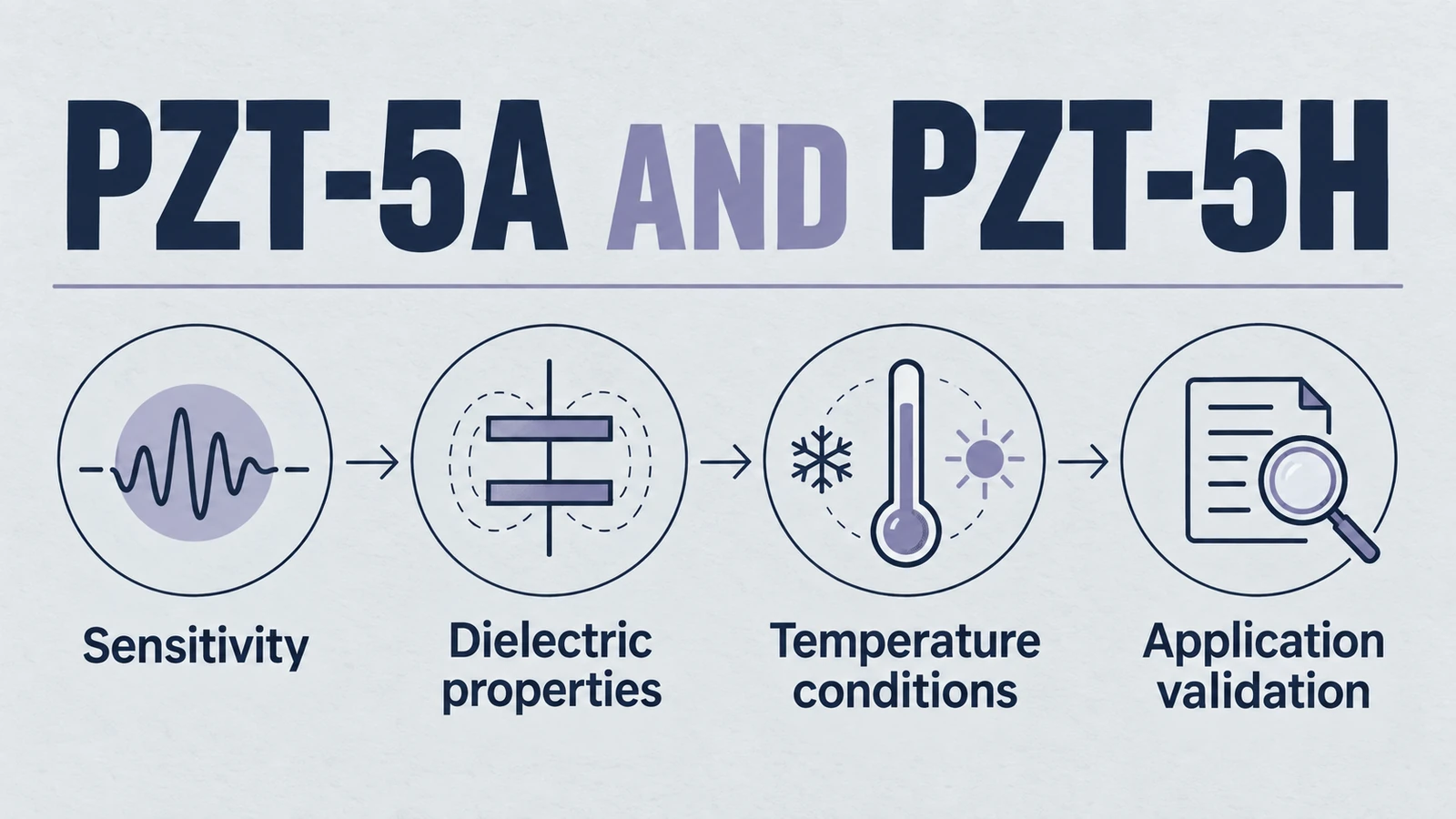
The most common selection error inside the soft-PZT family is not a misunderstanding of piezoelectricity itself. It is a misunderstanding of what the system is actually being optimized for. Many teams see a higher , a higher dielectric constant, or a more dramatic bench-top response and assume the material must be better. That shortcut is exactly how projects end up over-selecting PZT-5H for applications that are ultimately governed by temperature drift, calibration retention, fatigue, and long-term reliability.
For this article, the Yujie mapping is explicit: P51 corresponds to PZT-5A, and P52 corresponds to PZT-5H. The engineering question is therefore not whether P52 can look more impressive on an initial data sheet. It often can. The real question is whether that extra responsiveness survives actual operating conditions without forcing the rest of the system into a compensation-heavy, maintenance-heavy, or short-life design.
If you need a broad introduction to PZT families first, start with what PZT means in material selection and the broad soft-vs-hard overview. If you need a supplier-side discussion about consistency and manufacturing control inside the PZT-5 family, the best companion piece is the PZT-5 consistency article. For comparison with a different architecture-led material boundary, see the PZT-4 versus PZT-5A design note and the PZT-4 sourcing note. This article is narrower. It focuses on one decision: why P51 / PZT-5A is usually the better engineering baseline when the device must remain trustworthy across heat, time, cycling stress, and field variation.
Problem Context
Product path for this search intent
Match the article topic to the right YJ Piezo product page
Use this article when the choice is not just a shape, but a material tradeoff between sensitivity, loss, coupling, stability, and operating field. For "PZT-5H vs PZT-5A: Sensitivity vs Stability Trade-offs in Real Operating Conditions", the practical value is in turning the topic into a measurable selection or sourcing decision.
- PZT Material Hub
Material grades and application tradeoffs
- Piezoelectric Ceramics
Shapes and ceramic manufacturing options
- PZT Material Supplier Hub
Material control, grade selection, and sourcing support
At room temperature, in a stable lab, PZT-5H can look seductive. Higher charge coefficient. Higher permittivity. Bigger initial electrical response. That profile naturally appeals to engineers who are trying to maximize sensitivity, especially in early concept reviews where the system has not yet been exposed to thermal cycling, packaging stress, adhesive mismatch, cable loading, or long-duration drift.
But most piezoelectric devices are not judged by a one-hour benchtop sweep. They are judged after repeated thermal ramps, years of storage, millions of vibration cycles, field recalibration intervals, and changing front-end electronics behavior. The wrong decision usually happens because the team optimizes for initial free response while the deployed product is actually limited by stability of response.
That is why the real trade-off between PZT-5H and PZT-5A should be framed as sensitivity versus stability, not as a generic soft-PZT popularity contest. P52 / PZT-5H is the higher-gain option. P51 / PZT-5A is the wider-margin option. In practice, most industrial and commercial systems need the wider margin more than they need the extra paper sensitivity.
Aerospace sensing, deepwater acoustics, field instrumentation, long-life structural monitoring, and dynamically stressed measurement hardware all teach the same lesson. The material that looks slightly less exciting in a marketing table is often the one that keeps the entire system simple, calibratable, and credible.
Why a Higher Does Not End the Discussion
A higher matters, but only inside the rest of the architecture. Once the ceramic is bonded into a structure, connected to a front end, exposed to ambient variation, and asked to hold performance over time, the governing variables change. The engineering decision moves toward dielectric drift, thermal depoling margin, source-capacitance stability, fatigue, and how much compensation the electronics team must carry to make the material look well behaved.
That is why a material like P51 can be the better choice even when P52 looks stronger in a single initial sensitivity metric. The question is never just “which material responds more?” The question is “which material still behaves predictably after the environment has taken its turn?”
Engineering Constraints
1) Soft Behavior Comes From Domain-Wall Mobility, Not Free Performance
Both PZT-5A and PZT-5H belong to the soft-PZT family, which means both rely on donor-doped chemistry that makes domain-wall motion easier than in hard materials. The constitutive relations are familiar:
Practical interpretation: electrical displacement depends on both the applied stress and the dielectric response. A material with high apparent sensitivity can also impose a more difficult electrical behavior on the front end if its dielectric behavior moves too much with environment.
Practical interpretation: mechanical strain is a coupled result of compliance, electrical drive, and stress state. The useful system response is therefore never determined by alone.
P52 / PZT-5H pushes this soft behavior further. Domain walls move more easily, and that is exactly why the initial response can be larger. But the same low internal barrier that allows bigger small-signal motion also makes the polarized state easier to disturb. P51 / PZT-5A remains soft enough to be highly useful in sensing and actuation, yet it preserves a more survivable stability margin when heat, stress, and time begin to accumulate.
2) Curie Temperature Is Not an Abstract Number; It Defines Margin
The most decisive thermal distinction between these two materials is Curie temperature. P51 / PZT-5A gives a much wider thermal ceiling than P52 / PZT-5H. That difference is not cosmetic. It determines how much safety margin remains after ambient heat, self-heating, bonding losses, and thermal spikes are added together.
Use manufacturer-qualified continuous and peak temperature limits for the exact grade and assembly. A fraction of published Celsius Tc is sometimes used for preliminary screening, but it is not a physical safe-temperature equation and cannot replace drive, stress and lifetime validation.
Practical interpretation: in real engineering, continuous operating temperature must remain well below the Curie point if the ceramic is expected to hold stable polarization and repeatable output. A lower means the appropriate operating envelope collapses much sooner than many teams expect.
That is one of the main reasons P51 usually becomes the default industrial baseline. It gives the stack, the packaging, and the electronics more room to breathe. P52 can still work in controlled thermal environments, but it gives the project less forgiveness. Once the design depends on forgiveness, P51 wins the review more often than not.
3) Temperature Drift Hits the Electronics Team Before It Hits the Materials Team
In many real products, the first visible symptom of choosing an unstable soft ceramic is not immediate failure. It is signal-conditioning pain. The ceramic behaves as a capacitive source, and large dielectric drift changes how the analog front end behaves across temperature.
This is a capacitive-region noise-gain approximation; include applicable cable, input and parasitic capacitance in Csource. Source-capacitance changes can affect amplified voltage noise, loop stability and finite-bandwidth response. For an ideal inverting charge amplifier, output charge conversion is set by the feedback capacitance within its passband and adequate loop gain. Changes in source capacitance alone do not force that conversion calibration to change; material charge sensitivity and feedback-capacitor drift can separately change calibration.
This is where P52 becomes expensive in a way that a data sheet does not show. If dielectric variation is too large, the system often needs temperature sensing, software compensation, or a more complex analog design just to restore behavior that P51 would have delivered more naturally. In other words, the “higher sensitivity” material can quietly shift cost and complexity into the rest of the stack.
4) Dielectric Loss and Self-Heating Punish Narrow-Margin Soft Materials
Once the device is driven dynamically, dielectric loss matters immediately:
Practical interpretation: loss rises with frequency, capacitance, RMS voltage, and dielectric loss tangent. Any material that combines large capacitance with higher environmental sensitivity can make self-heating much more difficult to control in real duty cycles.
Practical interpretation: once loss power exists, temperature rise follows the thermal resistance of the package and stack. This is the mechanism behind the familiar engineering trap where a material looks acceptable at low duty, then drifts, detunes, or partially depoles once real operating time is applied.
P51 does not become lossless. That is not the claim. The claim is that P51 gives a wider thermal operating cushion and is therefore much less likely to force the design into a fragile loop of heat, drift, compensation, and recalibration.
5) Aging Is Logarithmic, Which Makes the Wrong Choice Look Fine at First
Soft piezoelectric materials do not remain frozen after poling. Even in storage, internal defect structures and domain states continue to relax with time. A standard aging model is:
Here X is one specified measured property; t and t0 are positive elapsed times from the same defined event, and a is its change per decade. Specify conditioning history, temperature and the validated time interval. This approximation does not establish the relative aging or recalibration performance of P51 and P52 without comparable measurements.
For long-life instrumentation, underwater arrays, remote monitoring nodes, or any system with infrequent recalibration, this matters enormously. A material with the larger initial response is not necessarily the material with the more trustworthy five-year response. P51 is favored in many of these programs because its behavior over time is easier to budget, easier to calibrate, and less likely to erase the original margin the designer thought was available.
6) Mechanical Fatigue Rewards the Material That Resists Ferroelastic Switching
Dynamic loading introduces another trap. Under repeated mechanical stress, soft ceramics can lose performance through ferroelastic domain reorientation and cumulative damage mechanisms. A simple degradation form is often written as:
A logarithmic fit may describe a particular measured degradation curve over a limited cycle range. Define X, stress amplitude, waveform, frequency, temperature, preload, geometry, fitted constants and cycle interval. NPL Report CMMT(A)148 found inadequate extrapolation at high stress; do not use this fit as a universal life law or transfer it to different conditions.
This is one reason P51 is so often the safer recommendation for vibration-rich industrial systems, wide-temperature field sensors, and harsh deployment hardware. It is not merely “less sensitive than P52.” It is materially harder to push out of a usable state under repeated mechanical abuse.
7) Mechanical Quality Factor Still Matters Inside the Soft-Family Decision
Neither P51 nor P52 is a high-power hard-PZT choice, but the difference in still matters because it tells the engineer something about loss, damping, and durability under dynamic use. Lower usually means more internal mechanical loss and a smaller comfort zone under repeated energy storage.
That is why the P51-versus-P52 choice should not be reduced to “both are soft, so both behave similarly.” They do not. P52 is the narrower-window variant. If the design review includes temperature variation, repetitive mechanical loading, or long service life, that difference becomes fundamental rather than marginal.
8) Better Processing Can Help P52, But It Cannot Rewrite the Physics
Improved densification and better sintering control can lift the apparent quality of a PZT-5H-class material. Those improvements are valuable. But they do not remove the underlying trade-off that created the sensitivity advantage in the first place. Process can reduce porosity, improve consistency, and sharpen initial output. It cannot magically turn a lower-margin thermal system into a wide-margin one. That is why the final decision still has to be made at the physics level rather than the processing-claim level.
Selection Matrix
The first table is not meant to glorify a bigger number. It is meant to show what those differences imply once the material leaves the data sheet and enters a real system.
| Property | P51 / PZT-5A | P52 / PZT-5H | Engineering Meaning |
|---|---|---|---|
| Kp | 0.65 | 0.64 | Very close in planar coupling. This is not where the practical separation is decided. |
| K33 | 0.74 | 0.76 | P52 converts a little more aggressively, but the gain comes with a smaller operating margin. |
| Kt | 0.50 | 0.49 | Thickness-mode coupling is not dramatically different, so thermal and stability criteria often dominate instead. |
| Relative permittivity | 2100 | 3250 | P52 offers more stored charge, but also creates a more temperature-sensitive capacitive source. |
| d31 | -210 | -260 | P52 looks stronger in transverse response, which matters in sensitive receive structures. |
| d33 | 450 | 575 | This is the headline number that attracts teams to P52, but it is not the same as long-term system superiority. |
| d15 | 710 | 950 | Again, P52 is more responsive, but the design must decide whether that responsiveness is worth the narrower stability window. |
| Qm | ≥ 70 | ≥ 65 | P51 carries slightly better loss behavior inside the soft family, which helps under cyclic and resonant use. |
| tanδ | ≤ 0.020 | ≤ 0.020 | Even when nominal loss limits look similar, the lower-margin material is still less forgiving once heat and dielectric drift start interacting. |
| Curie temperature | ≥ 260 C | ≥ 180 C | This is the biggest industrial separator. P51 gives a much healthier thermal buffer. |
| Stress Source | P51 / PZT-5A Behavior | P52 / PZT-5H Behavior | System Consequence |
|---|---|---|---|
| Temperature swings | More stable dielectric and polarization behavior | Larger drift and lower thermal safety margin | P52 forces more compensation work and reduces confidence in calibration retention. |
| Long storage and aging | Lower practical aging burden | Higher sensitivity to long-term relaxation | Unattended or low-maintenance systems usually favor P51. |
| Repeated mechanical cycling | Better resistance to cumulative drift under stress | More vulnerable to ferroelastic switching and fatigue | The apparent sensitivity advantage of P52 erodes faster in long-duty field use. |
| High-frequency dynamic drive | Wider comfort zone before thermal instability becomes dominant | More reactive to self-heating and detuning | P51 is easier to keep inside a sane operating envelope. |
| Field recalibration intervals | Longer usable interval between recalibration events | Tighter maintenance window if output consistency matters | P52 can increase total ownership cost even if the initial material looks more capable. |
| Application Class | Dominant Risk | Preferred Material | Why | Boundary Condition |
|---|---|---|---|---|
| Industrial sensors | Drift, field variation, maintenance burden | P51 / PZT-5A | Better thermal and long-life predictability | Use P52 only if the signal budget is truly sensitivity-limited. |
| Underwater acoustics / hydrophones | Pressure bias, long deployment, recalibration difficulty | Usually P51 / PZT-5A | More stable under harsh deployment logic | P52 remains valid only in tightly controlled sensitivity-first receive systems. |
| Medical imaging | Weak-signal resolution | Case-dependent; P52 may be justified | This is one of the few domains where extra sensitivity can dominate | Thermal control and validation must be excellent before locking P52. |
| focused ultrasound / high-power pulsed transmit | Self-heating and depoling margin | P51 or harder class | P52 is rarely the appropriate baseline when thermal load rises | Re-open the shortlist if the duty pattern approaches true power-ultrasonic territory. |
| SHM / energy harvesting | Long-term drift and cycle fatigue | P51 / PZT-5A | Long unattended life rewards stability over paper sensitivity | Only move to P52 if the harvest threshold cannot be met otherwise. |
| WIM and harsh outdoor measurement | Thermal cycling and shock loading | P51 / PZT-5A | Wider operating margin and lower compensation burden | P52 is usually the wrong default unless the environment is far more controlled than typical field deployment. |
Application Mapping
Aerospace and High-Temperature Precision Sensing
Preferred baseline: P51 / PZT-5A. The dominant constraint is not maximum small-signal response. It is whether the sensing element keeps behaving after thermal gradients, storage, and repeated flight or structural cycles. The usual failure of the wrong choice is not a dramatic explosion. It is a quiet collapse of trust in the signal because drift, heat sensitivity, or depoling margin has been underestimated.
Deepwater Hydrophones and Underwater Arrays
Preferred baseline: P51 / PZT-5A. Static pressure bias, deployment duration, and recalibration difficulty all favor the more stable material. The usual failure of the wrong choice is a gradual loss of useful sensitivity under pressure and time, combined with increasing uncertainty about the electrical behavior of the array.
Medical Imaging and High-Fidelity Receive Chains
Preferred baseline: case dependent. This is where P52 can still be justified because the dominant constraint may truly be very weak signal capture. But that justification only holds when the architecture has tight thermal control, strong validation discipline, and a clear demonstration that P51 cannot meet the required sensitivity. The usual failure of the wrong choice is to specify P52 reflexively for “performance” when the actual system never needed that degree of sensitivity in the first place.
Structural Health Monitoring and Energy Harvesting
Preferred baseline: P51 / PZT-5A. The dominant constraint is long-duration credibility. These systems often operate where hardware is difficult to revisit, recalibrate, or replace. The usual failure of the wrong choice is that the node works beautifully at first and then slowly stops meeting its own power or sensing assumptions because aging and cyclic degradation were underweighted.
Dynamic Traffic Measurement and Harsh Outdoor Sensing
Preferred baseline: P51 / PZT-5A. The dominant constraints are thermal cycling, shock, and baseline retention. The usual failure of the wrong choice is an output that becomes harder and harder to map back to the real physical event because both material drift and compensation burden grow together.
Across these classes, one pattern remains stable. If the application is not unmistakably sensitivity-limited and tightly controlled, the engineering review should begin with P51. P52 should be promoted from an exception only when the system proves it needs the extra sensitivity badly enough to pay for the narrower stability window.
RFQ Checklist
A material RFQ for this decision should read like a validation handoff, not a generic request for “soft PZT pricing.” If the supplier is not forced to respond to drift, thermal margin, and life assumptions, the quote will often hide the most important risk.
- Frequency: operating frequency and acceptable shift window.
- Drive voltage: nominal and peak electrical stress.
- Temperature range: ambient, self-heating, and thermal cycling exposure.
- Duty cycle: burst, intermittent, repeated measurement, or long-duration drive.
- Transmit / receive role: whether the material is mainly listening, driving, or doing both.
- Drift budget: how much output change is acceptable before recalibration becomes mandatory.
- Calibration interval: expected service window between verifications.
- Mechanical stress / pressure condition: preload, shock, hydrostatic pressure, or cyclic vibration.
- Packaging and bonding method: adhesive, clamp, housing constraint, and cable / front-end assumptions.
- Sample quantity: required for engineering validation.
- Annual volume: expected demand after approval.
Copy-paste RFQ starter
Project: We are evaluating P51 (PZT-5A equivalent) versus P52 (PZT-5H equivalent) for a soft-PZT sensing design.
Frequency:
Drive voltage:
Temperature range:
Duty cycle:
Transmit / receive role:
Drift budget:
Calibration interval:
Mechanical stress / pressure condition:
Packaging / bonding method:
Sample quantity:
Annual volume:

Please recommend which material should be the engineering baseline and explain why.
If you recommend P52, please state clearly whether the recommendation is driven by sensitivity, bandwidth, temperature assumptions, or another factor.
Please also state the boundary conditions under which the design should revert to P51 instead.
If your team is still early in the process, the safest commercial starting point is usually to review the material selection reference, compare against the d33, Qm, and dielectric-loss reference, and check the relevant shapes in the piezoelectric ceramics catalog before requesting a formal recommendation through material selection support or engineering contact. For projects that will end up in underwater or general acoustic service, it is also useful to keep the underwater acoustics range and acoustic transducer range in view while the material decision is being closed. That keeps the material discussion anchored in physics rather than marketing labels.
FAQ
Is a higher always better?
No. A higher is only better if the rest of the system can preserve that advantage without being damaged by drift, thermal sensitivity, or shorter useful life. In many industrial systems, the material with the slightly lower free response ends up delivering the better long-term signal.
Why is PZT-5A usually safer than PZT-5H in industrial systems?
Because industrial systems are rarely judged by ideal-room initial sensitivity. They are judged by thermal margin, calibration retention, fatigue resistance, and long service life. P51 / PZT-5A offers a better balance across those constraints, which is why it is usually the safer default baseline.
When is P52 / PZT-5H still justified?
When the design is genuinely limited by weak-signal sensitivity and the environment is controlled tightly enough that the narrower thermal and aging margin can be managed. High-end receive chains and very sensitivity-driven architectures are the main examples. Even there, the justification should be explicit rather than assumed.
How much does Curie-temperature margin matter in a real design?
Usually more than teams expect. Curie temperature is not just a chemistry label. It sets the size of the thermal safety window after ambient heat, self-heating, and process excursions are added together. A lower margin can turn a good lab result into a fragile field product.
Can temperature compensation fully solve P52 drift?
Not completely. Compensation can reduce output error, but it does not remove the underlying material sensitivity to temperature, aging, and stress. It also adds electronics complexity, validation burden, and more opportunities for the total system to go wrong. Compensation is a tool, not a substitute for selecting a better baseline material.
What should be validated before locking P51 or P52 into OEM production?
Validate at least these items: thermal drift across the real operating range, behavior after repeated cycling, calibration retention over time, front-end electrical stability, and whether the packaged transducer still behaves acceptably after bonding and enclosure constraints are introduced. Material approval should follow the packaged system, not the free ceramic alone.
What is the practical takeaway for most buyers and design teams?
Start with P51 / PZT-5A unless your system can prove it is truly sensitivity-limited and controlled enough to justify P52. In most real operating conditions, stability is the more valuable resource.
Engineering decision notes
PZT material and ceramic selection
Use this article when the choice is not just a shape, but a material tradeoff between sensitivity, loss, coupling, stability, and operating field. For "PZT-5H vs PZT-5A: Sensitivity vs Stability Trade-offs in Real Operating Conditions", the practical value is in turning the topic into a measurable selection or sourcing decision.
YJ Piezo coordinates PZT ceramic projects with manufacturing support, so material formulation, sintering, polarization, electrode process, and outgoing inspection can be reviewed against the final application.
Selection checks
- Separate sensing needs from high-power actuation needs before comparing d33 or coupling values.
- Check dielectric loss, Qm, Curie temperature, aging behavior, and operating field against the real duty cycle.
- Confirm whether the application needs standard PZT grades or a custom formulation and geometry.
Failure risks
- Choosing only the highest d33 can create heat, drift, or depolarization risk in power ultrasonics.
- A ceramic that performs well in free measurement can fail once bonded, clamped, or loaded.
- Material substitutions without batch testing can change capacitance, resonance, and system tuning.
RFQ details
- Is the part used for sensing, actuation, atomization, cleaning, welding, or measurement?
- What field strength, temperature, duty cycle, and mechanical load will the ceramic see?
- Which values must be controlled: d33, capacitance, resonance, impedance, Qm, or dimensional tolerance?
Relevant YJ Piezo pages
- PZT Material Hub
Material grades and application tradeoffs
- Piezoelectric Ceramics
Shapes and ceramic manufacturing options
- PZT Material Supplier Hub
Material control, grade selection, and sourcing support
Application FAQ
- Is the highest d33 always the best PZT choice?
- No. High d33 can be useful for sensitivity, but high-power ultrasonic systems often need lower loss, higher Qm, better thermal stability, and safer operation under field and stress.
- What makes PZT material selection different from catalog buying?
- The right PZT choice depends on geometry, load, drive field, duty cycle, temperature, and inspection targets. A catalog value is only useful when it is tied to the final assembly conditions.