
Buying Piezoelectric Rings: Procurement, QA, and Supplier Due Diligence
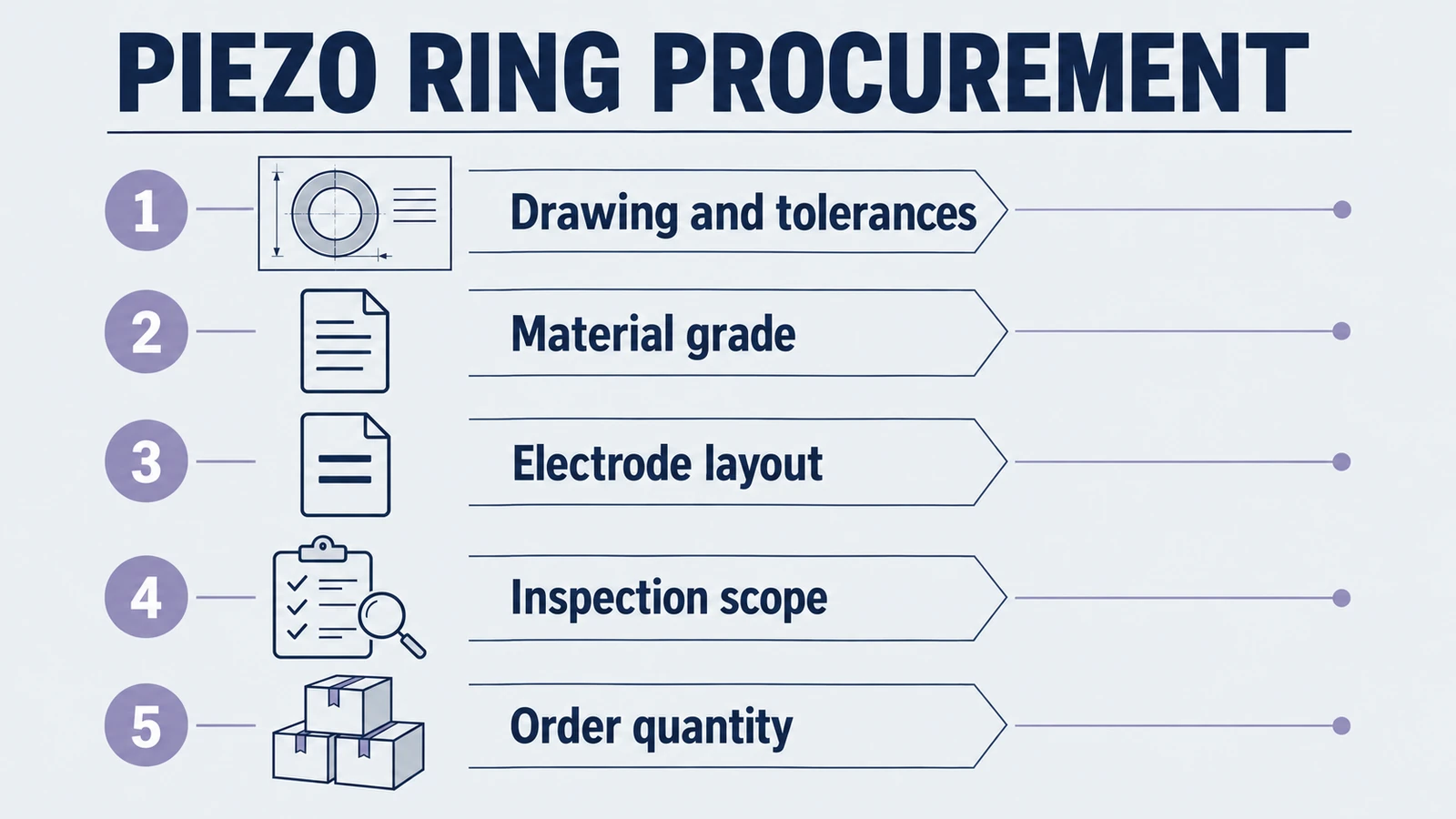
Buying a piezoelectric ring is not the same thing as choosing the right ring geometry, and it is not the same thing as co-developing a custom ring for a new OEM program. Those three decisions often get collapsed into one conversation, which is exactly how sourcing risk slips into the project. This page is intentionally narrower: it is the procurement and supplier due-diligence guide for ring-based programs.
If your team is still deciding whether the right shape family is a disc, ring, tube, rectangular plate, or curved ceramic, start with our geometry selection guide. If the geometry is already ring-based and the real challenge is custom specification, prototyping, and OEM co-development, use our custom ring engineering guide. This article assumes the question has shifted to sourcing discipline: how to buy the right ring, from the right supplier, with the right controls.
If you already buy a specified ring and want another supply option, see the second-source PZT ceramics guide for a focused alternative-supplier enquiry.
1. Procurement starts by locking the ring specification package
Product path for this search intent
Match the article topic to the right YJ Piezo product page
Use this article when the risk is supplier selection, engineering support, validation evidence, integration reliability, and whether the manufacturer can scale from sample to production. For "Buying Piezoelectric Rings: Procurement, QA, and Supplier Due Diligence", the practical value is in turning the topic into a measurable selection or sourcing decision.
- Ultrasonic Transducer Supplier Hub
OEM sourcing and engineering collaboration
- PZT Material Supplier Hub
Material control and grade selection
- Piezoelectric Ceramics
Ceramic manufacturing and custom shapes
Many ring sourcing problems begin with an incomplete RFQ. The buyer sends a sketch, a nominal frequency, and perhaps one old sample, then expects the market to quote comparable parts. In practice, that creates a pricing exercise, not a controlled sourcing process. Different suppliers fill the missing gaps with different material assumptions, tolerances, and process shortcuts, so the quotes look similar while the parts are not.
A proper ring sourcing package should define:
- Outer diameter, inner diameter, and thickness, including which dimensions are critical to acoustic behavior and which are only packaging constraints.
- Material intent, such as hard PZT for high-power stacks or softer formulations for sensing and receive sensitivity.
- Electrical targets, including resonance band, anti-resonance behavior, capacitance, impedance, and acceptable tolerance windows.
- Mechanical interface assumptions, especially preload method, bolt-through architecture, bond-line sensitivity, or mating surface requirements.
- Electrode and finish requirements, such as silver, nickel, gold, solderability, or plating compatibility.
- Incoming quality expectations, meaning what the buyer will measure on receipt and what lot documentation the supplier must provide.
That package is what lets procurement compare quotes on equal terms. Without it, the cheapest quote may simply be the loosest interpretation of your requirement.
2. Supplier due diligence for rings is not generic supplier screening
Ring programs deserve ring-specific diligence because the geometry is often tied to pre-stressed stacks, high-power ultrasonics, or assembly interfaces that are more sensitive than a generic catalog ceramic. A supplier that can ship a disc on time is not automatically a good ring supplier.
For ring sourcing, diligence should cover five areas:
2.1 Material and process control
Ask how the supplier verifies ceramic grade, not just how they label it. If the program depends on hard PZT behavior, the factory should be able to discuss lot control for Qm, dielectric loss, and stability under drive. If the answer is just “we use PZT-8,” that is not enough.
2.2 Dimensional capability
Ring parts are especially sensitive to OD/ID/thickness variation because those dimensions affect resonance and stack fit. The supplier should state how those dimensions are measured, what the process capability looks like, and whether grinding or lapping is used for critical surfaces.
2.3 Assembly awareness
Even if you are buying only the ceramic ring, the supplier should understand how the ring behaves inside a bolted transducer, a bonded stack, or a custom acoustic assembly. A factory that treats a ring as “just a disc with a hole” is more likely to miss the real functional risks.
2.4 Quality documentation
You should know whether every lot can be released with impedance or capacitance records, dimensional results, visual criteria, and traceability to the production batch. If the supplier cannot define a lot-level data package, procurement is effectively buying blind.
2.5 Change control
Ring programs often fail after the first good samples because a later lot uses a different raw-material batch, tooling condition, or process window. Ask how change notification works and what events require customer approval or requalification.
3. Commercial terms must reflect ring-program risk
Price is important, but it is not the only commercial variable that matters. For ring-based programs, MOQ, lead time, sample policy, and lot segmentation often have a bigger effect on schedule and total cost than a small difference in unit price.
Procurement should clarify:
- Sample MOQ: can the supplier support an engineering quantity without forcing a full production lot?
- Production MOQ: does MOQ change if dimensions, plating, or resonance target are customized?
- Lead-time definition: does the quoted lead time include ceramic production, grinding, testing, and outgoing reports, or only nominal factory output?
- Lot structure: will 5,000 parts ship as one lot, or multiple sub-lots with separate traceability?
- Pricing stability: what conditions trigger price changes, especially for custom materials or metal price exposure?
- Nonconformance handling: what is the process for replacement, containment, and corrective action if a lot fails incoming inspection?
These terms are not paperwork. They determine whether procurement can support engineering validation without creating hidden schedule traps.
4. Build an incoming QA plan before the first PO is released
One of the simplest ways to de-risk ring sourcing is to align the incoming inspection plan before commercial production starts. That gives both sides a common definition of acceptable product. If buyer and supplier do not agree in advance, the first failed lot becomes a negotiation instead of a controlled quality event.
A practical incoming QA plan for piezoelectric rings often includes:
- Dimensional checks: OD, ID, thickness, parallelism, and any chamfer or edge requirement tied to stack assembly.
- Electrical checks: resonance, anti-resonance, capacitance, impedance, and loss window at defined conditions.
- Visual checks: chips, cracks, edge quality, electrode defects, contamination, and packaging damage.
- Lot documents: outgoing test summary, batch identification, and any agreed compliance or material statements.
- Escalation rule: what triggers full lot hold, tightened inspection, or supplier corrective action.
For higher-risk programs, incoming QA should also include periodic destructive or semi-destructive verification. That might mean cross-section review on sample pieces, bondability checks, or independent impedance re-measurement on retained samples after storage.
5. Ring-specific red flags procurement should not ignore
Certain warning signs show up repeatedly in unstable ring supply chains:
- Generic material naming without data. “PZT-8 equivalent” is not enough if the supplier cannot explain lot verification or release criteria.
- No distinction between engineering sample and production process. If the sample route is hand-tuned and the production route is undefined, the sample tells you little.
- Loose language around tolerances. If a supplier says tolerances are “normally okay” but does not state inspection method or acceptance window, expect drift later.
- No lot-level release data. That usually means the supplier cannot prove consistency, only shipment.
- Lead-time promises disconnected from capacity reality. Rings with custom grinding, plating, or electrical screening do not behave like catalog commodities.
- Weak understanding of stack integration. For ring programs, that often predicts downstream failures in preload, thermal behavior, or resonance stability.
6. A practical scorecard for ring sourcing decisions
Procurement teams can use a simple scorecard to keep the decision disciplined:
| Category | What Good Looks Like | Common Failure Mode |
|---|---|---|
| Specification control | Supplier quotes against a locked ring spec package | Quotes are based on assumptions and cannot be compared cleanly |
| Quality data | Lot-level dimensional and electrical release data available | No repeatable evidence of batch consistency |
| Process maturity | Clear difference between prototype, pilot, and production controls | Sample success depends on hand tuning or one-off effort |
| Commercial fit | MOQ, lead time, and lot structure fit the program timeline | Cheap quote creates hidden schedule or inventory risk |
| Engineering alignment | Supplier understands stack and application context | Factory treats the ring as a generic catalog item |
7. Use the right companion page for the next decision
This page deliberately stays on the procurement side of the decision. If your team still needs to choose the correct shape family, go back to the geometry selection guide. If the geometry is already narrowed to rings and the next challenge is custom application-specific design, prototype logic, and OEM collaboration, continue with our custom ring engineering guide.
Using those pages together prevents one URL from trying to do three different jobs. This page is for sourcing discipline. The geometry hub is for shape choice. The custom ring page is for engineering the ring into a real OEM program.
Conclusion: Buy rings with a release plan, not only with a quote
The right ring supplier is not merely the one who can offer a plausible sample or a low headline price. The right supplier is the one who can quote against a controlled specification, release lots against agreed data, survive incoming QA, and support the program without silent process drift.
Use this guide when procurement needs a repeatable framework for buying piezoelectric rings. Use our geometry selection guide for shape decisions, and our custom ring engineering guide for ring-specific OEM development. Keeping those questions separate makes each decision easier to review and act on.
Need Ring RFQ Support?
Send your target dimensions, resonance band, material intent, MOQ, and incoming QA requirements so our engineering team can review whether the release plan is realistic before production starts.
Engineering decision notes
OEM integration and supplier qualification
Use this article when the risk is supplier selection, engineering support, validation evidence, integration reliability, and whether the manufacturer can scale from sample to production. For "Buying Piezoelectric Rings: Procurement, QA, and Supplier Due Diligence", the practical value is in turning the topic into a measurable selection or sourcing decision.
YJ Piezo combines direct project coordination with ceramic manufacturing support, so procurement and engineering teams can evaluate material control, application review, sample validation, and production consistency together.
Selection checks
- Ask whether the supplier controls ceramic manufacturing or only assembles purchased elements.
- Review sample policy, inspection records, engineering response quality, and production lead-time stability.
- Compare suppliers and integration paths by validation evidence, not only by unit price and datasheet similarity.
Failure risks
- A low-price sample can pass early tests but fail when batch variation, thermal load, or assembly stress appears.
- A supplier without material control may not explain why impedance, capacitance, or resonance drift occurs.
- Weak RFQ information leads to quotes that are fast but not technically comparable.
RFQ details
- What application, operating environment, and failure cost should the supplier design around?
- Which sample tests and outgoing records are required before pilot production?
- What customization, MOQ, tooling, and delivery constraints must be known before quotation?
Relevant YJ Piezo pages
- Ultrasonic Transducer Supplier Hub
OEM sourcing and engineering collaboration
- PZT Material Supplier Hub
Material control and grade selection
- Piezoelectric Ceramics
Ceramic manufacturing and custom shapes
Application FAQ
- How should an OEM compare piezoelectric suppliers?
- Compare material control, engineering support, test evidence, customization ability, sample policy, and batch consistency. Unit price matters, but only after the technical risk is understood.
- What makes an RFQ technically useful?
- A useful RFQ includes application, dimensions, target frequency, electrical limits, duty cycle, operating medium, environment, expected quantity, required reports, and current failure or replacement context.