
Future of Piezoelectric Sensors: Emerging Technologies and Market Trends
Introduction
Piezoelectric sensors have been a cornerstone in precision measurement, industrial automation, and healthcare devices for decades. In recent years, rapid advancements in material science, manufacturing techniques, and data integration have positioned piezoelectric sensors at the forefront of emerging technologies. With global industries increasingly demanding higher sensitivity, miniaturization, and integration with IoT ecosystems, the future of piezoelectric sensors looks both promising and transformative.
This article explores the latest innovations, market trends, and potential growth areas that will shape the next decade of piezoelectric sensor development.
What Are Piezoelectric Sensors?
Product path for this search intent
Match the article topic to the right YJ Piezo product page
Use this article when sensor performance depends on target distance, beam angle, housing material, liquid behavior, or false echo control. For "Future of Piezoelectric Sensors: Emerging Technologies and Market Trends", the practical value is in turning the topic into a measurable selection or sourcing decision.
- Ultrasonic Sensors
Distance, level, and detection sensor portfolio
- Flow Measurement Transducers
Bubble and flow-related ultrasonic sensing paths
- Air Acoustic Transducers
Air-coupled transducers for range and presence detection
Piezoelectric sensors utilize the piezoelectric effect, where certain materials generate an electric charge in response to mechanical stress. These sensors are highly valued for their:
- High sensitivity and precision
- Wide frequency response range
- Durability in extreme conditions
Typical applications include vibration monitoring, ultrasonic transducers, structural health monitoring, and medical diagnostics. For detailed understanding of how these sensors work, see our guide on piezo sensor working principles.
Emerging Technologies in Piezoelectric Sensors
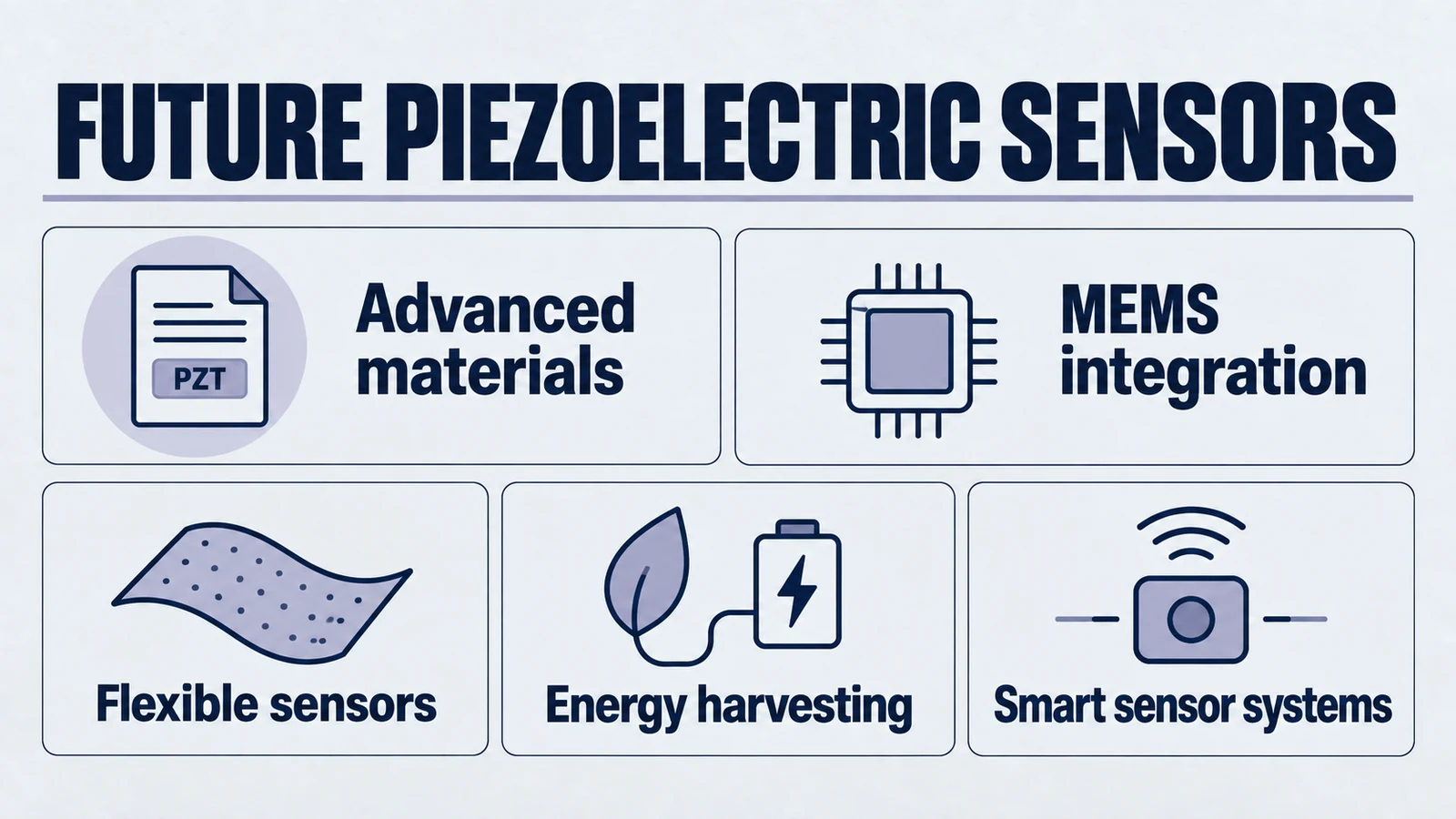
1. Advanced Piezoelectric Materials
Traditional lead zirconate titanate (PZT) remains dominant, but research is accelerating into lead-free alternatives such as potassium sodium niobate (KNN) and bismuth sodium titanate (BNT). These eco-friendly materials aim to comply with global regulations like RoHS while maintaining high performance.
Key development: High Curie temperature lead-free ceramics for automotive and aerospace environments. Learn more about high-performance piezo ceramics and their applications.
2. Miniaturization & MEMS Integration
Micro-electromechanical systems (MEMS)-based piezoelectric sensors are enabling ultra-compact devices for consumer electronics, wearable health monitors, and implantable medical devices.
Example: MEMS ultrasonic transducers (MUTs) for precise distance measurement in smartphones and robotics.
3. Flexible and Printed Sensors
Flexible piezoelectric films, such as PVDF (polyvinylidene fluoride), allow sensor integration into curved or wearable surfaces. Printed electronics technologies are reducing production costs and enabling mass customization.
4. Energy Harvesting Capabilities
Piezoelectric sensors can also serve as energy harvesters, converting vibration or pressure into electrical power for low-energy devices, supporting self-powered IoT sensor networks.
Industry example: Bridge-mounted piezoelectric harvesters powering structural health monitoring systems. Explore our insights on piezoelectric energy harvesting for IoT applications.
5. Smart Sensor Systems
Integration with artificial intelligence and cloud-based analytics is creating "smart" piezoelectric sensors capable of real-time diagnostics, predictive maintenance, and autonomous decision-making.
Market Trends Driving Growth
1. Rising Demand in Industry 4.0
Smart factories are adopting piezoelectric sensors for precision control, quality assurance, and predictive maintenance in automated systems.
2. Medical and Healthcare Expansion
From ultrasound imaging to wearable cardiac monitors, healthcare applications are one of the fastest-growing segments. Our facial ultrasonic transducers demonstrate documented precision in beauty devices.
3. Automotive and Electric Vehicles
Piezoelectric knock sensors, pressure sensors, and vibration monitoring systems are critical for improving engine efficiency and enhancing safety in EVs.
4. Infrastructure and Civil Engineering
Structural health monitoring for bridges, railways, and buildings is becoming a priority, driving adoption of durable piezoelectric solutions.
5. Consumer Electronics Integration
Smartphones, AR/VR devices, and gaming peripherals are increasingly incorporating piezoelectric sensors for motion tracking and haptic feedback.
Regional Market Insights
- Asia-Pacific: The largest manufacturing hub for piezoelectric components, driven by China, Japan, and South Korea.
- North America: Strong demand from aerospace, defense, and medical industries.
- Europe: Focus on sustainable and lead-free piezoelectric materials.
Challenges and Opportunities
Challenges:
- Cost of advanced materials
- Integration complexity with existing systems
- Regulatory restrictions on lead-based ceramics
Opportunities:
- Development of fully recyclable sensors
- Expansion into renewable energy systems
- Partnerships between sensor manufacturers and AI analytics companies
Future Outlook
The next generation of piezoelectric sensors will be smaller, smarter, and more environmentally sustainable. Advances in AI, IoT, and materials science will enable these devices to play a central role in industries ranging from smart cities to precision medicine.
By 2035, piezoelectric sensor technology is expected to see exponential growth, driven by the convergence of miniaturization, wireless communication, and self-powered operation.
Conclusion
Piezoelectric sensors are no longer just passive measurement devices—they are becoming active participants in intelligent systems. Businesses that invest in innovative piezoelectric solutions today will be well-positioned to lead in tomorrow's interconnected, data-driven world.
For manufacturers, engineers, and decision-makers, staying ahead of emerging trends and technological breakthroughs will be the key to unlocking the full potential of piezoelectric sensors in the coming decade.
Explore our comprehensive range of ultrasonic sensors, cleaning transducers, and welding solutions to see how advanced piezoelectric technology is shaping various industries today.
Engineering decision notes
Ultrasonic sensing and detection
Use this article when sensor performance depends on target distance, beam angle, housing material, liquid behavior, or false echo control. For "Future of Piezoelectric Sensors: Emerging Technologies and Market Trends", the practical value is in turning the topic into a measurable selection or sourcing decision.
YJ Piezo treats ultrasonic sensing as an acoustic interface problem: transducer frequency, beam shape, housing, drive electronics, and target environment are reviewed together.
Selection checks
- Define target range, dead zone, beam angle, and mounting geometry before choosing the sensor family.
- Check the medium, target surface, temperature swing, foam, vapor, and side-wall risk.
- Separate detection repeatability from ideal lab accuracy when the sensor will operate in a tank, tube, or moving line.
Failure risks
- A sensor can pass bench distance tests and still fail in tanks with foam, agitation, vapor, or narrow geometry.
- Changing only frequency without reviewing beam angle and mounting can increase false echoes.
- Ignoring housing material or sealing requirements can shorten lifetime in washdown or chemical environments.
RFQ details
- What is the minimum and maximum detection distance?
- Is the target liquid, solid, sheet material, air flow, or a moving object?
- What temperature, humidity, IP rating, and output signal does the system require?
Relevant YJ Piezo pages
- Ultrasonic Sensors
Distance, level, and detection sensor portfolio
- Flow Measurement Transducers
Bubble and flow-related ultrasonic sensing paths
- Air Acoustic Transducers
Air-coupled transducers for range and presence detection
Application FAQ
- What makes an ultrasonic sensor page useful for procurement?
- It should connect range, beam angle, output signal, housing, mounting, and environmental limits to a concrete use case. A model name alone is not enough for reliable supplier comparison.
- Which information speeds up an ultrasonic sensor RFQ?
- Send the target material, distance range, installation geometry, output interface, temperature range, IP rating, and whether the application involves foam, vapor, liquid, or moving objects.