
High-Performance Piezo Ceramics: Advanced Materials for Demanding Applications
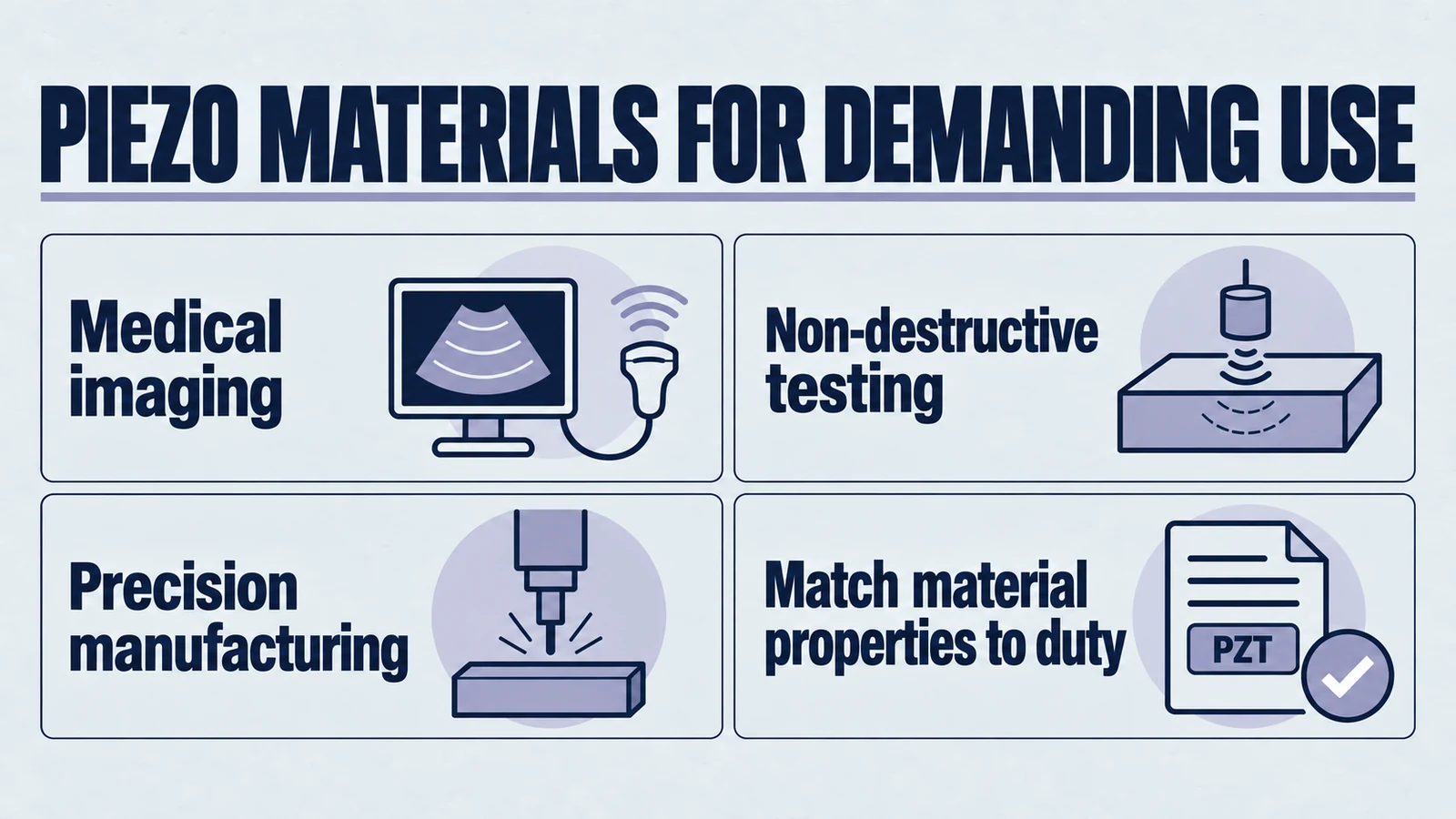
In the ever-evolving landscape of high-tech industries, high-performance piezo ceramics have emerged as essential materials for applications that demand exceptional precision, durability, and efficiency. From medical imaging to industrial sensing and advanced manufacturing, these engineered ceramics deliver strong electromechanical performance.
1. Understanding High-Performance Piezo Ceramics
Piezo ceramics are engineered materials that convert mechanical energy into electrical energy and vice versa. High-performance variants are specially formulated for extreme operational requirements such as high temperature, high mechanical stress, or ultra-precise control.
2. Key Material Properties
Product path for this search intent
Match the article topic to the right YJ Piezo product page
Use this article when the choice is not just a shape, but a material tradeoff between sensitivity, loss, coupling, stability, and operating field. For "High-Performance Piezo Ceramics: Advanced Materials for Demanding Applications", the practical value is in turning the topic into a measurable selection or sourcing decision.
- PZT Material Hub
Material grades and application tradeoffs
- Piezoelectric Ceramics
Shapes and ceramic manufacturing options
- PZT Material Supplier Hub
Material control, grade selection, and sourcing support
When selecting high-performance piezo ceramics, engineers typically evaluate electromechanical coupling coefficient, Curie temperature, mechanical quality factor, dielectric loss, and piezoelectric charge constant.
For example, PZT-8 ceramics are optimized for high-power ultrasonic applications with low dielectric loss and high Qm, making them ideal for demanding industrial tasks.
3. Applications of High-Performance Piezo Ceramics
Medical Imaging & medical-devices
- Ultrasound transducers for diagnostics and medical-device workflows.
- High-intensity focused ultrasound (focused ultrasound) for non-invasive surgery.
Industrial Non-Destructive Testing (NDT)
- Flaw detection in metals, composites, and welds.
- Thickness gauging in pipelines and aerospace components.
Precision Manufacturing
- Micro-positioning stages in semiconductor production.
- Laser beam steering systems.
Conclusion
High-performance piezo ceramics are the backbone of modern precision systems. Whether in safety-related medical equipment, high-speed manufacturing lines, or cutting-edge aerospace technologies, the right material choice can mean the difference between success and costly downtime.
Explore custom actuator designs and energy harvesting applications utilizing high-performance ceramics.
Looking for specific performance piezoelectric ceramics? Contact our material experts for custom material solution recommendations.
Related Technical Resources
Use these internal references to compare geometry, material selection, reliability testing, and sourcing decisions.
- Focused Piezo Ceramics in Medical Ultrasound: Engineering Constraints
- Mode Coupling Risk in Piezo Ceramic Geometry
- Selecting Piezo Ceramics for Continuous Duty Applications
- Common Mistakes Integrating Ultrasonic Transducers into OEM Systems
- Piezoelectric Ceramics Geometry and Shape Guide
- Understanding Ultrasonic Transducers: Types and Uses
- How to Test and Measure Piezoelectric Materials
- Understanding Piezoelectric Constants d33, k, and Qm
Engineering decision notes
PZT material and ceramic selection
Use this article when the choice is not just a shape, but a material tradeoff between sensitivity, loss, coupling, stability, and operating field. For "High-Performance Piezo Ceramics: Advanced Materials for Demanding Applications", the practical value is in turning the topic into a measurable selection or sourcing decision.
YJ Piezo coordinates PZT ceramic projects with manufacturing support, so material formulation, sintering, polarization, electrode process, and outgoing inspection can be reviewed against the final application.
Selection checks
- Separate sensing needs from high-power actuation needs before comparing d33 or coupling values.
- Check dielectric loss, Qm, Curie temperature, aging behavior, and operating field against the real duty cycle.
- Confirm whether the application needs standard PZT grades or a custom formulation and geometry.
Failure risks
- Choosing only the highest d33 can create heat, drift, or depolarization risk in power ultrasonics.
- A ceramic that performs well in free measurement can fail once bonded, clamped, or loaded.
- Material substitutions without batch testing can change capacitance, resonance, and system tuning.
RFQ details
- Is the part used for sensing, actuation, atomization, cleaning, welding, or measurement?
- What field strength, temperature, duty cycle, and mechanical load will the ceramic see?
- Which values must be controlled: d33, capacitance, resonance, impedance, Qm, or dimensional tolerance?
Relevant YJ Piezo pages
- PZT Material Hub
Material grades and application tradeoffs
- Piezoelectric Ceramics
Shapes and ceramic manufacturing options
- PZT Material Supplier Hub
Material control, grade selection, and sourcing support
Application FAQ
- Is the highest d33 always the best PZT choice?
- No. High d33 can be useful for sensitivity, but high-power ultrasonic systems often need lower loss, higher Qm, better thermal stability, and safer operation under field and stress.
- What makes PZT material selection different from catalog buying?
- The right PZT choice depends on geometry, load, drive field, duty cycle, temperature, and inspection targets. A catalog value is only useful when it is tied to the final assembly conditions.