
The Invisible Ruler: Why the MU18 Ultrasonic Sensor is the Backbone of Industrial Precision
In the fast-paced world of industrial automation, "good enough" is no longer acceptable. Whether you are monitoring corrosive chemical levels in a processing plant or detecting transparent glass on a high-speed bottling line, the margin for error is measured in millimeters.
Enter the MU18 Ultrasonic Distance Sensor by Yujie Piezo.
While the market is flooded with generic sensors, the MU18 stands apart not just for its standard M18 form factor, but for what lies inside: proprietary piezoelectric technology refined since 1996. This article explores why the MU18 is the common choice for engineers demanding reliability, precision, and material excellence.
1. Beyond the Datasheet: The Yujie Material Advantage
Product path for this search intent
Match the article topic to the right YJ Piezo product page
Use this article when sensor performance depends on target distance, beam angle, housing material, liquid behavior, or false echo control. For "The Invisible Ruler: Why the MU18 Ultrasonic Sensor is the Backbone of Industrial Preci...", the practical value is in turning the topic into a measurable selection or sourcing decision.
- Ultrasonic Sensors
Distance, level, and detection sensor portfolio
- Flow Measurement Transducers
Bubble and flow-related ultrasonic sensing paths
- Air Acoustic Transducers
Air-coupled transducers for range and presence detection
Most sensor suppliers are merely assemblers—they buy generic ceramic discs from third parties and package them into housings. Yujie Piezo is different. We don't just build the sensor; we engineer the "heartbeat" of the device.
Since 1996, Yujie has been a leader in manufacturing high-performance Piezoelectric (PZT) Ceramics. The core of every MU18 sensor is a PZT transducer developed in our own laboratories.
- Custom Formulation: Unlike off-the-shelf components, our ceramics are formulated for specific acoustic impedances. This means better signal transmission and cleaner echoes.
- Hard vs. Soft PZT: Depending on the application range, we utilize specific "Hard PZT" formulations (like PZT-4 or PZT-8) to handle high-power transmission without overheating, ensuring the MU18 lasts longer in continuous-duty environments.
When you specify a Yujie MU18, you aren't just buying hardware; you are investing in material science that supports stability.
2. Technical Mastery: The MU18 Specifications
The MU18 series is designed around the industry-standard M18 threaded housing, ensuring it is a drop-in replacement for existing setups. However, its performance metrics push the boundaries of the form factor.
Precision in the Blind Zone
One of the greatest challenges with ultrasonic sensors is the "blind zone" (dead band) directly in front of the sensor face. Through advanced Active Damping technology, the MU18 significantly reduces transducer ringing. This allows it to detect objects as close as 50mm (model dependent), solving critical space constraints in compact machinery.
Temperature Stability
The speed of sound changes with air temperature, which can introduce measurement errors. The MU18 features an integrated NTC thermistor that continuously monitors ambient temperature. The on-board microprocessor dynamically adjusts the time-of-flight calculations, ensuring that a 40°C heat wave in a factory doesn't drift your measurements.
Versatile Output Options
To integrate seamlessly into any PLC or control system, the MU18 offers flexible output configurations:
- Analog: 4-20mA or 0-10V for continuous level monitoring.
- Switching: NPN/PNP for simple object detection.
- Digital: RS485 options for data-rich environments.
3. Solving the "Impossible" Detection Tasks
Optical sensors (lasers, infrared) struggle with the real world. Dust, steam, changing colors, and transparency can all render optical devices useless. The MU18 utilizes sound waves, making it immune to visual interference.
The Clear Glass Challenge
In the packaging industry, detecting clear glass bottles or transparent plastic trays is notoriously difficult for photoelectric sensors because light passes right through them. The MU18 relies on sound reflection, treating clear glass exactly the same as solid steel. It provides 100% reliable detection for bottling lines and solar panel manufacturing.
Liquid Level Monitoring
For tanks containing water, fuel, or chemicals, the MU18 offers a non-contact solution. Unlike float switches that can jam or corrode, the MU18 sits above the liquid.
- Corrosion Resistance: With options for PVDF faces or chemically resistant housings, it withstands aggressive fumes.
- Hygiene: In food and beverage applications, the non-contact nature prevents contamination, adhering to strict sanitary standards.
4. Why Industrial Leaders Choose Yujie Piezo
In an era of supply chain uncertainty, partnering with a true manufacturer is a strategic advantage.
- Vertical Integration: Because we manufacture the ceramic elements in-house, we control quality from the powder to the finished product. We are not reliant on external fluctuations for our core technology.
- Customization: Need a specific beam angle? A unique cable length? A specialized PZT formulation for high-temperature environments? Yujie's engineering team can modify the MU18 to fit your exact machine requirements.
- Direct Support: When you have a technical question, you speak with engineers who understand the physics of ultrasound, not just sales representatives.
Conclusion
The MU18 Ultrasonic Distance Sensor is more than a component; it is a precision instrument built on a foundation of material expertise. Whether you are upgrading a legacy system or designing the next generation of smart factories, choose the sensor that sees what others miss.
Ready to upgrade your sensing precision?
Explore the full specifications of the MU18 series and contact our engineering team today for a custom consultation.
Related Resources
Engineering decision notes
Ultrasonic sensing and detection
Use this article when sensor performance depends on target distance, beam angle, housing material, liquid behavior, or false echo control. For "The Invisible Ruler: Why the MU18 Ultrasonic Sensor is the Backbone of Industrial Preci...", the practical value is in turning the topic into a measurable selection or sourcing decision.
YJ Piezo treats ultrasonic sensing as an acoustic interface problem: transducer frequency, beam shape, housing, drive electronics, and target environment are reviewed together.
Selection checks
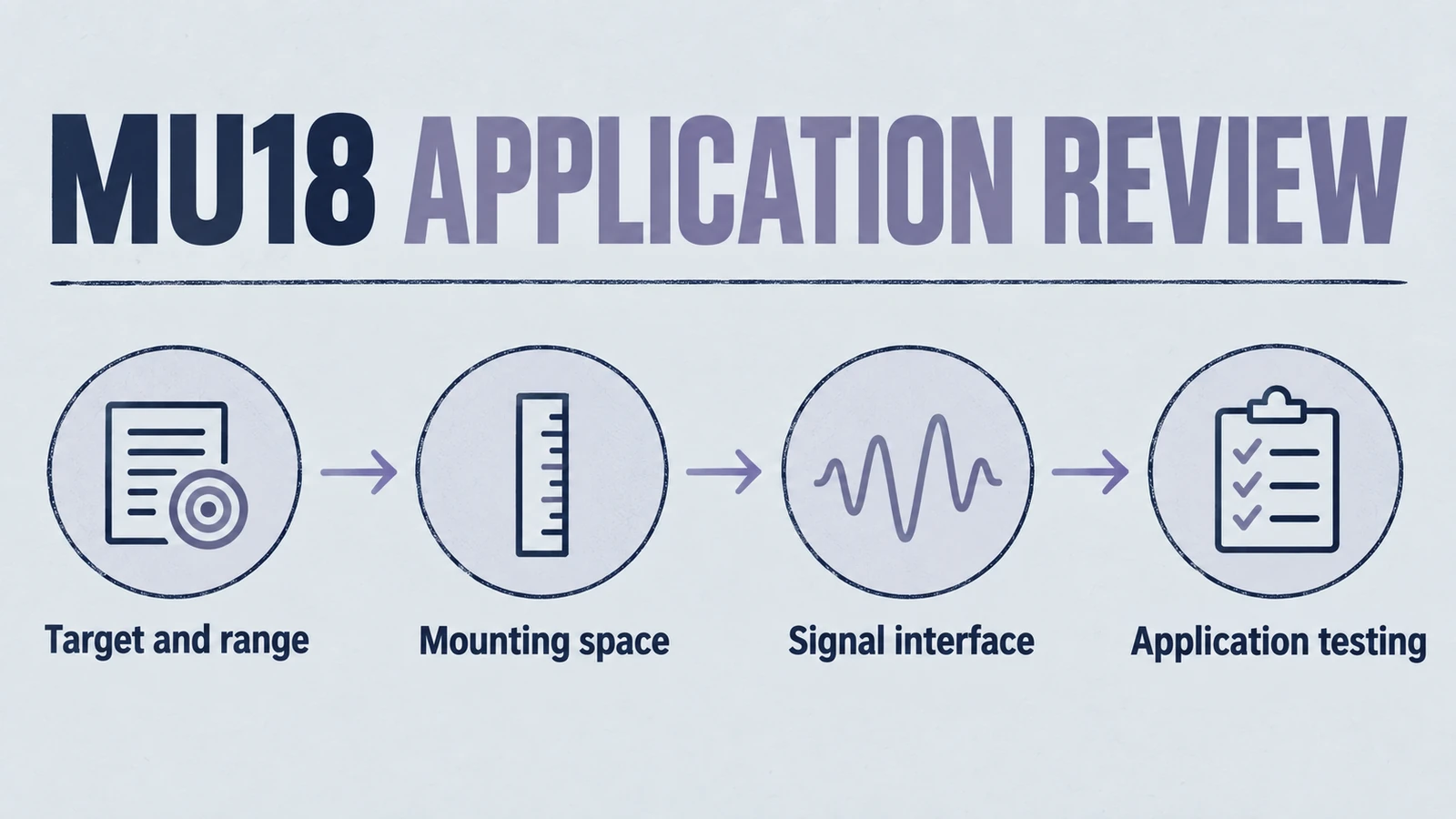
- Define target range, dead zone, beam angle, and mounting geometry before choosing the sensor family.
- Check the medium, target surface, temperature swing, foam, vapor, and side-wall risk.
- Separate detection repeatability from ideal lab accuracy when the sensor will operate in a tank, tube, or moving line.
Failure risks
- A sensor can pass bench distance tests and still fail in tanks with foam, agitation, vapor, or narrow geometry.
- Changing only frequency without reviewing beam angle and mounting can increase false echoes.
- Ignoring housing material or sealing requirements can shorten lifetime in washdown or chemical environments.
RFQ details
- What is the minimum and maximum detection distance?
- Is the target liquid, solid, sheet material, air flow, or a moving object?
- What temperature, humidity, IP rating, and output signal does the system require?
Relevant YJ Piezo pages
- Ultrasonic Sensors
Distance, level, and detection sensor portfolio
- Flow Measurement Transducers
Bubble and flow-related ultrasonic sensing paths
- Air Acoustic Transducers
Air-coupled transducers for range and presence detection
Application FAQ
- What makes an ultrasonic sensor page useful for procurement?
- It should connect range, beam angle, output signal, housing, mounting, and environmental limits to a concrete use case. A model name alone is not enough for reliable supplier comparison.
- Which information speeds up an ultrasonic sensor RFQ?
- Send the target material, distance range, installation geometry, output interface, temperature range, IP rating, and whether the application involves foam, vapor, liquid, or moving objects.