
Piezoelectric Ceramic Procurement: 6 Key Supplier Questions
(and why Yujie has the answers ready)
Why this checklist matters
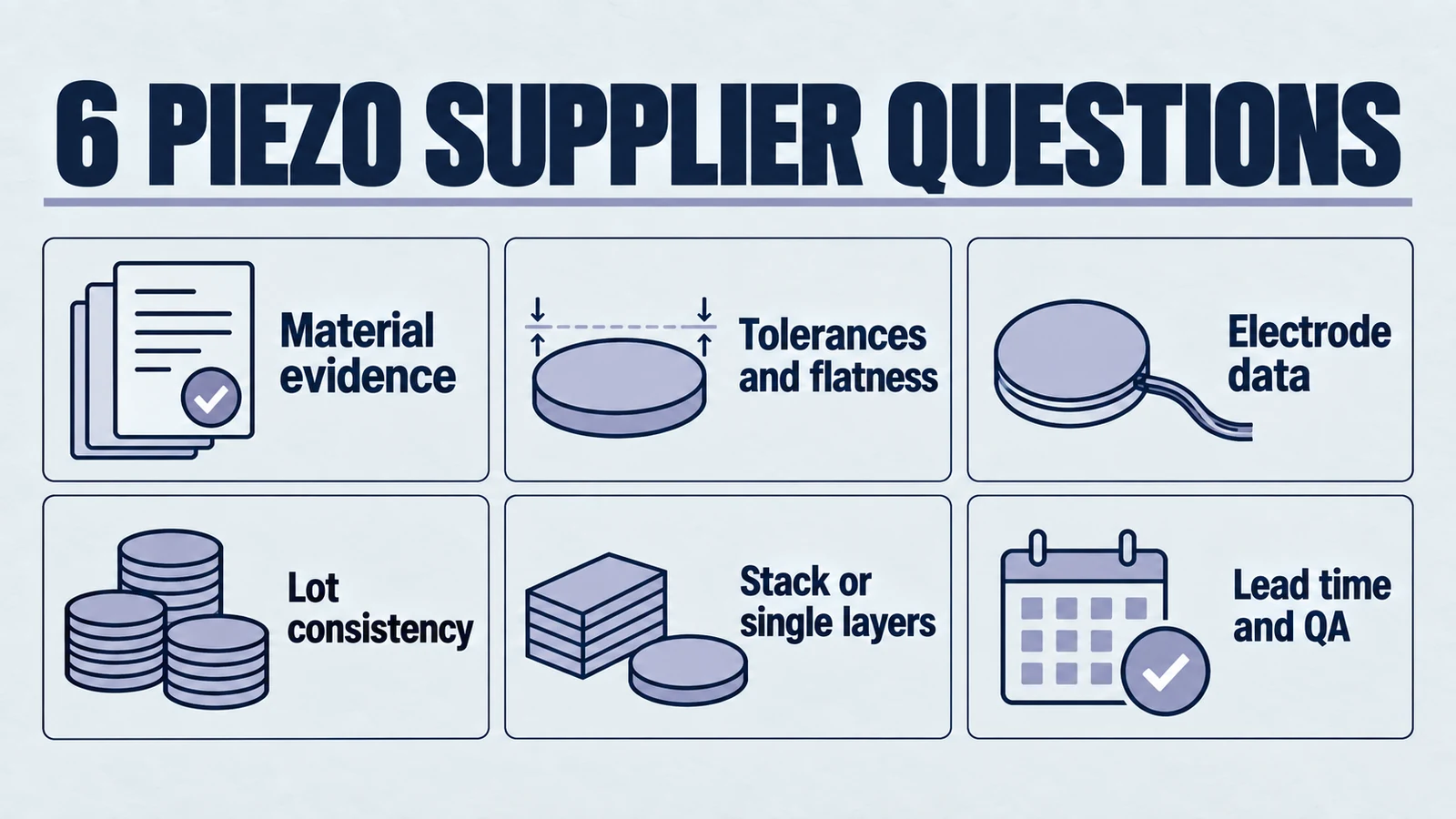
Sourcing piezoelectric ceramics is not like buying generic electronic parts. Tiny deviations in formulation, densification, or electrode deposition can multiply into audible noise, unstable resonance, or outright device failure. By asking the six questions below—and knowing the red-flag answers—you flip the information asymmetry, cut through sales jargon, and protect your engineering timeline and budget.
1. Which material family and grade best match my application—and how do you prove it?
Product path for this search intent
Match the article topic to the right YJ Piezo product page
Use this article when the risk is supplier selection, engineering support, validation evidence, integration reliability, and whether the manufacturer can scale from sample to production. For "Piezoelectric Ceramic Procurement: 6 Key Supplier Questions", the practical value is in turning the topic into a measurable selection or sourcing decision.
- Ultrasonic Transducer Supplier Hub
OEM sourcing and engineering collaboration
- PZT Material Supplier Hub
Material control and grade selection
- Piezoelectric Ceramics
Ceramic manufacturing and custom shapes
What you're really validating: whether the supplier has a complete, application-oriented material map (PZT-5H vs. PZT-8, soft vs. hard, etc.) and the lab data to back each recommendation.
Green-light answer: A clear comparison of electromechanical coupling kp, dielectric constant ε33T, mechanical quality factor Qm, plus references to ASTM- or IEC-compliant test reports.
Yujie advantage: In-house R&D built since 1996 with a full P-series portfolio (P-52, P-81, P-85, custom hard PZT-8 variants). Certified test reports are delivered with every lot, no NDAs required.
2. What dimensional tolerances and flatness can you document at production scale?
Why it matters: In stack actuators or ultrasonic horns, a 0.02 mm thickness drift shifts the resonant frequency by kilohertz. That can destroy efficiency or break a beauty-device standard.
Benchmark: ≤ ±0.01 mm thickness, ≤ 0.03 mm flatness over a 25 mm disk.
Yujie advantage: CNC-assisted green machining and ultrasonic lapping deliver ±0.008 mm routinely—even on 0.1 mm wafers—because the same lines produce medical transducer blanks.
3. Which electrode systems do you offer, and what adhesion & resistivity data back them up?
Typical pitfalls: Silver-thick electrodes that blister during reflow; nickel layers with poor adhesion on hard PZT.
What to request: SEM cross-sections, peel-strength numbers, sheet resistance in Ω/□ (bulk resistivity uses Ω·m), and RoHS / REACH declarations.
Electrode/process evidence: Confirm the selected electrode material, application/firing schedule and order relative to final poling. Conventional high-temperature metallization precedes final poling; a sub-850 °C ceiling does not preserve a previously poled PZT merely by being below 850 °C. Request the actual adhesion method, results and named standard/edition before treating an unnamed “double IEC baseline” or ≥4 N/mm figure as an approved requirement. Factory-specific Ag/Pd processes require supporting records.
4. How do you manage lot-to-lot consistency, and what is your CoV target?
Translation: You need statistical proof, not anecdotes.
KPI: Coefficient of Variation < 5% on d33 across 10,000 pcs.
Yujie advantage: SPC on every furnace run and digital traceability down to raw-powder batch. Last 12-month rolling CoV: 3.2% on d33, publicly shareable.
5. What is your maximum achievable stack height, and can you ship single layers instead?
Why ask: Many suppliers excel at sintering but lack precision lamination; others can only bond in-house, limiting your design freedom.
Decision tip: If you need 5-layer 10 × 10 × 0.5 mm blocks, confirm whether the vendor can:
- deliver single 0.1 mm slices (for your own bonding), or
- supply pre-bonded stacks without trapped air (validated by C-scan).
Yujie advantage: Either path works. We ship mirror-polished 0.1 mm slices within 3 weeks or pre-bonded mini-stacks up to 30 layers via vacuum-hot-press partners.
6. What is the real lead time—including internal QA and export clearance?
Hidden risk: A quoted "4-week" lead may exclude 10 days of QC burn-in or the extra paperwork for dual-use goods.
Checklist:
- Sintering + machining calendar
- 100% d33 screening time
- Export licence / HS code review
Yujie advantage: Firm 4-week lead time including QA. Pre-cleared HS 854160 for most destinations; dedicated export broker shaves 2–3 days off customs.
Quick reference table
| Question | KPI to look for | Red flag | Yujie datapoint |
|---|---|---|---|
| Material match | Full k_p, ε_r, Q_m sheet | "Equivalent to PZT-5H" with no data | P-series datasheets, ASTM test logs |
| Tolerance | ≤ ±0.01 mm | "Per drawing" without numbers | ±0.008 mm verified |
| Electrodes | Peel ≥ 2 N/mm | Only Ag, no adhesion data | Confirm electrode system, adhesion method/results and agreed limit |
| Consistency | CoV < 5% | "Random QC sample" | 3.2% on d33 |
| Stack options | Single layer or bonded | "We only sell stacks" | Both; up to 30 layers |
| Lead time | QA included | Excludes QC or export | 4 wks incl. shipping paperwork |
Feel free to repurpose the table for RFQ templates or internal audits.
Ready to get started?
Book a 15-minute material-fit consultation with a Yujie applications engineer. Because when you ask better questions, you build better devices—and we're here to make sure the answers are measurably right.
Contact us: business@szyujie.com
Related Technical Resources
Use these internal references to compare geometry, material selection, reliability testing, and sourcing decisions.
Engineering decision notes
OEM integration and supplier qualification
Use this article when the risk is supplier selection, engineering support, validation evidence, integration reliability, and whether the manufacturer can scale from sample to production. For "Piezoelectric Ceramic Procurement: 6 Key Supplier Questions", the practical value is in turning the topic into a measurable selection or sourcing decision.
YJ Piezo combines direct project coordination with ceramic manufacturing support, so procurement and engineering teams can evaluate material control, application review, sample validation, and production consistency together.
Selection checks
- Ask whether the supplier controls ceramic manufacturing or only assembles purchased elements.
- Review sample policy, inspection records, engineering response quality, and production lead-time stability.
- Compare suppliers and integration paths by validation evidence, not only by unit price and datasheet similarity.
Failure risks
- A low-price sample can pass early tests but fail when batch variation, thermal load, or assembly stress appears.
- A supplier without material control may not explain why impedance, capacitance, or resonance drift occurs.
- Weak RFQ information leads to quotes that are fast but not technically comparable.
RFQ details
- What application, operating environment, and failure cost should the supplier design around?
- Which sample tests and outgoing records are required before pilot production?
- What customization, MOQ, tooling, and delivery constraints must be known before quotation?
Relevant YJ Piezo pages
- Ultrasonic Transducer Supplier Hub
OEM sourcing and engineering collaboration
- PZT Material Supplier Hub
Material control and grade selection
- Piezoelectric Ceramics
Ceramic manufacturing and custom shapes
Application FAQ
- How should an OEM compare piezoelectric suppliers?
- Compare material control, engineering support, test evidence, customization ability, sample policy, and batch consistency. Unit price matters, but only after the technical risk is understood.
- What makes an RFQ technically useful?
- A useful RFQ includes application, dimensions, target frequency, electrical limits, duty cycle, operating medium, environment, expected quantity, required reports, and current failure or replacement context.