
Piezoelectric Rings vs. Discs – Choosing the Right Element for Your Ultrasonic Device
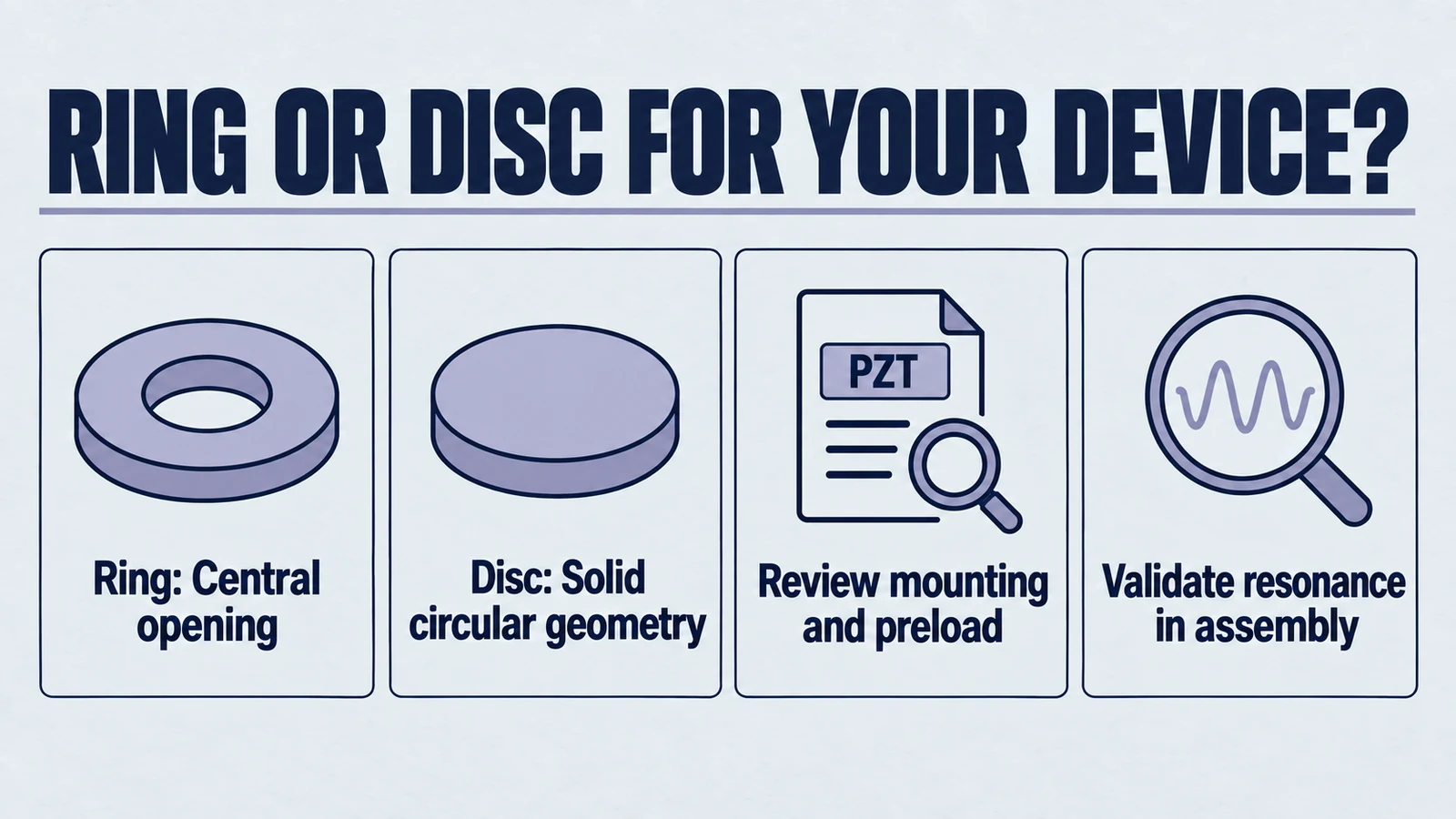
Piezoelectric ceramics are the core of ultrasonic devices, converting electrical signals into precise mechanical vibrations for cleaning, atomization, medical imaging, and sensing applications. Among various forms, piezo rings and piezo discs are the most commonly used piezoelectric elements in the ultrasonic industry. Choosing between them directly impacts your product's performance, energy efficiency, durability, and market competitiveness.
This comprehensive guide will help engineers, procurement managers, and ultrasonic device developers systematically understand the differences, applications, performance considerations, and selection frameworks when choosing between piezo rings and piezo discs.
Case note: choosing ring elements for a surgical transducer
A medical-device company developing ultrasonic surgical transducers came to us for hard PZT-8 rings in the 16–25 mm outer-diameter range — a dozen pieces for design validation, with stability under surgical duty as the stated priority rather than price.
One requested geometry did not match existing tooling. Instead of committing the customer to tooling cost at validation stage, we proposed validating first with the nearest in-stock ring size and opening dedicated tooling only after design freeze. The sample order was completed on stock dimensions, and the tooling decision now waits where it belongs — behind validated acoustics, not ahead of them. At prototype stage, a supplier’s job is to reduce your irreversible spend.
1. Understanding Piezoelectric Elements: Rings vs. Discs
Product path for this search intent
Match the article topic to the right YJ Piezo product page
Use this article when the choice is not just a shape, but a material tradeoff between sensitivity, loss, coupling, stability, and operating field. For "Piezoelectric Rings vs. Discs – Choosing the Right Element for Your Ultrasonic Device", the practical value is in turning the topic into a measurable selection or sourcing decision.
- PZT Material Hub
Material grades and application tradeoffs
- Piezoelectric Ceramics
Shapes and ceramic manufacturing options
- PZT Material Supplier Hub
Material control, grade selection, and sourcing support
What is a Piezo Disc?
A piezo disc is a flat, circular piezoelectric ceramic component without a central hole, typically featuring electrodes on the top and bottom surfaces. It can support thickness, radial and, in assemblies, flexural modes. Surface displacement depends on mode, aspect ratio, mounting and load; disc shape does not guarantee uniform amplitude.
What is a Piezo Ring?
A piezo ring is similar in shape but has a central hole, allowing it to be mounted using a bolt or shaft, which is particularly useful in applications requiring precise axial alignment, clamping, and easy mechanical integration. The presence of the hole changes the vibration distribution, which can be leveraged in specific ultrasonic designs.
2. Structural and Mounting Differences
Mounting Methods
- Piezo discs are typically bonded directly to metal plates or substrates using epoxy or conductive adhesive.
- Piezo rings allow for mechanical clamping with bolts, washers, or spring structures, making assembly and replacement easier in high-power ultrasonic systems.
Design Integration
- Discs are ideal for flat transducer surfaces, requiring uniform contact.
- Rings enable easy centering and improved mechanical stability under high-power ultrasonic operation.
3. Vibration Modes and Resonance Behavior
Piezo Discs:
- Vibrate primarily in thickness and radial modes.
- Require loaded mode-shape and amplitude validation; disc geometry alone does not ensure uniform energy transmission.
- Suitable for applications requiring precise control of resonance frequency.
Piezo Rings:
- Exhibit modified vibration patterns due to the central hole, influencing energy distribution.
- Capable of handling higher mechanical stresses during high-amplitude oscillations.
- Can support lower resonance frequencies due to geometry, which benefits large ultrasonic cleaning and atomization systems.
4. Application Suitability
Applications Ideal for Piezo Discs:
- Small ultrasonic cleaners
- Medical imaging transducers
- Ultrasonic sensors for flow, distance, and level measurement
- Actuators in precision positioning devices
Applications Ideal for Piezo Rings:
- High-power ultrasonic cleaning equipment
- Ultrasonic welding and cutting devices
- Nebulizers for medical and industrial use
- Large-area ultrasonic atomizers
- Applications requiring bolt-clamped Langevin transducers
5. Performance Considerations in Selection
Frequency and Power Handling
- Piezo rings can operate efficiently in lower-frequency, high-power ultrasonic systems.
- Piezo discs are preferred in higher-frequency, low to moderate power applications requiring precise control.
Mechanical Stress Tolerance
- Rings distribute mechanical stress more evenly during high-amplitude operations, reducing crack risk and improving service life.
- Discs are better suited for moderate mechanical loads where stable mounting can be achieved.
Efficiency and Energy Transmission
- The geometry affects coupling efficiency; ensure your driver circuit matches the element's resonance frequency.
- Choosing the correct thickness and diameter for your application can maximize energy transfer efficiency.
Thermal Management
- High-power ultrasonic applications generate heat; rings allow better thermal management in clamped assemblies.
- Discs require careful adhesive selection to manage heat without delaminating.
6. Customization and Material Considerations
At Yujie, we produce piezo rings and discs using advanced PZT formulations with stable and high electromechanical coupling coefficients, low dielectric losses, and excellent mechanical Q factors. We offer:
- Custom outer diameter, thickness, and inner diameter (for rings)
- Custom electrode patterns (full, segmented, double-sided)
- Material options including PZT-4, PZT-5, and high-power low-loss materials for demanding applications
- Tolerance control for consistent resonance performance across batches
7. Step-by-Step Selection Framework
- Clarify Your Application Needs: Define operating frequency, voltage, power, and amplitude requirements.
- Identify Mounting Constraints: Determine whether adhesive bonding or mechanical clamping is preferred.
- Assess Vibration Requirements: Validate the actual disc/ring mode shape and amplitude distribution under the intended load.
- Evaluate Environmental Conditions: Consider heat dissipation, moisture, and mechanical stress factors.
- Prototype and Validate: Test with small batches to confirm real-world performance in your device.
- Consult Experts: Engage with manufacturers like Yujie for tailored recommendations.
8. Common Myths About Piezoelectric Rings and Discs
"Discs are always better for precision applications."
Not always. Rings can also provide precision when aligned correctly and can handle higher stress, making them suitable for precision in high-power applications.
"Rings and discs are interchangeable."
They are not fully interchangeable. While both are piezoelectric elements, their mechanical integration and vibration characteristics differ, affecting your device's efficiency and output.
9. Case Studies
Case 1: Ultrasonic Cleaning Device
A client in the industrial cleaning sector required a transducer that could handle high power (600W) at 28 kHz while maintaining thermal stability. A piezo ring was chosen, allowing bolt clamping for thermal and mechanical stability, achieving a 15% increase in cleaning efficiency.
Case 2: Medical Nebulizer
For a medical nebulizer requiring fine droplet generation at 1.7 MHz, a piezo disc with specific diameter and thickness was selected, with uniformity and aerosol output requiring loaded-assembly validation.
Case 3: Ultrasonic Sensor
An ultrasonic level sensor developer needed high sensitivity and frequency stability. A piezo disc was selected for a particular mode and mounting arrangement. Any claimed range improvement requires the actual before/after test conditions; uniform vibration cannot be inferred from shape.
10. How Yujie Supports Your Projects
Yujie has manufactured piezoelectric components since 1996, including piezoelectric rings and discs for global OEMs across medical, industrial, and consumer sectors. We provide:
- Engineering consultations for design selection
- Custom samples with short lead times
- Stable batch supply for your production needs
- Consistent quality control to reduce device variability
Conclusion: Choosing the Right Piezoelectric Element
Piezo rings and piezo discs each offer unique advantages depending on your ultrasonic device's design, power, and performance requirements. By understanding their differences in structure, vibration behavior, and application suitability, you can make informed choices to enhance your product's efficiency and longevity.
If you need assistance selecting the optimal piezoelectric element for your ultrasonic devices, contact Yujie for a detailed consultation.
Engineering decision notes
PZT material and ceramic selection
Use this article when the choice is not just a shape, but a material tradeoff between sensitivity, loss, coupling, stability, and operating field. For "Piezoelectric Rings vs. Discs – Choosing the Right Element for Your Ultrasonic Device", the practical value is in turning the topic into a measurable selection or sourcing decision.
YJ Piezo coordinates PZT ceramic projects with manufacturing support, so material formulation, sintering, polarization, electrode process, and outgoing inspection can be reviewed against the final application.
Selection checks
- Separate sensing needs from high-power actuation needs before comparing d33 or coupling values.
- Check dielectric loss, Qm, Curie temperature, aging behavior, and operating field against the real duty cycle.
- Confirm whether the application needs standard PZT grades or a custom formulation and geometry.
Failure risks
- Choosing only the highest d33 can create heat, drift, or depolarization risk in power ultrasonics.
- A ceramic that performs well in free measurement can fail once bonded, clamped, or loaded.
- Material substitutions without batch testing can change capacitance, resonance, and system tuning.
RFQ details
- Is the part used for sensing, actuation, atomization, cleaning, welding, or measurement?
- What field strength, temperature, duty cycle, and mechanical load will the ceramic see?
- Which values must be controlled: d33, capacitance, resonance, impedance, Qm, or dimensional tolerance?
Relevant YJ Piezo pages
- PZT Material Hub
Material grades and application tradeoffs
- Piezoelectric Ceramics
Shapes and ceramic manufacturing options
- PZT Material Supplier Hub
Material control, grade selection, and sourcing support
Application FAQ
- Is the highest d33 always the best PZT choice?
- No. High d33 can be useful for sensitivity, but high-power ultrasonic systems often need lower loss, higher Qm, better thermal stability, and safer operation under field and stress.
- What makes PZT material selection different from catalog buying?
- The right PZT choice depends on geometry, load, drive field, duty cycle, temperature, and inspection targets. A catalog value is only useful when it is tied to the final assembly conditions.