
Custom Piezo Actuator Solutions for Industrial Applications
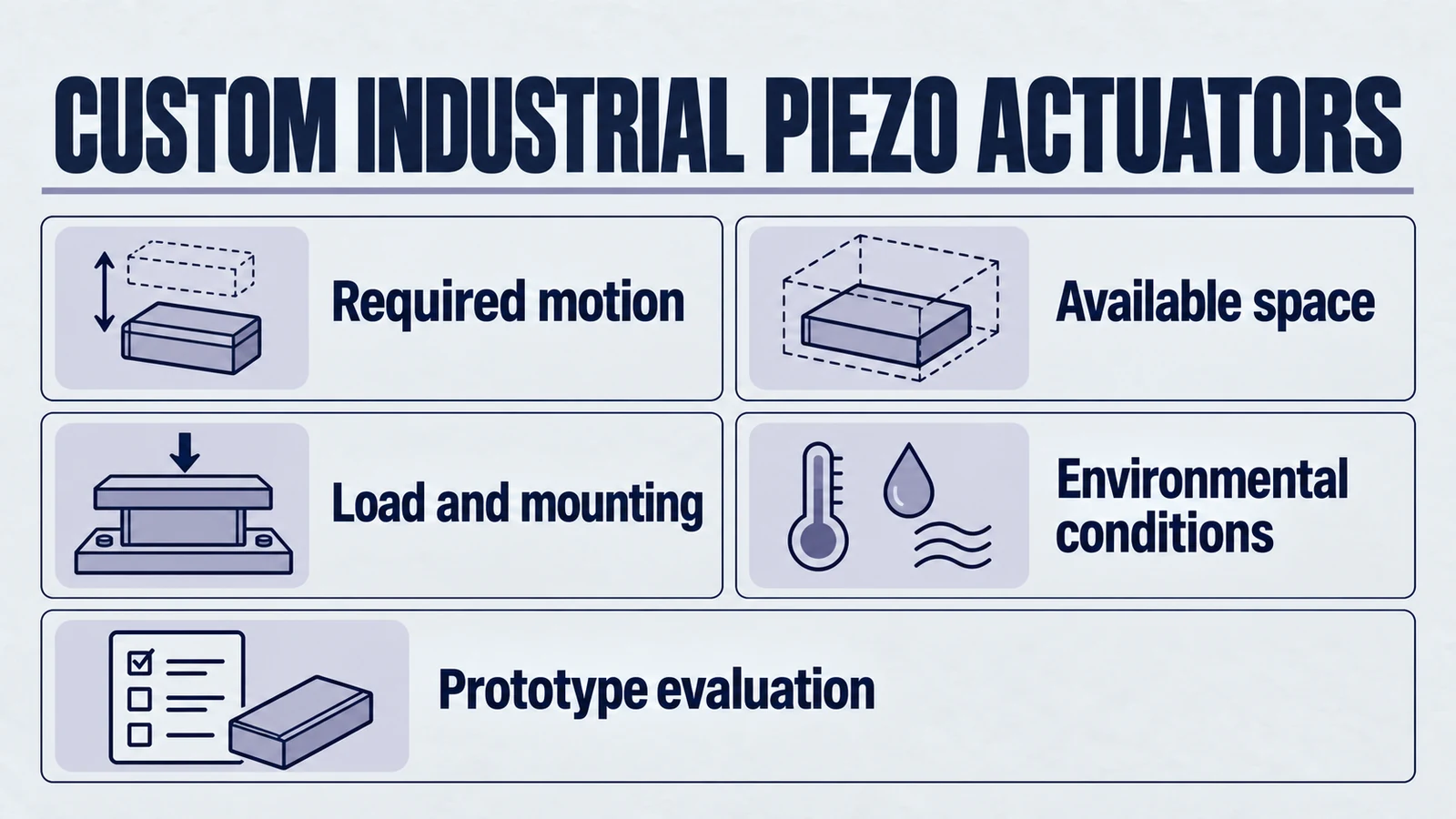
As industries evolve and the demand for precision, efficiency, and reliability increases, custom piezo actuator solutions are becoming a critical component in high-performance systems. From micro-positioning in semiconductor manufacturing to robust automation in heavy machinery, custom piezo actuators offer strong control and responsiveness.
What Are Custom Piezo Actuators?
Piezo actuators are devices that convert electrical energy into precise mechanical motion using the piezoelectric effect. When customized to specific application requirements, these actuators can offer superior performance compared to off-the-shelf options. Custom piezo actuators are engineered to meet unique size constraints, force outputs, travel ranges, and environmental conditions—tailoring performance to the exact demands of a project.
Why Customization Matters in Industrial Settings
Product path for this search intent
Match the article topic to the right YJ Piezo product page
Use this article when the choice is not just a shape, but a material tradeoff between sensitivity, loss, coupling, stability, and operating field. For "Custom Piezo Actuator Solutions for Industrial Applications", the practical value is in turning the topic into a measurable selection or sourcing decision.
- PZT Material Hub
Material grades and application tradeoffs
- Piezoelectric Ceramics
Shapes and ceramic manufacturing options
- PZT Material Supplier Hub
Material control, grade selection, and sourcing support
In industrial environments, the one-size-fits-all approach rarely suffices. Precision machinery, automation systems, and measurement devices often face unique operational challenges such as:
- Extreme temperatures
- Vibrations and mechanical shocks
- Vacuum or cleanroom conditions
- Miniaturization requirements
- High dynamic loads
Custom piezo actuators are designed to accommodate these specialized requirements. Tailoring the geometry, material composition, drive electronics, and housing can dramatically enhance reliability, response time, and mechanical performance.
Key Industrial Applications of Custom Piezo Actuators
1. Semiconductor Manufacturing
Custom piezo actuators are widely used in wafer inspection, lithography stages, and alignment systems, where nanometer-level precision and vibration resistance are critical. These applications require highly sensitive and accurate positioning systems.
2. Optics and Photonics
In laser tuning, beam steering, and mirror positioning systems, custom actuators enable ultra-fine movement and repeatability in compact form factors. Our acoustic series products demonstrate precision control in optical applications.
3. Automotive and Aerospace
Active vibration control, injector systems, and aerodynamic testing equipment benefit from piezo actuators' fast response and durability under harsh conditions. Learn more about piezoelectric applications across industries.
4. Industrial Automation and Robotics
Precision dispensing, micro-welding, and end-effector positioning in automated production lines require actuators tailored for high speed and force. Our welding transducers showcase high-performance solutions for industrial automation.
5. Medical Devices
From surgical robotics to ultrasound equipment, piezo actuators customized for safety, compactness, and precision are essential for end user-centric solutions. The beauty industry also benefits from custom piezoelectric solutions.
Design Considerations for Custom Piezo Actuators
Creating a high-performance custom actuator involves close collaboration between engineers and end-users. Key design parameters include:
- Stroke Length: Determined by application movement requirements.
- Blocking Force: Must align with load demands.
- Drive Voltage: Optimization for power supply compatibility and safety.
- Response Time: Critical for dynamic applications.
- Material Selection: Impacts temperature resistance and long-term stability. Learn about choosing the right piezoelectric ceramics.
- Packaging and Mounting: Custom housings for integration into existing systems.
Advanced simulation tools and prototyping techniques are often used to iterate and validate designs before final production. Understanding manufacturing techniques is crucial for optimal design.
Partnering with a Reliable Manufacturer
A successful custom piezo actuator project hinges on a manufacturer's ability to:
- Provide material flexibility (e.g., PZT, lead-free ceramics)
- Support small-batch or large-volume production
- Offer in-house design, simulation, and testing capabilities
- Ensure quality assurance through ISO and industry certifications
When choosing a reliable supplier, consider their track record in custom solutions and OEM manufacturing capabilities.
At Yujie, we specialize in engineering and manufacturing custom piezo actuators for industrial clients around the world. With experience built since 1996 and a strong track record in OEM and ODM services, we help clients bring their ideas from concept to reality with speed and precision.
Advanced Custom Solutions
Our expertise extends beyond standard actuators to include:
- Multilayer stack actuators for high-force applications
- Tube actuators for radial motion control - see our tube series
- Ring actuators for rotational positioning - explore our ring series
- Custom shapes including discs, rectangles, and specialized geometries
Each solution is backed by comprehensive testing, including performance comparisons and long-term reliability assessments.
Conclusion
Custom piezo actuator solutions empower industrial applications with tailored performance, enhanced reliability, and maximum design flexibility. Whether you're developing next-generation robotics or fine-tuning optical systems, choosing a bespoke actuator designed for your specific needs can unlock new levels of innovation.
Understanding the science behind transducers and working with experienced manufacturers ensures optimal results for your industrial applications.
For inquiries about custom piezo actuators or to discuss your project requirements, contact us at business@szyujie.com or visit yujiepiezo.com.
Explore our complete range of sensor solutions, cleaning transducers, and flow measurement devices to discover how custom piezo actuators can transform your industrial applications.
Engineering decision notes
PZT material and ceramic selection
Use this article when the choice is not just a shape, but a material tradeoff between sensitivity, loss, coupling, stability, and operating field. For "Custom Piezo Actuator Solutions for Industrial Applications", the practical value is in turning the topic into a measurable selection or sourcing decision.
YJ Piezo coordinates PZT ceramic projects with manufacturing support, so material formulation, sintering, polarization, electrode process, and outgoing inspection can be reviewed against the final application.
Selection checks
- Separate sensing needs from high-power actuation needs before comparing d33 or coupling values.
- Check dielectric loss, Qm, Curie temperature, aging behavior, and operating field against the real duty cycle.
- Confirm whether the application needs standard PZT grades or a custom formulation and geometry.
Failure risks
- Choosing only the highest d33 can create heat, drift, or depolarization risk in power ultrasonics.
- A ceramic that performs well in free measurement can fail once bonded, clamped, or loaded.
- Material substitutions without batch testing can change capacitance, resonance, and system tuning.
RFQ details
- Is the part used for sensing, actuation, atomization, cleaning, welding, or measurement?
- What field strength, temperature, duty cycle, and mechanical load will the ceramic see?
- Which values must be controlled: d33, capacitance, resonance, impedance, Qm, or dimensional tolerance?
Relevant YJ Piezo pages
- PZT Material Hub
Material grades and application tradeoffs
- Piezoelectric Ceramics
Shapes and ceramic manufacturing options
- PZT Material Supplier Hub
Material control, grade selection, and sourcing support
Application FAQ
- Is the highest d33 always the best PZT choice?
- No. High d33 can be useful for sensitivity, but high-power ultrasonic systems often need lower loss, higher Qm, better thermal stability, and safer operation under field and stress.
- What makes PZT material selection different from catalog buying?
- The right PZT choice depends on geometry, load, drive field, duty cycle, temperature, and inspection targets. A catalog value is only useful when it is tied to the final assembly conditions.